Electronic Shelf Label IC Market Insights
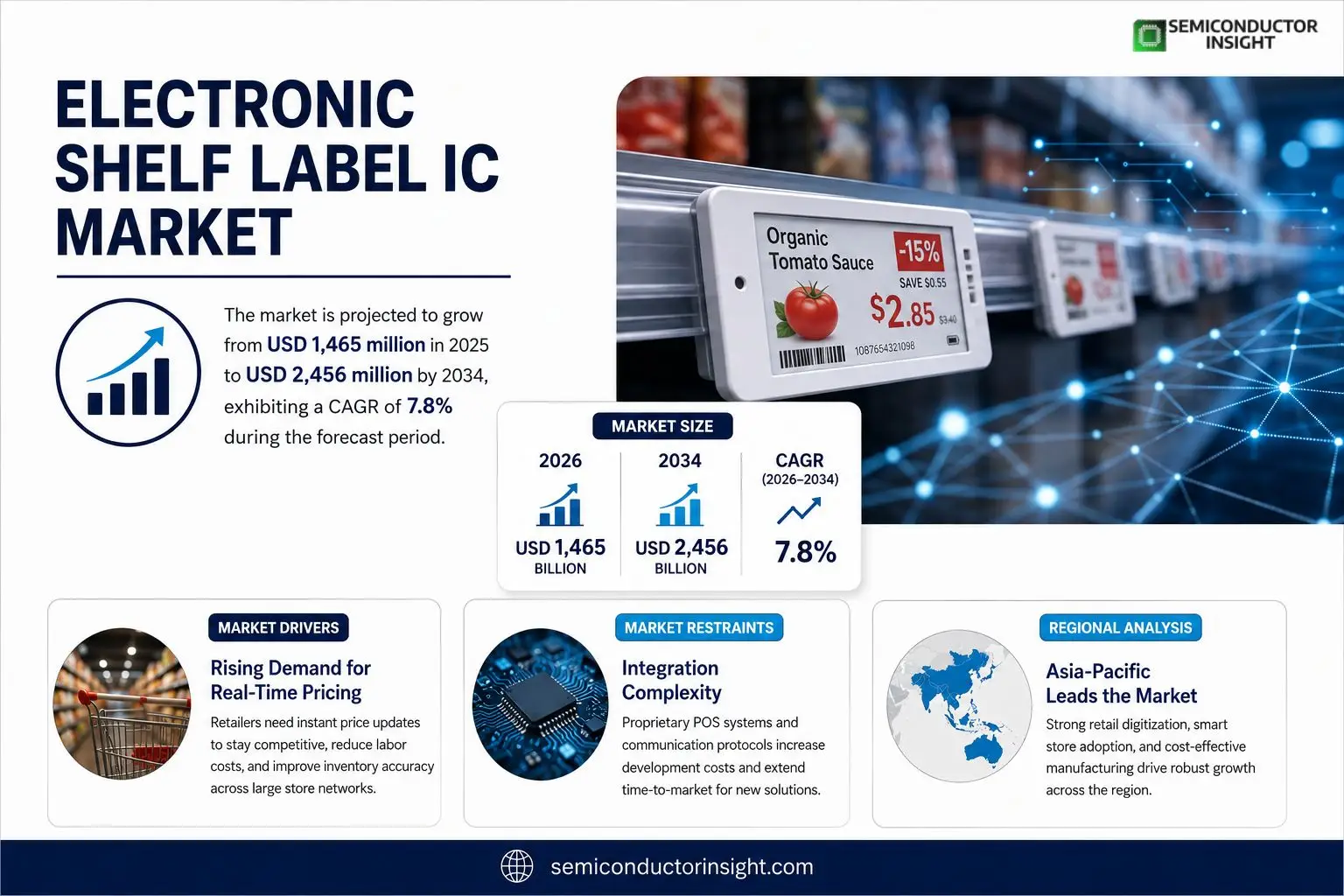
Electronic Shelf Label IC market size was valued at USD 1,465 million in 2025. The market is projected to grow from USD 1,465 million in 2025 to USD 2,456 million by 2034, exhibiting a CAGR of 7.8% during the forecast period.
Electronic Shelf Label ICs feature cutting‑edge ink‑screen driver technology that delivers ultra‑low power consumption for black‑white, three‑color and four‑color e‑ink displays. Production in 2025 reached approximately 697.64 million units at an average price of USD 2.36 per unit, supporting the emergence of unmanned retail concepts.The expansion of digital‑first store models, escalating labor expenses and ongoing enhancements in display performance are prompting retailers to adopt electronic price‑tag systems for improved inventory control and customer interaction. Surveyed manufacturers indicate robust demand across smart retail, healthcare and logistics applications.
MARKET DRIVERS
Rising Demand for Real‑Time Pricing
Retail operators are increasingly confronting the need to adjust prices on the fly as competitor promotions and inventory levels shift. Electronic Shelf Label IC Market supplies the ultra‑low‑power chips that make instant price changes feasible without manual labor, directly translating into labor cost reductions of up to 30 % for large grocery chains.
Advances in Low‑Power Semiconductor Design
Recent silicon‑on‑glass processes and sub‑microwatt architectures have pushed the energy consumption of label ICs below the threshold of a single AA battery lasting three years. This breakthrough not only lowers total cost of ownership but also removes a major barrier for small‑format retailers who previously balked at battery‑replacement logistics.
➤ “Dynamic pricing is reshaping the retail floor, and the label IC is the silent engine behind that transformation.”
As supermarkets expand their digital shelf‑management platforms, the interdependence between POS software and label hardware tightens. Companies that can deliver a seamless integration stack will capture a larger share of Electronic Shelf Label IC Market by leveraging the cost efficiencies inherent in automated price dissemination.
MARKET CHALLENGES
Integration Complexity
Legacy point‑of‑sale ecosystems often rely on proprietary communication protocols, forcing manufacturers to develop multiple adapters for a single label IC family. This technical heterogeneity inflates development budgets and extends time‑to‑market, especially for mid‑size retailers that lack in‑house engineering resources.
Other Challenges
Supply‑Chain Volatility
The semiconductor shortage that began in 2020 continues to ripple through component sourcing, leading to lead‑times that can exceed six months for high‑volume label ICs. Buyers must negotiate buffer inventories, a practice that erodes the headline cost advantage of electronic shelving.
MARKET RESTRAINTS
Regulatory and Compliance Costs
Every electronic label sold in the European Union must meet CE marking requirements, while North American units must pass FCC certification. The testing and documentation overhead associated with these mandates adds a fixed cost component that is disproportionately felt by smaller IC vendors.Beyond formal certifications, retailers are encountering local data‑privacy statutes that restrict wireless communication frequencies in certain regions. Adapting label IC firmware to comply with these fragmented regulations can delay product rollouts and dampen market enthusiasm.
MARKET OPPORTUNITIES
Expansion into Emerging Markets
Rapid urbanisation in Southeast Asia and Latin America is spurring the development of modern supermarket formats that favour digital price displays. Electronic Shelf Label IC Market stands to benefit as regional manufacturers partner with chip suppliers to meet the growing appetite for energy‑efficient labeling solutions.
IoT‑Enabled Store Ecosystems
Retailers are experimenting with fully connected store concepts where inventory sensors, demand‑forecasting analytics, and shelf‑side displays exchange data in real time. Label ICs equipped with ultra‑secure Bluetooth Low Energy (BLE) stacks are positioned to become the backbone of these ecosystems, unlocking new revenue streams from subscription‑based software services.
Electronic Shelf Label IC Market Trends
Shift to Multi‑Color E‑Ink Drivers
The adoption of three‑ and four‑color e‑ink driver ICs has moved from niche prototypes to mainstream deployments. Manufacturers now deliver ultra‑low‑power solutions that sustain months of operation on a single coin cell, a capability that directly supports the rise of fully automated retail environments. Retailers seeking to eliminate manual price‑tag updates find that richer colour palettes enable more engaging shelf‑side communication, from promotional highlights to hazard warnings. This functional expansion not only shortens the time‑to‑market for new promotions but also generates measurable improvements in inventory turnover, as staff can redirect attention from routine labeling to higher‑value customer interactions.
Other Trends
Packaging Innovation Fuels Cost Efficiency
Advanced package formats such as QFN and wafer‑level chip‑scale packaging (WLCSP) are reshaping the cost structure of Electronic Shelf Label IC Market. QFN offers a balance between thermal performance and mechanical robustness, allowing high‑density board designs without compromising reliability. WLCSP, by contrast, reduces material usage and streamlines assembly steps, translating into lower unit‑costs for high‑volume producers. Suppliers that can flexibly switch between these formats are better positioned to meet divergent customer requirementsfrom premium flagship stores demanding ultra‑thin form factors to discount chains prioritising budget‑friendly solutions.
Wireless Protocol Diversification Expands Deployment Scenarios
Historically, a single proprietary 2.4 GHz protocol dominated label communication, but recent offerings now blend Bluetooth Low Energy and other open standards alongside private solutions. This multiplicity grants system integrators the latitude to align connectivity choices with existing store infrastructure, whether that involves leveraging smartphones for ad‑hoc updates or integrating with warehouse management systems for synchronized stock data. The broader protocol ecosystem also mitigates supply‑chain risk, as manufacturers are no longer locked into a sole chipset provider. Consequently, retailers can scale deployments across heterogeneous environmentssmart retail, healthcare, and logisticswithout incurring prohibitive re‑engineering costs.
COMPETITIVE LANDSCAPE
Key Industry Players
Electronic Shelf Label IC – Competitive Overview 2024‑2034
Texas Instruments commands the upper tier of the market, supplying a broad portfolio that spans single‑color to four‑color e‑ink drivers. Its extensive R&D budget and fab network allow it to keep unit costs under $2.30 while delivering the ultra‑low‑power performance demanded by large‑scale retailers. This scale creates a de‑facto benchmark for pricing and reliability, prompting midsize OEMs to align their design roadmaps with TI’s reference architectures. The competitive structure, therefore, resembles a tiered hierarchy: a handful of multinational fabs dominate volume and price, while a growing cohort of specialist silicon houses compete on niche functionality such as 2.4 GHz proprietary protocols or advanced WLCSP packaging.Beyond the giants, a cluster of regionally focused firms is reshaping the value chain. Nordic Semiconductor leverages its expertise in low‑energy wireless stacks to capture the Bluetooth‑enabled segment, whereas NXP’s mixed‑signal offerings address automotive‑grade reliability requirements. In Asia, Yichip, Telink, and JADARD Technology deliver cost‑effective QFN solutions that appeal to price‑sensitive retailers expanding into emerging markets. Companies like Quaming Intelligence and Rockchip Electronics are experimenting with integrated AI accelerators that could enable on‑label analytics. The diversity of these players reflects a market that rewards both economies of scale and differentiated innovation, forcing incumbents to accelerate feature roll‑outs while giving challengers room to gain footholds through price or unique capabilities.
List of Key Electronic Shelf Label IC Companies Profiled
- Texas Instruments
- Nordic Semiconductor
- NXP Semiconductors
- STMicroelectronics
- Infineon Technologies
- Nexperia
- Yichip Microelectronics
- Telink Semiconductor
- JADARD Technology
- Lenze Technologies
- Quaming Intelligence
- Rockchip Electronics
- Wuhan Ruinajie Semiconductor
- Ingchips Technology
- Phyplus Technologies
Segment Analysis:
| Segment Category | Sub-Segments | Key Insights |
| By Type |
|
Ink Screen Driver ICs drive the core functionality of electronic shelf labels; – Provide ultra‑low power operation that extends battery life for unmanned retail environments; – Enable multi‑color displays that support richer visual communication; – Offer high reliability that aligns with the increasing demand for automated pricing solutions. |
| By Application |
|
Smart Retail is the predominant application driver; – Enhances price agility and dynamic promotions, boosting shopper engagement; – Reduces labor overhead by automating label updates across large store footprints; – Integrates with inventory and analytics platforms, creating a seamless omni‑channel experience. |
| By End User |
|
Supermarkets lead adoption; – Leverage high‑volume shelving to justify digital label roll‑out; – Benefit from rapid price changes driven by promotions and perish‑able inventory; – Align with sustainability goals through reduced paper tag waste. |
| By Packaging |
|
QFN Package dominates due to; – Compact footprint that fits thin label designs; – Proven thermal performance supporting continuous operation; – Compatibility with existing surface‑mount manufacturing lines, accelerating time‑to‑market. |
| By Wireless Communication |
|
Bluetooth gains traction because; – Provides a widely adopted, interoperable link for mobile device integration; – Supports low‑energy operation suitable for battery‑powered labels; – Enables flexible network topologies that can scale with store size. |
Regional Analysis: Electronic Shelf Label IC Market
Europe
The European Union’s eco‑design framework is compelling IC suppliers to certify ultra‑low‑power consumption, which in turn accelerates adoption of energy‑conscious label solutions. Compliance pathways are increasingly linked to procurement criteria, nudging retailers toward vendors that can demonstrate verified power‑saving credentials.
Large‑format grocery operators are leading the rollout, yet specialty chains are following suit as they recognize the operational agility that electronic pricing delivers. Faster price changes reduce out‑of‑stock risk and empower localized promotions.
Recent joint ventures between IC manufacturers and software platform providers are creating end‑to‑end ecosystems. These alliances streamline integration with inventory management systems, making the overall solution more attractive to mid‑size retailers.
Proximity of component fabs in Central Europe mitigates lead‑time volatility, allowing label producers to meet escalating demand without sacrificing quality or cost efficiency.
North America
In the United States and Canada, Electronic Shelf Label IC Market is shaped by a blend of technology‑savvy consumers and aggressive discounting strategies. Retail chains view digital labels as a tool for price optimization, especially during high‑traffic periods such as holiday sales. Supplier negotiations now focus on firmware flexibility, enabling quick response to market fluctuations. Meanwhile, Canadian retailers, constrained by broader margins, prioritize cost‑effective IC designs that still deliver reliable connectivity across large store footprints. The competitive environment pushes vendors to differentiate through modular architectures that can be retrofitted to existing label hardware, extending asset life cycles.
Asia‑Pacific
The Asia‑Pacific region exhibits heterogeneous maturity levels, with Japan and South Korea embracing sophisticated label ecosystems, while emerging markets in Southeast Asia are still evaluating pilot projects. Consumer expectations for seamless checkout experiences drive retailers to experiment with integrated displays that combine pricing, promotions, and RFID data. Local IC producers are leveraging advanced silicon‑on‑glass processes to meet high‑resolution display demands, positioning themselves as preferred partners for fast‑moving consumer goods firms seeking differentiated shelf experiences. However, supply‑chain constraints related to rare‑earth components occasionally force manufacturers to explore alternative materials, influencing long‑term roadmap decisions.
South America
Retailers across Brazil, Argentina and Chile are increasingly aware that static price tags hinder promotional agility in highly price‑sensitive markets. Early adopters are deploying pilot programs that couple electronic labels with cloud‑based pricing engines, enabling near‑real‑time adjustments. The region’s fragmented retail landscape means that IC vendors must offer scalable solutions that can be tailored to both large supermarket chains and independent grocers. Additionally, regional trade agreements are easing component import tariffs, which helps lower upfront costs and encourages broader rollout of digital shelf technology.
Middle East & Africa
In the Gulf Cooperation Council states, premium retail concepts are leveraging electronic shelf labels to convey luxury branding while maintaining operational efficiency. The focus is less on price fluidity and more on enhancing the visual appeal of product information. Conversely, sub‑Saharan markets are in the exploratory phase, where limited broadband penetration poses challenges for real‑time label updates. Vendors are therefore experimenting with hybrid connectivity models that combine low‑power wide‑area networks with local mesh configurations, laying groundwork for future expansion as infrastructure improves.
Report Scope
This market research report provides a comprehensive analysis of the Electronic Shelf Label IC Market , covering the forecast period 2026–2034. It offers detailed insights into market dynamics, technological advancements, competitive landscape, and key trends shaping the industry.
Key focus areas of the report include:
- Market Overview: The report begins with an overview outlining its current market scenario, key growth indicators, and industry transformation drivers. It discusses macroeconomic factors, demand–supply balance, regulatory landscape, and the strategic role of semiconductors in powering advancements across industries such as automotive, telecommunications, consumer electronics, and industrial automation.
- Market Size & Forecast: Historical data and future projections for revenue, unit shipments, and market value across major regions and segments.
- Segmentation Analysis: Detailed breakdown by product type, technology, application, and end-user industry to identify high-growth segments and investment opportunities.
- Regional Insights: Insights into market performance across North America, Europe, Asia-Pacific, Latin America, and the Middle East & Africa, including country-level analysis where relevant.
- Competitive Landscape: Profiles of leading market participants, including their product offerings, R&D focus, manufacturing capacity, pricing strategies, and recent developments such as mergers, acquisitions, and partnerships.
- Technology Trends & Innovation: Assessment of emerging technologies, integration of AI/IoT, semiconductor design trends, fabrication techniques, and evolving industry standards.
- Market Drivers & Restraints: Evaluation of factors driving market growth along with challenges, supply chain constraints, regulatory issues, and market-entry barriers.
- Stakeholder Insights: Insights for component suppliers, OEMs, system integrators, investors, and policymakers regarding the evolving ecosystem and strategic opportunities.
Primary and secondary research methods are employed, including interviews with industry experts, data from verified sources, and real-time market intelligence to ensure the accuracy and reliability of the insights presented.
FREQUENTLY ASKED QUESTIONS:
What is the current market size of Electronic Shelf Label IC Market?
-> Electronic Shelf Label IC Market was valued at USD 1465 million in 2025 and is expected to reach USD 2456 million by 2034, growing at a CAGR of 7.8% over the forecast period.
Which key companies operate in Electronic Shelf Label IC Market?
-> Key players include Nordic Semiconductor (NO), Texas Instruments (US), NXP Semiconductors (NL), STMicroelectronics (CH), Infineon (DE), Nexperia (NL), Yichip Microelectronics (CN), Telink (CN), JADARD TECHNOLOGY (CN), Lenze Technologies (CN), Quaming Intelligence (CN), Rockchip Electronics (CN), Wuhan Ruinajie Semiconductor (CN), Ingchips Technology (CN), Phyplus Technologies (CN), and EDOM Technology (TW).
What are the key growth drivers?
-> Key growth drivers include the digitalization of retail environments, rising labor costs prompting automation, and continuous technological advancements delivering ultra‑low‑power ink‑screen driver ICs that enable unmanned stores and advanced pricing functionalities.
Which region dominates the market?
-> Asia exhibits the strongest growth momentum due to rapid adoption of electronic pricing systems in large retail chains, while North America and Europe also show significant market penetration.
What are the emerging trends?
-> Emerging trends comprise advanced multi‑color e‑ink screen driver ICs, integration of AI/IoT for smart retail analytics, and the expansion of unmanned store concepts powered by ultra‑low‑power semiconductor solutions.
Get Sample Report PDF for Exclusive Insights
Report Sample Includes
- Table of Contents
- List of Tables & Figures
- Charts, Research Methodology, and more...
 Download Sample Report PDF