Electronic Passports Market Insights
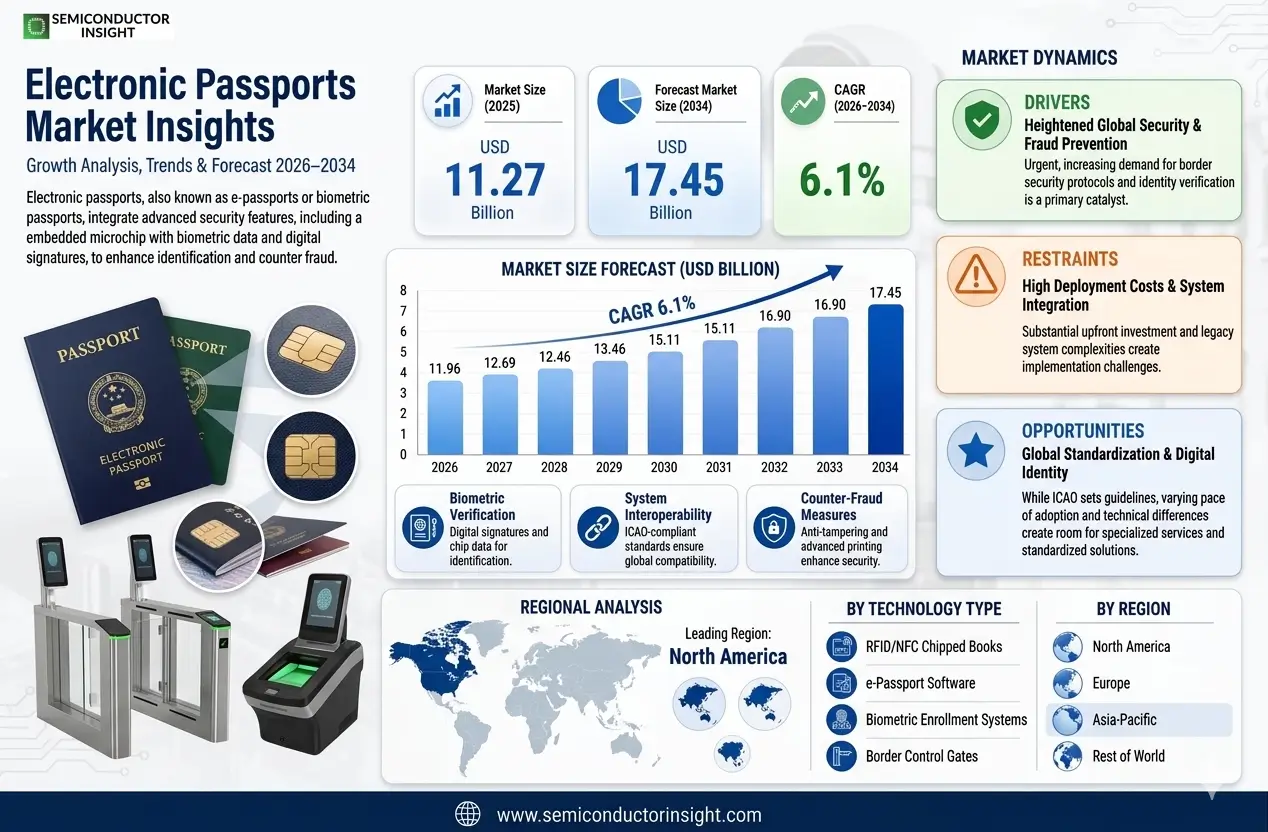
Global Electronic Passports Market size was valued at USD 11.27 billion in 2025. The market is projected to grow from USD 11.96 billion in 2026 to USD 17.45 billion by 2034, exhibiting a CAGR of 6.1% during the forecast period.
An electronic passport, or e-passport, is a biometric travel document that incorporates an embedded microprocessor chip containing the holder’s biographic data, a digital photograph, and other security features. This chip securely stores the same information printed on the passport’s data page, such as name, date of birth, and nationality, and can include biometric identifiers like fingerprints or iris scans to enhance identity verification. E-passports are designed for use with automated border control (ABC) gates, enabling faster and more secure passenger processing compared to manual checks by border officers.
The market is experiencing robust growth driven by heightened global security concerns and increased government investment in advanced border control infrastructure. Furthermore, technological advancements in biometrics and contactless chip technology have reduced production costs while improving functionality and reliability. International standardization efforts led by bodies like the International Civil Aviation Organization (ICAO) have been crucial for ensuring global interoperability, thereby boosting adoption rates across nations. The resurgence of international travel post-pandemic is also a significant demand driver, as governments and travelers alike seek more efficient and secure crossing processes.
MARKET DRIVERS
Heightened Global Security Protocols and Identity Fraud Prevention
The primary catalyst for Electronic Passports Market is the urgent, worldwide need to bolster border security and combat identity fraud. Traditional document forgery is becoming increasingly sophisticated, driving governments to adopt biometric e-passports with embedded RFID chips. These chips store the holder’s biometric data, such as facial recognition and fingerprints, creating a secure link between the document and its legitimate owner. This technological upgrade is a direct response to international mandates and collaborative security frameworks, making it significantly harder to alter or counterfeit travel documents.
Mandates for Automated Border Control and Streamlined Passenger Processing
Government initiatives to modernize border infrastructure are a powerful market driver. Airports and border crossings globally are deploying automated e-gates and self-service kiosks that read electronic passports. This investment aims to dramatically reduce passenger wait times, enhance operational efficiency for immigration authorities, and manage growing passenger volumes. The convenience and speed offered by these systems create a self-reinforcing cycle, encouraging more countries to issue e-passports and more travelers to demand faster processing.
➤ The global shift towards contactless and seamless travel experiences post-pandemic has accelerated the adoption of e-passport reader technologies at a CAGR of approximately 8.5% over the past five years.
Furthermore, international travel recovery and rising passenger numbers are putting immense pressure on legacy systems. The electronic passport, as the cornerstone of modern Automated Border Control (ABC) systems, is essential for meeting this demand efficiently and securely, ensuring Electronic Passports Market remains on a strong growth trajectory.
MARKET CHALLENGES
High Initial Deployment Costs and Legacy System Integration
A significant challenge for Electronic Passports Market is the substantial upfront investment required by governments. This includes the cost of procuring new chip-embedded passport booklets, issuing infrastructure, software systems, and border control readers. For many developing nations, this capital expenditure is a major budgetary hurdle. Additionally, integrating new e-passport systems with existing legacy databases and national identity management frameworks presents complex technical and logistical challenges that can delay implementation.
Other Challenges
Privacy Concerns and Data Security Vulnerabilities
The storage of sensitive biometric data on a RFID chip raises persistent public and regulatory concerns about privacy and data protection. Fears of unauthorized data skimming, tracking, or large-scale database breaches pose a reputational and adoption risk. Governments and technology providers must continuously invest in advanced encryption and security protocols, such as Public Key Infrastructure (PKI), to maintain public trust in the e-passport ecosystem.
MARKET RESTRAINTS
Lack of Global Standardization and Interoperability Issues
While ICAO sets global guidelines, the pace and technical specifications of e-passport adoption vary significantly between countries. This lack of absolute standardization can lead to interoperability issues where passports from one nation are not fully or reliably readable by systems in another. Such inconsistencies restrain market growth by creating friction in international travel and necessitating costly software updates and hardware adjustments for border agencies to ensure universal readability.
Slow Replacement Cycles and Budgetary Constraints
The nature of passport issuance acts as a natural market restraint. Passports have a long validity period, typically 5 to 10 years, leading to slow, phased replacement cycles rather than bulk adoption. During periods of economic austerity, governments may postpone upgrades to next-generation e-passport technologies or delay the renewal of reader infrastructure at borders, directly impacting the refresh rate and volume of Electronic Passports Market.
MARKET OPPORTUNITIES
Integration with Digital Identity and Mobile Travel Credentials
The convergence of physical and digital identity presents a major frontier for Electronic Passports Market. The development of Mobile Travel Credentials (MTCs), digital versions of the e-passport stored on a secure smartphone app, creates vast opportunities. This evolution can streamline the travel process further, enable pre-clearance, and open new applications in digital onboarding for services beyond air travel, such as hotel check-ins or car rentals, leveraging the verified identity data from the e-passport.
Advancements in Biometric and Chip Security Technology
Continuous innovation in security technologies offers robust growth opportunities. The next generation of electronic passports is likely to incorporate multi-modal biometrics (e.g., iris scanning), more secure embedded chips with enhanced anti-tamper features, and blockchain-based verification for immutable audit trails. These advancements will address current security challenges, renew demand for upgraded documents, and create a premium segment withElectronic Passports Market focused on utmost security and functionality.
Electronic Passports Market Trends
Convergence of Enhanced Security Protocols and Automation
A dominant trend is the integration of advanced biometrics, including facial recognition and multiple fingerprints, into Electronic Passports Market chip architecture. This evolution, driven by global security mandates, directly enhances border integrity and fraud prevention. Concurrently, the proliferation of automated border control e-gates and self-service kiosks at international hubs is transforming passenger flow. These systems rely on the standardized data within electronic passports to expedite clearance, aligning with growing international travel volumes and the demand for more efficient, contactless processes. This symbiosis between heightened security and streamlined automation is fundamentally reshaping border management strategies worldwide.
Other Trends
Technological Standardization and Interoperability
Adherence to International Civil Aviation Organization (ICAO) technical standards remains a critical enabler for Electronic Passports Market. This global framework ensures chip interoperability and data structure uniformity, allowing passports issued in one country to be reliably read by systems in another. This trend reduces technical barriers to adoption and fosters international confidence, encouraging more nations to transition from legacy documents. The ongoing refinement of these standards to incorporate newer cryptographic and data protection methods is a continuous process that supports market stability and expansion.
Geographic Expansion and Government-Led Initiatives
While adoption in technologically mature regions like Europe and North America remains high, significant growth momentum is now observed across Asia-Pacific. National initiatives in countries such as Japan, South Korea, and the United Arab Emirates, often linked to digital identity programs and visa facilitation policies, are accelerating the issuance and usage of electronic passports. Furthermore, efforts in major emerging economies to upgrade citizen identity and travel documents to modern, ICAO-compliant standards represent a substantial, long-term driver for Electronic Passports Market, as these programs involve large-scale, government-funded rollouts.
COMPETITIVE LANDSCAPE
Key Industry Players
A Market Dominated by Established Security and Printing Specialists
Global Electronic Passports Market is characterized by a concentrated landscape where a core group of specialized security printing and technology firms hold significant market share. These companies are typically state-owned or government-contracted entities with deep expertise in high-security document production, often operating as national printers. The market leader, Thales (following its acquisition of Gemalto N.V.), exemplifies this dominance, providing end-to-end solutions from chip manufacturing to personalization for numerous governments worldwide. The competitive structure is defined by long-term government contracts, extensive R&D in biometrics and cryptography, and stringent compliance with International Civil Aviation Organization (ICAO) standards. High barriers to entry related to security certifications, capital investment, and sovereign trust ensure that the market remains consolidated among a few established players.
Beyond the top-tier global suppliers, several significant niche and regional players contribute to a diversified competitive environment. Companies like Iris Corporation Berhad in Malaysia and Semlex Group have carved out strong positions in specific geographic markets, often in Asia and Africa, respectively. Furthermore, state-owned mints and security printers, such as Goznak (Russia), the Polish Security Printing Works (PWPW), and the Japan National Printing Bureau, are critical within their domestic markets and for regional partnerships. The competitive dynamic is further shaped by strategic joint ventures, such as Veridos (a partnership between Giesecke+Devrient and Bundesdruckerei), which combine expertise to offer integrated passport solutions. Technological innovation in contactless chip security, durability, and automated border control system integration remains a primary competitive differentiator.
List of Key Electronic Passports Companies Profiled
- Thales Group (Gemalto)
- IDEMIA
- Veridos GmbH
- Bundesdruckerei GmbH
- Istituto Poligrafico e Zecca dello Stato (Italy)
- Iris Corporation Berhad
- Japan National Printing Bureau
- Goznak
- Canadian Bank Note Company, Ltd.
- KOMSCO (Korea Minting, Security Printing & ID Card Operating Corp.)
- Polish Security Printing Works (PWPW)
- Semlex Group
- Shanghai Mite Speciality & Precision Printing Co., Ltd.
- India Security Press
- Beijing Jinchen Cvic Security Printing Co., Ltd.
Segment Analysis:
| Segment Category | Sub-Segments | Key Insights |
| By Type |
|
Ordinary E-passport represents the dominant segment, forming the backbone of the market due to its mass issuance to the general public. The segment’s leadership is underpinned by its critical role in national security infrastructure and the facilitation of international tourism and business travel. Widespread government mandates and renewal cycles for this document ensure continuous demand. Moreover, its adoption is a prerequisite for countries to participate in global automated border control initiatives, which significantly enhances passenger processing efficiency and improves the traveler experience, thereby reinforcing its market position. |
| By Application |
|
The Adult segment is the clear market leader, driven by the sheer volume of the global adult traveling population. The demand stems from both first-time applications and the mandatory renewal of passports, which typically have a validity of five to ten years. This segment’s growth is further propelled by the rising penetration of e-passports in developing economies and the increasing complexity of international travel security protocols. Stricter global border controls and the need for robust identity verification in the face of security threats make the adoption of biometric e-passports for adults a top priority for immigration authorities worldwide. |
| By End User |
|
Government Immigration Authorities are the primary and most influential end users, acting as both the procurement entities and the final distributors. Their leadership is anchored in the sovereign responsibility to secure national borders and verify citizen identity. These authorities drive market specifications, demand the highest security and durability standards, and form long-term partnerships with certified security printers. The transition to e-passports is a strategic government-led initiative, often mandated by law, to combat identity fraud and terrorism, which solidifies this segment’s controlling role in shaping the entire market’s direction and technological evolution. |
| By Security Feature |
|
The Biometric Chip is the cornerstone security feature defining the modern e-passport and is a primary driver of value addition. Its leadership is based on its unparalleled ability to provide a secure, machine-readable link between the passport holder and the document’s data, which is critical for automated border control systems. The chip’s capacity to store complex biometric data like facial recognition templates and fingerprints makes forgery exceedingly difficult. Continuous advancements in encryption and data protection protocols for these chips are a major focal point for industry R&D, as they address evolving cybersecurity threats and maintain public trust in digital identity systems. |
| By Issuance Model |
|
Centralized Government Printing remains a prevalent and leading model, especially for nations with high security sovereignty concerns. This approach allows for maximum control over the entire production chain, from blank passport book procurement to personalization and issuance. The model ensures adherence to strict national security protocols and minimizes the risk of supply chain vulnerabilities. However, the Privatized/Contract Manufacturing model is gaining significant traction, driven by the need for advanced technological expertise, scalability, and cost efficiency. This segment leverages the specialized capabilities of global security printing firms who invest heavily in cutting-edge anti-counterfeiting technologies and secure logistics networks. |
Regional Analysis: Electronic Passports Market
Europe
The European electronic passports market is heavily shaped by robust EU-wide mandates. Regulations enforce the inclusion of biometric data and advanced cryptographic security, creating a uniform, high-specification market. This top-down legislative approach ensures consistent upgrade cycles across member states, providing long-term visibility and stability for technology vendors and government contractors involved in the electronic passports supply chain.
European nations are pioneers in deploying cutting-edge security features in electronic passports, including secondary biometrics and complex digital signatures. The market is characterized by intense R&D focused on anti-counterfeiting and data protection. This technological vanguard position not only meets internal security needs but also allows European security solution providers to export expertise and components globally.
A large, tech-savvy population with high passport penetration rates underpins market volume. Mandatory renewal periods (typically 5-10 years) guarantee a predictable, recurring demand stream for electronic passports. This established installed base, combined with the need to replace first-generation biometric passports, creates a continuous and resilient market for manufacturers and service providers.
The electronic passport is a critical component of Europe’s integrated border management systems, such as the Entry/Exit System (EES). This integration drives demand for documents that can interface seamlessly with automated e-Gates and centralized databases, pushing continuous innovation in chip technology and interoperability standards within the European electronic passports ecosystem.
North America
The North American electronic passports market, led by the United States and Canada, is defined by a strong focus on national security and bilateral travel agreements. The U.S. Department of State’s initiatives, like the Next Generation Passport, exemplify the drive for enhanced document security with advanced data pages and integrated chip technology. The Western Hemisphere Travel Initiative (WHTI) and trusted traveler programs like NEXUS and Global Entry have institutionalized the use of electronic passports for land, sea, and air travel, creating a sustained replacement market. Collaboration between government printing bureaus and a select group of credentialed private sector vendors ensures secure production. While adoption is mature, ongoing upgrades to counter emerging digital threats and to maintain compatibility with international standards ensure Electronic Passports Market remains dynamic and innovation-focused in this region.
Asia-Pacific
The Asia-Pacific electronic passports market is the world’s most rapidly evolving, fueled by rising international travel, economic growth, and strategic government digitization agendas. Nations such as Japan, South Korea, Australia, and Singapore are leaders, deploying passports with sophisticated security features and exploring innovations like polycarbonate data pages. China and India present immense scale, with ongoing national rollouts and upgrades representing vast volumes in the global electronic passports landscape. Regional cooperation, such as ASEAN’s facilitation initiatives, promotes standardization. The market growth is further accelerated by investments in automated border control (ABC) systems at major hubs, which require compatible electronic passports. This combination of scale, innovation, and infrastructure development positions APAC as a critical growth engine for the electronic passports industry.
Middle East & Africa
Electronic Passports Market in the Middle East & Africa is characterized by a strategic divergence. Gulf Cooperation Council (GCC) states, including the UAE, Saudi Arabia, and Qatar, are proactive adopters, leveraging electronic passports as part of broader economic diversification, tourism promotion, and smart city visions. These nations often deploy premium, feature-rich documents. In contrast, broader adoption across Africa is more gradual, influenced by factors such as cost, infrastructure, and governmental capacity. However, continental initiatives by the African Union promoting free movement and enhanced security are acting as catalysts. The region presents a spectrum from early-stage adoption to advanced implementation, offering long-term growth potential for Electronic Passports Market as digital identity systems mature.
South America
The South American electronic passports market is progressing steadily, driven by modernization efforts and regional integration projects. Countries like Brazil, Argentina, and Chile have implemented electronic passports to comply with international standards and enhance border security. Mercosur’s influence promotes harmonization of travel document features among member states. While economic variances can affect the pace of nationwide rollouts and renewal cycles, the overarching trend is toward digitization and security enhancement. The market’s development is closely tied to government investments in public security and initiatives to combat document fraud, ensuring a consistent, if measured, demand for upgraded electronic passports across the continent.
Report Scope
This market research report provides a comprehensive analysis of the Electronic Passports Market , covering the forecast period 2026–2034. It offers detailed insights into market dynamics, technological advancements, competitive landscape, and key trends shaping the industry.
Key focus areas of the report include:
- Market Overview: The report begins with an overview outlining the current market scenario, key growth indicators, and industry transformation drivers. It discusses the definition of electronic passports, the role of biometric and microchip technologies, global security imperatives, and the impact of regulatory standards from bodies like the International Civil Aviation Organization (ICAO).
- Market Size & Forecast: Historical data and future projections for revenue, unit shipments, and market value, including analysis of growth at a CAGR of 6.1% from 2026-2034.
- Segmentation Analysis: Detailed breakdown by Type (e.g., Ordinary E-passport, Service & Diplomatic E-Passport) and by Application (e.g., Adult, Child) to identify high-growth segments.
- Regional Insights: Insights into market performance across North America, Europe, Asia, South America, and the Middle East & Africa, with country-level analysis for leading and emerging markets.
- Competitive Landscape: Profiles of leading market participants, including their product offerings, revenue shares, sales, and recent strategic developments such as mergers and acquisitions.
- Technology Trends & Innovation: Assessment of advancements in high-security printing, biometric integration, microchip functionality, and automated border control systems.
- Market Drivers & Restraints: Evaluation of factors driving growth such as enhanced border security needs and globalization, alongside potential industry challenges and risks.
- Stakeholder Insights: Insights for manufacturers, suppliers, distributors, OEMs, investors, and policymakers regarding strategic opportunities within the evolving security documentation ecosystem.
Primary and secondary research methods are employed, including interviews with industry experts, surveys of manufacturers and suppliers, and data from verified sources to ensure the accuracy and reliability of the insights presented.
FREQUENTLY ASKED QUESTIONS:
What is the current market size of Electronic Passports Market?
-> Global Electronic Passports Market was valued at USD 11270 million in 2025 and is projected to reach USD 17450 million by 2034, growing at a CAGR of 6.1% during the forecast period.
Which key companies operate Electronic Passports Market?
-> Key players include Gemalto N.V. (Thales), IDEMIA, Veridos, Bundesdruckerei, Iris Corporation Berhad, Semlex Group, and Japan National Printing Bureau, among others.
What are the key growth drivers?
-> Key growth drivers include increased global security threats and investment in border control, technological advancements in biometrics and microchips, standardization by international bodies like ICAO, and rising demand for efficient international travel.
Which region dominates the market?
-> Europe and North America currently have higher adoption rates due to technological maturity, while Asia and the Middle East are rapidly growing markets driven by government initiatives and investments.
What are the emerging trends?
-> Emerging trends include wider integration of biometric data like fingerprints, expansion of automated border control systems, government policies facilitating travel (e.g., visa-free trials), and continuous enhancement of security features in passport design.

Get Sample Report PDF for Exclusive Insights
Report Sample Includes
- Table of Contents
- List of Tables & Figures
- Charts, Research Methodology, and more...
 Download Sample Report PDF