Key Statistics
Key Takeaways
- FOG technology remains the leading IMU architecture in precision applications because aerospace and defense customers prioritize low drift, stability and established qualification pathways under demanding environmental conditions.
- Aerospace is the largest application segment because inertial measurement is fundamental to flight-control, navigation and stabilization systems where external position references can be interrupted or degraded.
- Military & Defense is the primary end-user group, supported by guidance, stabilization and navigation requirements across aircraft, unmanned systems, missiles, ground systems and maritime platforms.
- MEMS-based IMUs are the fastest-growing technology because miniaturization, lower power consumption and improving accuracy open opportunities in systems with tighter size, weight and power constraints.
- North America leads the market through its aerospace and defense ecosystem, while Asia Pacific is the fastest-growing region as China, Japan and India expand aerospace, drone and industrial automation programs.
- Calibration, export controls and qualification barriers constrain market expansion because high-performance IMUs are difficult to develop, validate and transfer across jurisdictions without extensive technical and regulatory work.
Electronic IMU Sensors Market Overview
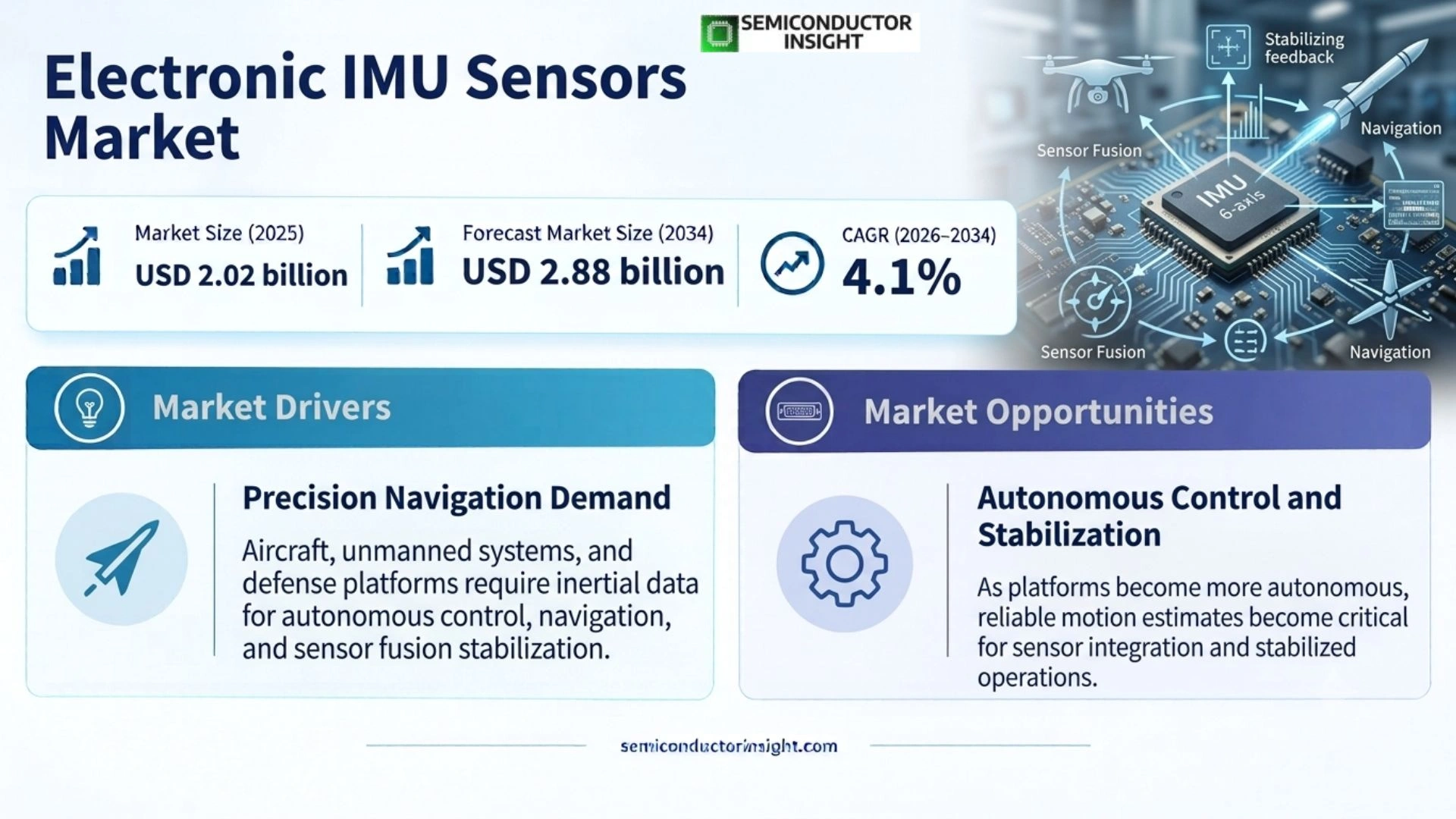
Electronic IMU sensors market was valued at USD 2.02 billion in 2025 and is projected to reach approximately USD 2884.39 million by 2034, representing an implied 4.1% CAGR during 2026–2034. North America holds the largest regional position because of its aerospace, defense and precision-navigation ecosystem, while Asia Pacific provides the fastest growth through aerospace modernization, drone adoption and industrial automation.
An electronic inertial measurement unit combines motion-sensing elements such as accelerometers and gyroscopes, with some configurations also incorporating magnetometers or additional pressure sensing, to estimate motion, attitude and gravitational forces. In precision applications, the IMU is not simply a sensor but a calibrated measurement subsystem whose value depends on bias stability, noise, drift, environmental compensation and the quality of the electronics that transform raw signals into navigation-grade data.
Electronic IMUs are especially important where satellite positioning cannot be assumed to be continuously available or where motion must be estimated at very high rates. Aircraft, unmanned platforms, naval systems, industrial machines and defense equipment use inertial information for stabilization and control. The purchase decision therefore evaluates a combination of accuracy, size, weight, power consumption, thermal behavior, shock and vibration tolerance, interface compatibility and the supplier’s ability to support long qualification programs.
The market is changing as precision requirements move into smaller systems. MEMS technologies are reducing the size and cost of inertial sensing, allowing more equipment categories to use electronic IMUs without accepting the mass and power penalties of older architectures. At the same time, premium aerospace and defense customers continue to require fiber-optic and other high-performance technologies where low drift and environmental robustness matter more than component cost. This creates a layered competitive structure rather than a single technology replacement cycle.
Segment Analysis: By Type
The report defines FOG, RLG, DTG and Others Mechanical, Si/Quartz MEMS, and HRG and Emerging Technology. FOG holds the strongest position in high-precision environments, while MEMS-based technologies are growing fastest as improvements in sensing performance reduce the trade-off between compactness, power and navigation capability.
| Type | Technology role | Market position |
|---|---|---|
| FOG | Fiber-optic gyroscopes derive rotation from optical interference and are valued for low moving-part count, high reliability and stable performance under demanding conditions. | Leading precision segment. Strong in aerospace and defense where established qualification and environmental performance justify premium pricing. |
| RLG | Ring laser gyroscopes use laser resonance to measure angular rate with high precision and long-term stability. | Established high-end architecture. Strongest where navigation performance and proven qualification outweigh system cost and size considerations. |
| DTG and Others Mechanical | Mechanical or dynamically tuned designs provide mature inertial measurement for established platforms and specialized legacy systems. | Mature installed-base segment. Replacement demand remains important even as newer architectures gain share in greenfield programs. |
| Si/Quartz MEMS | Microelectromechanical accelerometers and gyroscopes use compact microstructures with integrated electronics to measure motion. | Fastest-growing technology. Benefits from compact size, low power and improving accuracy, particularly in unmanned, industrial and space-constrained systems. |
| HRG and Emerging Technology | High-performance resonant and emerging architectures target very low drift and specialized navigation requirements. | Smaller strategic segment. Opportunity depends on achieving mission-grade qualification and demonstrating lifecycle advantages over established architectures. |
Segment Analysis: By Application
The report divides application demand into Aerospace, Defense, and Industrial, Naval, Offshore. Aerospace is the largest application because precise inertial data is fundamental to flight control and navigation, while industrial, naval and offshore applications provide diversification beyond the traditional aerospace-defense core.
| Application | Demand characteristics |
|---|---|
| Aerospace | The largest segment. Flight-control, navigation and stabilization systems require high-rate motion data and predictable performance under vibration, temperature and acceleration. Certification and lifecycle support make qualification history a major purchasing criterion. |
| Defense | Demand is driven by guidance, stabilization, targeting and navigation in environments where GPS denial, jamming or battlefield conditions make inertial reference critical. Export controls and security requirements shape supplier selection. |
| Industrial, Naval, Offshore | Rugged positioning, stabilization, surveying, marine navigation and equipment monitoring create growing non-defense demand. Buyers emphasize reliability, vibration resistance, environmental protection and integration with broader control systems. |
Regional Analysis
North America is the largest electronic IMU sensors market, while Asia Pacific is the fastest-growing region. North America is supported by aerospace, defense and precision-navigation programs, Europe by aerospace and industrial engineering, Asia Pacific by aerospace modernization and drone deployment, South America by agriculture and defense, and Middle East & Africa by aviation, defense, offshore and surveying projects.
How does regional IMU demand differ?
Regional demand reflects different mission profiles and industrial capabilities. North America has the deepest premium-navigation ecosystem and a concentration of qualified suppliers, Europe combines aerospace manufacturing with industrial automation, Asia Pacific is adding new capacity and domestic aerospace programs, South America is developing through agriculture and defense use cases, and the Middle East & Africa is project led. Commercial strategy must therefore match the region’s qualification cycle, localization expectations and dominant application rather than applying a single global price model.
| Region | Position | Growth outlook | Demand profile | What decides supplier selection |
|---|---|---|---|---|
| North America | Largest | Strong | Aerospace, defense and autonomy | Qualification, performance stability, export compliance and lifecycle support |
| Europe | Second | Moderate to strong | Aerospace, defense and industrial automation | Certification, engineering collaboration and navigation performance |
| Asia Pacific | Fastest growth | Highest | Aerospace modernization, drones and industry | Cost-performance, local engineering and domestic supply capability |
| South America | Fourth | Moderate | Agriculture, defense and mining | Ruggedness, price, distribution and field support |
| Middle East & Africa | Smallest | Selective / project led | Defense, aviation, offshore and surveying | Project qualification, environmental robustness and service availability |
Competitive Landscape
The electronic IMU market is concentrated around aerospace, defense and precision-navigation specialists, with competition increasingly extending into compact MEMS and autonomous-system products. High-end suppliers differentiate through drift performance, calibration, environmental robustness and qualification history, while emerging MEMS players compete through size, power consumption and price-performance. Long certification cycles and defense export controls reinforce the importance of established supplier relationships.
Key Industry Players
- Honeywell International
- Northrop Grumman Corp
- SAFRAN
- Thales
- Kearfott
- KVH Industries
- UTC
- Systron Donner Inertial
- IAI Tamam
- Elop
- L-3 Communications
- VectorNav
- Tronics
- SBG systems
- AOSense
The leading companies compete primarily through precision and qualification rather than commodity volume. Honeywell, Northrop Grumman, SAFRAN and Thales have deep relationships with aerospace and defense platforms, enabling them to participate in programs where inertial performance becomes part of the system certification basis. Their installed base and long-term support capabilities create a structural barrier to entry that smaller competitors must overcome with differentiated technology or lower-cost architectures.
Mid-tier and specialist companies compete by targeting particular performance bands and use cases. Kearfott, KVH Industries and similar suppliers can focus on precision navigation, compact FOG devices or industrial applications that do not require the same scale as major aerospace primes. This allows specialization to offset corporate size, particularly when the supplier offers a product that fits a defined size, weight, power or integration requirement better than larger alternatives.
MEMS-focused competitors are changing the market by narrowing the gap between compact sensors and traditional high-performance systems. The commercial opportunity is strongest where a customer can accept a modest reduction in inertial performance in exchange for lower size, weight, power and cost. This creates new applications in drones, robotics, autonomous vehicles and industrial equipment while preserving premium FOG, RLG and other architectures for the most demanding navigation tasks.
Competition is also shaped by export controls and qualification. A technically strong product may not be commercially interchangeable with another device if it lacks the required certification, export classification or interface validation. Consequently, companies that can provide long-term support, documented production continuity and regulatory expertise often retain customers even when alternative technologies improve. The commercial test is therefore the combination of performance, qualification and supply assurance.
Production Capacity Analysis
Electronic IMU production capacity is constrained by more than sensor assembly. High-performance products require precision fabrication, optical or MEMS process control, inertial calibration, environmental testing and long qualification runs. The release capacity of a supplier is therefore the amount of fully calibrated and validated output it can deliver consistently, not simply the number of sensing elements physically assembled on a line.
| Capacity stage | Primary constraint | Commercial implication |
|---|---|---|
| Sensor fabrication | MEMS process, optical components or precision mechanical assembly | Yield and process stability directly affect available output and unit cost. |
| Electronics integration | Signal conditioning, compensation and firmware | Integration resources can become a bottleneck for complex multi-axis products even when sensing elements are available. |
| Calibration and test | Reference equipment, thermal/vibration testing and compensation routines | This is often the most important capacity gate for precision and safety-critical IMUs. |
| Qualification and release | Customer-specific validation and documentation | Physical production can exceed sellable capacity when products are waiting for program qualification or controlled release. |
Capacity expansion therefore requires balanced investment. Adding fabrication equipment without expanding calibration and test capability can leave the real bottleneck unchanged, while increasing test capacity without stable upstream yields can raise cost without improving shipment volume. The most effective suppliers treat calibration, environmental validation and process documentation as production infrastructure, enabling new designs to move from engineering samples to qualified recurring shipments without repeatedly rebuilding the manufacturing workflow.
Market Dynamics
The market is moving along two parallel tracks: premium navigation systems continue to demand highly stable inertial performance, while MEMS improvements are opening new applications that previously could not justify an IMU. Defense and aerospace remain the value anchor, but industrial, naval, offshore and autonomous platforms are widening the market. At the same time, qualification, calibration and export controls prevent rapid substitution between suppliers.
Market Drivers
Precision navigation demand
Aircraft, unmanned systems and defense platforms require reliable motion estimates to maintain control and navigation. As platforms become more autonomous, inertial data becomes more central to sensor fusion and stabilization. Suppliers respond by improving bias stability, thermal compensation and multi-axis integration. The market implication is a sustained premium for high-quality IMUs, particularly where navigation failure has direct safety or mission consequences and where certification makes supplier switching difficult.
MEMS miniaturization
MEMS technologies are shrinking the physical and power burden of inertial sensing while improving performance through better microstructures, packaging and compensation algorithms. This changes the customer requirement from “maximum accuracy at any cost” toward “sufficient accuracy within a tight system envelope.” The result is new demand from drones, robotics, compact industrial machines and other systems where older inertial architectures were too large, expensive or power intensive.
Autonomous and unmanned systems
Autonomous aircraft, marine platforms and industrial machines need continuous motion data to stabilize themselves and to combine inputs from GNSS, cameras, lidar and other navigation sources. IMUs provide high-rate measurements that bridge gaps between slower external references. This makes the sensor a central element of sensor-fusion architectures, increasing demand for devices that offer low latency, predictable drift and straightforward digital integration.
Industrial automation
Robotics and automated equipment create growing opportunities outside defense. Motion sensing helps machines estimate orientation, compensate for vibration and improve navigation or positioning. Suppliers can address this demand with compact MEMS architectures rather than premium aerospace-grade units, lowering system cost. The commercial implication is volume expansion across many industrial platforms, although price sensitivity and integration simplicity become more important than ultimate inertial accuracy.
Market Restraints
Calibration complexity
Accurate IMU performance depends on calibration across temperature, bias, scale factor, alignment and other error sources. This creates substantial test time and specialized equipment requirements. Calibration is particularly demanding for navigation-grade products because small drift errors accumulate over time. The restraint limits how quickly manufacturers can scale capacity and makes low-cost products difficult to produce without sacrificing consistency or creating a large downstream field-calibration burden.
Export controls
Advanced IMUs can fall within dual-use or defense export-control frameworks, restricting where products may be sold and which customers can receive technical information. This fragments the market and can increase compliance cost for both suppliers and buyers. Companies need classification, licensing and secure technical processes, while customers often prefer suppliers with established compliance structures. Export restrictions therefore affect market access as well as product economics.
High development cost
New precision IMUs require specialized development teams, environmental test infrastructure and long validation cycles. A product can take years to move from laboratory concept to a qualified aerospace or defense device. This slows innovation relative to simpler sensors and favors suppliers with existing test equipment, application relationships and reference designs. Smaller firms can still succeed, but they generally need a sharply differentiated architecture or niche application to justify the development investment.
Vibration and shock environments
IMUs operate inside platforms that can experience strong vibration, acceleration and temperature changes. Mechanical stress can influence bias, alignment and sensing performance, creating challenging compensation requirements. Suppliers respond with improved mounting, packaging, calibration and algorithms, but ruggedization increases cost and development time. The restraint is strongest where customers need both compactness and very high stability, because those requirements can pull the design in opposing directions.
Market Opportunities
Autonomous drones
Small autonomous aircraft create a strong opportunity for compact MEMS and hybrid IMUs. The buyer needs accurate attitude and motion information without sacrificing payload, endurance or computing resources. Suppliers that can offer integrated multi-axis sensing, efficient interfaces and stable calibration can become part of standardized drone platforms. The commercial opportunity expands further when one sensor architecture can serve multiple airframes or robotic platforms with limited redesign.
Industrial and offshore navigation
Industrial, naval and offshore systems need reliable motion data for stabilization, surveying and machine control. These markets can accept different performance tiers than strategic navigation, opening a larger role for compact MEMS. Suppliers benefit where they can provide rugged packaging and simple integration, while customers benefit from reduced downtime and improved equipment positioning. The implication is a volume opportunity that does not require winning a major aircraft platform first.
Space and small satellites
Space systems increasingly value compact, low-power sensing because payload constraints are severe. MEMS and resonant technologies can address missions where size and power are tightly constrained, while higher-grade architectures remain relevant for more demanding navigation. Suppliers with space-qualification pathways and radiation-aware designs can capture premium opportunities as satellite constellations and specialized spacecraft architectures diversify the customer base for electronic inertial sensing.
Sensor-fusion architectures
IMUs increasingly operate as one input within sensor-fusion systems that combine inertial, GNSS, vision, lidar and other measurements. This creates an opportunity for suppliers to compete on interface quality, synchronization, error models and software tools rather than the sensor element alone. A well-integrated IMU can reduce customer development time, improve navigation robustness and create software or calibration revenue around the hardware, increasing the overall commercial value of the supplier relationship.
Supply Chain Analysis
Sensing-element supply is differentiated by technology. MEMS suppliers depend on microfabrication and packaging processes, FOG and RLG products depend on optical and precision components, and mechanical architectures require highly controlled assemblies. The upstream bottleneck is therefore technology specific rather than universal. Suppliers with qualified materials and stable component sources gain resilience because replacing a critical element can trigger recalibration or customer requalification.
Electronics and assembly turn the raw inertial element into a usable multi-axis product. Signal conditioning, processing and compensation determine how much of the sensor’s theoretical performance reaches the customer interface. The commercial value rises when suppliers integrate these functions internally because system designers can work with a validated module rather than individual accelerometers and gyroscopes, reducing engineering time and interface risk.
Calibration and validation are frequently the strongest supply-chain constraints because high-performance IMUs must be characterized across temperature, motion and vibration conditions. These facilities are capital intensive and their throughput is not easily increased through simple staffing changes. Suppliers with strong calibration infrastructure can therefore create a durable advantage, particularly where customers require repeatability over large production lots and long platform lifecycles.
System integration captures value through software, interfaces, qualification support and field service. An inertial product becomes commercially useful only when customers can incorporate its output into navigation and control systems. Suppliers that provide evaluation tools, interface documentation and application support can shorten the path to design-in, while field calibration and replacement programs create recurring revenue after the initial hardware shipment.
Recent Developments
2026
Development: Analog Devices continued expanding its precision MEMS IMU portfolio, including miniature and tactical-grade six-degree-of-freedom products. Why it matters: The product breadth demonstrates how MEMS architectures are being positioned across multiple performance classes, supporting expansion into compact autonomy and industrial applications alongside traditional precision uses.
2025
Development: Aerospace and defense manufacturers continued increasing use of autonomous and unmanned platforms that depend on high-rate inertial measurements for stabilization and navigation. Why it matters: The development expands the addressable market beyond conventional crewed aircraft and creates demand for compact IMUs with lower size, weight and power requirements.
2025
Development: Precision inertial products remained part of long-life aerospace and defense electronics programs where documented qualification and supply assurance are critical. Why it matters: Long platform lifecycles support recurring demand for calibrated replacements and strengthen the competitive advantage of suppliers with established qualification records.
Report Scope & Segmentation
| Attribute | Report scope |
|---|---|
| Market | Electronic IMU Sensors |
| Base year | 2025 |
| Forecast period | 2026–2034 |
| Source-page endpoint | 2033 |
| 2025 market size | USD 2,017 million |
| 2034 projected size | USD 2884.39 million |
| CAGR | 4.1% (2026–2034) |
| By Type | FOG; RLG; DTG and Others Mechanical; Si/Quartz MEMS; HRG and Emerging Technology |
| By Application | Aerospace; Defense; Industrial, Naval, Offshore |
| By End User | Commercial Aviation; Military & Defense; Maritime & Offshore |
| By Performance Level | Tactical Grade; Navigation Grade; Strategic Grade |
| By Technology | Traditional Mechanical; MEMS-based; Fiber Optic |
| Regions | North America; Europe; Asia Pacific; South America; Middle East & Africa |
| Profiled companies | Honeywell International; Northrop Grumman Corp; SAFRAN; Thales; Kearfott; KVH Industries; UTC; Systron Donner Inertial; IAI Tamam; Elop; L-3 Communications; VectorNav; Tronics; SBG systems; AOSense |
Frequently Asked Questions
What is the 2025 electronic IMU sensors market size?
The electronic IMU sensors market was valued at USD 2,017 million in 2025 on the report page. The market focuses on precision-oriented inertial measurement for aerospace, defense and industrial, naval and offshore systems rather than consumer-oriented motion sensors.
What is the projected electronic IMU sensors market size by 2034?
Extending the published 2025 and 2033 market anchors gives an implied 2034 market size of about USD 2884.39 million. The opportunity is supported by aerospace and defense demand as well as the gradual expansion of compact IMUs into autonomous and industrial applications.
What is the expected CAGR from 2026 to 2034?
The anchor-implied rate is approximately 4.1% during 2026–2034. This rate is derived from the two published market-size anchors and is used consistently with the extended 2034 endpoint.
Which IMU type is the leading segment?
FOG is the leading type in the report because fiber-optic gyroscopes provide strong performance and reliability in high-precision environments. Their position is particularly strong in aerospace and defense applications where drift and environmental behavior are critical.
Which application is largest?
Aerospace is the largest application segment because aircraft and flight-control systems require reliable inertial data for navigation, stabilization and control. Certification requirements also create strong entry barriers and increase the value of suppliers with established qualification records.
Which end user is the largest?
Military and defense is the primary end-user group in the report because precision navigation, stabilization and guidance are required across defense platforms. Export controls and qualification requirements strongly influence the competitive structure of this segment.
Which technology is growing fastest?
MEMS-based technology is identified as the fastest-growing technology because miniaturization, lower power consumption and improving accuracy allow IMU capability to move into smaller autonomous, industrial and other space-constrained systems.
Which region is largest?
North America is the largest regional market with a stated 40% share. Its position reflects the concentration of aerospace and defense programs, advanced manufacturing, precision navigation research and established IMU suppliers.
What are the main restraints?
Calibration complexity, high development cost, vibration and shock requirements, and defense-related export restrictions are the main restraints. These factors increase product-development time, validation cost and market-entry friction for new suppliers.
Who are the key electronic IMU sensor companies?
The profiled companies include Honeywell International, Northrop Grumman Corp, SAFRAN, Thales, Kearfott, KVH Industries, UTC, Systron Donner Inertial, IAI Tamam, Elop, L-3 Communications, VectorNav, Tronics, SBG systems and AOSense.

Get Sample Report PDF for Exclusive Insights
Report Sample Includes
- Table of Contents
- List of Tables & Figures
- Charts, Research Methodology, and more...
 Download Sample Report PDF