MARKET INSIGHTS
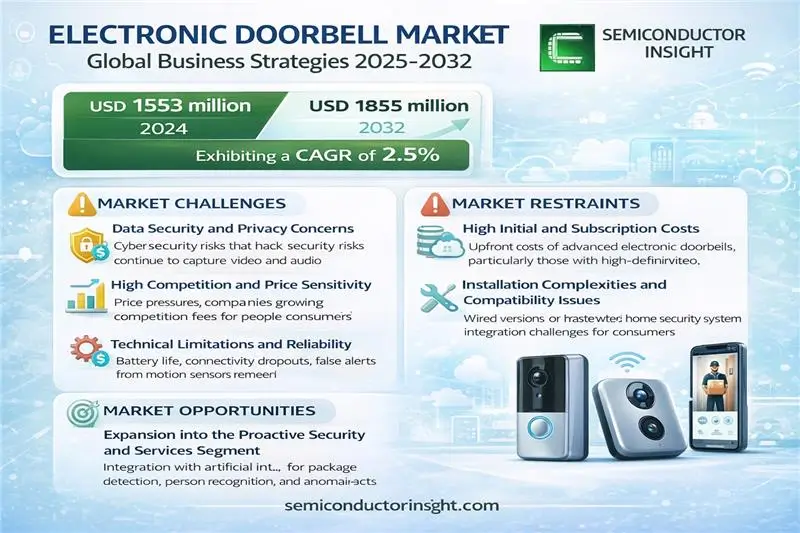
Global Electronic Doorbell Market size was valued at USD 1553 million in 2024 to USD 1855 million by 2032, exhibiting a CAGR of 2.5% during the forecast period.
An electronic doorbell is a device that uses an electronic mechanism to generate sound or visual alerts when a button is pressed. It typically consists of a push-button unit installed outside an entrance and a receiver unit inside the building, which emits a chime, melody, or notification. Modern variants often include features such as wireless connectivity, video cameras, and integration with smart home systems.
The market growth is primarily driven by the rising adoption of smart home technologies and increasing consumer demand for enhanced security and convenience. The wireless doorbell segment dominates the market, holding a share of about 77%, due to its ease of installation and flexibility. Furthermore, the residential application segment accounts for the largest share, approximately 97%, because doorbells are a standard feature in homes globally. Asia-Pacific is the largest regional market, with a share of about 33%, fueled by rapid urbanization and growing construction activities. Key players such as Panasonic, Samsung, and ABB are focusing on innovation, including Wi-Fi-enabled video doorbells with two-way audio, to strengthen their market position.
MARKET DRIVERS
Rising Consumer Demand for Smart Security
Electronic Doorbell Market is significantly driven by the global trend toward smart homes and enhanced home security. Consumers are increasingly investing in connected devices that offer convenience and safety. The integration of video cameras, two-way audio, and mobile app connectivity in doorbells has made them a central component of modern home security systems. This demand is further amplified by the rising awareness of home security and the availability of affordable smart home technologies.
Technological Advancements and Connectivity
Continuous innovation in wireless technology, such as improved Wi-Fi connectivity, low-power communication protocols like Zigbee and Z-Wave, and advancements in battery life, is a key driver. The proliferation of high-speed internet and the adoption of 5G networks are enabling more reliable and faster real-time video streaming and cloud storage features, enhancing the user experience and functionality of electronic doorbells.
Furthermore, the growth of the do-it-yourself (DIY) installation trend lowers the barrier to entry, allowing a broader customer base to easily adopt these products without professional help. The market is also seeing increased demand from the residential real estate sector, where smart doorbells are becoming a standard feature in new constructions and rental properties.
MARKET CHALLENGES
Data Security and Privacy Concerns
A primary challenge facing the Electronic Doorbell Market is the persistent concern over data privacy and cybersecurity. As these devices continuously capture video and audio from private properties, they are potential targets for hacking. High-profile incidents of data breaches have made consumers cautious, and manufacturers face increasing pressure to implement robust encryption and transparent data handling policies to build trust.
Other Challenges
High Competition and Price Sensitivity
The market is highly competitive with numerous established players and new entrants, leading to price pressures. While premium features command higher prices, a significant portion of the market is sensitive to cost, pushing manufacturers to balance advanced functionality with affordability to maintain market share.
Technical Limitations and Reliability
Issues such as limited battery life for wireless models, connectivity dropouts, and false alerts from motion sensors can lead to customer dissatisfaction. Ensuring consistent performance across different home environments and network conditions remains a significant technical hurdle for providers.
MARKET RESTRAINTS
High Initial and Subscription Costs
The upfront cost of advanced electronic doorbells, particularly those with high-definition video, facial recognition, and extensive cloud storage, can be a barrier for budget-conscious consumers. Additionally, many premium features are locked behind recurring subscription fees for cloud video recording and advanced analytics, which can deter long-term adoption and limit market penetration in cost-sensitive regions.
Installation Complexities and Compatibility Issues
Despite the growth of DIY models, many electronic doorbells, especially wired versions or those integrating with existing home security systems, require professional installation. This adds to the total cost of ownership. Furthermore, compatibility issues with older home wiring or with various smart home platforms can create friction for consumers, potentially slowing down adoption rates.
MARKET OPPORTUNITIES
Expansion into the Proactive Security and Services Segment
A significant opportunity lies in evolving from reactive notification devices to proactive security systems. Integration with artificial intelligence for package detection, person recognition, and anomalous activity alerts can create new value-added services. Partnerships with security monitoring companies to offer professional response services based on doorbell alerts represent a growing revenue stream.
Growth in Emerging Markets and Multi-Dwelling Units
Emerging economies with growing urban populations and increasing disposable income present a substantial growth frontier. Furthermore, there is untapped potential in the multi-dwelling unit (MDU) segment, such as apartments and condominiums, where integrated video doorbell systems can enhance security for residents and property managers, creating a B2B sales channel.
Integration with Broader IoT Ecosystems
Electronic Doorbell Market is positioned to become a central data hub for the smart home. Opportunities exist for deeper integration with other IoT devices, such as smart locks, lights, and thermostats, to create automated routines (e.g., unlocking the door for recognized guests). This interoperability can drive higher product bundling and increase the average revenue per user.
Electronic Doorbell Market Trends
Steady Market Growth Driven by Smart Home Integration
Global Electronic Doorbell Market is on a path of stable expansion, with its valuation projected to grow from USD 1,553 million in 2024 to USD 1,855 million by 2032, reflecting a compound annual growth rate (CAGR) of 2.5%. This sustained growth is largely fueled by the increasing integration of electronic doorbells into broader smart home ecosystems. Modern devices now incorporate features such as high-definition video streaming, two-way audio communication, and motion detection, which are accessible remotely via smartphone applications. This evolution from a simple audible alert system to a comprehensive home security and monitoring tool is a primary driver of consumer adoption, particularly in the residential sector.
Other Trends
Dominance of the Wireless Segment
The market is overwhelmingly dominated by wireless doorbells, which hold a commanding share of approximately 77%. The preference for wireless models is driven by their ease of installation, flexibility in placement, and elimination of the need for complex wiring, making them ideal for both new constructions and retrofitting existing homes. This segment’s growth is further supported by advancements in battery technology, providing longer operational life and reducing maintenance for consumers.
Asia-Pacific as the Leading Regional Market
Geographically, the Asia-Pacific region is the largest market for electronic doorbells, accounting for approximately 33% of the global share. This leadership is attributed to rapid urbanization, rising disposable incomes, and increasing investments in home security and smart infrastructure, particularly in densely populated countries like China and India. The region’s strong manufacturing base also contributes to the availability and affordability of a wide range of products.
Consolidation and Innovation Among Key Players
The competitive landscape features a mix of established electronics giants and specialized security brands, with the top three players Panasonic, Samsung, and ABB collectively holding over 22% of the market share. This concentration indicates a trend towards market consolidation, where larger companies leverage their brand reputation and distribution networks. Competition is intensifying around product innovation, with companies focusing on enhancing video quality, improving battery life, integrating artificial intelligence for person detection, and ensuring robust cybersecurity for connected devices. The market remains highly fragmented beyond the top players, encouraging continuous innovation and competitive pricing.
COMPETITIVE LANDSCAPE
Key Industry Players
An Analysis of Market Concentration and Strategic Positioning
Global Electronic Doorbell Market is characterized by a moderately concentrated competitive landscape, with the top three players Panasonic, Samsung, and ABB collectively commanding over 22% of the total market share. These established technology and electronics giants leverage their extensive brand recognition, robust global distribution networks, and significant investment in R&D to maintain leading positions. Their product portfolios often encompass a wide range of smart home and security devices, with electronic doorbells integrated into broader ecosystem strategies. The market structure is further influenced by the dominance of the wireless doorbell segment, which accounts for approximately 77% of the market, driven by consumer preference for easy installation and smart features like video surveillance and mobile integration.
Beyond the top-tier players, the market includes a diverse array of significant niche and specialized competitors. Companies such as Ring (owned by Amazon) and Arlo have gained substantial traction by focusing exclusively on smart home security and pioneering the video doorbell category. European players like Legrand, Honeywell, Aiphone, and Fermax hold strong positions, particularly in the commercial and high-security segments, offering robust and reliable wired and wireless solutions. The Asia-Pacific region, being the largest market with about 33% share, hosts influential manufacturers like Commax, Guangdong Roule Electronics, Leelen, and Anker Innovations (through its Eufy brand), which compete effectively on cost, innovation, and regional market understanding. This creates a dynamic environment with competition based on technological features, price points, and integration capabilities.
List of Key Electronic Doorbell Companies Profiled
- Panasonic
- Samsung
- ABB
- Legrand
- Honeywell
- Ring
- Aiphone
- Arlo
- Apical
- Commax
- Anker Innovations (Eufy)
- Guangdong Roule Electronics
- Skybell
- Leelen
- KallGlow
- Fermax
Segment Analysis:
| Segment Category | Sub-Segments | Key Insights |
| By Type |
|
Wireless Doorbell has established itself as the leading segment, primarily driven by the significant convenience and ease of installation it offers, eliminating the need for complex wiring systems. The proliferation of smart home ecosystems and consumer preference for retrofitting existing homes with modern security features without structural modifications further solidifies its dominance. Technological advancements, including improved battery life and stable connectivity, continue to enhance user experience, while innovative features such as integration with mobile applications and other smart devices expand its appeal beyond basic functionality. |
| By Application |
|
Residential application is the unequivocal leader in the Electronic Doorbell Market, as these devices are a fundamental component of home security and convenience. The primary driver is the growing emphasis on home safety, property monitoring, and package delivery management among homeowners. The integration of video capabilities and two-way audio has transformed doorbells into proactive security tools, fueling adoption. While the commercial segment shows steady demand for access control and visitor management in offices and apartment complexes, the sheer volume of single-family homes and multi-dwelling units globally ensures residential applications command the largest share of the market. |
| By End User |
|
Individual Homeowners constitute the most significant end-user segment, propelled by DIY installation trends and the direct-to-consumer sales models of many leading brands. This group values the enhanced security, convenience of remote monitoring, and the ability to integrate doorbells with existing smart home platforms. Property developers and managers represent a growing segment, increasingly specifying smart electronic doorbells as standard amenities in new constructions and renovations to increase property value and appeal. Commercial enterprises primarily utilize these systems for secure entry points and professional visitor management, though their overall volume is smaller compared to the residential sector. |
| By Technology |
|
Smart Connected Doorbells are the leading technological segment, representing the core of market innovation and growth. These devices offer advanced features such as high-definition video streaming, motion detection, cloud storage, and seamless integration with broader smart home automation systems and voice assistants. The demand is driven by consumer desire for comprehensive home security solutions that provide real-time alerts and remote interaction capabilities. While standard audio doorbells maintain a presence in the value segment, the market is clearly shifting towards feature-rich, connected devices that offer greater functionality and peace of mind to users. |
| By Sales Channel |
|
Online Retail channels have emerged as the dominant sales channel, significantly influencing market dynamics. The convenience of comparing products, reading detailed reviews, and accessing a wide variety of brands and models from e-commerce platforms drives this trend. Furthermore, many smart doorbell companies employ direct-to-consumer online marketing strategies, offering bundled services and subscriptions. Offline retail, including electronics and home improvement stores, remains crucial for customers who prefer to see and feel the product before purchasing, offering immediate possession and in-person expert advice, though its relative share is being challenged by the rapid growth of online commerce. |
Regional Analysis: Electronic Doorbell Market
North America
The market maturity is evident through deep integration with broader smart home systems. Consumers expect electronic doorbells to work effortlessly with other security cameras, smart locks, and voice assistants, creating a unified home automation experience that is a major driver of demand and brand loyalty in the region.
A landscape populated by leading global brands and agile startups fosters a highly competitive environment. This competition accelerates innovation, focusing on differentiating features such as high-definition video with HDR, advanced motion zones, and AI-powered person detection, keeping the market dynamic and growth-oriented.
There is a well-established consumer understanding of the benefits of video doorbells for package security, visitor monitoring, and overall property safety. This awareness, combined with a cultural emphasis on home security, creates a sustained and responsive market for new product launches and feature updates.
The preference for easy, wire-free do-it-yourself installation kits is a significant market characteristic. This trend lowers the barrier to entry for consumers, appealing to renters and homeowners alike who seek enhanced security without the complexity or cost of professional installation services.
Europe
The European market for electronic doorbells is experiencing robust growth, characterized by a strong focus on privacy, data security, and high-quality manufacturing standards. The European Union’s stringent regulations, such as the GDPR, influence product design, leading to features emphasizing local data storage and robust encryption. Markets in the United Kingdom, Germany, and France are particularly mature, driven by urbanization and an increasing investment in home security solutions. There is a notable demand for aesthetically pleasing designs that complement traditional and modern architecture. The market is also seeing a rise in adoption within multi-tenant buildings, with solutions tailored for apartment complexes gaining traction.
Asia-Pacific
The Asia-Pacific region represents the fastest-growing market for electronic doorbells, fueled by rapid urbanization, a burgeoning middle class, and increasing smartphone penetration. Countries like China, Japan, and South Korea are at the forefront, with local manufacturers offering cost-effective and feature-rich products. A key dynamic is the integration of doorbells with popular local messaging and e-commerce platforms, creating unique ecosystem lock-in. The market is highly price-sensitive, driving innovation in budget-friendly models without compromising on core features like video quality. Growing concerns about personal safety and property security in densely populated cities are primary catalysts for adoption.
South America
The South American market is in a developing phase, with growth concentrated in major urban centers in countries like Brazil and Argentina. Market expansion is primarily driven by rising crime rates and a subsequent increase in the demand for affordable home security solutions. The price point is a critical factor, with consumers favoring basic, reliable video doorbell models. Economic volatility in the region can impact purchasing power, but the essential nature of security products provides a steady baseline demand. Infrastructure challenges, such as inconsistent internet connectivity in some areas, influence product preferences towards models with strong offline capabilities.
Middle East & Africa
This region shows nascent but promising growth for electronic doorbells, with demand centered in affluent Gulf Cooperation Council (GCC) countries like the UAE and Saudi Arabia. The market is driven by high disposable income, government-led smart city initiatives, and a strong emphasis on luxury residential security. In other parts of Africa, the market is emerging slowly, with adoption limited to high-income urban households. The harsh climatic conditions in many areas necessitate products with high durability and resistance to extreme temperatures. The market potential is significant but is closely tied to economic development and the expansion of reliable internet infrastructure.
Report Scope
This market research report provides a comprehensive analysis of the Electronic Doorbell Market , covering the forecast period 2025–2032. It offers detailed insights into market dynamics, technological advancements, competitive landscape, and key trends shaping the industry.
Key focus areas of the report include:
- Market Overview: The report begins with an overview outlining its current market scenario, key growth indicators, and industry transformation drivers. It discusses macroeconomic factors, demand–supply balance, regulatory landscape, and the strategic role of home automation and security in powering advancements across consumer electronics and residential infrastructure.
- Market Size & Forecast: Historical data and future projections for revenue, unit shipments, and market value across major regions and segments.
- Segmentation Analysis: Detailed breakdown by product type (Wired and Wireless), application (Residential, Commercial), and distribution channel to identify high-growth segments and investment opportunities.
- Regional Insights: Insights into market performance across North America, Europe, Asia-Pacific, Latin America, and the Middle East & Africa, including country-level analysis where relevant.
- Competitive Landscape: Profiles of leading market participants, including their product offerings, R&D focus, manufacturing capacity, pricing strategies, and recent developments such as mergers, acquisitions, and partnerships.
- Technology Trends & Innovation: Assessment of emerging technologies, integration of smart features, IoT connectivity, energy efficiency, and evolving consumer preferences.
- Market Drivers & Restraints: Evaluation of factors driving market growth along with challenges, supply chain constraints, regulatory issues, and market-entry barriers.
- Stakeholder Insights: Insights for component suppliers, OEMs, system integrators, investors, and policymakers regarding the evolving ecosystem and strategic opportunities.
Primary and secondary research methods are employed, including interviews with industry experts, data from verified sources, and real-time market intelligence to ensure the accuracy and reliability of the insights presented.
FREQUENTLY ASKED QUESTIONS:
What is the current market size of Electronic Doorbell Market?
-> Electronic Doorbell Market size was valued at USD 1553 million in 2024 to USD 1855 million by 2032, exhibiting a CAGR of 2.5% during the forecast period.
Which key companies operate in Electronic Doorbell Market?
-> Key players include Panasonic, Samsung, ABB, Legrand, Honeywell, and Ring, among others. The top three players hold a share over 22%.
What are the key segments in the market?
-> By product type, Wireless Doorbell is the largest segment, with a share of about 77%. By application, the Residential segment is dominant, accounting for a share of about 97%.
Which region dominates the market?
-> Asia-Pacific is the largest market, holding a share of about 33%.
What is an Electronic Doorbell?
-> An electronic doorbell is a device that uses an electronic mechanism to generate a sound or melody when a button is pressed. It typically consists of a button outside the door connected to a receiver inside the house.

Get Sample Report PDF for Exclusive Insights
Report Sample Includes
- Table of Contents
- List of Tables & Figures
- Charts, Research Methodology, and more...
 Download Sample Report PDF