Key Statistics
Key Takeaways
- Semiconductors / active components are the leading type on the source page because processors, analog ICs, power devices and sensors provide the functional intelligence and switching capability in modern electronic systems, while passive components and connectors scale alongside them.
- Consumer Electronics is identified as the largest application in the page’s segment analysis, but Automotive is described as the fastest-growing segment because EVs, ADAS and software-defined vehicles increase semiconductor, sensor, connector and passive-component content per vehicle.
- Asia Pacific dominates production and consumption because China, Taiwan, South Korea and Japan combine semiconductor fabs, passive-component manufacturing, electronics assembly and a dense supplier ecosystem. The region also posted the strongest semiconductor sales growth in 2025 according to WSTS.
- AI infrastructure is reshaping component mix. TDK is targeting roughly tenfold growth in passive-component sales for AI data-center applications, while Infineon’s 2026 Smart Power Fab expands power-semiconductor and analog capacity for AI power systems and software-defined vehicles.
- The source page’s 4.7% CAGR does not reconcile with its stated market-size anchors. USD 461.79 billion in 2024 and USD 634.48 billion in 2032 imply approximately 4.05% annual growth, which is the rate used for the 2025–2034 rebasing.
Electronic Components Market Overview
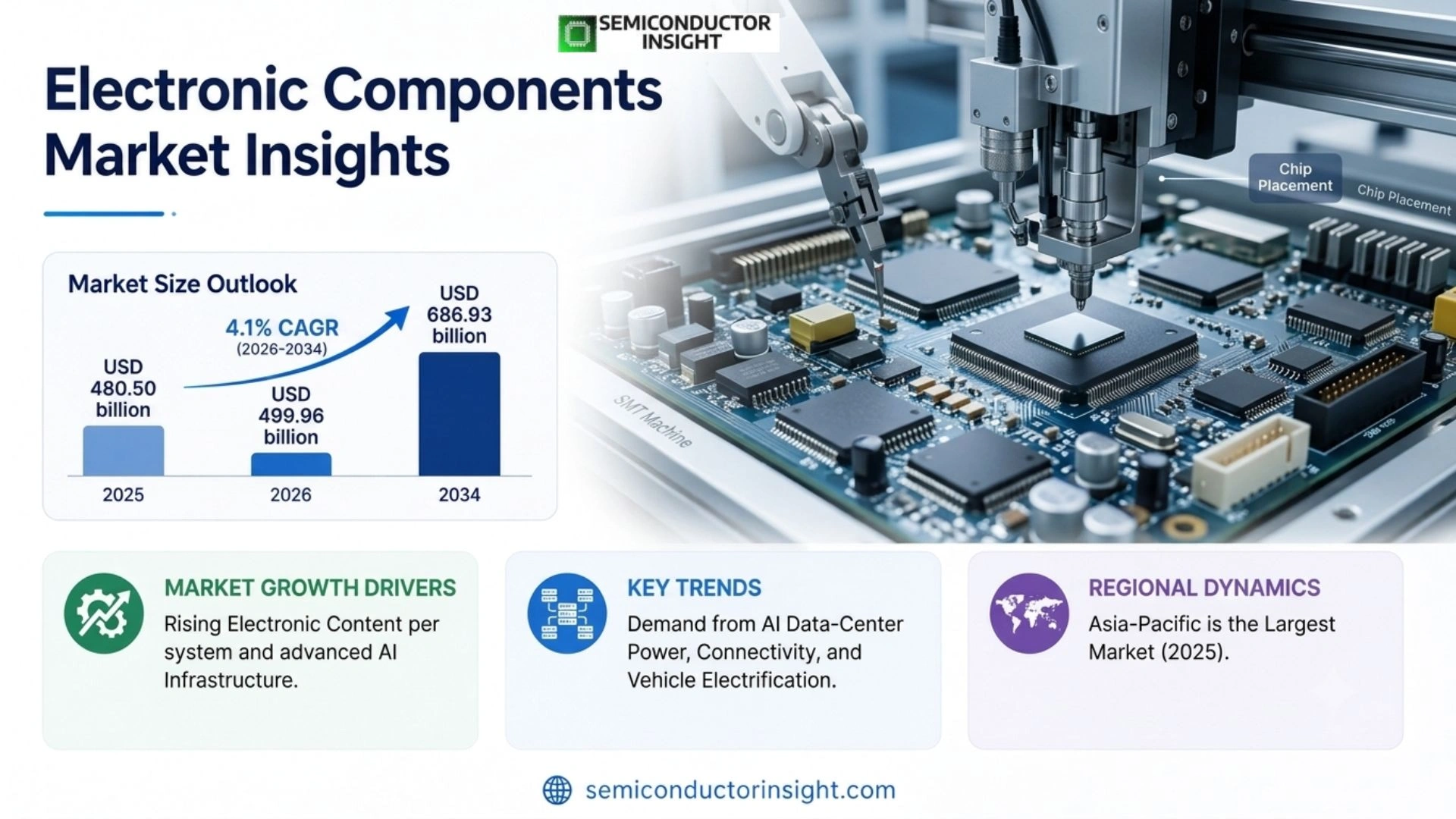
Electronic Components Market is rebased to USD 480.50 billion in 2025, increases to an estimated USD 499.96 billion in 2026, and is projected to reach USD 686.93 billion by 2034. The selected source-page size anchors imply a 4.1% CAGR during 2026–2034. Asia Pacific is the largest market in 2025, while current demand is being reshaped by AI data-center power and connectivity, vehicle electrification and ADAS, industrial automation, semiconductor recovery, higher component density per system and supply-chain localization across semiconductors, passives, connectors and optoelectronics.
Electronic components include semiconductors, passive devices, electromechanical parts, connectors, sensors, optoelectronic devices and related modules that provide switching, signal processing, energy storage, filtering, sensing, interconnection and protection inside electronic systems. The market therefore spans very different manufacturing technologies-from silicon wafer fabrication and ceramic sintering to metal stamping, molding and precision connector assembly-but all segments are linked by rising electronic content in vehicles, factories, data centers, healthcare devices and consumer products.
Demand is recovering unevenly by product category. WSTS reported that global semiconductor sales reached USD 795.6 billion in 2025, up 26.2% year over year, driven particularly by logic and memory for AI and data-center infrastructure, while other categories grew more moderately. This matters to the wider electronic-components market because every new processor board also requires capacitors, inductors, power-management devices, connectors, sensors and thermal or protection components, so semiconductor growth creates a multiplier effect through the surrounding bill of materials.
The strongest structural themes are power density, electrification and miniaturization. TDK’s 2026 investor briefing described AI data-center architectures moving toward 400–800 V power systems and outlined accelerated investment in MLCCs, film capacitors, aluminum electrolytic capacitors and inductors. In automotive, Murata introduced new high-capacitance AEC-Q200 MLCCs and Infineon opened a €5 billion Smart Power Fab for power semiconductors and analog/mixed-signal devices serving AI data centers, renewable energy and software-defined vehicles.
Segment Analysis: By Type
The source page uses two partially inconsistent type taxonomies: its segment analysis lists Semiconductors, Passive Components, Electromechanical and Optoelectronics, while the FAQ/Table of Contents refers to Active Components, Passive Components and Electromechanical Components. This article preserves both by treating semiconductors as the principal active-component class and retaining optoelectronics as a distinct segment because the page explicitly lists it in the detailed segment analysis.
| Type | Technical / commercial role | Market position |
|---|---|---|
| Semiconductors / Active Components | This group includes integrated circuits, processors, analog and mixed-signal devices, power semiconductors, discrete devices and sensors that actively control current, process data or perform switching and sensing. The segment captures the highest system value because device architecture and process technology determine computing performance, power efficiency and functional differentiation across data-center, automotive, industrial and consumer applications. | Largest functional segment. WSTS reported very strong 2025 semiconductor growth led by logic and memory, while Infineon’s 2026 Smart Power Fab expands power and analog capacity for AI and automotive. Growth is highly technology-sensitive, with advanced logic, memory, analog and power devices following different demand and capacity cycles. |
| Passive Components | Passive devices include capacitors, resistors, inductors, filters and magnetic components that store, filter or condition electrical energy without providing gain. Their individual unit prices are typically lower than semiconductors, but every electronic system uses large quantities, and higher operating frequencies, voltages and current densities increase specification difficulty even when basic functionality is mature. | High-volume segment with strong AI and automotive content growth. TDK plans to expand passive-component sales for AI data centers sharply and is investing in high-voltage capacitors and low-voltage/high-current inductors. Murata continues to increase capacitance density in automotive MLCCs as ADAS and 48 V systems increase board-level requirements. |
| Electromechanical Components | This category includes connectors, relays, switches, terminals, sockets and related parts that provide physical signal or power interfaces. Performance depends on contact resistance, mechanical durability, sealing, thermal behavior and high-speed signal integrity. Data centers and vehicles require more sophisticated interconnection as power levels and data rates increase. | Durable growth segment. AI servers require high-speed and high-power connectors, while EVs and zonal vehicle architectures add high-voltage terminals, sealed connectors and board-to-board interfaces. The segment is more mechanically intensive than semiconductor manufacturing and benefits from long qualification cycles in automotive and industrial markets. |
| Optoelectronics | Optoelectronic components convert electrical and optical signals and include LEDs, lasers, photodetectors, image sensors, optical transceivers and display-related devices. Demand spans communications, sensing, consumer devices and industrial systems. The segment can be cyclical in displays but strategically important in data-center optics, machine vision and automotive sensing. | Specialized high-growth pockets. The source page highlights optoelectronics as a distinct type, while WSTS showed 2025 optoelectronic growth recovering more modestly than logic and memory. AI optical interconnects, lidar, machine vision and sensing provide selective growth even when some mature LED or display categories face pricing pressure. |
Secondary segmentation: By Technology
The source page further divides the market into Silicon-based, Compound Semiconductors, Emerging Materials and Traditional. This taxonomy cuts across component types and reflects the material platform used to achieve performance, cost and reliability targets. Silicon remains dominant because of manufacturing maturity, while compound semiconductors gain share where voltage, frequency or optical efficiency require wider bandgaps or direct-bandgap materials.
| Technology | Commercial role |
|---|---|
| Silicon-based | Silicon dominates logic, memory, analog, microcontrollers and a large share of power devices because the fabrication ecosystem is mature and globally scaled. Cost per function remains difficult to beat, making silicon the default technology for mass-market electronics. Advanced packaging and process-node scaling continue to extend silicon performance rather than displacing it broadly. |
| Compound Semiconductors | SiC, GaN, GaAs and related materials are used where high voltage, high frequency, high temperature or optical emission provide system advantages. EV traction, fast chargers, AI data-center power supplies and RF systems are major growth applications. Infineon’s portfolio expansion across Si, SiC and GaN illustrates the increasing system-level role of compound semiconductors. |
| Emerging Materials | Emerging materials include new dielectrics, magnetic systems, advanced ceramics, thin films and novel semiconductor substrates designed to increase power density, thermal performance or component miniaturization. Commercial adoption requires a clear system-level advantage because new materials must justify tooling, qualification and supply-chain changes. |
| Traditional | Traditional component technologies include long-established resistive, magnetic, ceramic, metal-contact and mechanical systems that remain economical in mature applications. Innovation focuses on smaller form factor, higher reliability and automated production rather than radical material replacement, supporting long product lifecycles in industrial and infrastructure markets. |
Secondary segmentation: By End User
The page identifies OEMs, Contract Manufacturers, Distributors and Resellers, and System Integrators as end-user groups. OEMs lead direct consumption, while distributors play a strategically important role because electronic-component portfolios contain thousands of part numbers and customers require inventory availability, technical support and traceability across many suppliers. For electronic-component suppliers, the commercial consequence is that design-in status, qualification, supply assurance and application-specific performance determine revenue much more directly than broad electronics shipment growth.
| End user | Commercial characteristics |
|---|---|
| OEMs | Original equipment manufacturers select and qualify components against system requirements for cost, performance, supply assurance and lifecycle. Large automotive, industrial and consumer OEMs can influence supplier roadmaps directly and often require multi-year quality agreements. Their design-in decisions create recurring component revenue through an entire product platform. |
| Contract Manufacturers | EMS and contract manufacturers purchase large volumes against customer bills of materials and are highly sensitive to lead times, allocation and component substitutions. They create scale for distributors and suppliers but usually have less freedom to change specifications unless the OEM approves an alternative source. |
| Distributors and Resellers | Distributors aggregate thousands of component lines and provide inventory, design support, logistics and small-lot access. Their importance increases when supply chains become complex or fragmented. Authorized distribution also supports traceability and counterfeit risk reduction, particularly for industrial, aerospace and medical buyers. |
| System Integrators | System integrators combine semiconductors, passives, connectors, sensors and modules into automation, communication, medical and infrastructure solutions. They value reference designs and interoperability because engineering time can be more important than unit component cost. Suppliers that provide system-level application support can therefore gain influence beyond individual part specifications. |
Segment Analysis: By Application
The source page’s segment analysis lists Consumer Electronics, Automotive, Industrial Automation, Healthcare, Telecommunications and Others. It identifies consumer electronics as the largest application and automotive as the fastest-growing. The report’s Table of Contents uses a different application taxonomy-Automotive, Communications and Computing, Lighting, Industrial, Medical, Security and Others-which is disclosed in the reviewer note rather than silently reconciled.
| Application | Demand characteristics |
|---|---|
| Consumer Electronics | Smartphones, PCs, wearables, televisions and home devices use very large volumes of semiconductors, MLCCs, inductors, connectors, sensors and optoelectronic components. Unit volumes are high and product cycles are short, so suppliers compete aggressively on miniaturization and cost. Premium devices increase component density even when overall device shipments grow slowly. |
| Automotive | Vehicles are becoming electronic platforms through EV powertrains, ADAS, infotainment, battery management and zonal architectures. The source page identifies automotive as the fastest-growing application. Murata’s new high-capacitance automotive MLCCs and Infineon’s power-semiconductor capacity expansion provide current evidence of increasing component content and performance requirements per vehicle. |
| Industrial Automation | Robotics, machine vision, motor drives, PLCs, sensors and predictive-maintenance systems require durable semiconductors, power devices, connectors and passive components. Industrial buyers prioritize long product lifecycles and availability because equipment remains in service for many years, making supplier continuity an important selection criterion. |
| Healthcare | Imaging, patient monitoring, diagnostics, surgical equipment and wearable health devices use sensors, analog ICs, power-management devices, connectors and passive components. Medical qualification and traceability increase switching costs, while miniaturization and portable care create demand for lower-power electronics and high-reliability interconnects. |
| Telecommunications | 5G networks, fiber infrastructure, routers and data transmission systems use RF semiconductors, power amplifiers, filters, capacitors, optical components and high-speed connectors. Demand follows network upgrades and data-center interconnect growth, while component specifications rise with frequency, bandwidth and thermal density. |
| Others | Other applications include aerospace, defense, energy, security, lighting and research systems. These markets can require radiation tolerance, high temperature, long lifecycle or unusual packaging. Unit volumes are lower, but strict qualification and specialized performance can support attractive margins for selected component suppliers. |
Alternative application taxonomy used in the source Table of Contents
The page’s formal Table of Contents uses Automotive, Communications and Computing, Lighting, Industrial, Medical, Security Application and Others. This alternative taxonomy overlaps strongly with the segment-analysis categories but separates communications/computing and lighting more explicitly. It is preserved here to avoid losing source-page structure. This distinction matters because semiconductors, passives and connectors operate under different manufacturing cycles, so the same end-market trend can create sharply different utilization, pricing and capacity outcomes across component categories.
| TOC application | How it maps commercially |
|---|---|
| Automotive | Directly corresponds to the automotive segment and includes EV, ADAS, connectivity, lighting and power distribution. The category has rising content per vehicle and some of the industry’s longest qualification cycles. |
| Communications and Computing | Combines telecom infrastructure with PCs, servers and data centers. AI has shifted the growth center toward high-performance computing, high-speed interconnects and power delivery, creating demand across active, passive and electromechanical components. |
| Lighting | Includes LEDs, drivers, power supplies, control electronics and sensing for general, automotive and industrial lighting. Energy efficiency and smart control support long-term demand, although mature LED products can face strong price pressure. |
| Industrial / Medical / Security | These applications prioritize reliability, long product availability and regulatory or environmental performance. Component suppliers can defend pricing through qualification, ruggedization and specialized support even when unit volumes are lower than consumer markets. |
Regional Analysis
Asia Pacific is the largest market because it combines the world’s deepest electronics manufacturing ecosystem with major semiconductor, passive-component, connector and display production. The source page explicitly identifies Asia Pacific as dominant in both production and consumption, while WSTS reported especially strong 2025 semiconductor growth in Asia Pacific / All Others and China.
Why does the electronic-components market remain heavily concentrated in Asia Pacific?
Electronic components benefit from industrial clustering because semiconductors, ceramics, connectors, PCBs, displays and final assembly all interact through short development and logistics cycles. Asia Pacific combines manufacturing scale with leading suppliers and large domestic demand. North America drives AI, automotive and industrial design; Europe is strong in power, automotive and industrial electronics; South America and MEA remain more import-dependent but gain from data-center, energy and manufacturing investment.
| Region | Position | Growth outlook | Demand profile | What decides supplier selection |
|---|---|---|---|---|
| Asia Pacific | Largest | High | Electronics manufacturing and semiconductor-led | Scale, cost, technology depth and integrated supply chain |
| North America | Technology-demand leader | High | AI, automotive, industrial and aerospace-led | Innovation, supply assurance and application support |
| Europe | High-value specialty market | Moderate to high | Automotive, power and industrial-led | Reliability, localization and regulatory compliance |
| South America | Smaller | Moderate | Automotive, telecom and industrial-led | Landed cost, channels and local service |
| Middle East & Africa | Emerging | Moderate from small base | Data-center, energy and telecom-led | Supply reliability, durability and integration support |
Competitive Landscape
The source page lists a broad group of semiconductor, passive, connector, automation and electromechanical suppliers, reflecting the fragmented nature of electronic components. Texas Instruments, Murata, STMicroelectronics, NXP, Infineon, TDK, TE Connectivity and Amphenol are among the strategically important companies because each leads different technology domains rather than competing directly across the full component universe.
Texas Instruments, STMicroelectronics, NXP, Infineon, onsemi and Analog Devices compete primarily in semiconductors, especially analog, embedded, power and sensing. Their advantage lies in process technology, broad portfolios and application support. Infineon’s 2026 Dresden fab and AI power investments show how capital intensity and manufacturing capacity remain decisive in power and analog markets.
Murata, TDK, Samsung Electro-Mechanics, Kyocera and Panasonic are strong in passive, ceramic, magnetic and electromechanical components. They defend positions through materials science, miniaturization and high-volume process control. Murata’s 2026 automotive MLCC launches and TDK’s AI data-center passive strategy illustrate how traditional component categories gain new value as systems become more power dense.
Amphenol, TE Connectivity and Molex compete in interconnects, where electrical bandwidth, power handling, mechanical durability and application-specific packaging determine value. Distribution breadth and customer co-design matter because connectors must fit mechanical and electrical architectures exactly. The market therefore remains fragmented even though many individual subcategories are concentrated. Buyers therefore evaluate not only unit price but also reliability, lifecycle availability, system efficiency, technical support and second-source resilience before approving a component into a high-volume product platform.
| Competitive tier | Companies | Why they matter |
|---|---|---|
| Semiconductor leaders | Texas Instruments; STMicroelectronics; NXP Semiconductors; Infineon Technologies; Analog Devices; onsemi; Microchip Technology | These companies supply active devices that determine system intelligence, sensing and power efficiency. Their competitive advantage is based on process technology, broad product families, software support and long-term design-in relationships across automotive, industrial and data-center applications. |
| Passive / ceramic / module leaders | Murata Manufacturing; TDK; Samsung Electro-Mechanics; Kyocera; Panasonic | These suppliers combine proprietary materials, ceramic processing and miniaturization to produce capacitors, inductors, sensors and modules at high volume. AI and vehicle electrification are increasing performance requirements, allowing technically differentiated passives to capture more value. |
| Interconnect & electromechanical leaders | Amphenol; TE Connectivity; Molex; ABB; Omron; Vishay | These companies serve connectors, relays, switches, protection and related electromechanical or passive categories. They compete through application-specific engineering, global customer support and qualification in automotive, industrial, data-center and infrastructure systems. |
Companies profiled in the report
The source page profiles Texas Instruments Inc., Murata Manufacturing Co., Ltd., ABB Ltd., STMicroelectronics N.V., NXP Semiconductors N.V., Kyocera Corporation, Omron Corporation, Amphenol Corporation, Infineon Technologies AG, Samsung Electro-Mechanics Co., Ltd., TDK Corporation, Analog Devices, Inc., Molex, LLC, Vishay Intertechnology, Inc., ON Semiconductor Corporation, Microchip Technology Inc., Panasonic Corporation and TE Connectivity Ltd.
Production Capacity Analysis
Production capacity is highly heterogeneous because electronic components are manufactured using different processes. Semiconductor fabs require billion-dollar cleanrooms and wafer equipment, MLCC plants require ceramic powder and high-temperature sintering, connectors use stamping and molding, and sensors may combine MEMS, semiconductor and package assembly. Effective supply therefore depends on a network of specialized capacities rather than one universal production metric.
Semiconductor capacity remains the most capital intensive. Infineon’s €5 billion Smart Power Fab in Dresden opened in July 2026 and doubles the company’s manufacturing capacity at the site for power semiconductors and analog/mixed-signal technologies. Such investments are justified by long-term demand from AI power systems, renewable energy and vehicles, but they expose suppliers to utilization risk if end markets weaken.
Passive-component capacity is driven by materials, layering, electrode technology, sintering and automated inspection. TDK’s 2026 strategy accelerates investment in high-voltage capacitors and thin-film inductors for AI data centers, while Murata continues to push higher capacitance into smaller automotive MLCC packages. In these categories, practical capacity is constrained by process yield at extreme miniaturization, not simply by factory floor area.
Connector and electromechanical production is more flexible but still qualification intensive. New stamping, plating and molding lines can be installed faster than a semiconductor fab, yet automotive, medical and high-speed data applications require extensive testing for signal integrity, contact resistance and mechanical life. Suppliers with global tooling and automation can localize production closer to customers without sacrificing design consistency.
Market Dynamics
Market growth is driven by electronic content per system, AI infrastructure, vehicle electrification and automation, while restraints include cyclical inventories, capital intensity, geopolitical concentration and price erosion. Component suppliers must balance scale with product specialization because the strongest growth often occurs in technically demanding niches rather than across the entire catalog.
Market Drivers
| Driver | Directional impact* | Commercial mechanism |
|---|---|---|
| AI data centers | High | AI infrastructure increases demand for processors, memory, power devices, high-current passives, optical interfaces and connectors. Power density creates new specifications across the entire board-level component stack. |
| Vehicle electrification & ADAS | High | EVs and software-defined vehicles require more semiconductors, sensors, MLCCs, connectors and power electronics per vehicle, supporting high-value automotive-qualified components. |
| Industrial automation | Medium to High | Robotics, machine vision, drives and smart factories expand demand for sensors, analog ICs, power devices and rugged interconnects with long product lifecycles. |
| 5G and connectivity | Medium | Network upgrades increase RF, optical, power-management and connector content. Growth is slower than early 5G rollout but continues through densification, fiber and higher data-rate systems. |
AI infrastructure multiplies supporting-component content
AI systems require far more than GPUs. High-power racks need voltage conversion, current sensing, capacitors, inductors, high-speed connectors, optical interfaces and thermal monitoring. TDK’s plan to grow AI data-center passive sales sharply illustrates how a computing trend propagates through multiple component categories and raises value per server rather than only semiconductor units.
Electrification increases electronics per vehicle
EV traction, battery management, ADAS, zonal architectures and 48 V systems require higher-voltage power semiconductors, more sensors, capacitors and connectors. Murata’s new automotive MLCCs and Infineon’s power capacity expansion show that vehicle electronics continue to move toward higher reliability, voltage and component density, supporting faster growth than traditional mechanical vehicle content.
Industrial automation creates long-lifecycle demand
Robots, drives, PLCs, sensors and machine vision use diverse components and remain installed for many years. Industrial customers value continuity and ruggedness because requalification is expensive. This creates a market where mature components can generate stable revenue long after consumer platforms migrate to newer generations. Through 2034, suppliers that combine product specialization with scalable manufacturing and strong distribution are positioned to capture higher-value demand in AI, automotive and industrial systems while reducing exposure to commodity price erosion.
Regionalization strengthens duplicate sourcing
Recent supply disruptions encouraged OEMs to qualify second sources and localize strategic production. This can increase aggregate component opportunities because multiple suppliers are designed into the same platform for resilience. However, it also raises documentation and traceability requirements, favoring established suppliers and authorized distributors. The market outcome depends on converting system-level trends into qualified component content per platform, because nominal electronics growth does not guarantee equal demand for every active, passive or electromechanical product family.
Market Restraints
| Restraint | Directional impact* | Commercial mechanism |
|---|---|---|
| Cyclical inventories | High | Electronic-component demand can overshoot during shortages and correct sharply when customers destock. This creates volatile utilization and pricing, particularly in semiconductors and commodity passives. |
| Capital intensity | High | Advanced semiconductor and precision-component factories require large upfront investment. Capacity must be committed years before demand is certain, increasing utilization risk. |
| Price erosion | Medium to High | Mature components face continuous cost reduction as multiple suppliers qualify. Manufacturers must offset ASP declines through miniaturization, automation and higher-value product mix. |
| Geopolitical concentration | Medium to High | Many component and materials supply chains remain concentrated in East Asia. Trade restrictions, disasters or logistics disruptions can affect globally distributed OEM production. |
Inventory cycles can overwhelm underlying demand trends
Electronic components are stocked through OEMs, distributors and contract manufacturers, so shortages often cause over-ordering followed by extended destocking. A supplier can face falling orders even while the final application market grows. This makes capacity planning difficult and explains why broad market growth does not translate evenly into every component category.
New capacity requires large and early capital commitments
Semiconductor fabs, ceramic component plants and automated connector lines must be installed before customer demand is fully visible. Infineon’s €5 billion Dresden investment demonstrates the scale of leading semiconductor expansion. If demand timing shifts, depreciation and fixed costs can pressure margins even when the long-term market remains attractive. For electronic-component suppliers, the commercial consequence is that design-in status, qualification, supply assurance and application-specific performance determine revenue much more directly than broad electronics shipment growth.
Mature categories experience persistent price pressure
Standard resistors, capacitors, connectors and mature semiconductors often become multi-sourced once technology stabilizes. OEMs then negotiate lower prices annually, forcing suppliers to automate production and improve yield. Value creation therefore depends on moving toward smaller, higher-voltage, higher-frequency or more reliable products faster than commodity prices decline. This distinction matters because semiconductors, passives and connectors operate under different manufacturing cycles, so the same end-market trend can create sharply different utilization, pricing and capacity outcomes across component categories.
Supply chains remain geographically concentrated
Asia produces a large share of semiconductors, passives, displays and electronic assemblies. Customers are diversifying, but duplicating qualified production requires tooling, process knowledge and supplier ecosystems. During the transition, regional shocks can still disrupt global OEMs even when demand and final assembly are located elsewhere. Buyers therefore evaluate not only unit price but also reliability, lifecycle availability, system efficiency, technical support and second-source resilience before approving a component into a high-volume product platform.
Market Opportunities
AI data-center passives and power delivery
TDK expects rapid growth in high-voltage capacitors, high-current inductors and other passives for AI infrastructure, while Infineon is investing in power semiconductors and digital power management. Suppliers that optimize efficiency from grid input to processor core can participate in a fast-growing system-level market. Through 2034, suppliers that combine product specialization with scalable manufacturing and strong distribution are positioned to capture higher-value demand in AI, automotive and industrial systems while reducing exposure to commodity price erosion.
48 V and software-defined vehicles
Vehicle electrical architectures are shifting toward higher-voltage low-voltage buses, zonal controllers and more centralized compute. This increases demand for high-voltage MLCCs, smart power switches, connectors and sensors. Automotive qualification creates high barriers that favor suppliers with long reliability histories. The market outcome depends on converting system-level trends into qualified component content per platform, because nominal electronics growth does not guarantee equal demand for every active, passive or electromechanical product family.
Component localization and nearshoring
Governments and OEMs are encouraging more regional production in North America and Europe. Established suppliers can replicate mature processes in new geographies and gain strategic value through resilience, while smaller regional firms can enter selected niches with local service and fast logistics. For electronic-component suppliers, the commercial consequence is that design-in status, qualification, supply assurance and application-specific performance determine revenue much more directly than broad electronics shipment growth.
Integrated modules and SiP
Miniaturization encourages system-in-package, integrated passive devices and module solutions that combine several components into one qualified subassembly. Suppliers can capture more value and reduce customer design time, although module integration may reduce the number of individually sourced discrete parts. This distinction matters because semiconductors, passives and connectors operate under different manufacturing cycles, so the same end-market trend can create sharply different utilization, pricing and capacity outcomes across component categories.
Supply Chain Analysis
Raw materials & wafers
Component fabrication
Packaging, assembly & test
Distribution & OEM integration
Raw materials & wafers
Electronic components begin with silicon wafers, ceramics, metals, polymers, rare-earth materials, semiconductor gases and specialty chemicals. Purity and availability influence the economics of every downstream category, while geopolitical concentration can affect both price and continuity. Buyers therefore evaluate not only unit price but also reliability, lifecycle availability, system efficiency, technical support and second-source resilience before approving a component into a high-volume product platform.
Component fabrication
Semiconductors undergo wafer processing; passives use layering, printing, sintering or winding; connectors use stamping, plating and molding. Each process has its own bottlenecks and yield drivers, so capacity expansion must be analyzed by component family rather than total electronics factory space. Through 2034, suppliers that combine product specialization with scalable manufacturing and strong distribution are positioned to capture higher-value demand in AI, automotive and industrial systems while reducing exposure to commodity price erosion.
Packaging, assembly & test
Components are packaged, terminated, plated, molded and electrically tested before shipment. Automotive, medical and industrial products require additional reliability screening, while high-speed connectors and power modules need application-specific validation for thermal and signal performance. The market outcome depends on converting system-level trends into qualified component content per platform, because nominal electronics growth does not guarantee equal demand for every active, passive or electromechanical product family.
Distribution & OEM integration
Authorized distributors, EMS companies and OEMs manage enormous part-number portfolios and inventory. Design-in support, traceability and allocation determine commercial success. Once a component is qualified into a platform, recurring revenue continues until the system is redesigned or the part is end-of-life. For electronic-component suppliers, the commercial consequence is that design-in status, qualification, supply assurance and application-specific performance determine revenue much more directly than broad electronics shipment growth.
Recent Developments
Recent developments show electronic-component suppliers investing around AI power density, automotive miniaturization and regional capacity. The strongest signals come from actual factory openings, mass-production launches and product platforms rather than broad digital-transformation announcements. This distinction matters because semiconductors, passives and connectors operate under different manufacturing cycles, so the same end-market trend can create sharply different utilization, pricing and capacity outcomes across component categories.
July 2, 2026 – Infineon opened the €5 billion Smart Power Fab in Dresden
Infineon opened what it describes as the world’s largest fab for power semiconductors and analog/mixed-signal technologies, doubling its manufacturing capacity at the Dresden site. The plant targets AI data-center power, renewable energy and software-defined vehicles, directly connecting new component capacity with the market’s strongest power-electronics demand drivers. Buyers therefore evaluate not only unit price but also reliability, lifecycle availability, system efficiency, technical support and second-source resilience before approving a component into a high-volume product platform.
June 2026 – TDK accelerated passive-component investment for AI data centers
TDK’s FY March 2026 performance briefing outlined plans to expand high-voltage capacitors, low-voltage/high-current inductors and related passive components for AI data centers. The company said it aims to increase passive-component sales for AI data-center applications by approximately tenfold, making AI infrastructure a material strategic growth platform. Through 2034, suppliers that combine product specialization with scalable manufacturing and strong distribution are positioned to capture higher-value demand in AI, automotive and industrial systems while reducing exposure to commodity price erosion.
April 8, 2026 – Murata began mass production of seven high-capacitance automotive MLCCs
Murata began mass production of seven AEC-Q200-qualified MLCCs designed to deliver very high capacitance for their voltage and package size. The parts target ADAS, autonomous-driving and automotive power-line applications, demonstrating how rising electronic content and space constraints are increasing value density within passive components. The market outcome depends on converting system-level trends into qualified component content per platform, because nominal electronics growth does not guarantee equal demand for every active, passive or electromechanical product family.
March 23, 2026 – Texas Instruments launched isolated power modules for data centers and EVs
Texas Instruments introduced isolated power modules using its IsoShield technology to increase power density and reduce solution size in data-center and automotive applications. The release illustrates how analog semiconductors and packaging innovation are being combined to address higher power density, safety and reliability requirements in two of the market’s fastest-growing end uses.
Report Scope & Segmentation
| Attribute | Coverage |
|---|---|
| Market | Electronic Components |
| Base Year | 2025 |
| Estimated Year | 2026 |
| Forecast Period | 2026–2034 |
| 2025 Market Size | USD 480.50 billion |
| 2034 Forecast Size | USD 686.93 billion |
| CAGR | 4.1% (2026–2034) |
| Largest Market in 2025 | Asia Pacific |
| By Type | Semiconductors / Active Components; Passive Components; Electromechanical; Optoelectronics |
| By Application | Consumer Electronics; Automotive; Industrial Automation; Healthcare; Telecommunications; Others |
| By End User | OEMs (Original Equipment Manufacturers); Contract Manufacturers; Distributors and Resellers; System Integrators |
| By Technology | Silicon-based; Compound Semiconductors; Emerging Materials; Traditional |
| Regions | Asia Pacific; North America; Europe; South America; Middle East & Africa |
| Companies Profiled | Texas Instruments Inc.; Murata Manufacturing Co., Ltd.; ABB Ltd.; STMicroelectronics N.V.; NXP Semiconductors N.V.; Kyocera Corporation; Omron Corporation; Amphenol Corporation; Infineon Technologies AG; Samsung Electro-Mechanics Co., Ltd.; TDK Corporation; Analog Devices, Inc.; Molex, LLC; Vishay Intertechnology, Inc.; ON Semiconductor Corporation; Microchip Technology Inc.; Panasonic Corporation; TE Connectivity Ltd. |
Frequently Asked Questions
What is the electronic components market size in 2025?
The source page publishes USD 461.79 billion in 2024 and USD 634.48 billion in 2032. Those anchors imply a 2025 value of approximately USD 480.50 billion. Applying the same compound growth factor produces an estimated USD 499.96 billion in 2026 and a projected USD 686.93 billion in 2034. For electronic-component suppliers, the commercial consequence is that design-in status, qualification, supply assurance and application-specific performance determine revenue much more directly than broad electronics shipment growth.
What is the projected market size by 2034?
The rebased 2034 electronic components market is approximately USD 686.93 billion. This extends the source page’s 2024–2032 market-size series using the compound rate implied by those endpoints, keeping 2025, 2026 and 2034 mathematically consistent. This distinction matters because semiconductors, passives and connectors operate under different manufacturing cycles, so the same end-market trend can create sharply different utilization, pricing and capacity outcomes across component categories.
Why is the CAGR 4.1% instead of the page’s 4.7%?
The source page states USD 461.79 billion in 2024 and USD 634.48 billion in 2032. Those values imply approximately 4.05% annual compound growth over eight years, not 4.7%. Under the batch method, the published size anchors control when the printed CAGR does not reconcile. Buyers therefore evaluate not only unit price but also reliability, lifecycle availability, system efficiency, technical support and second-source resilience before approving a component into a high-volume product platform.
Which type leads the market?
The source page identifies semiconductors as the dominant type in its segment analysis. Its FAQ and Table of Contents use the broader term active components. This article treats semiconductors as the principal active-component class while retaining passive, electromechanical and optoelectronic segments separately. Through 2034, suppliers that combine product specialization with scalable manufacturing and strong distribution are positioned to capture higher-value demand in AI, automotive and industrial systems while reducing exposure to commodity price erosion.
Which application is the largest?
The source page’s segment analysis identifies Consumer Electronics as the largest application because smartphones, PCs and smart devices consume very large component volumes. It also describes Automotive as the fastest-growing application because electrification, ADAS and connectivity increase electronic content per vehicle. The market outcome depends on converting system-level trends into qualified component content per platform, because nominal electronics growth does not guarantee equal demand for every active, passive or electromechanical product family.
Which region dominates the market?
Asia Pacific is the largest region because China, Japan, South Korea and Taiwan combine component manufacturing, semiconductor production, electronics assembly and large domestic demand. The source page explicitly identifies Asia Pacific as dominant in both production and consumption. For electronic-component suppliers, the commercial consequence is that design-in status, qualification, supply assurance and application-specific performance determine revenue much more directly than broad electronics shipment growth.
How is AI changing electronic-component demand?
AI infrastructure increases component content across processors, power semiconductors, capacitors, inductors, connectors, sensors and optical interfaces. TDK is accelerating passive-component investment for AI data centers, while Infineon is expanding power and analog capacity for AI power systems, demonstrating a broad bill-of-material impact. This distinction matters because semiconductors, passives and connectors operate under different manufacturing cycles, so the same end-market trend can create sharply different utilization, pricing and capacity outcomes across component categories.
Why is automotive a fast-growing component market?
EVs, ADAS, software-defined vehicles and 48 V architectures require more power devices, sensors, MLCCs, connectors and control electronics per vehicle. Automotive qualification also supports higher value because products must meet strict temperature, vibration and lifecycle requirements. Buyers therefore evaluate not only unit price but also reliability, lifecycle availability, system efficiency, technical support and second-source resilience before approving a component into a high-volume product platform.
Who are the major companies profiled?
The source page profiles Texas Instruments, Murata, ABB, STMicroelectronics, NXP, Kyocera, Omron, Amphenol, Infineon, Samsung Electro-Mechanics, TDK, Analog Devices, Molex, Vishay, onsemi, Microchip, Panasonic and TE Connectivity. Through 2034, suppliers that combine product specialization with scalable manufacturing and strong distribution are positioned to capture higher-value demand in AI, automotive and industrial systems while reducing exposure to commodity price erosion.
What is the main strategic shift through 2034?
The main shift is from volume-driven component demand toward higher value per system. AI servers, EVs and automated factories require more power density, sensing, connectivity and miniaturization, allowing suppliers with differentiated materials, packaging and application engineering to outperform commodity component categories. The market outcome depends on converting system-level trends into qualified component content per platform, because nominal electronics growth does not guarantee equal demand for every active, passive or electromechanical product family.
Get Sample Report PDF for Exclusive Insights
Report Sample Includes
- Table of Contents
- List of Tables & Figures
- Charts, Research Methodology, and more...
 Download Sample Report PDF