MARKET INSIGHTS
The global Electronic Bag Tag Market size was valued at US$ 234 million in 2024 and is projected to reach US$ 456 million by 2032, at a CAGR of 8.9% during the forecast period 2025-2032.
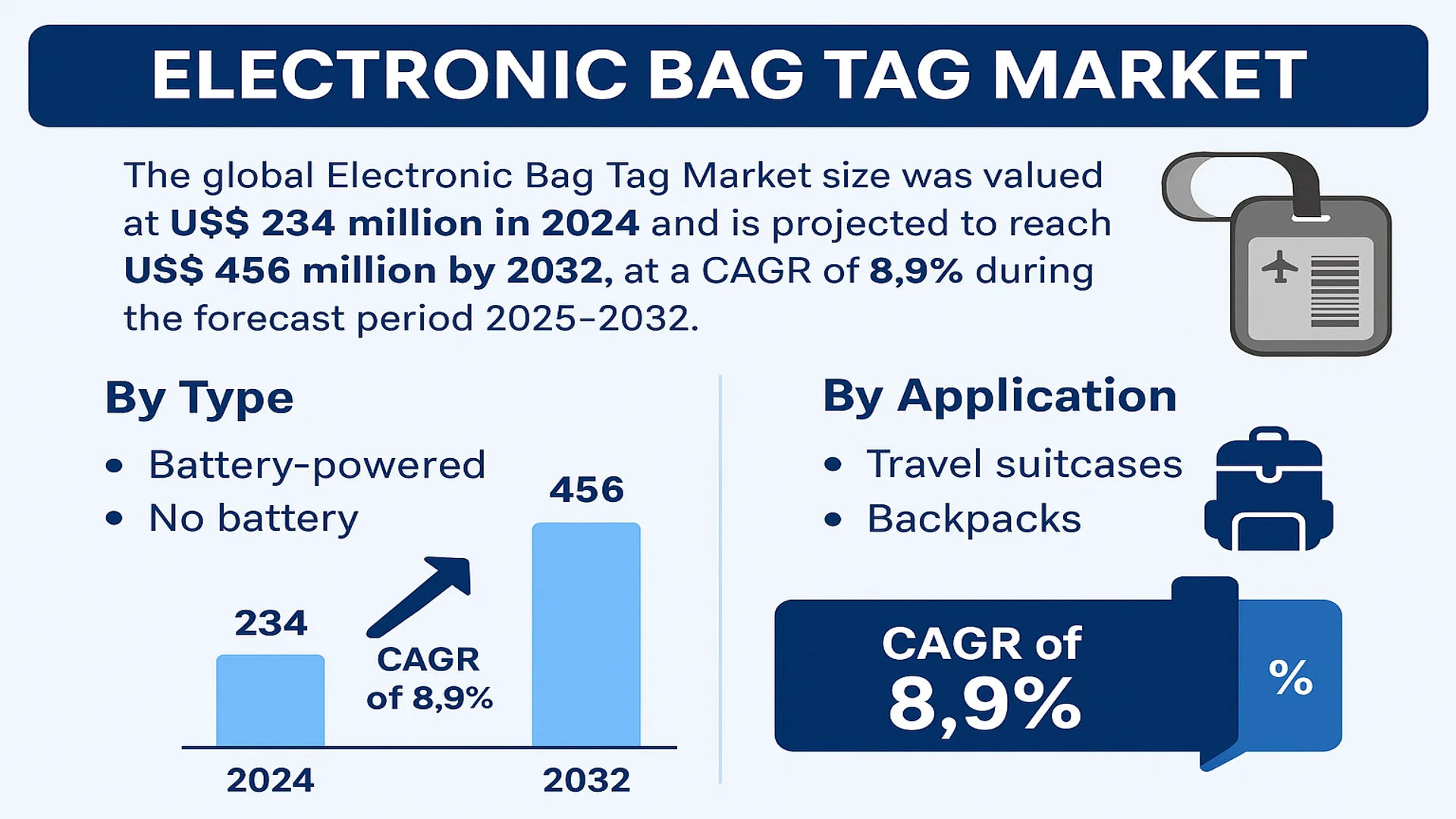
Electronic Bag Tags are smart luggage tracking devices that digitize traditional paper baggage tags. These battery-powered or passive devices use electronic ink displays to show flight information transmitted via Bluetooth from airline apps. Key functionalities include real-time baggage tracking, automated check-in processes, and reduced airport congestion. Major variants include battery-operated active tags and passive NFC-enabled versions.
The market growth is primarily driven by increasing air passenger traffic, which reached 4.7 billion globally in 2023, and airlines’ focus on digital transformation initiatives. While North America currently dominates with 38% market share, Asia-Pacific is emerging as the fastest-growing region due to expanding middle-class air travel. Key challenges include higher costs compared to traditional tags and limited compatibility across airline systems. Major players like BAGTAG and SITA are investing in interoperable solutions to address this fragmentation.
MARKET DRIVERS
Rising Air Passenger Traffic to Accelerate Electronic Bag Tag Adoption
The global air transport industry is witnessing robust recovery post-pandemic, with passenger volumes expected to exceed 4.35 billion in 2024 – surpassing pre-pandemic levels. This surge in air travel creates substantial demand for streamlined baggage handling solutions. Electronic bag tags enable passengers to check luggage in seconds via smartphone integration, reducing airport congestion and improving operational efficiency. Airlines are increasingly adopting this technology as they handle larger passenger volumes with constrained infrastructure.
Growing Focus on Digital Transformation in Aviation Spurs Innovation
Major airlines worldwide are investing heavily in digital transformation, with baggage handling representing a key focus area. The aviation industry’s transition towards smart airports and seamless travel experiences is driving adoption of electronic bag tags. Major carriers have begun large-scale deployments, recognizing the technology’s ability to reduce costs – electronic tags can decrease baggage handling expenses by up to 30% compared to traditional paper tags. These efficiency gains, coupled with enhanced passenger experience benefits, are accelerating market penetration.
Furthermore, regulatory support for digital baggage solutions is emerging as a significant growth catalyst. Aviation authorities in several regions are establishing frameworks to standardize electronic tag implementations, creating favorable conditions for market expansion.
MARKET RESTRAINTS
High Initial Implementation Costs Limit Widespread Adoption
While electronic bag tags offer long-term operational savings, their upfront costs present a significant barrier to widespread implementation. A single electronic tag unit can cost between $40-$100, making large-scale fleet deployments cost-prohibitive for many airlines. Infrastructure upgrades at airports to support electronic tag scanning require additional capital investments. These financial challenges are particularly acute for budget carriers and regional airlines operating with thin profit margins.
Technology Standardization Challenges Hinder Ecosystem Development
The lack of universal technical standards for electronic bag tags creates interoperability issues across different airline systems and airports. Currently, most solutions operate on proprietary platforms, limiting their usefulness for passengers traveling with multiple carriers. This fragmentation slows down industry-wide adoption and creates integration challenges for airports handling baggage from various airlines. Standardization efforts are underway, but achieving global consensus remains an ongoing challenge that temporarily constrains market growth.
MARKET OPPORTUNITIES
Integration with Emerging Technologies Creates New Use Cases
The convergence of electronic bag tags with advanced technologies like IoT and blockchain presents significant growth opportunities. Smart tags equipped with real-time tracking sensors can provide continuous baggage location updates, addressing a major pain point for travelers. When combined with blockchain-based baggage reconciliation systems, these solutions could virtually eliminate lost luggage incidents – a problem that currently costs the aviation industry approximately $2 billion annually.
Expansion of Loyalty Programs and Ancillary Services
Electronic bag tags offer airlines new avenues for customer engagement and revenue generation. The technology enables personalized baggage handling services tied to frequent flyer status, creating opportunities for premium service differentiation. Airlines can leverage tagged baggage data to offer targeted ancillary services, from expedited handling to insurance products. This capability becomes increasingly valuable as carriers seek to diversify revenue streams beyond ticket sales in the post-pandemic landscape.
MARKET CHALLENGES
Battery Life and Durability Concerns Impact Consumer Acceptance
While electronic bag tags offer clear advantages, technical limitations around battery performance and physical durability may slow consumer adoption. Current battery-powered models typically require replacement every 2-3 years, creating ongoing maintenance requirements. Durability in harsh baggage handling environments remains problematic, with some early-generation tags proving susceptible to damage from impacts and extreme temperatures. These limitations require continued R&D investment to overcome before mass consumer adoption becomes viable.
Data Privacy and Security Considerations Require Attention
As electronic bag tags collect and transmit passenger data, they introduce new cybersecurity vulnerabilities that must be addressed. Concerns about tracking traveler movements and potential data breaches could create hesitation among privacy-conscious consumers. The industry must establish robust data protection frameworks and clearly communicate security measures to build trust in these connected baggage solutions.
ELECTRONIC BAG TAG MARKET TRENDS
Rising Adoption of Smart Luggage Solutions to Drive Market Growth
The global electronic bag tag market is witnessing significant growth due to increasing passenger traffic and the demand for contactless travel solutions. With air travel rebounding post-pandemic, the need for efficient baggage handling systems has intensified. Electronic bag tags (EBTs) eliminate the need for traditional paper tags by digitally displaying flight and baggage information. Airlines worldwide are increasingly adopting this technology to enhance operational efficiency—cutting check-in times by up to 40% compared to conventional systems. Major airports across North America and Europe now offer EBT-enabled self-service kiosks, accelerating mainstream adoption.
Other Trends
Sustainability and Paperless Travel Initiatives
Environmental concerns are propelling the shift toward paperless baggage handling, with EBTs reducing waste from an estimated 50 million printed tags annually in the aviation sector alone. Policies like the IATA’s Resolution 753, which mandates airlines to track baggage throughout the journey, have further boosted the demand for RFID-enabled reusable tags. Innovations in e-ink display technology have extended battery life to 2+ years, making EBTs economically viable for frequent travelers while aligning with global carbon-neutral initiatives.
Integration with IoT and Mobile Ecosystems
The convergence of EBTs with Internet of Things (IoT) platforms is revolutionizing luggage tracking capabilities. Real-time synchronization with airline apps via Bluetooth Low Energy (BLE) allows passengers to receive push notifications if baggage is mishandled—addressing a pain point that affects 20% of travelers annually. Manufacturers are now embedding GPS in premium tags, enabling passive tracking even outside airport premises. Partnerships between tech firms like Samsung SmartThings and luggage brands highlight the growing emphasis on interconnected smart travel ecosystems, expected to expand the EBT market beyond aviation into rail and cruise sectors.
COMPETITIVE LANDSCAPE
Key Industry Players
Innovation and Strategic Partnerships Drive Market Competition
The global Electronic Bag Tag market exhibits a dynamic competitive landscape, characterized by a mix of established brands and emerging innovators. BAGTAG holds a dominant position in 2024, controlling approximately 22% of the market share, thanks to its early entry into the space and patented e-ink display technology. Their collaboration with major airlines like Lufthansa and Delta has significantly expanded their installed base globally.
Meanwhile, RIMOWA and ViewTa have gained traction through premium product positioning and integration with luxury luggage lines. RIMOWA’s partnership with Lufthansa for their Electronic Tag program has been particularly successful, with over 500,000 units deployed since 2021. ViewTa differentiates through its proprietary energy harvesting technology that eliminates battery replacement.
The market has seen increasing competition from agile startups as well. TeamUC and Bagtap have captured niche segments with ultra-thin form factors targeting business travelers, while OneBagTag has focused on affordability – its sub-$50 price point making it popular in Asian markets. However, durability concerns with budget options present an ongoing challenge for widespread adoption.
Recent months have seen notable strategic moves. In Q2 2024, BAGTAG acquired Groen&Boothman to enhance its European distribution network, while OneBagTag secured $18 million in Series B funding to expand production capacity. Such developments indicate intensifying competition as companies prepare for projected market expansion.
List of Key Electronic Bag Tag Companies Profiled
- BAGTAG (Netherlands)
- OneBagTag (Singapore)
- ViewTa (U.S.)
- TeamUC (Germany)
- Bagtap (South Korea)
- Groen&Boothman (Netherlands)
- RIMOWA (Germany)
Segment Analysis:
By Type
Battery-Powered Electronic Bag Tags Dominate the Market Due to Wireless Functionality
The market is segmented based on type into:
- Battery-powered
- Subtypes: Rechargeable and non-rechargeable batteries
- No battery (passive)
By Application
Travel Suitcases Lead the Market Due to High Adoption by Frequent Flyers
The market is segmented based on application into:
- Travel suitcases
- Backpacks
- Business luggage
- Specialty bags (sports equipment, musical instruments)
By Technology
Bluetooth-Enabled Tags Hold Major Share for Seamless Smartphone Connectivity
The market is segmented based on technology into:
- Bluetooth-enabled
- NFC-enabled
- RFID-enabled
By Distribution Channel
Online Sales Channels Growing Rapidly Due to E-Commerce Expansion
The market is segmented based on distribution channel into:
- Online retail
- Offline retail
- Airlines/direct partnerships
Regional Analysis: Electronic Bag Tag Market
North America
The North American Electronic Bag Tag market is currently dominated by the United States, where major airlines like Delta and American Airlines have begun large-scale adoption of this technology. The region benefits from high passenger traffic, with U.S. airports handling over 800 million travelers annually, creating substantial demand for efficient baggage tracking solutions. Strict TSA regulations mandating improved luggage traceability are accelerating adoption, while technological partnerships between airlines and tech firms (e.g., Delta-BAGTAG collaboration since 2016) create market stability. However, consumer reluctance to replace traditional luggage tags and higher product costs ($25-$50 per unit) currently limit penetration to <20% of frequent travelers.
Europe
Europe represents the most mature market for Electronic Bag Tags due to early adoption by IATA member airlines and EU-driven standardization efforts. The region’s leadership stems from Amsterdam’s Schiphol Airport pioneering permanent E-ink bag tags in 2014. Lufthansa, Air France-KLM, and British Airways now offer reusable e-tags across hubs like Frankfurt, Paris CDG, and Heathrow. Key growth drivers include EU Regulation 2018/494 requiring improved baggage tracking by 2025 and environmental sustainability benefits (reducing 35 million paper tags annually). Challenges include Brexit-related regulatory divergence and NFC technology incompatibility between some national carriers.
Asia-Pacific
China, Japan, and Singapore are spearheading Asia’s explosive Electronic Bag Tag market growth, projected to exceed 35% CAGR through 2030. This reflects massive airport expansions (Beijing Daxing, Changi Terminal 5) serving over 3.5 billion regional passengers annually. China’s “Smart Aviation” initiative has driven adoption by China Eastern and Hainan Airlines, while Japanese developers lead in battery-free RFID tag innovation. However, the market faces unique challenges including price sensitivity (only 8% penetration among budget carriers) and infrastructure limitations at secondary airports across India and Southeast Asia.
South America
Electronic Bag Tag adoption in Brazil and Chile shows promising growth (12% CAGR) driven by LATAM Airlines’ modernization programs and Copa Airlines’ regional hub strategy. São Paulo-Guarulhos and Bogotá airports now process 15% of baggage via e-tags, with emphasis on loss prevention in a region where mishandled luggage rates exceed global averages. Market constraints include economic instability impacting airline CAPEX and lower smartphone penetration (68% vs 85% global average) limiting Bluetooth/NFC functionality. Recent Avianca bankruptcy restructuring has temporarily slowed Colombia’s market development.
Middle East & Africa
The region presents a bifurcated market, with Gulf carriers like Emirates and Qatar Airways achieving 40% e-tag penetration at Dubai and Doha hubs through premium passenger offerings. Contrastingly, African adoption remains below 5% outside South Africa due to infrastructure gaps, though Kenya Airways’ recent SkyTeam partnership signals potential growth. The 2023 IATA Global Hub certification of Addis Ababa Airport may drive Ethiopian adoption, while Saudi Arabia’s Vision 2030 includes major baggage system upgrades at Jeddah and Riyadh. Political volatility and lower replacement demand (average luggage replacement cycles are 2x longer than global norms) remain persistent challenges.
Report Scope
This market research report provides a comprehensive analysis of the global and regional Electronic Bag Tag markets, covering the forecast period 2024–2032. It offers detailed insights into market dynamics, technological advancements, competitive landscape, and key trends shaping the industry.
Key focus areas of the report include:
- Market Size & Forecast: Historical data and future projections for revenue, unit shipments, and market value across major regions and segments. The Global Electronic Bag Tag market was valued at US$ 234 million in 2024 and is projected to reach US$ 456 million by 2032.
- Segmentation Analysis: Detailed breakdown by product type (battery-powered vs. battery-free), application (travel suitcases, backpacks), and end-user sectors to identify high-growth opportunities.
- Regional Outlook: Insights into market performance across North America (U.S. market size estimated at USD 42.3 million in 2024), Europe, Asia-Pacific (China projected to reach USD 67.5 million), Latin America, and Middle East & Africa.
- Competitive Landscape: Profiles of leading market participants including BAGTAG, OneBagTag, ViewTa, TeamUC, and RIMOWA, covering their market share (top five players held approximately 58% revenue share in 2024), product innovations, and strategic initiatives.
- Technology Trends & Innovation: Assessment of Bluetooth connectivity advancements, e-ink display technologies, and integration with airline baggage handling systems.
- Market Drivers & Restraints: Evaluation of factors such as rising air passenger traffic, digital transformation in aviation, alongside challenges like high product costs and limited airline adoption.
- Stakeholder Analysis: Strategic insights for luggage manufacturers, airline operators, technology providers, and investors regarding market entry strategies and partnership opportunities.
The research methodology combines primary interviews with industry experts and analysis of verified market data from airports, airlines, and technology providers to ensure accuracy and reliability.
FREQUENTLY ASKED QUESTIONS:
What is the current market size of Global Electronic Bag Tag Market?
-> Electronic Bag Tag Market size was valued at US$ 234 million in 2024 and is projected to reach US$ 456 million by 2032, at a CAGR of 8.9% during the forecast period 2025–2032.
Which key companies operate in Global Electronic Bag Tag Market?
-> Key players include BAGTAG, OneBagTag, ViewTa, TeamUC, Bagtap, Groen&Boothman, and RIMOWA, with the top five companies holding approximately 58% market share.
What are the key growth drivers?
-> Key growth drivers include rising air travel demand, digital transformation in aviation, and increasing adoption of smart luggage solutions.
Which region dominates the market?
-> North America currently leads the market (USD 42.3 million in 2024), while Asia-Pacific is the fastest-growing region.
What are the emerging trends?
-> Emerging trends include integration with airline mobile apps, sustainable battery solutions, and RFID-enabled tracking capabilities.

Get Sample Report PDF for Exclusive Insights
Report Sample Includes
- Table of Contents
- List of Tables & Figures
- Charts, Research Methodology, and more...
 Download Sample Report PDF