Electrochemical Phosphine Sensor Market Insights
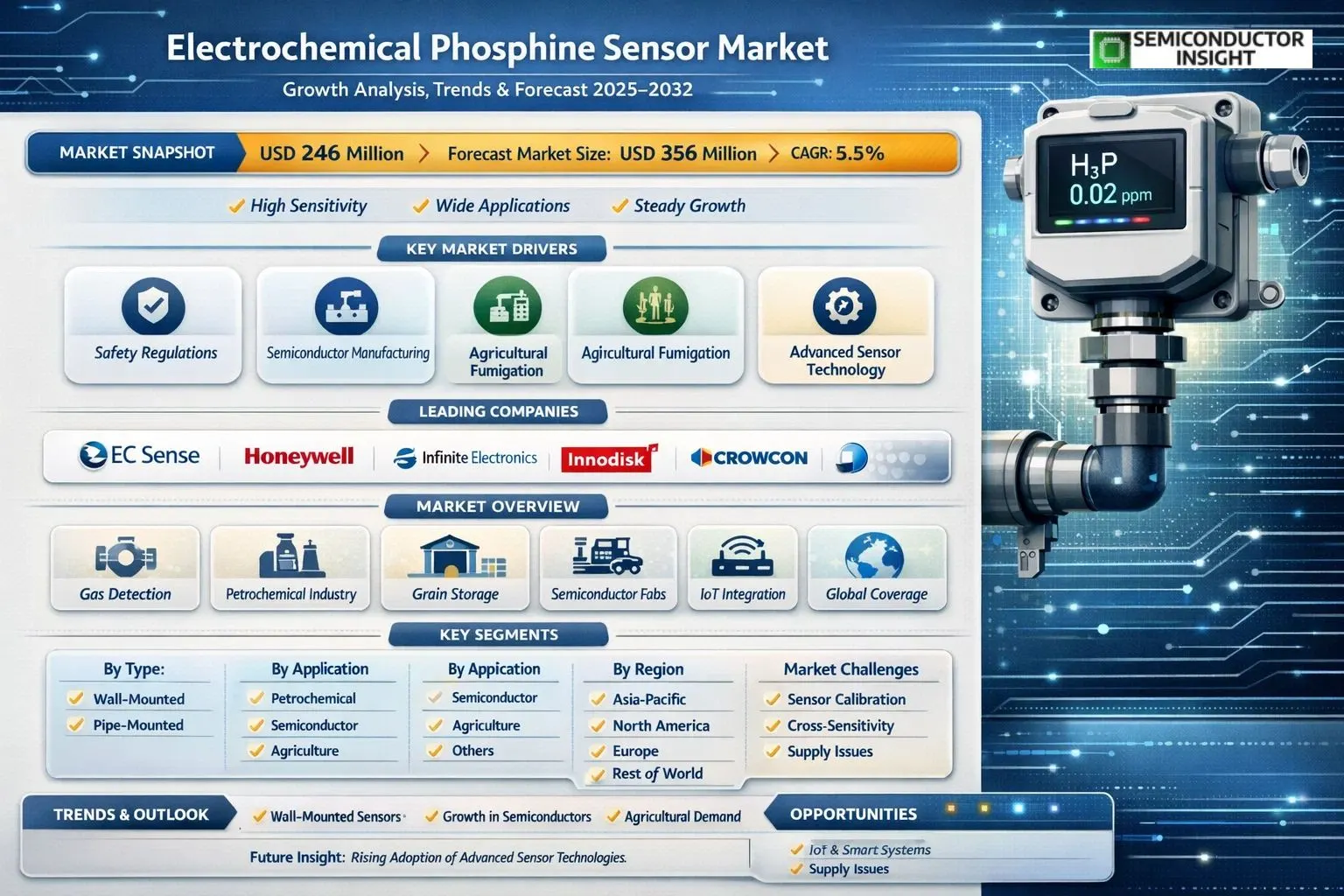
Global Electrochemical Phosphine Sensor market size was valued at USD 246 million in 2025. The market is projected to reach USD 356 million by 2032, exhibiting a CAGR of 5.5% during the forecast period.
Electrochemical Phosphine Sensor is an electronic device used to detect the concentration of phosphine gas. It is based on electrochemical principles and contains three electrodes. It generates a current signal proportional to the concentration of phosphine through redox reactions. It has the characteristics of high sensitivity, high selectivity, good stability, strong anti-interference ability, and long service life. It is widely used in petrochemical, semiconductor manufacturing, agricultural production, and other fields.
The market is experiencing steady growth due to several factors, including stringent safety regulations for toxic gas monitoring, expansion in semiconductor manufacturing, and rising demand for fumigation in agriculture. Furthermore, advancements in sensor technology improve reliability and response times, supporting broader industrial adoption. Key players such as Honeywell, Crowcon, RC Systems, Zhengzhou Winsen Electronics Technology, and Guangzhou Luftmy Intelligent Technology operate in the market with diverse portfolios focused on gas detection solutions.
MARKET DRIVERS
Regulatory Mandates for Phosphine Detection
Electrochemical Phosphine Sensor Market is propelled by stringent occupational health and safety regulations across agriculture and industrial sectors. Agencies like OSHA and EU REACH enforce limits on phosphine exposure below 0.3 ppm, necessitating reliable real-time monitoring solutions. Electrochemical sensors, prized for their high selectivity and sensitivity, enable compliance in fumigation processes where phosphine gas is widely used for pest control in stored grains.
Growth in Global Food Supply Chains
Rising demand for food security drives phosphine fumigation volumes, with global grain storage exceeding 2.5 billion tons annually. This amplifies the need for durable electrochemical phosphine sensors in silos and shipping containers. Advancements in sensor miniaturization support portable devices, enhancing worker safety in export hubs like North America and Asia-Pacific.
➤ The market witnesses a CAGR of approximately 6.2% from 2023-2030, fueled by a 15% rise in fumigation applications.
Integration with IoT platforms further accelerates adoption, allowing remote phosphine monitoring and predictive maintenance in Electrochemical Phosphine Sensor Market.
MARKET CHALLENGES
Sensor Drift and Cross-Sensitivity Issues
Electrochemical phosphine sensors face challenges from environmental interferences like humidity and temperature fluctuations, leading to signal drift over time. In humid fumigation environments, cross-sensitivity to gases such as hydrogen sulfide can compromise accuracy, requiring frequent recalibration and increasing operational downtime in Electrochemical Phosphine Sensor Market.
Other Challenges
Calibration and Maintenance Demands
Routine calibration protocols strain resources for end-users in agriculture, where sensors must maintain precision below 0.1 ppm. Limited sensor lifespan, typically 2-3 years, elevates replacement costs amid varying phosphine concentrations.
Supply chain disruptions for platinum-based electrodes add to pricing volatility, hindering scalability in emerging markets.
MARKET RESTRAINTS
High Manufacturing Costs and Material Dependencies
Production of electrochemical phosphine sensors relies on rare noble metals like gold and platinum for electrodes, contributing to costs 20-30% higher than competing technologies. Volatility in raw material prices restrains market expansion, particularly for small-scale fumigators in Electrochemical Phosphine Sensor Market.
Regulatory approval processes for sensor variants delay new product launches by 12-18 months, limiting innovation pace. Additionally, low awareness in developing regions caps penetration despite growing phosphine usage.
Competition from optical sensors, which offer longer lifespans, poses a restraint, capturing 25% of the gas detection segment.
MARKET OPPORTUNITIES
Integration with Wireless Monitoring Systems
Electrochemical Phosphine Sensor Market holds potential in IoT-enabled networks for continuous phosphine tracking in smart warehouses, projected to grow 25% by 2028. Wireless connectivity enhances data analytics, reducing false alarms and optimizing fumigation cycles.
Expansion into semiconductor fabrication, where phosphine dopes silicon wafers, opens avenues as production capacity rises 8% yearly in Asia. Portable, multi-gas electrochemical sensors combining phosphine detection with others like arsine will capture niche demands.
Emerging markets in Africa and South America, with surging grain exports, offer untapped growth, supported by government subsidies for safety equipment.
Electrochemical Phosphine Sensor Market Trends
Dominance of Wall-Mounted Sensors in Key Applications
Electrochemical Phosphine Sensor Market is experiencing notable growth driven by the widespread adoption of wall-mounted sensors, which offer high sensitivity, selectivity, stability, and anti-interference capabilities essential for precise phosphine detection. These sensors, utilizing three-electrode systems for redox reactions generating current signals proportional to gas concentrations, are increasingly integrated in environments requiring continuous monitoring. In sectors like petrochemical and semiconductor manufacturing, wall-mounted configurations provide reliable performance, supporting safety protocols where phosphine exposure poses risks.
Other Trends
Expansion in Semiconductor Manufacturing
Semiconductor manufacturing represents a critical application area for electrochemical phosphine sensors, fueled by the need for stringent gas detection in cleanroom settings. The market sees heightened demand as production scales up globally, particularly in Asia, with sensors ensuring worker safety and process integrity through their long service life and robust design.
Growth in Agricultural Production
Agricultural production, especially fumigation processes, drives another key trend in Electrochemical Phosphine Sensor Market. Sensors enable accurate monitoring of phosphine levels during grain storage and pest control, reducing health hazards and enhancing efficiency. This segment benefits from the devices’ strong anti-interference ability, vital in variable field conditions.
Regional Shifts and Competitive Dynamics
Regionally, Electrochemical Phosphine Sensor Market shows strong momentum in North America and Asia, with key countries like the US and China leading deployment. Manufacturers such as EC Sense, Honeywell, and Crowcon are intensifying efforts through product innovations and strategic expansions, consolidating market positions. Pipe-mounted sensors complement wall-mounted ones in petrochemical pipelines, while overall industry surveys highlight drivers like regulatory compliance and technological reliability shaping future trajectories. Challenges including supply chain dependencies are met with supplier diversification, fostering sustained market evolution.
COMPETITIVE LANDSCAPE
Key Industry Players
Dominating Electrochemical Phosphine Sensor Market Dynamics
Electrochemical Phosphine Sensor Market is characterized by a moderately concentrated structure, with the global top five players collectively holding a significant revenue share in 2025. Leading manufacturers such as Honeywell and EC Sense dominate due to their advanced electrochemical sensor technologies, offering high sensitivity and selectivity for phosphine detection in critical applications like petrochemical and semiconductor industries. Honeywell leverages its extensive portfolio in industrial safety solutions, while EC Sense specializes in compact, reliable gas sensors. This leadership stems from robust R&D investments and established distribution networks, enabling them to capture substantial market segments amid a projected growth from US$246 million in 2025 to US$356 million by 2032 at a 5.5% CAGR.
Beyond the top tier, niche players contribute through specialized innovations and regional strengths, particularly in Asia. Companies like Crowcon, RC Systems, and Chinese firms such as Zhengzhou Winsen Electronics Technology and Guangzhou Luftmy Intelligent Technology focus on cost-effective, wall-mounted and pipe-mounted sensors for agricultural and manufacturing uses. Emerging entities including Shenzhen Singoan Electronic Technology, Skesen, Prsens, Advanced Sensors Application, and Sangbay enhance competition by addressing anti-interference and longevity needs. Infinite Electronics, Interlink Electronics, and Innodisk Corporation add value in integrated electronics, fostering a dynamic landscape where mergers, acquisitions, and product developments drive market evolution and blue ocean opportunities in underserved regions.
List of Key Electrochemical Phosphine Sensor Companies Profiled
- EC Sense
- Honeywell
- Infinite Electronics
- Interlink Electronics
- Innodisk Corporation
- Crowcon
- RC Systems
- Zhengzhou Winsen Electronics Technology
- Guangzhou Luftmy Intelligent Technology
- Shenzhen Singoan Electronic Technology
- Sksen
- Prsens
- Advanced Sensors Application
- Sangbay
Segment Analysis:
| Segment Category | Sub-Segments | Key Insights |
| By Type |
|
Wall-Mounted
|
| By Application |
|
Petrochemical Industry
|
| By End User |
|
Industrial Facilities
|
| By Deployment |
|
Fixed Deployment
|
| By Connectivity |
|
Wired
|
Regional Analysis: Electrochemical Phosphine Sensor Market
Asia-Pacific
Stringent safety norms in agriculture and manufacturing propel Electrochemical Phosphine Sensor adoption. Fumigation protocols mandate precise phosphine detection to prevent exposure hazards. Local standards align with international benchmarks, encouraging sensor upgrades for better sensitivity in tropical climates.
Dense semiconductor clusters demand robust sensors for phosphine precursors in wafer doping. Cost-competitive production scales up sensor deployment in electronics hubs, fostering innovations like wireless integration for fumigation monitoring.
Massive grain exports require reliable phosphine sensors in storage silos. Post-harvest treatments emphasize leak detection to ensure food safety, with rural electrification enabling smart sensor networks across vast farmlands.
R&D collaborations yield durable sensors resistant to local contaminants. Integration with fumigation systems optimizes dosage control, minimizing environmental release while enhancing operational efficiency in agro-industries.
North America
North America exhibits strong growth in Electrochemical Phosphine Sensor Market, propelled by advanced agricultural practices and rigorous OSHA regulations. Large-scale grain elevators and food processing plants prioritize sensor technology for phosphine fumigation safety. The region’s focus on precision farming integrates sensors with automated systems, enabling proactive gas leak detection. Innovations from leading tech firms emphasize portability and data analytics for compliance reporting. Chemical and pest control industries adopt these sensors to mitigate risks in enclosed spaces. Environmental concerns drive demand for low-maintenance, long-life units suitable for North America’s diverse climates. Collaborative efforts between regulators and industry stakeholders foster market expansion, positioning the region as a key adopter of next-generation monitoring solutions.
Europe
Europe’s Electrochemical Phosphine Sensor Market thrives amid strict EU REACH directives and food safety mandates. Agricultural cooperatives utilize sensors in warehouse fumigation to safeguard stored commodities. The push for sustainable pest management integrates electrochemical detection with eco-friendly fumigants. Pharmaceutical and specialty chemical sectors require high-accuracy sensors for trace phosphine monitoring. Regional manufacturers excel in developing explosion-proof models for industrial applications. Cross-border harmonization of standards accelerates technology deployment, while R&D investments target multi-gas capabilities. Consumer awareness of occupational health further boosts market penetration across Eastern and Western Europe.
South America
South America’s Electrochemical Phosphine Sensor Market gains traction with expanding soybean and grain exports. Fumigation in port silos demands reliable sensors to meet international phytosanitary requirements. Tropical conditions challenge sensor durability, spurring local adaptations for humidity resistance. Agribusiness giants invest in training for sensor-based protocols, enhancing worker protection. Growing biofuel production heightens need for phosphine detection in processing facilities. Partnerships with global suppliers introduce affordable, scalable solutions, supporting regional infrastructure development. Market evolution reflects a shift toward integrated safety systems in agriculture-dominated economies.
Middle East & Africa
The Middle East & Africa region sees rising interest in Electrochemical Phosphine Sensor Market, linked to food import dependencies and petrochemical activities. Phosphine fumigation in date and grain storage necessitates sensors for arid environments. Oil and gas sectors employ them for impurity detection in phosphine-related processes. Capacity-building programs address skill gaps, promoting adoption in emerging markets. Harsh climates drive demand for rugged, battery-efficient designs. Strategic investments in logistics hubs integrate sensors into supply chains, aligning with global safety trends. The market’s potential lies in infrastructure modernization and regulatory alignment.
Report Scope
This market research report provides a comprehensive analysis of Electrochemical Phosphine Sensor Market, covering the forecast period 2025–2032. It offers detailed insights into market dynamics, technological advancements, competitive landscape, and key trends shaping the industry.
Key focus areas of the report include:
- Market Overview: The report begins with an overview outlining its current market scenario, key growth indicators, and industry transformation drivers. It discusses macroeconomic factors, demand–supply balance, regulatory landscape, and the strategic role of electrochemical phosphine sensors in detecting phosphine gas across industries such as petrochemical, semiconductor manufacturing, agricultural production, and others.
- Market Size & Forecast: Historical data and future projections for revenue, unit shipments, and market value across major regions and segments.
- Segmentation Analysis: Detailed breakdown by product type, technology, application, and end-user industry to identify high-growth segments and investment opportunities.
- Regional Insights: Insights into market performance across North America, Europe, Asia-Pacific, Latin America, and the Middle East & Africa, including country-level analysis where relevant.
- Competitive Landscape: Profiles of leading market participants, including their product offerings, R&D focus, manufacturing capacity, pricing strategies, and recent developments such as mergers, acquisitions, and partnerships.
- Technology Trends & Innovation: Assessment of emerging technologies, integration of AI/IoT, semiconductor design trends, fabrication techniques, and evolving industry standards.
- Market Drivers & Restraints: Evaluation of factors driving market growth along with challenges, supply chain constraints, regulatory issues, and market-entry barriers.
- Stakeholder Insights: Insights for component suppliers, OEMs, system integrators, investors, and policymakers regarding the evolving ecosystem and strategic opportunities.
Primary and secondary research methods are employed, including interviews with industry experts, data from verified sources, and real-time market intelligence to ensure the accuracy and reliability of the insights presented.
FREQUENTLY ASKED QUESTIONS:
What is the current market size of Electrochemical Phosphine Sensor Market?
-> Electrochemical Phosphine Sensor Market was valued at USD 246 million in 2025 and is expected to reach USD 356 million by 2032, at a CAGR of 5.5% during the forecast period.
Which key companies operate in Electrochemical Phosphine Sensor Market?
-> Key players include EC Sense, Honeywell, Infinite Electronics, Interlink Electronics, Innodisk Corporation, Crowcon, RC Systems, Zhengzhou Winsen Electronics Technology, Guangzhou Luftmy Intelligent Technology, Shenzhen Singoan Electronic Technology, among others.
What are the key growth drivers?
-> Key growth drivers include demand in petrochemical industry, semiconductor manufacturing, agricultural production, high sensitivity and selectivity requirements, and stringent safety regulations.
Which region dominates the market?
-> Asia is the fastest-growing region, while North America remains a dominant market.
What are the emerging trends?
-> Emerging trends include advancements in electrochemical sensor technology, improved anti-interference ability, longer service life, and portable gas detection solutions.

Get Sample Report PDF for Exclusive Insights
Report Sample Includes
- Table of Contents
- List of Tables & Figures
- Charts, Research Methodology, and more...
 Download Sample Report PDF