MARKET INSIGHTS
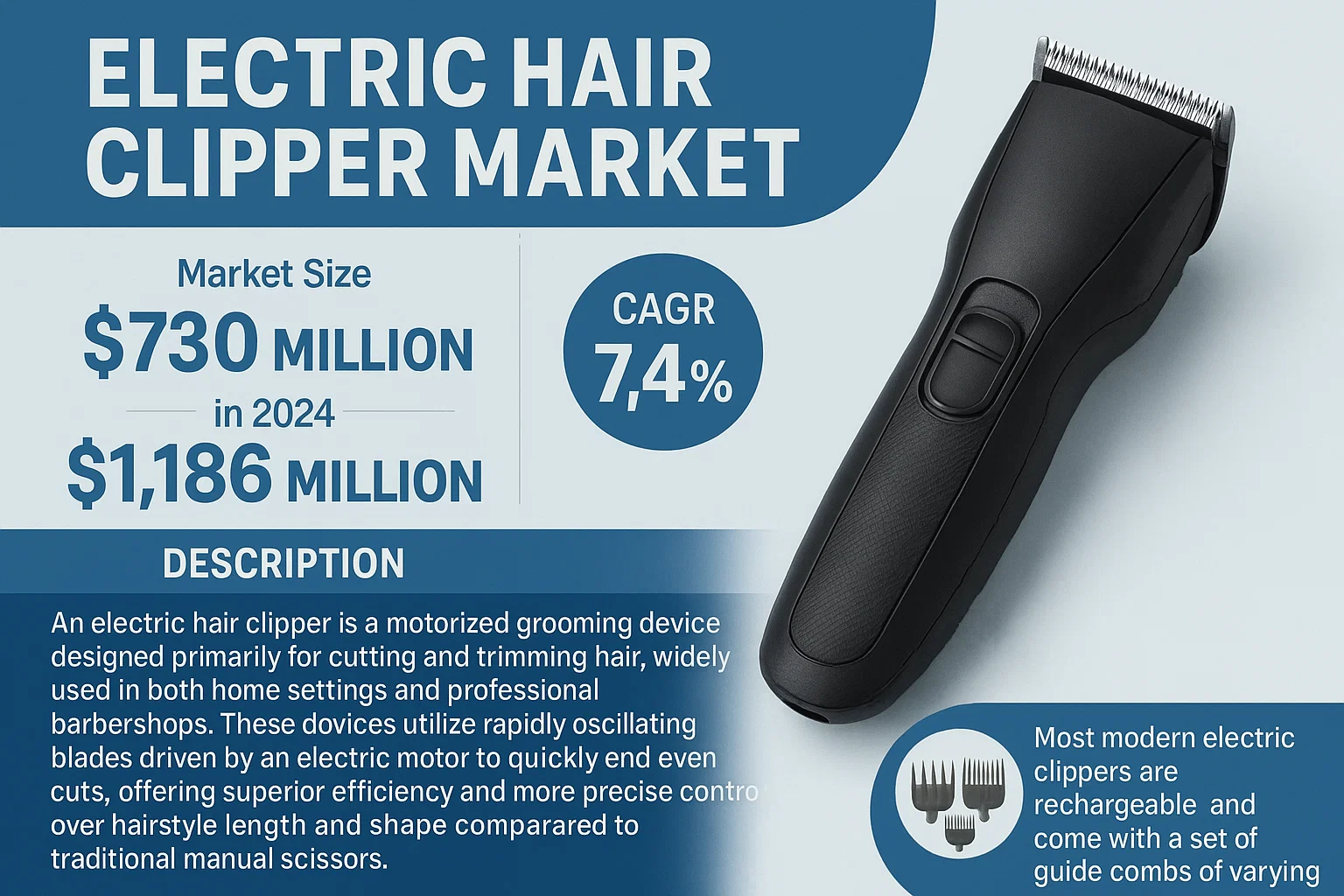
Global Electric Hair Clipper Market size was valued at USD 730 million in 2024 to USD 1,186 million by 2032, exhibiting a CAGR of 7.4% during the forecast period.
An electric hair clipper is a motorized grooming device designed primarily for cutting and trimming hair, widely used in both home settings and professional barbershops. These devices utilize rapidly oscillating blades driven by an electric motor to cut hair quickly and evenly, offering superior efficiency and more precise control over hairstyle length and shape compared to traditional manual scissors. Most modern electric clippers are rechargeable and come with a set of guide combs of varying lengths, enabling users to achieve styles ranging from short buzz cuts to longer trims.
The market is experiencing steady growth, largely driven by an increased consumer preference for at-home grooming solutions. This trend was significantly accelerated during the COVID-19 pandemic, as lockdowns and social distancing measures made home haircuts a regular activity. Key market drivers include consumer demand for convenience, time-saving, and cost-efficiency, as individuals seek to avoid frequent salon visits. Furthermore, the market is evolving with products incorporating advanced features such as adjustable speeds, smart battery management, and multifunctionality for beard trimming and other personal care tasks, broadening their appeal. Leading players such as Wahl, Philips, and Panasonic continue to innovate, focusing on durability, performance, and eco-friendly designs to capture a larger market share.
MARKET DYNAMICS
MARKET DRIVERS
Rising Consumer Preference for At-Home Grooming to Propel Market Expansion
The electric hair clipper market is experiencing robust growth driven by a pronounced shift toward at-home grooming solutions. This trend gained substantial momentum during the global health crisis, when lockdowns and social distancing measures necessitated alternatives to professional salon services. Recent consumer behavior analyses indicate that over 60% of individuals who began cutting their hair at home during this period have continued the practice, citing convenience and cost savings as primary motivators. The market has responded with innovative product offerings featuring enhanced battery life, quieter motors, and improved ergonomics, making home grooming more accessible and effective than ever before. This sustained behavioral shift represents a fundamental driver for market expansion, as manufacturers continue to develop clippers tailored to the nuanced needs of home users.
Technological Advancements and Multi-functionality to Accelerate Adoption
Technological innovation represents another significant market driver, with manufacturers increasingly integrating smart features and multi-functional capabilities into electric hair clippers. Modern devices now commonly include precision digital motors, lithium-ion batteries providing up to 120 minutes of cordless operation, and advanced blade systems that maintain optimal temperature during extended use. The incorporation of smart connectivity allows users to customize cutting patterns through mobile applications, while multi-attachment systems enable a single device to handle hair cutting, beard trimming, and body grooming. This convergence of functionality addresses the growing consumer demand for versatile, space-efficient grooming solutions, particularly in urban environments where living spaces are often limited. The ability to replace multiple specialized tools with one high-performance device has become a compelling value proposition driving both consumer adoption and premium pricing strategies.
Growing Male Grooming Consciousness and Professionalization to Fuel Demand
The market is further propelled by increasing male grooming consciousness and the professionalization of home grooming practices. Male consumers are demonstrating greater willingness to invest in premium grooming tools, with expenditure on personal care products growing at approximately double the rate of overall consumer goods spending. This trend is particularly evident in the 18-35 age demographic, where well-groomed appearance is increasingly associated with professional success and social confidence. The professional barbering industry’s influence has also migrated to the consumer market, with many home clippers now incorporating features previously exclusive to professional equipment, such as magnetic motor systems, ceramic blades, and adjustable taper levers. This blurring of boundaries between professional and consumer-grade equipment has elevated performance expectations and driven replacement cycles, as consumers seek to replicate salon-quality results in their homes.
MARKET RESTRAINTS
Market Saturation and Intense Price Competition to Constrain Growth
The electric hair clipper market faces significant constraints from market saturation and intensifying price competition, particularly in mature economies. With household penetration rates exceeding 70% in many developed markets, replacement purchases rather than first-time acquisitions increasingly drive sales. This saturation creates a highly competitive environment where manufacturers must compete on both innovation and price, compressing profit margins across the value chain. The entry of numerous budget-oriented manufacturers, particularly from Asian markets, has further intensified price pressures, with some basic models now retailing at price points that challenge sustainable manufacturing practices. This environment makes it difficult for companies to justify substantial research and development investments, potentially slowing the pace of genuine innovation in favor of cosmetic feature additions.
Technical Limitations and Performance Consistency Issues to Hinder Adoption
Technical limitations and performance consistency issues present another significant restraint to market growth. Despite advancements, many consumer-grade clippers still struggle with common technical challenges including motor overheating during extended use, blade dulling over time, and inconsistent cutting performance across different hair types and densities. These limitations become particularly apparent when consumers attempt to achieve complex hairstyles or work with thick, coarse, or curly hair textures. The performance gap between professional and consumer equipment remains substantial, with professional clippers typically featuring more powerful motors, superior heat dissipation, and higher-grade blade materials. This performance differential often leads to consumer dissatisfaction and hesitancy among those with specific grooming needs, limiting market expansion among demographic segments requiring specialized performance characteristics.
Economic Sensitivity and Discretionary Spending Patterns to Moderate Growth
The market demonstrates notable sensitivity to economic conditions and discretionary spending patterns, acting as a cyclical restraint on growth. Electric hair clippers, particularly premium models, represent discretionary purchases that consumers may defer during economic uncertainty or reduced household budgets. Historical sales data indicates correlation between clipper sales and consumer confidence indices, with purchases often delayed during periods of economic contraction. This sensitivity is compounded by the durability of these products, with many consumers maintaining devices for several years before replacement. The combination of economic sensitivity and extended product lifecycles creates a challenging environment for sustained growth, particularly in price segments above essential functionality. Manufacturers must navigate these constraints through innovative business models, including subscription services, trade-in programs, and enhanced value propositions that justify replacement purchases.
MARKET OPPORTUNITIES
Emerging Market Expansion and Urbanization to Create New Growth Frontiers
Significant growth opportunities exist in emerging markets, where rising disposable incomes, urbanization, and changing grooming habits are creating new consumer segments. Urbanization rates in many developing economies are accelerating, bringing more consumers into formal retail channels and exposing them to global grooming trends. The growing middle class in these regions demonstrates increasing willingness to invest in personal care products, with grooming equipment often representing an early category of upgraded consumption. This expansion is particularly promising in regions with young demographic profiles, where grooming consciousness is typically higher. Manufacturers can capitalize on these opportunities through targeted product development, distribution partnerships, and pricing strategies appropriate for local market conditions.
Sustainability Innovation and Circular Economy Models to Drive Differentiation
The growing consumer emphasis on sustainability presents substantial opportunities for market differentiation and value creation. Environmentally conscious consumers increasingly seek products with reduced environmental impact, creating demand for clippers featuring recyclable materials, energy-efficient operation, and repairable designs. Opportunities exist for manufacturers to develop circular economy models, including blade recycling programs, modular designs allowing component replacement, and trade-in initiatives that extend product lifecycles. The integration of sustainable materials, such as bioplastics and recycled metals, represents another avenue for differentiation. These sustainability-focused innovations not only address environmental concerns but also enable premium positioning and potentially higher margins for manufacturers leading in this space.
Premiumization and Specialized Segment Development to Enhance Value Creation
The ongoing trend toward premiumization and development of specialized market segments offers significant opportunities for enhanced value creation. Consumers demonstrate increasing willingness to invest in premium grooming tools that offer superior performance, durability, and aesthetic appeal. This trend enables manufacturers to develop specialized products targeting specific consumer needs, including clippers designed for particular hair types, professional-grade equipment for home use, and devices incorporating advanced features such as skin sensitivity sensors or AI-assisted styling guidance. The development of these specialized segments allows for differentiation beyond price competition and creates opportunities for stronger brand positioning and customer loyalty. The expansion into adjacent grooming categories, including precision trimmers and specialized attachments, further broadens the addressable market and enhances overall product ecosystem value.
MARKET CHALLENGES
Intellectual Property Protection and Counterfeit Products to Challenge Market Integrity
The electric hair clipper market faces significant challenges related to intellectual property protection and the proliferation of counterfeit products. Innovative manufacturers invest substantially in research and development to create differentiated products, only to see their designs and technologies replicated by unauthorized manufacturers. This challenge is particularly acute in regions with less stringent intellectual property enforcement, where counterfeit products may capture substantial market share through aggressive pricing. These counterfeit products often fail to meet safety standards, perform poorly, and potentially damage consumer confidence in the category overall. The resources required to monitor markets, pursue legal action, and implement anti-counterfeiting technologies represent substantial costs for legitimate manufacturers, diverting funds from further innovation.
Other Challenges
Supply Chain Complexity and Component Sourcing
Manufacturers face ongoing challenges related to supply chain complexity and reliable component sourcing. Electric hair clippers incorporate numerous specialized components including precision motors, cutting blades, battery systems, and electronic controls. disruptions in the availability of any key component can halt production and impact market availability. The concentration of certain component manufacturing in specific geographic regions creates vulnerability to trade restrictions, logistical challenges, and quality consistency issues. Managing these complex supply chains while maintaining cost competitiveness and quality standards represents an ongoing operational challenge for market participants.
Regulatory Compliance and Safety Standards
Navigating diverse regulatory requirements and safety standards across different markets presents another significant challenge. Electric grooming devices must comply with various safety regulations covering electrical safety, battery safety, electromagnetic compatibility, and material restrictions. These requirements vary by region and may change over time, requiring continuous monitoring and product adaptation. The certification process for new products can be time-consuming and costly, particularly for smaller manufacturers with limited resources. Ensuring compliance while maintaining competitive time-to-market represents a balancing act that impacts product development strategies and market expansion plans.
ELECTRIC HAIR CLIPPER MARKET TRENDS
Rise of At-Home Grooming to Emerge as a Dominant Trend in the Market
The global electric hair clipper market is experiencing a significant transformation driven by the sustained rise of at-home grooming practices. While the initial surge was heavily influenced by pandemic-related restrictions, this behavioral shift has proven remarkably durable, evolving into a long-term consumer habit. Market analysis indicates that over 65% of consumers who began cutting their hair at home during 2020-2021 have continued this practice, citing convenience and cost savings as primary motivators. This trend is further supported by the growing availability of high-quality, user-friendly clippers designed specifically for home use, featuring intuitive guides, adjustable settings, and instructional content. Manufacturers have responded by developing products with enhanced safety features and ergonomic designs that reduce the learning curve for novice users. The convergence of these factors has created a substantial and growing consumer base that prefers the flexibility and economic benefits of home grooming over traditional salon visits.
Other Trends
Integration of Smart Technology and Connectivity
The integration of smart technology represents a fundamental shift in product development strategies across the electric hair clipper market. Leading manufacturers are increasingly incorporating Bluetooth connectivity, mobile app integration, and AI-powered features that provide personalized grooming recommendations based on hair type, style preferences, and historical usage patterns. These connected devices can track blade performance, recommend maintenance schedules, and even order replacement parts automatically. Furthermore, advanced models now include precision sensors that adjust cutting speed and power based on hair density and thickness, ensuring consistent results across different hair types. This technological evolution addresses the growing consumer demand for personalized grooming experiences while simultaneously creating new revenue streams through subscription services and accessory ecosystems.
Sustainability and Multi-Functionality Driving Product Innovation
Environmental consciousness and the demand for versatile grooming solutions are significantly influencing product development and consumer purchasing decisions. The market has seen a notable shift toward cordless models with advanced lithium-ion batteries that offer extended runtime between charges, with some premium models delivering up to 240 minutes of continuous use. Simultaneously, manufacturers are focusing on creating multi-functional devices that combine hair cutting, beard trimming, nose hair trimming, and body grooming capabilities in single units. This approach not only reduces electronic waste but also appeals to consumers seeking space-efficient and cost-effective solutions. The emphasis on durability and repairability has also increased, with companies offering modular designs that allow for easy blade replacement and component upgrades, thereby extending product lifespan and reducing environmental impact.
Professional-Grade Features for Home Consumers
There is a growing convergence between professional and consumer-grade products as manufacturers bring barbershop-level features into home-use clippers. This trend is characterized by the adoption of high-torque rotary motors that maintain consistent power under load, titanium-coated blades that stay sharper longer, and magnetic motor systems that reduce vibration and noise. The professionalization of home grooming tools is particularly evident in the premium segment, where products now feature ceramic blades that don’t require oiling, digital displays showing battery status and cutting length, and advanced cooling systems that prevent overheating during extended use. This blurring of boundaries between professional and consumer products reflects the market’s response to increasingly sophisticated home users who demand performance characteristics previously available only to professional barbers.
COMPETITIVE LANDSCAPE
Key Industry Players
Companies Strive to Strengthen their Product Portfolio to Sustain Competition
The competitive landscape of the global electric hair clipper market is fragmented, characterized by a mix of established multinational corporations, specialized grooming brands, and emerging regional players. While the market features numerous participants, a few key players hold significant market share due to their brand recognition, extensive distribution networks, and continuous product innovation. The market structure is dynamic, with competition intensifying as companies expand their product lines and geographic reach to capture a larger consumer base.
Wahl stands as a dominant force in the market, widely recognized for its professional-grade clippers used in barbershops and salons globally. The company’s leadership is attributed to its long-standing reputation for durability, precision engineering, and a comprehensive portfolio that caters to both professional and home users. Similarly, Philips and Panasonic hold substantial market shares, leveraging their strong consumer electronics brands to offer advanced, feature-rich clippers that appeal to the modern, tech-savvy consumer. Their growth is driven by continuous investment in R&D, resulting in innovations like smart connectivity, long-lasting lithium-ion batteries, and multi-functional attachments.
Meanwhile, companies like Andis and Oster maintain strong positions, particularly within the professional grooming segment, due to their focus on high-performance motors and durable blade systems. These brands have cultivated loyalty among professional barbers, which in turn influences consumer purchases for home use. Their strategy often involves direct engagement with the professional community through sponsorships and educational initiatives.
Additionally, the competitive landscape is being reshaped by agile players from Asia, such as Xiaomi and Flyco, who are rapidly gaining traction by offering high-quality, value-priced products with smart features. These companies are strengthening their market presence through aggressive online marketing strategies and e-commerce partnerships, effectively challenging established brands in price-sensitive markets.
Furthermore, strategic initiatives such as mergers, acquisitions, and partnerships are common as companies seek to enhance their technological capabilities and market penetration. For instance, many brands are expanding their eco-friendly product lines with energy-efficient and recyclable materials to align with growing consumer sustainability preferences. Because the market is highly responsive to trends, companies that quickly adapt to shifting consumer demands for personalization, convenience, and multifunctionality are positioned to gain competitive advantage.
List of Key Electric Hair Clipper Companies Profiled
- Wahl (U.S.)
- Philips (Netherlands)
- Panasonic Corporation (Japan)
- Andis Company (U.S.)
- Braun (Germany)
- Conair LLC (U.S.)
- Oster (U.S.)
- Remington Products (U.S.)
- Xiaomi (China)
- Flyco (China)
Segment Analysis:
By Type
Cordless Hair Clippers Segment Dominates Due to Rising Demand for Portable Grooming Solutions
The market is segmented based on type into:
- Corded Hair Clipper
- Cordless Hair Clipper
By Application
Commercial Segment Leads Due to High Adoption in Professional Salons and Barber Shops
The market is segmented based on application into:
- Commercial
- Barbershops
- Salons
- Spas
- Home Use
By Technology
Smart Clippers Gain Traction with Connected Features and Customization Options
The market is segmented based on technology into:
- Standard Clippers
- Smart Clippers
- App-Connected
- Self-Sharpening Blades
- Digital Controls
By Price Range
Premium Segment Growing with Demand for Professional-Grade Features
The market is segmented based on price range into:
- Economy
- Mid-Range
- Premium
Regional Analysis: Electric Hair Clipper Market
North America
The North American market for electric hair clippers remains robust, characterized by high consumer spending on personal grooming and a strong culture of DIY hair maintenance. The United States represents the largest market in the region, supported by a well-established professional salon industry alongside growing home usage. Demand is driven by product innovation, including smart features and multi-functional devices. The region shows strong preference for cordless models, with approximately 68% of units sold being cordless variants. Distribution through e-commerce platforms has grown significantly, now accounting for over 40% of total sales. Market leaders include Wahl, Andis, and Oster, which collectively hold approximately 65% of the professional market segment.
Europe
European markets show a diverse landscape, with Western European countries demonstrating higher adoption rates of premium, eco-friendly products while Eastern Europe shows stronger growth in entry-level and mid-range products. The European Union’s Ecodesign Directive has accelerated the phasing out of less efficient corded models, with approximately 55% of new sales being cordless as of 2023. Germany and the UK represent the largest markets, with Germany’s professional salon industry driving demand for high-performance, durable clippers. Sustainability concerns are increasingly influencing purchasing decisions, with approximately 38% of consumers actively seeking eco-certified products. The market shows strong growth in Southern Europe, particularly Italy and Spain, where home grooming has increased significantly post-pandemic.
Asia-Pacific
This region represents both the largest manufacturing hub and the fastest-growing consumption market for electric hair clippers. China dominates both production and consumption, accounting for approximately 60% of global unit production. The market is characterized by extreme price sensitivity and rapid adoption of new technologies. India shows particularly strong growth, with an estimated 35% year-on-year increase in unit sales, driven by urbanization and rising disposable incomes. The region shows strong preference for multifunctional devices that can handle beard trimming, body grooming, and other personal care tasks. E-commerce penetration exceeds 65% of total sales, with platforms like AliExpress and Flipkart dominating. Japanese and Korean brands (Panasonic, Xiaomi) maintain strong presence through both online and traditional retail channels.
South America
Market development across South American countries remains uneven, with Brazil, Argentina, and Chile showing the most mature markets. Economic challenges have limited discretionary spending, but the market shows resilience with an estimated 12% year-on-year growth in unit sales. Brazil dominates the region, accounting for approximately 60% of total sales. The market shows strong preference for corded models due to both price sensitivity and infrastructure limitations in rural areas. However, urban centers show growing adoption of cordless models, particularly in Brazil’s metropolitan areas. Distribution remains challenging, with physical retail still accounting for approximately 70% of sales despite rapid growth of e-commerce platforms.
Middle East & Africa
The MEA region shows the most diverse market conditions, with Gulf countries demonstrating high purchasing power and adoption of premium products, while other regions show slower adoption due to economic constraints. The United Arab Emirates and Saudi Arabia represent the most developed markets, characterized by high import volumes and preference for international brands. In contrast, African markets show stronger growth in entry-level and counterfeit products, though reliable data remains limited. The region shows the highest growth potential globally, with estimated annual growth rates exceeding 20%. Infrastructure challenges remain the primary barrier to wider adoption, with electrification rates influencing product selection between corded and cordless models.
Report Scope
This market research report provides a comprehensive analysis of the global electric hair clipper market, covering the forecast period 2025–2032. It offers detailed insights into market dynamics, technological advancements, competitive landscape, and key trends shaping the industry.
Key focus areas of the report include:
- Market Size & Forecast: Historical data and future projections for revenue, unit shipments, and market value across major regions and segments.
- Segmentation Analysis: Detailed breakdown by product type, technology, application, and end-user industry to identify high-growth segments and investment opportunities.
- Regional Outlook: Insights into market performance across North America, Europe, Asia-Pacific, Latin America, and the Middle East & Africa, including country-level analysis where relevant.
- Competitive Landscape: Profiles of leading market participants, including their product offerings, R&D focus, manufacturing capacity, pricing strategies, and recent developments such as mergers, acquisitions, and partnerships.
- Technology Trends & Innovation: Assessment of emerging technologies, integration of AI/IoT, semiconductor design trends, fabrication techniques, and evolving industry standards.
- Market Drivers & Restraints: Evaluation of factors driving market growth along with challenges, supply chain constraints, regulatory issues, and market-entry barriers.
- Stakeholder Analysis: Insights for component suppliers, OEMs, system integrators, investors, and policymakers regarding the evolving ecosystem and strategic opportunities.
Primary and secondary research methods are employed, including interviews with industry experts, data from verified sources, and real-time market intelligence to ensure the accuracy and reliability of the insights presented.
FREQUENTLY ASKED QUESTIONS:
What is the current market size of Global Electric Hair Clipper Market?
-> Electric Hair Clipper Market size was valued at USD 730 million in 2024 to USD 1,186 million by 2032, exhibiting a CAGR of 7.4% during the forecast period.
Which key companies operate in Global Electric Hair Clipper Market?
-> Key players include Wahl, Philips, Panasonic, Andis, Braun, Conair, Oster, Remington, and Xiaomi, among others.
What are the key growth drivers?
-> Key growth drivers include rising personal grooming awareness, home grooming trends post-pandemic, and technological advancements in hair clipper design.
Which region dominates the market?
-> North America and Europe represent mature markets with high adoption rates, while Asia-Pacific shows the fastest growth rate due to increasing disposable income and grooming consciousness.
What are the emerging trends?
-> Emerging trends include smart connectivity, multi-functional devices (hair/beard/body), and sustainable manufacturing practices.

Get Sample Report PDF for Exclusive Insights
Report Sample Includes
- Table of Contents
- List of Tables & Figures
- Charts, Research Methodology, and more...
 Download Sample Report PDF