MARKET INSIGHTS
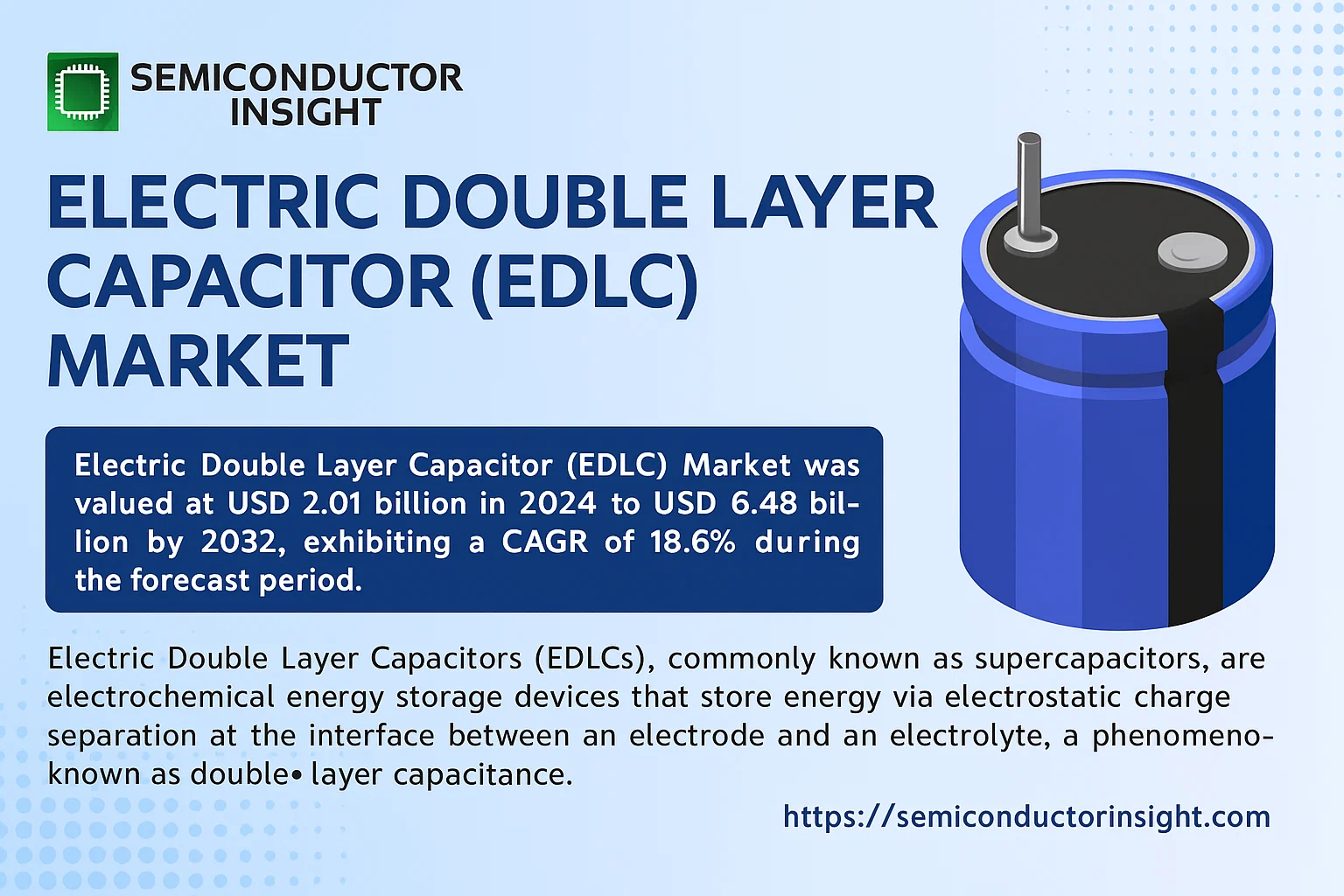
Global Electric Double Layer Capacitor (EDLC) Market was valued at USD 2.01 billion in 2024 to USD 6.48 billion by 2032, exhibiting a CAGR of 18.6% during the forecast period.
Electric Double Layer Capacitors (EDLCs), commonly known as supercapacitors, are electrochemical energy storage devices that store energy via electrostatic charge separation at the interface between an electrode and an electrolyte, a phenomenon known as double-layer capacitance. Unlike batteries, EDLCs store energy physically and contain no conventional dielectric; instead, a solid or liquid electrolyte fills the space between two electrodes, forming an “electrical double layer.”
The market is experiencing rapid growth due to several factors, including the rising demand for efficient energy storage in renewable energy systems and the automotive industry’s shift towards electrification. Additionally, the growing need for power backup in consumer electronics and industrial applications is contributing to market expansion. Initiatives by key players in the market are also expected to fuel growth; for instance, manufacturers are continuously innovating to increase energy density and reduce costs. Key global players such as Maxwell Technologies (acquired by Tesla), Panasonic, and Nippon Chemi-Con operate in this space with diverse product portfolios.
MARKET DRIVERS
Rising Demand for Energy-Efficient Solutions
Global push for energy efficiency and the integration of renewable energy sources are key drivers for the EDLC market. EDLCs, or supercapacitors, offer rapid charging and discharging capabilities, high power density, and long cycle life, making them ideal for applications requiring quick bursts of power. This is crucial for stabilizing power grids with intermittent renewable sources like solar and wind, and for regenerative braking systems in electric vehicles, which recapture energy that would otherwise be lost.
Expansion of Electric and Hybrid Electric Vehicles
The accelerating adoption of electric vehicles (EVs) and hybrid electric vehicles (HEVs) significantly propels the EDLC market. EDLCs are increasingly used alongside batteries in these vehicles to provide the high power needed for acceleration and to efficiently capture energy during regenerative braking. This combination enhances overall vehicle performance, extends battery life by handling peak power demands, and improves fuel efficiency, aligning with stringent global emissions regulations.
Furthermore, advancements in material science, particularly the development of advanced carbon-based electrodes and improved electrolytes, are continuously enhancing the energy density and reducing the cost of EDLCs, making them more competitive and accessible for a wider range of applications.
MARKET CHALLENGES
Inherently Lower Energy Density Compared to Batteries
A primary challenge facing the EDLC market is its fundamental characteristic of having a lower energy density than electrochemical batteries like lithium-ion. This means that for applications requiring sustained energy delivery over long periods, EDLCs are often not a standalone solution and must be used in conjunction with batteries, adding complexity and cost to system design.
Other Challenges
High Cost per Unit of Energy Stored
Although costs have decreased, EDLCs remain more expensive than traditional batteries on a cost-per-watt-hour basis. This economic factor can be a significant barrier to adoption, particularly in highly price-sensitive markets and applications where the high power density of EDLCs is not the primary requirement.
Technical and Integration Complexities
Integrating EDLCs effectively into existing electronic systems requires sophisticated power management and control circuitry to manage the charge/discharge cycles alongside batteries. This adds design complexity and can require specialized engineering expertise, potentially slowing down adoption.
MARKET RESTRAINTS
Competition from Advanced Battery Technologies
The rapid development of competing energy storage technologies, such as lithium-ion batteries with improved power capabilities and emerging solid-state batteries, poses a significant restraint. As these technologies advance, they begin to encroach on the traditional performance advantages of EDLCs, particularly in applications where a balance of energy and power density is required, potentially limiting market growth for standalone EDLC solutions.
Supply Chain Vulnerabilities for Raw Materials
The production of high-performance EDLCs relies on specialized materials, including high-purity activated carbon for electrodes and stable organic electrolytes. Disruptions in the supply chain for these critical raw materials can lead to price volatility and manufacturing delays, acting as a restraint on the market’s ability to scale consistently and meet growing demand.
MARKET OPPORTUNITIES
Growth in Renewable Energy Integration and Smart Grids
Global transition to renewable energy presents a substantial opportunity for EDLCs. Their ability to provide instant power for frequency regulation and smooth out short-term fluctuations in solar and wind power output makes them ideal for smart grid applications. The need for reliable grid-scale energy storage solutions is expected to create significant demand in this sector.
Emerging Applications in Industrial Automation and IoT
The rise of the Industrial Internet of Things (IIoT) and automation creates new opportunities for EDLCs in powering wireless sensors and providing backup power for critical data logging during power interruptions. Their long lifecycle and reliability in extreme temperatures are key advantages in harsh industrial environments. Furthermore, research into hybridization with batteries for a wider range of consumer and medical devices opens new market frontiers.
Electric Double Layer Capacitor (EDLC) Market Trends
Robust Global Market Expansion
Global Electric Double Layer Capacitor (EDLC) market is on a trajectory of significant growth, with its valuation projected to surge from USD 2013 million in 2024 to USD 6478 million by 2032. This expansion, representing a compound annual growth rate (CAGR) of 18.6%, is driven by the increasing demand for efficient energy storage solutions across various industries. The market’s momentum is underpinned by the fundamental advantages of EDLC technology, which stores energy electrostatically at the interface between a conductor electrode and an electrolyte, eliminating the need for a conventional dielectric material.
Other Trends
Dominant Regional Consumption Patterns
The geographical distribution of the EDLC market is a key trend, with China and the United States emerging as the dominant consumers, collectively accounting for 58% of the global market consumption. Following these leaders, the European and Japanese markets hold similar shares of 11% and 12%, respectively. This concentration highlights the critical role of advanced electronics manufacturing and industrial automation in these regions, which are primary drivers of EDLC demand.
Consolidated Competitive Landscape
The competitive landscape is characterized by a high degree of concentration among manufacturers, primarily located in America, Japan, and Korea, who collectively account for over 70% of total production. Maxwell, based in the USA, is the global market leader. The top ten manufacturers generate approximately 55% of the industry’s total revenue, indicating a market where scale and technological expertise are significant barriers to entry. Other prominent players include Panasonic, NEC TOKIN, LS Mtron, Nippon Chemi-Con, ELNA, and NICHICON.
Application and Product Segment Diversification
Application-wise, the market is segmented into Consumer Electronics, Transportation, Electricity, Military and Aerospace, and other sectors, demonstrating the versatility of EDLCs. This diversification is mirrored on the product side, with various form factors such as Radial, Cylindrical, Button, Square, and Pouch types catering to specific design and performance requirements in different applications, from small electronic devices to large-scale energy systems.
COMPETITIVE LANDSCAPE
Key Industry Players
A Market Dominated by Established Global Giants and Regional Specialists
Global Electric Double Layer Capacitor (EDLC) market is moderately concentrated, with the top 10 manufacturers accounting for approximately 55% of the total market revenue. Historically, production has been concentrated in the United States, Japan, and South Korea, which together represent over 70% of the global manufacturing output. The market has long been led by Maxwell Technologies (now part of UCAP Power, Inc.), a US-based pioneer renowned for its high-performance, large-cell ultracapacitors widely used in transportation and industrial applications. This leadership position is reinforced by strong intellectual property and extensive experience in high-power energy storage solutions. The competitive environment is characterized by technological innovation focused on increasing energy density and reducing costs, with established players leveraging their scale and R&D capabilities to maintain dominance.
Beyond the top-tier leaders, the landscape includes numerous significant niche players that cater to specific application segments and regional markets. Companies like Japan’s Nippon Chemi-Con and Panasonic hold substantial market share, particularly in consumer electronics and power backup applications. Korean firms such as LS Mtron and Samwha are also major forces. Furthermore, the market features a growing cohort of Chinese manufacturers, including Ningbo CRRC New Energy Technology and Jianghai Capacitor, which are expanding their presence aggressively, supported by domestic demand and government initiatives. European innovators like Skeleton Technologies are also making strides with advanced graphene-based electrode materials, targeting the high-performance segment in automotive and grid storage. While the market has seen some consolidation, the presence of approximately 50 active companies ensures robust competition across different product types and price points.
List of Key Electric Double Layer Capacitor (EDLC) Companies Profiled
- Maxwell Technologies (UCAP Power, Inc.)
- Panasonic Corporation
- Ningbo CRRC New Energy Technology
- LS Mtron
- Nippon Chemi-Con
- AVX Corporation
- ELNA Co., Ltd.
- Supreme Power Solutions
- KEMET (a YAGEO Company)
- Samwha Capacitor
- Jianghai Capacitor
- Man Yue Technology Holdings Limited (Samxon)
- Ioxus, Inc.
- Skeleton Technologies
- Cornell Dubilier Electronics
Segment Analysis:
| Segment Category | Sub-Segments | Key Insights |
| By Type |
|
Cylindricality Type demonstrates strong market leadership due to its superior mechanical stability and widespread adoption in high-reliability applications such as automotive systems and industrial equipment. The robust cylindrical housing provides excellent durability against physical stress and environmental factors, making it the preferred choice for demanding operational conditions. Manufacturers continue to innovate within this segment to enhance energy density and thermal performance, solidifying its dominant market position. |
| By Application |
|
Transportation is the leading application segment, driven by the critical role EDLCs play in automotive systems such as regenerative braking, start-stop functionality, and power stabilization for electric and hybrid vehicles. The technology’s ability to deliver rapid bursts of power and withstand numerous charge-discharge cycles makes it indispensable for modern transportation solutions. This segment benefits from continuous investment in vehicle electrification and the push for more energy-efficient systems globally. |
| By End User |
|
Automotive OEMs constitute the foremost end-user segment, leveraging EDLC technology to meet stringent requirements for reliability, performance, and efficiency in next-generation vehicles. The shift towards electrification and the need for advanced energy storage solutions in automotive applications create substantial demand from this customer base. Continuous collaboration between capacitor manufacturers and automotive companies drives innovation tailored to the specific power management challenges of the transportation industry. |
| By Electrolyte Type |
|
Organic Electrolyte is the dominant segment, favored for its higher operating voltage window which directly translates to superior energy density compared to aqueous alternatives. This characteristic makes organic electrolyte EDLCs highly suitable for a broad spectrum of applications requiring compact energy storage solutions. While ongoing research into solid-state electrolytes promises enhanced safety and longevity, organic electrolytes currently lead due to their proven performance and established manufacturing processes. |
| By Manufacturing Hub |
|
Asia-Pacific stands as the leading manufacturing hub, characterized by a concentration of key producers in Japan, South Korea, and China that collectively dominate global production capacity. This region benefits from strong supply chains, advanced technological expertise, and significant economies of scale. The presence of major market leaders and a robust electronics manufacturing ecosystem reinforces the Asia-Pacific’s pivotal role in supplying EDLCs to both regional and international markets. |
Regional Analysis: Electric Double Layer Capacitor (EDLC) Market
Asia-Pacific
The region’s dominance is underpinned by a mature and highly efficient manufacturing ecosystem. Major players have established large-scale production facilities that benefit from economies of scale, allowing for competitive pricing. A dense network of component suppliers for conductive materials, separators, and electrolytes creates a resilient and responsive supply chain, enabling rapid prototyping and volume production to meet global demand.
The massive automotive industry in countries like China, Japan, and South Korea is a primary driver. EDLCs are increasingly critical in start-stop systems, regenerative braking, and as backup power for advanced driver-assistance systems (ADAS) in both conventional and electric vehicles. Government mandates promoting fuel efficiency and electric vehicle adoption directly accelerate the integration of EDLC technology into next-generation transportation.
Asia-Pacific’s aggressive push for renewable energy, particularly solar and wind power, creates significant opportunities for EDLCs. They are essential for smoothing power fluctuations, providing short-term energy storage, and ensuring grid stability. Large-scale solar farms and wind turbine installations utilize EDLC-based systems for frequency regulation and peak shaving, a market segment experiencing rapid growth.
The region’s vast industrial base utilizes EDLCs for uninterruptible power supplies (UPS), crane and elevator energy recovery, and power conditioning. Simultaneously, the thriving consumer electronics sector employs EDLCs for memory backup, quick-charging applications, and in portable devices. This diverse application base ensures a stable and growing demand stream from multiple high-volume industries.
North America
North America represents a highly innovative and technologically advanced market for EDLCs, characterized by strong demand from the aerospace, defense, and industrial automation sectors. The region is a hub for cutting-edge R&D, with a focus on developing high-energy and high-power density capacitors for specialized applications. The push for grid modernization and the integration of renewable energy sources in the United States and Canada is fostering demand for EDLCs in smart grid applications and utility-scale energy storage projects. The well-established automotive industry, particularly with a growing emphasis on electric and autonomous vehicles, is also a significant consumer. While manufacturing may not match the scale of Asia-Pacific, North America excels in high-value, specialized EDLC solutions, supported by stringent quality standards and a robust intellectual property environment.
Europe
The European EDLC market is driven by stringent environmental regulations and a strong focus on sustainability and energy efficiency. The automotive industry is a major driver, with European manufacturers heavily investing in hybrid and electric vehicle technologies where EDLCs are vital for regenerative braking systems and power stabilization. The region’s commitment to renewable energy, especially wind power, creates substantial demand for EDLCs in grid stabilization and frequency regulation. Furthermore, industrial automation, railway systems, and medical devices represent key application areas where reliability and performance are paramount. European research institutions and companies are actively engaged in developing next-generation EDLC materials and designs, positioning the region as a leader in high-performance and environmentally conscious capacitor technology.
South America
The South American EDLC market is in a growth phase, with potential primarily linked to infrastructure development and the gradual modernization of industrial and energy sectors. Brazil and Argentina are the key markets, where EDLCs find applications in renewable energy projects, particularly in wind and solar farms, to manage intermittent power supply. The industrial sector utilizes them for power backup and voltage stabilization in manufacturing facilities. While the market is smaller compared to other regions, growing awareness of energy efficiency and the need for reliable power in remote areas presents opportunities. However, market growth is often tempered by economic volatility and slower adoption rates of advanced technologies compared to more developed regions.
Middle East & Africa
The EDLC market in the Middle East & Africa is nascent but shows promising growth drivers, particularly in the Middle East. The region’s focus on diversifying away from hydrocarbon dependence is leading to investments in renewable energy and smart infrastructure projects, where EDLCs can play a role in grid management. In the oil and gas sector, EDLCs are used for backup power in critical control systems. In Africa, the primary drivers include the need for reliable power solutions in telecommunications infrastructure and the gradual development of renewable microgrids. Market growth is uneven, with the more economically developed Gulf Cooperation Council (GCC) countries showing faster adoption, while broader regional expansion depends on infrastructure investment and economic stability.
Report Scope
This market research report provides a comprehensive analysis of the Electric Double Layer Capacitor (EDLC) Market , covering the forecast period 2025–2032. It offers detailed insights into market dynamics, technological advancements, competitive landscape, and key trends shaping the industry.
Key focus areas of the report include:
- Market Overview: The report begins with an overview outlining its current market scenario, key growth indicators, and industry transformation drivers. It discusses macroeconomic factors, demand–supply balance, regulatory landscape, and the strategic role of semiconductors in powering advancements across industries such as automotive, telecommunications, consumer electronics, and industrial automation.
- Market Size & Forecast: Historical data and future projections for revenue, unit shipments, and market value across major regions and segments.
- Segmentation Analysis: Detailed breakdown by product type, technology, application, and end-user industry to identify high-growth segments and investment opportunities.
- Regional Insights: Insights into market performance across North America, Europe, Asia-Pacific, Latin America, and the Middle East & Africa, including country-level analysis where relevant.
- Competitive Landscape: Profiles of leading market participants, including their product offerings, R&D focus, manufacturing capacity, pricing strategies, and recent developments such as mergers, acquisitions, and partnerships.
- Technology Trends & Innovation: Assessment of emerging technologies, integration of AI/IoT, semiconductor design trends, fabrication techniques, and evolving industry standards.
- Market Drivers & Restraints: Evaluation of factors driving market growth along with challenges, supply chain constraints, regulatory issues, and market-entry barriers.
- Stakeholder Insights: Insights for component suppliers, OEMs, system integrators, investors, and policymakers regarding the evolving ecosystem and strategic opportunities.
Primary and secondary research methods are employed, including interviews with industry experts, data from verified sources, and real-time market intelligence to ensure the accuracy and reliability of the insights presented.
FREQUENTLY ASKED QUESTIONS:
What is the current market size of Electric Double Layer Capacitor (EDLC) Market?
-> Electric Double Layer Capacitor (EDLC) Market was valued at USD 2.01 billion in 2024 to USD 6.48 billion by 2032, exhibiting a CAGR of 18.6% during the forecast period.
Which key companies operate in Electric Double Layer Capacitor (EDLC) Market?
-> Key players include Maxwell, Panasonic, NEC TOKIN, LS Mtron, Nippon Chemi-Con, and ELNA, among approximately 50 companies operating in this business. The top 10 manufacturers account for 55% of the total revenue.
What are the key growth drivers?
-> Key growth drivers include rising demand for energy storage solutions, technological advancements in electrochemical capacitors, and increasing applications across consumer electronics, transportation, and electricity sectors.
Which region dominates the market?
-> China is the largest market for EDLCs, accounting for a significant share, followed by the United States. Together, they consume approximately 58% of the global EDLC market.
What are the emerging trends?
-> Emerging trends include advancements in double-layer capacitance technology, expansion of manufacturing bases in America, Japan, and Korea, and growing adoption in military and aerospace applications.

Get Sample Report PDF for Exclusive Insights
Report Sample Includes
- Table of Contents
- List of Tables & Figures
- Charts, Research Methodology, and more...
 Download Sample Report PDF