Edge AI Gateway Processor Market Insights
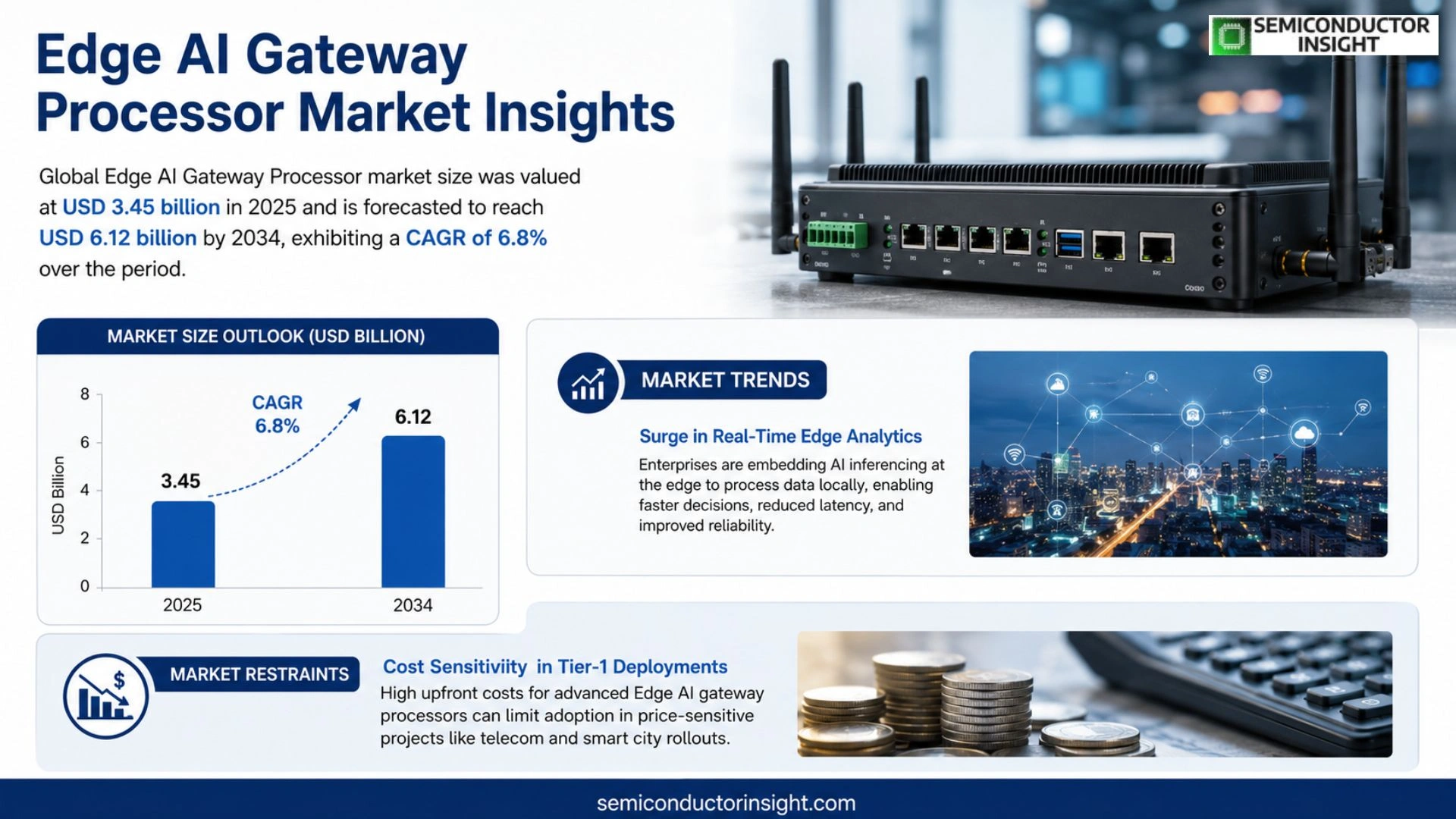
Global Edge AI Gateway Processor market size was valued at USD 3.45 billion in 2025 and is forecasted to reach USD 6.12 billion by 2034, exhibiting a CAGR of 6.8 % over the period.
Edge AI gateway processors integrate compute cores optimized for neural‑network inference with networking interfaces that sit at the boundary between cloud data centers and distributed devices. They enable real‑time analytics on video streams, sensor feeds or industrial telemetry without sending raw data upstream.
The expansion stems from mounting IoT deployments that demand sub‑second decision making, rising regulatory pressure for data sovereignty and the cost advantage of processing locally rather than relying on bandwidth‑intensive cloud links. Major silicon vendors such as NVIDIA, Qualcomm and Intel have announced dedicated edge‑AI chip families in 2023‑24, reinforcing ecosystem momentum.
MARKET DRIVERS
Accelerating Adoption of Edge Computing
The surge in data‑intensive applications,autonomous robotics, real‑time video analytics, and predictive maintenance,forces enterprises to move processing closer to the source. By relocating inference workloads to the edge, firms avoid latency penalties and reduce bandwidth costs, a shift that directly fuels demand for specialized processors in the Edge AI Gateway Processor Market.
Industry‑Specific Compliance Pressures
Regulatory frameworks governing data sovereignty in sectors such as healthcare and finance mandate that sensitive information remain on‑premise. This compliance imperative pushes manufacturers toward on‑device AI chips, creating a practical incentive for vendors to expand their product lines.
➤ “Enterprises that prioritize latency‑critical workloads are allocating up to 30% more budget to edge processors compared with the previous year.”
Combined, these forces translate into a measurable uplift,2023 saw a double‑digit percentage rise in shipments of AI‑enabled gateway devices, signaling a durable impetus for market participants.
MARKET CHALLENGES
Thermal Management Constraints
Edge installations often occupy confined enclosures where airflow is limited. High‑performance AI processors generate considerable heat, and insufficient cooling can throttle performance or shorten device lifespan, posing a design‑level obstacle for many OEMs.
Other Challenges
Supply‑Chain Volatility
Fluctuations in semiconductor raw‑material availability and logistics bottlenecks have introduced lead‑time uncertainty, forcing vendors to hold higher inventory buffers and compress margins.
These hurdles compel manufacturers to balance performance aspirations with pragmatic engineering, a tension that slows the velocity of new product introductions.
MARKET RESTRAINTS
Cost Sensitivity in Tier‑1 Deployments
Large‑scale deployments in telecommunications and smart‑city projects remain highly price‑driven. While AI acceleration delivers operational efficiencies, the upfront premium for cutting‑edge processors can exceed budget ceilings, limiting broader adoption.
Fragmented Software Ecosystem
Developers confront a bewildering mix of SDKs, inference frameworks, and runtime environments. The lack of a unified software stack raises integration costs and deters smaller firms from committing to edge AI solutions.
MARKET OPPORTUNITIES
Modular Processor Architectures
Emerging designs that decouple compute cores from accelerators enable customers to tailor silicon to specific workloads. This flexibility opens a revenue stream for vendors willing to offer configurable Edge AI Gateway Processor Market solutions, especially in niche verticals such as industrial IoT.
Integration with 5G Edge Nodes
The rollout of 5G edge cloud nodes presents a fertile venue for AI‑enabled gateways. Co‑locating inference engines with low‑latency network slices creates a compelling value proposition for service providers seeking to monetize edge services.
Capitalizing on these avenues will require sustained R&D investment and collaborative standards‑setting, but the upside,enhanced device differentiation and recurring software licensing,justifies the strategic focus.
Edge AI Gateway Processor Market Trends
Surge in Real‑Time Edge Analytics
Edge AI Gateway Processor Market is witnessing accelerated adoption as enterprises seek to eliminate latency inherent in cloud‑centric pipelines. By embedding inference‑optimized cores directly within gateway devices, organizations can analyze video, sensor and telemetry streams in milliseconds, delivering decisions at the point of generation. This capability reshapes operational models in manufacturing, transportation and retail, where millisecond‑scale actions,such as defect detection or safety interlock activation,translate into measurable cost avoidance. Consequently, the market’s valuation moved from USD 3.45 billion in 2025 to an estimated USD 6.12 billion by 2034, reflecting a compound increase of 6.8 % over the horizon.
Other Trends
Regulatory Momentum
Data‑sovereignty statutes enacted across Europe and Asia have heightened scrutiny of cross‑border data flows. Companies that process raw footage or sensor logs locally sidestep the expense and compliance risk of transmitting every byte to a remote data center. This regulatory pressure has nudged procurement teams toward edge‑capable gateways, reinforcing the market’s expansion as firms redesign architectures to retain sensitive information at the network edge.
Silicon Vendor Consolidation
In 2023‑24, leading silicon players,NVIDIA, Qualcomm and Intel,unveiled dedicated edge‑AI chip families that marry high‑throughput neural‑network engines with ruggedized networking interfaces. Their entry deepens the ecosystem, prompting software vendors to certify toolchains and enabling system integrators to assemble turn‑key solutions more rapidly. The ripple effect is a reduction in time‑to‑market for new products, which benefits end‑users seeking to upgrade legacy gateways without extensive redesign.
COMPETITIVE LANDSCAPE
Key Industry Players
Edge AI Gateways: Shaping the Edge Computing Frontier
The architecture of the Edge AI gateway processor market is anchored by three silicon powerhouses,NVIDIA, Intel and Qualcomm,which together capture the lion’s share of high‑performance designs destined for data‑intensive use cases such as video analytics, autonomous robotics and smart‑factory monitoring. NVIDIA’s Jetson family leverages GPU‑accelerated tensor cores, delivering sub‑millisecond inference on 4K video streams; Intel’s Xeon‑based Edge platforms combine familiar x86 instruction sets with AI‑optimized accelerators, easing the migration path for enterprises entrenched in Intel‑centric ecosystems; Qualcomm’s Snapdragon 8cx Gen 3 blends a mobile‑grade CPU, AI engine and integrated 5G modem, positioning it as the default choice for edge‑to‑cloud rollouts that require broadband connectivity. Their dominance reflects not only superior silicon but also extensive software stacks,CUDA, oneAPI, Hexagon,that lower development friction and lock in customers seeking end‑to‑end solutions. Consequently, the market structure resembles a tiered pyramid: a narrow apex of platform providers feeding a broader base of OEMs, system integrators and vertical specialists that embed these processors into gateways, appliances and edge boxes.
Beyond the tier‑one cohort, a constellation of niche innovators and IP vendors is expanding the competitive perimeter. Arm supplies the underlying CPU IP that powers many low‑power gateways, enabling designers to tailor core counts and power envelopes for embedded sensor hubs. MediaTek’s Dimensity series introduces heterogeneous AI accelerators tuned for cost‑sensitive consumer devices, while Xilinx (now under AMD) offers programmable SoCs that give manufacturers the flexibility to reconfigure inference pipelines post‑deployment. Texas Instruments continues to focus on ultra‑low‑power DSP‑centric devices, carving out a space in industrial telemetry. Horizon Robotics, Graphcore and Synopsys target specialist sectors,autonomous driving, high‑throughput inference and silicon‑level design services respectively,by delivering custom ASICs or IP blocks that address latency‑critical workloads. Samsung Electronics, Renesas Electronics, Marvell Technology and Amlogic round out the field, each leveraging legacy strengths in memory, automotive microcontrollers or fan‑optimized media processors to capture market slices that demand tight integration of connectivity, storage and AI compute. This diffusion of capabilities forces the leading vendors to broaden ecosystem support and accelerates the pace of differentiation across form factors and verticals.
List of Key Edge AI Gateway Processor Companies Profiled
- NVIDIA
- Intel
- Qualcomm
- Arm
- MediaTek
- Xilinx (AMD)
- Texas Instruments
- Horizon Robotics
- Graphcore
- Samsung Electronics
- Renesas Electronics
- Marvell Technology
- Amlogic
- Synopsys
Segment Analysis:
| Segment Category | Sub-Segments | Key Insights |
| By Type |
|
ASIC‑based processors are emerging as the leading segment because they provide tightly integrated AI inference engines that are power‑efficient and can be customized for specific workloads. • They enable sub‑second decision making in latency‑sensitive edge scenarios. • Their on‑chip memory hierarchy reduces data movement, supporting real‑time analytics on video and sensor streams. • Vendors are focusing on modular ASIC families that can be embedded across diverse device form factors, reinforcing ecosystem adoption. |
| By Application |
|
Industrial automation dominates this dimension as manufacturers demand on‑device inferencing to monitor equipment health, predict failures, and optimize processes without exposing proprietary data to the cloud. • Edge AI gateways process high‑frequency sensor telemetry locally, preserving data sovereignty. • Real‑time analytics enable closed‑loop control, improving productivity and reducing downtime. • The convergence of ruggedized processors and deterministic networking drives widespread deployment in factories and warehouses. |
| By End User |
|
Manufacturing is the leading end‑user segment because factories increasingly rely on edge AI to enforce quality control, perform visual inspection, and orchestrate robotic cells. • Processors embedded in camera nodes evaluate visual defects instantly, eliminating the need for centralized analysis. • Edge compute reduces network bandwidth consumption, aligning with cost‑sensitive production environments. • The push for predictive maintenance drives adoption of AI gateways that continuously learn from equipment data streams. |
| By Deployment Model |
|
On‑premises gateways lead this category as enterprises prioritize data residency and deterministic latency. • Local processing satisfies regulatory requirements for data sovereignty in regulated industries. • Tight integration with legacy control systems enhances reliability and simplifies operational workflows. • The model supports incremental upgrades, allowing organizations to evolve their edge AI capabilities without wholesale infrastructure changes. |
| By Connectivity |
|
5G wireless is gaining prominence because it delivers the bandwidth and low latency required for distributed AI inference across large geographic footprints. • Edge gateways equipped with 5G modems can operate in remote sites where wired infrastructure is impractical. • The seamless handoff between edge and central cloud enhances reliability for mission‑critical applications. • Integration of 5G accelerates use cases such as mobile surveillance drones and autonomous logistics robots. |
Regional Analysis: Edge AI Gateway Processor Market
North America
Enterprise demand for sub‑second decision making in manufacturing and logistics fuels the need for processors that can execute AI models at the edge. The rise of 5G connectivity further amplifies this demand by enabling real‑time data streams to be processed locally rather than routed to distant clouds.
Major semiconductor players are racing to integrate heterogeneous compute blocks,CPU, GPU, and dedicated AI accelerators,into single‑chip solutions. Start‑ups surface with domain‑specific IPs that challenge incumbents, prompting strategic alliances and IP licensing deals to secure market footholds.
Data‑privacy statutes such as CCPA encourage on‑device processing, reducing the need for bulk data transfers. This regulatory tilt aligns with the technical advantages of edge gateways, reinforcing adoption across regulated industries like healthcare and finance.
Venture capital continues to back AI‑hardware start‑ups targeting edge workloads, while larger firms allocate capital to expand foundry capacities. The combined effect sustains a pipeline of next‑generation processors that keep the market dynamic.
Europe
European manufacturers are capitalizing on stringent energy‑efficiency standards, shaping the Edge AI Gateway Processor Market toward ultra‑low‑power designs. The region’s strong automotive sector demands processors capable of handling sensor fusion in autonomous vehicles while complying with emissions regulations. Additionally, the EU’s emphasis on data sovereignty encourages local processing, prompting OEMs to embed sophisticated AI chips within edge nodes to avoid cross‑border data flows. Collaboration between pan‑European research consortia and chipmakers accelerates the translation of academic breakthroughs into commercially viable products, fostering a balanced ecosystem of innovation and deployment.
Asia‑Pacific
Asia‑Pacific exhibits a rapid scaling of edge deployments driven by dense manufacturing hubs and burgeoning smart‑city projects. Countries such as China, Japan, and South Korea invest heavily in localized AI compute to reduce latency for industrial automation and public‑infrastructure monitoring. The region’s supply‑chain depth supplies abundant silicon foundry capacity, enabling faster time‑to‑market for new processor generations. However, divergent regulatory approaches create a mosaic of compliance requirements, compelling vendors to adopt modular architectures that can be customized per jurisdiction.
South America
In South America, early‑stage adoption focuses on agricultural technology and remote healthcare delivery, where edge gateways enable real‑time analytics on vast field sensor networks. Limited broadband penetration makes local inference essential, positioning the Edge AI Gateway Processor Market as a catalyst for rural digital transformation. Regional partnerships between telecom operators and semiconductor firms are emerging to bundle connectivity with edge compute, creating integrated solutions that address both connectivity and processing challenges.
Middle East & Africa
The Middle East & Africa region is leveraging edge AI to support oil‑field automation and renewable‑energy grid management. Harsh environmental conditions demand processors with extended temperature tolerance and robust security features, prompting suppliers to harden silicon for these markets. Investment in smart‑infrastructure, especially in Gulf Cooperation Council nations, fuels demand for gateways that can process video and sensor data on site, reducing reliance on centralized data centers and aligning with national digital‑economy agendas.
Report Scope
This market research report provides a comprehensive analysis of the Edge AI Gateway Processor Market , covering the forecast period 2026–2034. It offers detailed insights into market dynamics, technological advancements, competitive landscape, and key trends shaping the industry.
Key focus areas of the report include:
- Market Overview: The report begins with an overview outlining its current market scenario, key growth indicators, and industry transformation drivers. It discusses macroeconomic factors, demand–supply balance, regulatory landscape, and the strategic role of semiconductors in powering advancements across industries such as automotive, telecommunications, consumer electronics, and industrial automation.
- Market Size & Forecast: Historical data and future projections for revenue, unit shipments, and market value across major regions and segments.
- Segmentation Analysis: Detailed breakdown by product type, technology, application, and end-user industry to identify high-growth segments and investment opportunities.
- Regional Insights: Insights into market performance across North America, Europe, Asia-Pacific, Latin America, and the Middle East & Africa, including country-level analysis where relevant.
- Competitive Landscape: Profiles of leading market participants, including their product offerings, R&D focus, manufacturing capacity, pricing strategies, and recent developments such as mergers, acquisitions, and partnerships.
- Technology Trends & Innovation: Assessment of emerging technologies, integration of AI/IoT, semiconductor design trends, fabrication techniques, and evolving industry standards.
- Market Drivers & Restraints: Evaluation of factors driving market growth along with challenges, supply chain constraints, regulatory issues, and market-entry barriers.
- Stakeholder Insights: Insights for component suppliers, OEMs, system integrators, investors, and policymakers regarding the evolving ecosystem and strategic opportunities.
Primary and secondary research methods are employed, including interviews with industry experts, data from verified sources, and real-time market intelligence to ensure the accuracy and reliability of the insights presented.
FREQUENTLY ASKED QUESTIONS:
What is the current market size of Edge AI Gateway Processor Market?
-> Edge AI Gateway Processor market size was valued at USD 3.45 billion in 2025 and is forecasted to reach USD 6.12 billion by 2034, exhibiting a CAGR of 6.8 % over the period.
Which key companies operate in Edge AI Gateway Processor Market?
-> Key players include NVIDIA, Qualcomm, Intel, among others.
What are the key growth drivers?
-> Key growth drivers include mounting IoT deployments demanding sub‑second decision making, regulatory pressure for data sovereignty, and cost advantages of processing locally.
Which region dominates the market?
-> The reference does not specify a dominant region for the Edge AI Gateway Processor market.
What are the emerging trends?
-> Emerging trends include dedicated edge‑AI chip families from major silicon vendors and deeper integration of AI with IoT for real‑time analytics.

Get Sample Report PDF for Exclusive Insights
Report Sample Includes
- Table of Contents
- List of Tables & Figures
- Charts, Research Methodology, and more...
 Download Sample Report PDF