MARKET INSIGHTS
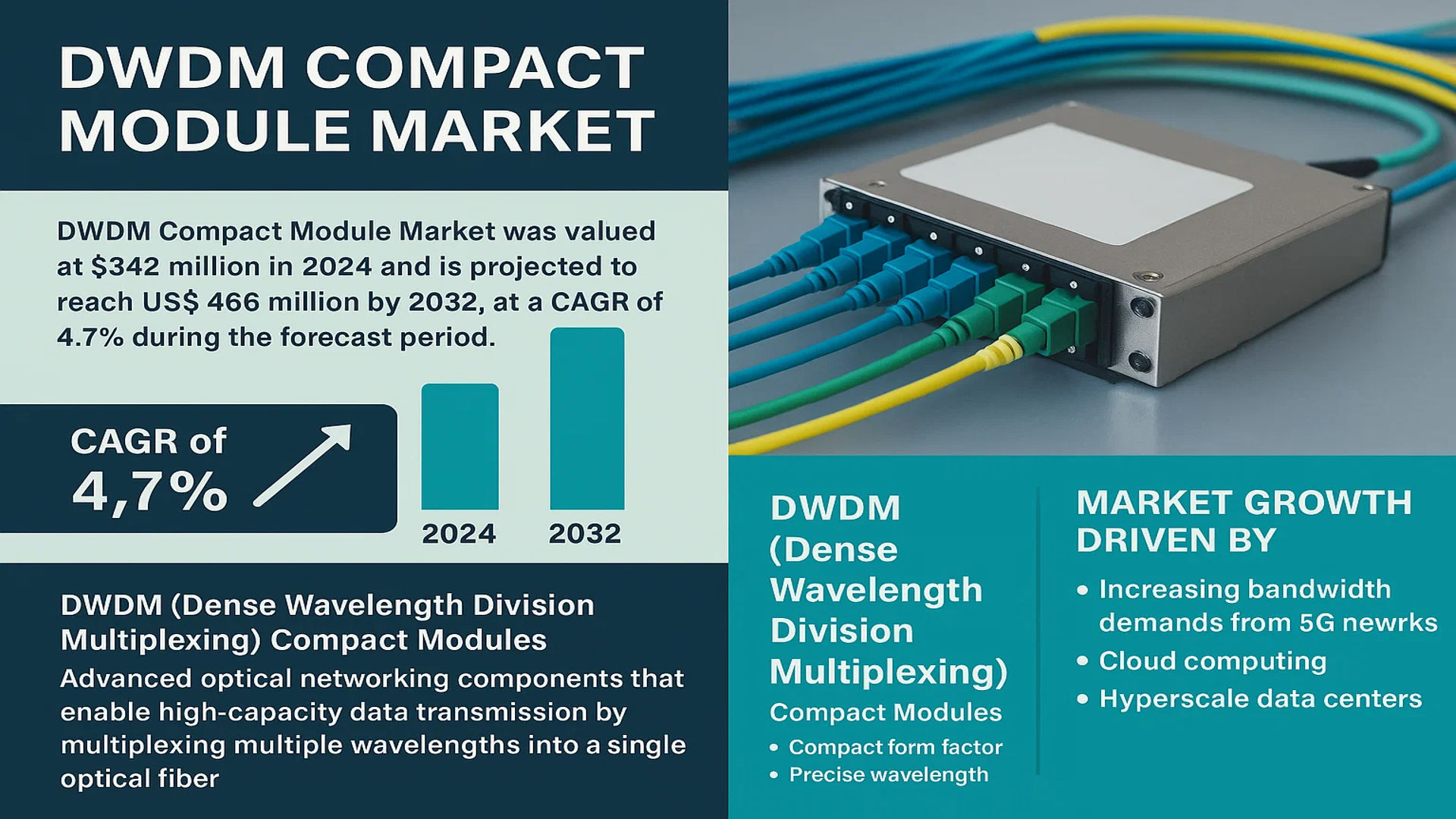
The global DWDM Compact Module Market was valued at 342 million in 2024 and is projected to reach US$ 466 million by 2032, at a CAGR of 4.7% during the forecast period.
DWDM (Dense Wavelength Division Multiplexing) Compact Modules are advanced optical networking components that enable high-capacity data transmission by multiplexing multiple wavelengths into a single optical fiber. These modules feature a compact form factor, making them ideal for space-sensitive deployments in data centers, telecom networks, and enterprise environments. Unlike traditional DWDM systems, they integrate technologies like thin-film filters and arrayed waveguide gratings to achieve precise wavelength separation with 100GHz or 50GHz channel spacing while reducing footprint and power consumption.
The market growth is driven by increasing bandwidth demands from 5G networks, cloud computing, and hyperscale data centers. North America currently holds the largest market share due to early technology adoption, while Asia-Pacific shows the fastest growth trajectory because of rapid digital infrastructure development. Key players like OptiWorks, VIAVI Solutions, and GLSUN are innovating in miniaturization and energy efficiency to meet evolving industry requirements.
MARKET DRIVERS
Explosive Growth in Data Traffic Demands Higher Network Capacity
The global internet traffic has been growing at an unprecedented rate, with estimates showing a compound annual growth rate exceeding 25% since 2020. This dramatic increase, fueled by 5G rollout, cloud computing expansion, and IoT adoption, is creating immense pressure on existing network infrastructure. The DWDM Compact Module provides an efficient solution to this challenge by enabling networks to multiply their capacity without expensive fiber trenching. Its ability to pack multiple wavelengths into a single strand of fiber makes it particularly valuable for backbone networks and data center interconnects, where bandwidth demands are growing fastest.
Adoption of Cloud Services Driving Infrastructure Modernization
Enterprise migration to cloud platforms has accelerated significantly, with cloud infrastructure services spending growing over 20% year-over-year. This shift is forcing hyperscalers and service providers to upgrade their networks to handle unpredictable traffic patterns and ensure low-latency connectivity. The DWDM Compact Module’s small footprint and scalability make it ideal for retrofitting existing facilities and building new hyperscale data centers. Major cloud providers are increasingly opting for these modules in their interconnect solutions because they reduce physical space requirements by up to 70% compared to traditional optical networking equipment while maintaining robust performance.
MARKET RESTRAINTS
High Initial Costs Pose Barrier for Emerging Markets
While DWDM technology offers excellent long-term value, the upfront investment remains substantial, particularly for compact modules that incorporate advanced features. The sophisticated optical components and precision manufacturing required to achieve the compact form factor result in costs that can be prohibitive for some network operators. This financial barrier is most pronounced in developing regions where budget constraints limit infrastructure investments, potentially slowing adoption rates in these growth markets despite increasing bandwidth needs. Pricing pressure from competing technologies further compounds this challenge, requiring manufacturers to continue driving down costs through improved production techniques.
MARKET CHALLENGES
Integration Complexity in Multi-Vendor Environments
The optical networking ecosystem involves equipment from numerous vendors, creating compatibility challenges when deploying DWDM Compact Modules. While standards like OpenROADM aim to improve interoperability, real-world implementations often encounter issues with signal conditioning, power management, and network management system integration. These technical hurdles increase deployment time and operational expenses, particularly in hybrid networks that mix legacy and new-generation equipment. The challenge is further amplified when modules from different manufacturers need to work together seamlessly in the same network infrastructure, a common requirement for service providers managing multi-vendor environments.
MARKET OPPORTUNITIES
Emerging 5G Networks Creating New Demand for Flexible Optical Solutions
The global rollout of 5G networks presents significant opportunities for DWDM Compact Module adoption, particularly in fronthaul and midhaul applications. With 5G base stations requiring high-bandwidth, low-latency connections, compact optical solutions offer an ideal way to upgrade existing fiber infrastructure without requiring complete overhauls. Additionally, the modular nature of these solutions enables telecom operators to gradually expand capacity in line with growing 5G subscriber bases. Network function virtualization in 5G architectures also benefits from the flexibility that compact DWDM modules provide, allowing for more dynamic resource allocation across the optical layer.
DWDM COMPACT MODULE MARKET TRENDS
Increasing Demand for High-Capacity Data Transmission Driving Market Growth
The global DWDM Compact Module market, valued at $342 million in 2024, is experiencing steady growth due to the rising demand for high-bandwidth data transmission in telecommunications and data centers. With projections indicating a climb to $466 million by 2032 at a 4.7% CAGR, the market is fueled by the exponential increase in internet traffic, cloud computing, and 5G network deployments. Compact DWDM modules are critical in addressing the need for space-efficient, scalable optical networking solutions. Leading manufacturers such as OptiWorks, OPTICO, and SpeedPhoton Technology are driving innovation in this space, with the top 5 players accounting for a notable market share.
Other Trends
Adoption in Data Center Interconnects
The surge in hyperscale data centers has accelerated the deployment of DWDM compact modules for cost-effective and high-density wavelength division multiplexing solutions. Modules with 4-channel and 8-channel configurations are particularly sought after for their balance of performance and compactness. Additionally, with data center operators requiring low latency and energy efficiency, manufacturers are integrating advanced thermal management and power optimization features into their designs. The U.S. market, valued in the millions as of 2024, remains a key driver due to its extensive cloud infrastructure investments.
Advancements in Optical Networking Technologies
Enhanced optical networking technologies, including coherent DWDM and pluggable optics, are shaping the future of compact modules. Innovations such as Thin-Film Filters (TFF) and Arrayed Waveguide Gratings (AWG) have improved channel spacing precision, enabling higher data rates up to 400G and beyond. Furthermore, developments in free-space optics allow modules to fit within tight form factors while maintaining signal integrity. China, projected to reach $X million by 2032, is witnessing rapid adoption of these solutions in both metro networks and long-haul telecom applications. As the market evolves, manufacturers are also focusing on plug-and-play modularity to facilitate easier upgrades and maintenance.
COMPETITIVE LANDSCAPE
Key Industry Players
Innovation and Strategic Expansion Shape Market Leadership
The global DWDM Compact Module market exhibits a dynamic competitive landscape with a mix of established optical networking leaders and specialized manufacturers. Asia-Pacific dominates production capabilities, while North American and European firms drive high-end innovation. VIAVI Solutions maintains a strong position due to its comprehensive test and measurement solutions supporting DWDM deployments, with over 15% market share in the monitoring segment.
The market sees increasing competition from Chinese manufacturers like GLSUN and Gezhi Photonics, who have captured nearly 30% of the global volume share through cost-optimized solutions. These manufacturers benefit from vertical integration and government support in China’s thriving photonics industry. Meanwhile, OptiWorks differentiates itself through patented thin-film filter technology supporting ultra-narrow channel spacing below 50GHz.
Recent industry developments show a trend toward vertical integration, with firms like OPELINK acquiring component suppliers to secure stable access to critical optical materials. The top five players collectively account for approximately 42% of 2024 revenues, though this concentration varies significantly by region—reaching 60% in North America but only 35% in Asia’s more fragmented markets.
Mid-sized players such as SpeedPhoton Technology and OPTICO are gaining traction by focusing on application-specific solutions, particularly for metro networks and 5G backhaul. Their growth strategies emphasize rapid prototyping and customized configurations unavailable from larger vendors. This specialization helps them compete despite smaller R&D budgets.
List of Key DWDM Compact Module Manufacturers
- VIAVI Solutions (U.S.)
- OptiWorks (China)
- OPTICO (Japan)
- SpeedPhoton Technology (China)
- GLSUN (China)
- Optosun (China)
- GAOTek (Canada)
- Flyin Group (China)
- Gracyfiber (China)
- OPELINK (China)
- Gezhi Photonics (China)
- Hilink (U.S.)
Segment Analysis:
By Type
4-Channel DWDM Modules Lead Due to Their Cost-Efficiency and Widespread Deployment in Metro Networks
The market is segmented based on type into:
- 4 Channels
- 8 Channels
- 16 Channels
- 18 Channels
- Others
By Application
Telecommunications Applications Dominate with Increasing Demand for High-Bandwidth Optical Networks
The market is segmented based on application into:
- Telecommunications
- Data Centers
- Enterprise Networks
- Others
By Technology
Thin-Film Filter (TFF) Technology Preferred for Its Reliability and Compact Size
The market is segmented based on technology into:
- Thin-Film Filter (TFF)
- Arrayed Waveguide Grating (AWG)
- Free-Space Optics
- Others
By Channel Spacing
100GHz Spacing Remains Standard for Most Network Deployments
The market is segmented based on channel spacing into:
- 100GHz
- 50GHz
- Others
Regional Analysis: DWDM Compact Module Market
Asia-Pacific
The Asia-Pacific region dominates the DWDM Compact Module Market, driven by extensive telecom infrastructure expansion, rapid data center deployments, and accelerating 5G network rollouts. China, Japan, and India are the key contributors, with China alone accounting for over 40% of the regional market share. Major investments in metro and long-haul optical networks, along with government initiatives like China’s “Digital Silk Road,” fuel demand for compact, high-capacity solutions. However, cost sensitivity in emerging economies leads to varied adoption, with larger enterprises prioritizing advanced modules while smaller operators opt for cost-effective alternatives. The presence of manufacturers such as OptiWorks and SpeedPhoton Technology further strengthens the supply chain.
North America
North America is a high-growth market for DWDM Compact Modules, propelled by the need for ultra-low-latency connectivity in data centers and enterprise networks. The U.S. leads the region, supported by heavy investments from hyperscalers like Google and Amazon in scalable, high-density optical solutions. Regulatory frameworks promoting fiber-optic expansion, such as the FCC’s Rural Digital Opportunity Fund, also stimulate adoption. However, the market faces challenges from stringent compliance requirements and competition from alternative technologies like coherent optics. Companies such as VIAVI Solutions and OPELINK play a significant role in catering to specialized demands.
Europe
Europe’s market thrives on a combination of sustainable network modernization and stringent data privacy laws, driving demand for energy-efficient, high-performance DWDM modules. Germany and the U.K. are at the forefront, with telecom giants like Deutsche Telekom deploying compact modules for metro networks. The EU’s focus on reducing carbon footprints encourages innovation in low-power optical components. Despite these drivers, slower-than-expected 5G adoption in some countries and budget constraints among smaller ISPs limit full-scale market penetration. Key players such as OPTICO and Flyin Group emphasize R&D to align with regional standards.
South America
South America presents emerging opportunities for DWDM Compact Module providers, particularly in Brazil and Argentina, where fiber-optic backbone expansions are underway. The region’s growing internet penetration and cloud service adoption create demand, but economic instability and underdeveloped infrastructure hinder rapid growth. Local operators often prioritize refurbished or lower-cost modules, delaying large-scale upgrades. Nonetheless, partnerships between global manufacturers and regional distributors aim to bridge the technology gap.
Middle East & Africa
The MEA market is in its nascent stage but shows potential due to rising smart city projects and submarine cable deployments. UAE and Saudi Arabia lead investments in next-gen networks, while African nations lag due to funding deficits. Limited local manufacturing forces reliance on imports, though initiatives like Egypt’s ICT 2030 strategy aim to bolster domestic capabilities. The competitive landscape includes niche players like GAOTek targeting specific high-growth verticals such as oil & gas and financial services.
Report Scope
This market research report provides a comprehensive analysis of the Global DWDM Compact Module Market, covering the forecast period 2024–2032. It offers detailed insights into market dynamics, technological advancements, competitive landscape, and key trends shaping the industry.
Key focus areas of the report include:
- Market Size & Forecast: Historical data and future projections for revenue, unit shipments, and market value across major regions and segments. The Global DWDM Compact Module market was valued at USD 342 million in 2024 and is projected to reach USD 466 million by 2032, growing at a CAGR of 4.7%.
- Segmentation Analysis: Detailed breakdown by product type (4 Channels, 8 Channels, 16 Channels, 18 Channels, Others) and application (Telecommunications, Data Centers, Enterprise Networks, Others) to identify high-growth segments.
- Regional Outlook: Insights into market performance across North America, Europe, Asia-Pacific, Latin America, and the Middle East & Africa, including country-level analysis where relevant. The U.S. and China are key markets with significant growth potential.
- Competitive Landscape: Profiles of leading market participants including OptiWorks, OPTICO, SpeedPhoton Technology, GLSUN, Optosun, and others, covering their product offerings, R&D focus, and recent developments.
- Technology Trends & Innovation: Assessment of emerging technologies in optical networking, including advancements in thin-film filters (TFF) and arrayed waveguide gratings (AWG).
- Market Drivers & Restraints: Evaluation of factors driving market growth (5G deployment, cloud computing expansion) along with challenges (supply chain constraints, technical complexity).
- Stakeholder Analysis: Insights for component suppliers, OEMs, system integrators, investors, and policymakers regarding the evolving ecosystem and strategic opportunities.
Primary and secondary research methods are employed, including interviews with industry experts, data from verified sources, and real-time market intelligence to ensure the accuracy and reliability of the insights presented.
FREQUENTLY ASKED QUESTIONS:
What is the current market size of Global DWDM Compact Module Market?
-> DWDM Compact Module Market was valued at 342 million in 2024 and is projected to reach US$ 466 million by 2032, at a CAGR of 4.7% during the forecast period.
Which key companies operate in Global DWDM Compact Module Market?
-> Key players include OptiWorks, OPTICO, SpeedPhoton Technology, GLSUN, Optosun, GAOTek, Flyin Group, Gracyfiber, OPELINK, and Gezhi Photonics, among others.
What are the key growth drivers?
-> Key growth drivers include increasing demand for high-capacity networks, 5G deployment, and growth in cloud computing and data centers.
Which region dominates the market?
-> Asia-Pacific is the fastest-growing region, driven by significant telecommunications infrastructure investments, while North America remains a technologically advanced market.
What are the emerging trends?
-> Emerging trends include development of ultra-compact modules, integration with coherent optical systems, and increasing adoption in metro networks.

Get Sample Report PDF for Exclusive Insights
Report Sample Includes
- Table of Contents
- List of Tables & Figures
- Charts, Research Methodology, and more...
 Download Sample Report PDF