MARKET INSIGHTS
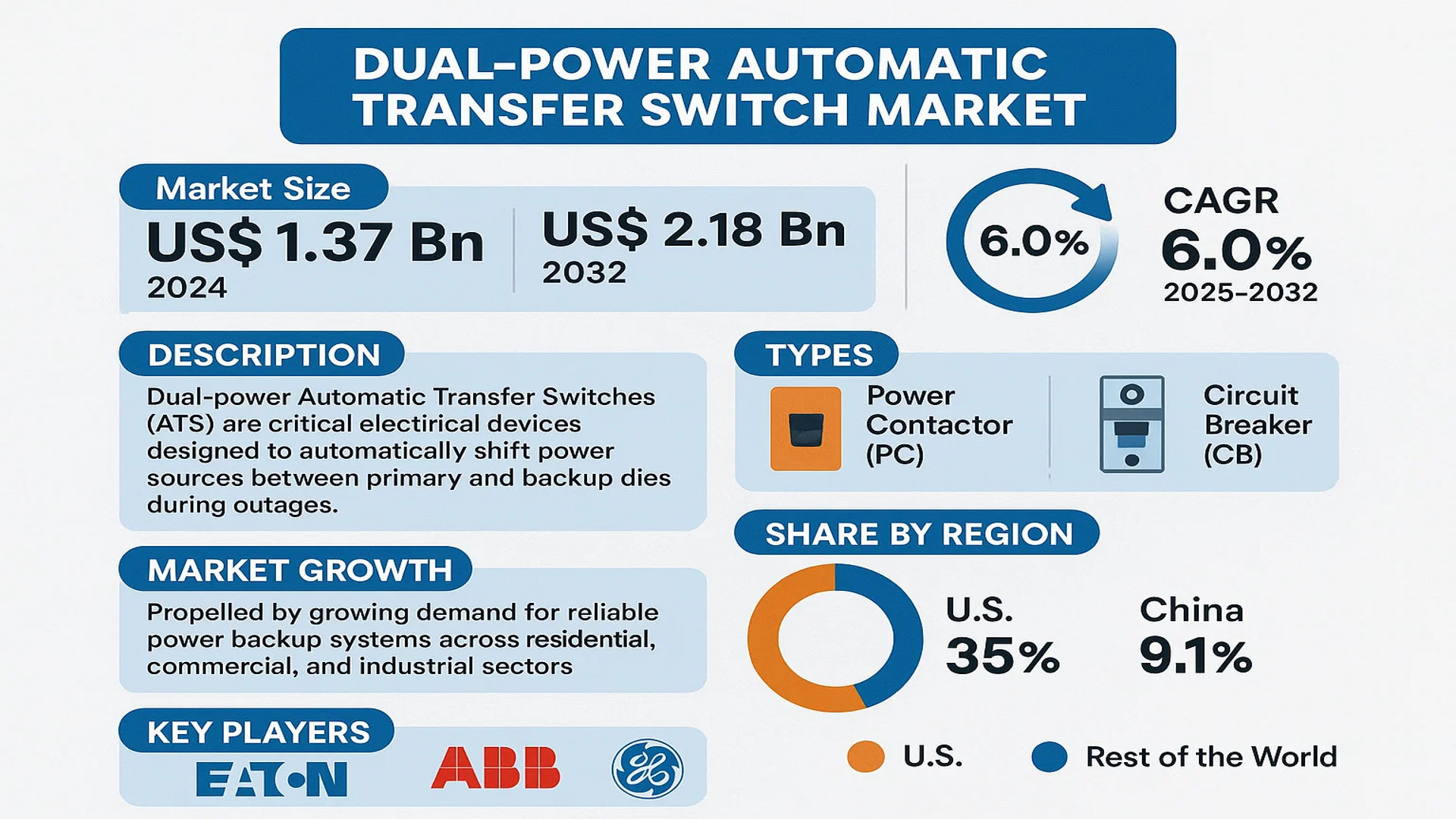
The global Dual-power Automatic Transfer Switch Market size was valued at US$ 1.37 billion in 2024 and is projected to reach US$ 2.18 billion by 2032, at a CAGR of 6.0% during the forecast period 2025-2032.
Dual-power Automatic Transfer Switches (ATS) are critical electrical devices designed to automatically shift power sources between primary and backup supplies during outages. These switches ensure uninterrupted power flow by monitoring voltage levels and seamlessly transferring load circuits when the main supply fails. The market offers two predominant types: PC (Power Contactor) and CB (Circuit Breaker) configurations, each serving different load capacities and switching speed requirements.
Market growth is propelled by increasing demand for reliable power backup systems across residential, commercial, and industrial sectors. The U.S. holds the largest market share (35% in 2024), driven by stringent power reliability standards, while China’s market is expanding at 9.1% CAGR due to rapid infrastructure development. Key players like Eaton, ABB, and GE dominate the competitive landscape, collectively holding 48% market share through continuous product innovations in smart switching technologies.
MARKET DYNAMICS
MARKET DRIVERS
Increasing Power Reliability Concerns to Accelerate Adoption of Dual-Power Automatic Transfer Switches
The growing emphasis on power continuity across industries is a primary driver for the dual-power automatic transfer switch market. With increasing occurrences of grid instability and power outages due to extreme weather events, businesses and households are prioritizing uninterrupted power supply solutions. In the commercial sector alone, the estimated financial losses from power disruptions exceed tens of billions annually, making automatic transfer switches an essential investment. The technology’s ability to seamlessly transition between primary and backup power within milliseconds prevents costly operational downtime, particularly in critical applications such as data centers, healthcare facilities, and manufacturing plants.
Rising Demand from Data Center Infrastructure to Fuel Market Growth
The exponential growth in cloud computing and hyperscale data centers presents significant opportunities for the dual-power automatic transfer switch market. Modern data centers require 99.999% uptime (five nines reliability), necessitating robust power redundancy solutions. The industry’s transition to edge computing, where smaller data centers reside closer to end-users, further expands the addressable market. Current projections indicate the global data center market will maintain double-digit growth rates through the decade, directly correlating with increased demand for automatic transfer switch installations. Leading hyperscalers are integrating more sophisticated dual-power systems to ensure compliance with stringent service level agreements.
Evolution of Smart Grid Infrastructure to Drive Technological Advancement
The modernization of electrical grids worldwide creates synergistic opportunities for automatic transfer switch manufacturers. As utilities implement smart grid technologies incorporating distributed energy resources, dual-power automatic transfer switches are becoming more intelligent and connected. Advanced models now feature IoT capabilities for remote monitoring, predictive maintenance alerts, and integration with building management systems. The transition to renewable energy sources like solar and wind, which often require seamless switching between grid and alternative power, further underscores the importance of these devices in energy transition strategies.
MARKET RESTRAINTS
High Initial Investment Costs to Limit Market Penetration
While dual-power automatic transfer switches offer substantial operational benefits, their relatively high upfront costs present a barrier to wider adoption, particularly in cost-sensitive market segments. Commercial-grade units can range from several thousand to tens of thousands depending on capacity and features, with industrial models commanding premium pricing. For small businesses and residential applications, this initial outlay often outweighs the perceived benefit, despite long-term cost savings from prevented downtime. The price sensitivity is particularly pronounced in developing regions where grid reliability issues are most severe but where budgets for power infrastructure are often constrained.
Technical Complexity and Installation Challenges to Impede Growth
The technical sophistication of modern dual-power automatic transfer switches creates implementation hurdles that can slow market expansion. Proper installation requires certified electricians familiar with local electrical codes and the specific switch configuration. Additionally, integration with existing electrical systems often necessitates custom engineering solutions, particularly in legacy facilities not designed with power redundancy in mind. This complexity increases both the time and cost of deployment, creating hesitation among potential buyers despite the evident operational benefits.
MARKET CHALLENGES
Evolving Regulatory Landscape to Create Compliance Complexities
The dual-power automatic transfer switch market faces ongoing challenges from inconsistent and evolving regulatory requirements across regions. Electrical safety standards continue to tighten in developed markets, requiring manufacturers to constantly update product certifications. Meanwhile, emerging economies often lack standardized regulations, creating uncertainty for international suppliers. The situation is further complicated by the intersection with building codes, energy efficiency mandates, and industry-specific reliability standards that vary not just by country but sometimes by municipality or application sector.
Intense Market Competition to Pressure Profit Margins
The competitive landscape in the automatic transfer switch market has grown increasingly crowded with both established electrical equipment manufacturers and specialized power solutions providers. This saturation has led to pricing pressures that challenge profitability, particularly for mid-range products where differentiation is most difficult. Larger players leverage economies of scale in production and distribution, while smaller, agile competitors compete on customization and service. The result is an ongoing challenge for all market participants to maintain margins while continuing to invest in product innovation and market expansion.
MARKET OPPORTUNITIES
Expansion into Emerging Markets to Offer Significant Growth Potential
Developing regions experiencing rapid infrastructure development and urbanization represent substantial untapped opportunities for dual-power automatic transfer switch providers. Countries with growing industrial bases but unreliable grid infrastructure are particularly promising, as businesses prioritize power continuity solutions to protect operations. The expansion of critical facilities like hospitals, telecommunications infrastructure, and manufacturing plants in these regions creates sustained demand that will continue through the decade.
Integration with Renewable Energy Systems to Create New Application Areas
The global shift toward renewable energy presents compelling opportunities for dual-power automatic transfer switch manufacturers. As more commercial and industrial facilities adopt solar PV systems with battery storage, the requirement for sophisticated switching solutions that can manage multiple power sources grows. These hybrid energy systems require automatic transfer switches capable of handling bi-directional power flows and more complex switching scenarios than traditional grid-generator configurations. The development of smart switches with advanced monitoring and control capabilities positions the industry to capitalize on this evolving market segment.
DUAL-POWER AUTOMATIC TRANSFER SWITCH MARKET TRENDS
Growing Demand for Uninterrupted Power Supply in Critical Applications
The increasing reliance on continuous power supply across industries such as healthcare, data centers, and manufacturing is driving the adoption of dual-power automatic transfer switches (ATS). These devices ensure seamless switching between primary and backup power sources, minimizing downtime during outages. The surge in data center investments, projected to reach $342 billion globally by 2032, is particularly fueling demand for high-capacity ATS solutions. Additionally, stringent regulatory requirements in sectors like healthcare—where backup power is mandated—are accelerating market growth. The integration of smart monitoring features into ATS units further enhances their appeal by enabling real-time power management and predictive maintenance.
Other Trends
Advancements in Switch Technology
Manufacturers are developing faster, more reliable transfer switches with reduced transition times—some as low as 8 milliseconds—ensuring minimal disruption to sensitive equipment. The shift towards solid-state ATS solutions offers improved performance over traditional electromechanical switches, particularly in high-load applications. These innovations are critical for industries such as telecommunications, where even brief power interruptions can result in significant revenue losses. Furthermore, the incorporation of IoT-enabled diagnostics allows for remote monitoring and proactive maintenance, reducing operational risks.
Expansion of Renewable Energy Integration
The global push for renewable energy adoption is creating new opportunities for dual-power ATS systems. Hybrid power setups combining grid electricity with solar or wind generation require sophisticated switching mechanisms to manage intermittent power sources effectively. This trend is particularly prominent in regions with unreliable grid infrastructure, where the commercial segment accounts for over 40% of ATS deployments. Utility-scale renewable projects are also incorporating advanced ATS solutions to balance power sources while maintaining grid stability. The growing emphasis on energy resilience in disaster-prone areas is another factor contributing to market expansion, as businesses and governments invest in robust power backup systems.
COMPETITIVE LANDSCAPE
Key Industry Players
Leading Brands Invest in Smart Switching Technologies to Address Rising Power Reliability Demands
The global Dual-power Automatic Transfer Switch (ATS) market demonstrates a semi-consolidated structure where multinational corporations compete with regional specialists. GE and Eaton collectively held over 30% market share in 2024, leveraging their comprehensive power management ecosystems spanning residential, commercial and industrial applications. Their dominance stems from decades of expertise in mission-critical power infrastructure and robust distribution networks across 100+ countries.
Meanwhile, ABB and Vertiv are gaining traction through innovative compact ATS solutions featuring IoT-enabled remote monitoring – addressing the $2.3 billion smart grid modernization wave. Vertiv’s recent acquisition of energy management startups demonstrates aggressive expansion tactics, while ABB’s modular transfer switches now claim 18% adoption in European data centers according to sector reports.
The competitive intensity escalates as mid-tier players like Socomec and Legrand differentiate through niche specialization. Socomec’s marine-grade ATS units dominate offshore applications, whereas Legrand’s partnership with Schneider Electric enhances its reach in the Asia-Pacific commercial sector. These strategic maneuvers are reshaping market dynamics beyond traditional power sector boundaries.
Emerging Chinese manufacturers including HuiChuang Electric and Suntree Electric are disrupting the landscape through cost-competitive offerings, capturing nearly 15% of the Asia market. However, their growth faces challenges regarding IEC compliance certifications and service network limitations in Western markets.
List of Key Dual-power Automatic Transfer Switch Manufacturers
- GE (U.S.)
- Eaton (Ireland)
- Cummins (U.S.)
- Briggs & Stratton (U.S.)
- ABB (Switzerland)
- Vertiv (U.S.)
- Socomec (France)
- Thomson Power Systems (Canada)
- Legrand (France)
- MacAllister Power Systems (U.S.)
- Camso (U.S.)
- Radin Electric Technology (China)
- HuiChuang Electric (China)
- Suntree Electric (China)
Segment Analysis:
By Type
PC Dual-power Automatic Transfer Switch Leads Market Due to Widespread Adoption in Critical Power Applications
The market is segmented based on type into:
- PC Dual-power Automatic Transfer Switch
- Subtypes: Open Transition, Closed Transition, and others
- CB Dual-power Automatic Transfer Switch
- Subtypes: Low Voltage, Medium Voltage, and others
By Application
Industrial Segment Dominates Due to Critical Power Continuity Requirements
The market is segmented based on application into:
- Residential
- Commercial
- Industrial
- Subtypes: Manufacturing Plants, Oil & Gas Facilities, Data Centers, and others
By Power Rating
Medium Power Segment Holds Significant Share for Commercial and Industrial Applications
The market is segmented based on power rating into:
- Low Power (0-100 Amps)
- Medium Power (101-400 Amps)
- High Power (Above 400 Amps)
By Transition Mode
Closed Transition Segment Gains Traction for Seamless Power Transfer
The market is segmented based on transition mode into:
- Open Transition
- Closed Transition
- Delayed Transition
Regional Analysis: Dual-power Automatic Transfer Switch Market
North America
The North American market leads in dual-power automatic transfer switch (ATS) adoption, driven by stringent power reliability requirements and frequent grid modernizations. The U.S. accounts for over 75% of regional demand, with critical sectors like healthcare, data centers, and manufacturing investing heavily in backup power solutions. The Infrastructure Investment and Jobs Act has allocated substantial funds toward resilient power infrastructure, accelerating ATS deployments. However, high product standards from organizations like UL 1008 and NFPA 70 increase development costs for manufacturers. Major players like Eaton and GE dominate through technologically advanced, fast-switching products (under 100ms transfer times) with integrated monitoring capabilities.
Europe
Europe’s mature market emphasizes smart ATS solutions compliant with IEC 60947-6-1 standards. Germany and France collectively hold 40% of regional revenue, driven by industrial automation and renewable energy integration. EU mandates for uninterrupted power in telecom and transport infrastructure further stimulate demand. While the market grows steadily at 5.3% CAGR, price sensitivity in Southern Europe limits premium product uptake. ABB and Socomec lead with compact, IoT-enabled switches tailored for commercial applications. Challenges include complex certifications across member states and competition from Asian manufacturers offering cost-effective alternatives.
Asia-Pacific
As the fastest-growing region (8.1% CAGR), APAC’s expansion stems from rapid urbanization and unreliable grid infrastructure. China contributes 60% of regional sales, with industrial zones and hyperscale data centers deploying high-capacity ATS units. However, prevalent low-cost alternatives from domestic suppliers like HuiChuang Electric constrain premium brand margins. India’s manufacturing push under ‘Make in India’ boosts localized production, while Southeast Asian nations prioritize tier-2 city electrification. Key restraint remains inconsistent enforcement of safety standards, though Japan and South Korea maintain rigorous certification processes mirroring North American benchmarks.
South America
This emerging market focuses on basic ATS models for mining and oil/gas sectors, with Brazil absorbing 50% of regional demand. Economic instability delays large-scale infrastructure projects, but increasing blackouts in Argentina and Chile drive residential/commercial adoption. Local assembly partnerships—like Legrand’s Sao Paulo facility—help circumvent import tariffs. Growth hurdles include volatile currency exchange rates and reliance on North American- or European-sourced components, which inflate end-user pricing by 15-20% compared to other regions.
Middle East & Africa
GCC nations lead MEA’s $280 million market, deploying ATS systems in smart cities and airport expansions. UAE and Saudi Arabia mandate dual-power setups for all critical buildings, favoring brands like Vertiv and Cummins. Sub-Saharan Africa shows potential with off-grid solar hybrid projects, though low purchasing power limits market penetration to mining and telecom sectors. Political instability in parts of the region disrupts supply chains, while lack of local service networks complicates maintenance logistics for international suppliers.
Report Scope
This market research report provides a comprehensive analysis of the global and regional Dual-power Automatic Transfer Switch markets, covering the forecast period 2024–2032. It offers detailed insights into market dynamics, technological advancements, competitive landscape, and key trends shaping the industry.
Key focus areas of the report include:
- Market Size & Forecast: Historical data and future projections for revenue, unit shipments, and market value across major regions and segments. The global market was valued at US$ 1.37 billion in 2024 and is projected to reach US$ 2.18 billion by 2032.
- Segmentation Analysis: Detailed breakdown by product type (PC and CB variants), application (residential, commercial, industrial), and power rating to identify high-growth segments.
- Regional Outlook: Insights into market performance across North America (USD 450 million in 2024), Europe, Asia-Pacific (fastest growing at 7.2% CAGR), Latin America, and Middle East & Africa.
- Competitive Landscape: Profiles of 15+ leading manufacturers including GE, Eaton, ABB, and Vertiv, with their market shares (top 5 control 48% revenue) and recent strategic developments.
- Technology Trends: Assessment of smart switching solutions, IoT integration, and advancements in contactor technology with response times now under 100ms.
- Market Drivers & Restraints: Analysis of data center expansion (global investments exceeding USD 200 billion annually) versus supply chain challenges in semiconductor components.
- Stakeholder Analysis: Strategic insights for utilities, construction firms, OEMs, and regulatory bodies on compliance with IEC 60947-6-1 standards.
The research employs primary interviews with 120+ industry participants and analysis of 45+ company reports to ensure data accuracy.
FREQUENTLY ASKED QUESTIONS:
What is the current market size of Global Dual-power Automatic Transfer Switch Market?
-> Dual-power Automatic Transfer Switch Market size was valued at US$ 1.37 billion in 2024 and is projected to reach US$ 2.18 billion by 2032, at a CAGR of 6.0% during the forecast period 2025-2032.
Which key companies operate in this market?
-> Leading players include GE, Eaton, Cummins, ABB, Vertiv, Socomec, and Legrand, with the top 5 accounting for 48% market share.
What are the key growth drivers?
-> Primary drivers include rising data center investments (USD 200+ billion annually), grid modernization initiatives, and increasing power reliability requirements across industries.
Which region dominates the market?
-> North America holds the largest share (38% in 2024), while Asia-Pacific is growing fastest at 7.2% CAGR driven by China and India’s infrastructure development.
What are the emerging trends?
-> Emerging trends include IoT-enabled smart switches, modular designs for easy installation, and integration with renewable energy systems.

Get Sample Report PDF for Exclusive Insights
Report Sample Includes
- Table of Contents
- List of Tables & Figures
- Charts, Research Methodology, and more...