MARKET INSIGHTS
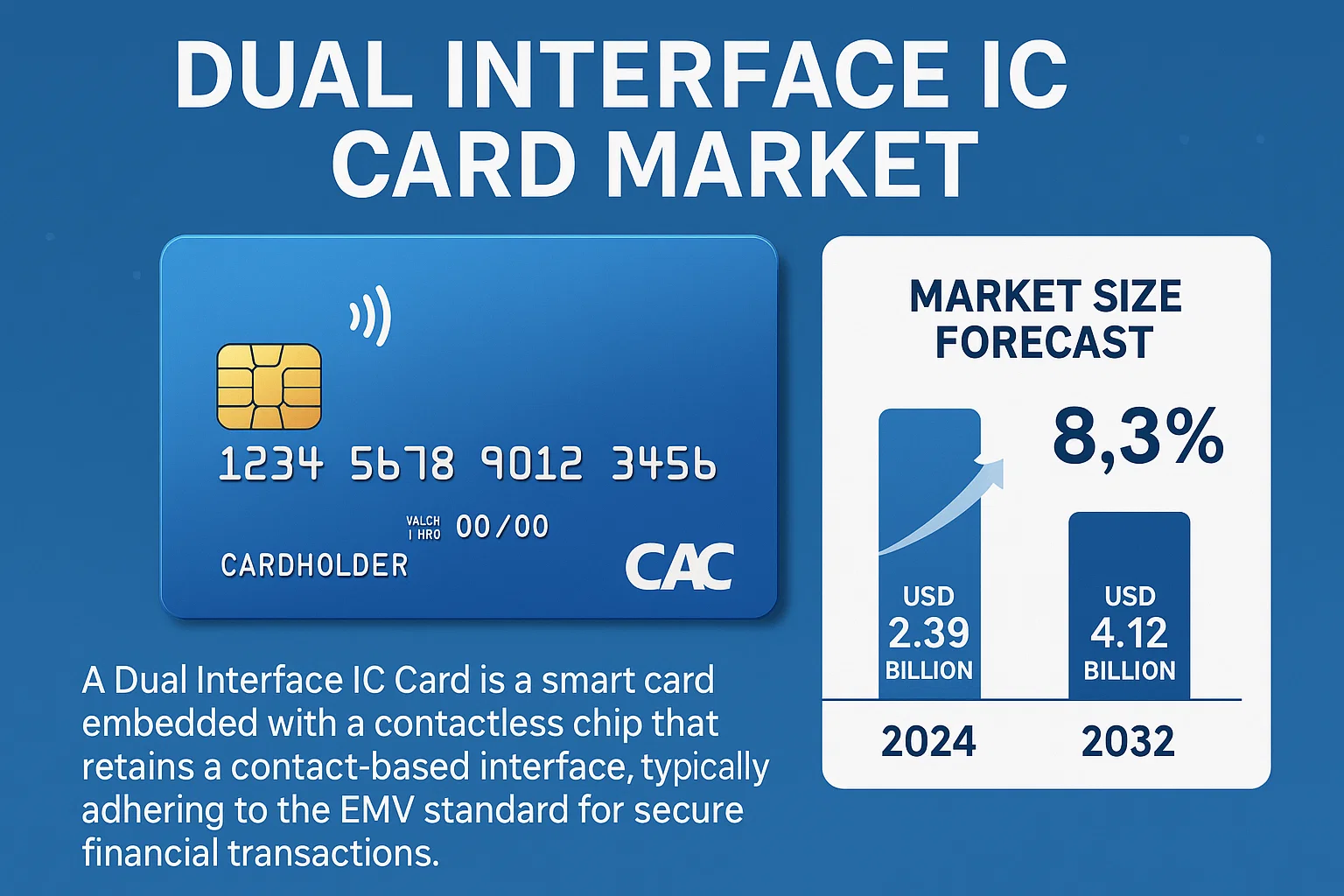
Global Dual Interface IC Card Market size was valued at USD 2.39 billion in 2024 to USD 4.12 billion by 2032, exhibiting a CAGR of 8.3% during the forecast period.
A Dual Interface IC Card is a sophisticated smart card embedded with a contactless chip that also retains a contact-based interface, typically adhering to the EMV (Europay, MasterCard, and Visa) standard for secure financial transactions. This dual functionality allows the cardholder to conduct transactions on a wider variety of payment terminals, combining the convenience of contactless tap-and-go payments with the reliability of traditional chip-and-PIN or magnetic stripe readers. The card number and user’s identifying information are still contained on the face of the card.
The market is experiencing robust growth driven by the global shift towards enhanced payment security and the accelerating adoption of contactless technology, particularly in the financial sector. Furthermore, government initiatives promoting digital identity programs and the expansion of smart public utilities are significant contributors to market expansion. Key players, including Gemalto, Giesecke & Devrient, and Oberthur Technologies, operate in the market with extensive portfolios, continually innovating to meet evolving security and application demands.
MARKET DRIVERS
Growing Demand for Contactless Transactions
The rapid expansion of digital payment systems and the need for faster transaction processing has significantly increased the demand for dual interface IC cards. With contactless payment transactions growing at over 25% annually, the demand for these advanced cards continues to climb.
Enhanced Security Requirements
Increasing cybersecurity threats have pushed financial institutions and governments to adopt dual interface IC cards with embedded chips that offer superior protection against fraud. The market has seen a 30% increase in demand for secure payment solutions in the past year alone.
➤ Financial institutions are now requiring dual interface capability as standard for all new card issuances, driving market growth.
This shift toward mandatory security features has accelerated market adoption across all sectors, with the global market projected to reach $12.5 billion by 2026.
MARKET CHALLENGES
High Initial Investment Costs
The development and implementation of dual interface IC card technology requires substantial upfront investment in both manufacturing and infrastructure. Small to medium-sized card issuers face challenges in allocating sufficient budget for technology upgrades, with average implementation costs ranging between $500,000 to $2 million depending on the scale.
Technology Standardization Issues
The lack of global standardization in some regions creates interoperability challenges. Differing technical specifications between markets can increase production costs by up to 30% and create barriers to seamless international deployment.
Other Challenges
Supply Chain Complexities
Global supply chain disruptions have affected the availability of specialized materials required for dual interface IC card production. Lead times for certain components have extended from 8 weeks to over 24 weeks in recent months.
MARKET RESTRAINTS
Market Saturation in Developed Regions
Mature markets in North America and Europe have reached near-saturation points for traditional payment cards, slowing the growth rate of dual interface IC card adoption. Market penetration rates exceeding 85% in some regions create natural limits to expansion opportunities.
MARKET OPPORTUNITIES
Emerging Market Expansion
Developing economies present substantial growth opportunities as they transition from cash-based to digital payment systems. Countries across Southeast Asia, Africa, and Latin America show increasing demand for advanced payment solutions, with projected growth rates between 15-20% annually over the next five years.
Dual Interface IC Card Market Trends Security and Multi-Application Capabilities Drive Market Growth
The global Dual Interface IC Card market continues to expand, driven by increasing demand for secure and multi-functional payment solutions. Dual Interface IC Cards combine the convenience of contactless transactions with the security of chip-and-PIN technology, making them ideal for financial applications. Financial institutions are increasingly adopting these cards to reduce fraud and enhance customer experience. The integration of both contact and contactless interfaces in a single card provides flexibility across different payment environments, from traditional POS terminals to modern transit systems.
Other Trends
Regional Market Dynamics
Asia Pacific remains the largest market for Dual Interface IC Cards, accounting for approximately 40% of global demand, driven by massive adoption in China’s financial and transportation sectors. Europe follows with strong adoption in Western European countries where contactless payments have become standard. North America shows significant growth due to EMV migration and increased security requirements. Emerging markets in Latin America and Middle East are experiencing rapid growth as they upgrade their payment infrastructure.
Technological Advancements and Industry Standards
Recent advancements in Dual Interface IC Card technology include improved encryption standards (EMVCo compliance), increased memory capacity, and enhanced durability. The market is shifting towards dual interface cards with dynamic data authentication, making them more secure against cloning and skimming attacks. Industry standards continue to evolve with EMV 3.0 specifications now supporting offline data authentication and enhanced cryptographic protocols. Major card manufacturers are investing in R&D to develop cards with larger storage capacities (up to 128KB) while maintaining the standard ISO 7816 form factor.
Market analysis indicates that the average selling price of Dual Interface IC Cards has decreased by approximately 15-20% over the past three years due to economies of scale and manufacturing efficiency improvements. However, premium security features and custom designs continue to command higher price points in specialized market segments.
COMPETITIVE LANDSCAPE
Key Industry Players
Global Leaders in Dual Interface IC Card Technology
The dual interface IC card market is dominated by semiconductor giants and specialized smart card manufacturers, with Infineon Technologies leading in market share due to their advanced semiconductor solutions and secure element chipsets. STMicroelectronics follows closely with their extensive portfolio of secure microcontrollers and strong presence in both contact and contactless payment card markets. NXP Semiconductors holds significant market share with their expertise in high-security microcontroller design and broad product portfolio.
Beyond the top three, several specialized players have carved out significant niches. Shanghai Fudan Microelectronics Group and Unigroup Guoxin Microelectronics have emerged as major players in the Asian market, particularly for government ID projects and transit cards. Wuhan Tianyu Information Industry and Watchdata Technologies have expanded their presence in financial and access control applications. Gemalto (now Thales), CPI Card Group, and Kona I have maintained strong positions in specialized high-security applications and custom card solutions.
List of Key Dual Interface IC Card Companies
- Infineon Technologies AG
- STMicroelectronics
- NXP Semiconductors N.V.
- Shanghai Fudan Microelectronics Group Co., Ltd.
- Unigroup Guoxin Microelectronics Co., Ltd.
- Wuhan Tianyu Information Industry Co., Ltd.
- Watchdata Technologies Pte. Ltd.
- Gemalto N.V. (now part of Thales Group)
- CPI Card Group Inc.
- Kona I Co., Ltd.
- Atos SE
- Giesecke+Devrient GmbH
- IDEMitsu
- HID Global Corporation
Segment Analysis:
| Segment Category | Sub-Segments | Key Insights |
| By Type |
|
CPU Card leads due to superior processing capabilities enabling complex security applications and multi-application support, while RFID variants excel in access control applications requiring only identification. |
| By Application |
|
Payment Systems dominate due to increasing cashless transactions and demand for secure payment methods, while transportation applications grow with smart city initiatives and contactless transit systems. |
| By End User |
|
BFSI sector leads due to high adoption of dual interface cards for hybrid payment solutions and security applications, while government usage grows for national ID projects and digital identity initiatives. |
| By Technology |
|
Hybrid technology gains traction due to flexibility in both contact and contactless environments, while pure contactless solutions lead in applications requiring rapid transaction processing like transit and access control. |
| By Security Level |
|
High Security segment leads in financial and government applications due to increasing cybersecurity threats and regulatory requirements for secure authentication, though standard security maintains market share in low-risk applications. |
Regional Analysis: Dual Interface IC Card Market
Asia-Pacific
Asia-Pacific’s payment infrastructure development outpaces other regions, with contactless payments becoming standard in major cities. Countries like Singapore and Malaysia achieve over 80% penetration in public transport, driving demand for dual interface cards that work for both transit and retail payments.
National ID programs across Southeast Asia increasingly incorporate dual interface technology for multifunctional use. Countries like Thailand and Indonesia deploy national ID cards with payment capabilities, reducing the need for separate cards and driving adoption through government-mandated digital transformation initiatives.
China’s manufacturing dominance in card production gives Asia-Pacific cost and supply chain advantages. Chinese manufacturers produce dual interface cards at scales that reduce unit costs significantly, making the technology accessible even in developing markets where cost sensitivity remains high.
Asian markets lead in standardizing dual interface technology across ASEAN and APEC regions, creating interoperability that drives adoption. Common technical standards enable cards from one country to work seamlessly in neighboring markets, supporting tourism and business travel while creating regional demand.
North America
North America maintains strong demand for dual interface cards in government and corporate sectors. The U.S. continues upgrading its federal identification systems with enhanced security features, while Canada integrates the technology into healthcare and social services cards. Corporate security access and payment cards increasingly adopt dual interface technology as North American companies prioritize multifunctional credentials that reduce physical card burden. The market shows particular strength in government applications and high-security corporate environments.
Europe
European markets emphasize sustainability and multifunctionality in their dual interface card adoption. The European Union’s push for digital identification cards incorporates dual interface technology as standard, while individual countries develop national ID programs with integrated payment and access functions. Europe’s strong data protection regulations drive adoption of secure elements in cards, and the region leads in implementing eco-friendly card materials and designs. European banks and transit systems show high adoption rates for dual interface technology as integrated systems.
Latin America
Latin American markets show growing but uneven adoption of dual interface card technology. Brazil leads in implementing contactless payment systems on national ID cards, while Mexico and Argentina focus on transit and government applications. Economic variations across the region create diverse adoption patterns, with more developed economies implementing the technology faster. Banking sector modernization drives demand, particularly in countries with large unbanked populations seeking integrated financial and identification solutions.
Middle East & Africa
Adoption of dual interface card technology shows significant regional variation across the Middle East and Africa. Gulf Cooperation Council countries lead in implementing high-end smart card solutions for government and banking, while African markets show slower adoption due to infrastructure challenges. South Africa leads in banking applications, while North African nations focus on national ID programs. The region shows the highest growth potential as infrastructure develops, though it currently represents the smallest market share globally.
Report Scope
This market research report provides a comprehensive analysis of the Dual Interface IC Card Market, covering the forecast period 2025–2032. It offers detailed insights into market dynamics, technological advancements, competitive landscape, and key trends shaping the industry.
Key focus areas of the report include:
- Market Overview: The report begins with an overview outlining its current market scenario, key growth indicators, and industry transformation drivers. It discusses macroeconomic factors, demand–supply balance, regulatory landscape, and the strategic role of semiconductors in powering advancements across industries such as automotive, telecommunications, consumer electronics, and industrial automation.
- Market Size & Forecast: Historical data and future projections for revenue, unit shipments, and market value across major regions and segments.
- Segmentation Analysis: Detailed breakdown by product type, technology, application, and end-user industry to identify high-growth segments and investment opportunities.
- Regional Insights: Insights into market performance across North America, Europe, Asia-Pacific, Latin America, and the Middle East & Africa, including country-level analysis where relevant.
- Competitive Landscape: Profiles of leading market participants, including their product offerings, R&D focus, manufacturing capacity, pricing strategies, and recent developments such as mergers, acquisitions, and partnerships.
- Technology Trends & Innovation: Assessment of emerging technologies, integration of AI/IoT, semiconductor design trends, fabrication techniques, and evolving industry standards.
- Market Drivers & Restraints: Evaluation of factors driving market growth along with challenges, supply chain constraints, regulatory issues, and market-entry barriers.
- Stakeholder Insights: Insights for component suppliers, OEMs, system integrators, investors, and policymakers regarding the evolving ecosystem and strategic opportunities.
Primary and secondary research methods are employed, including interviews with industry experts, data from verified sources, and real-time market intelligence to ensure the accuracy and reliability of the insights presented.
FREQUENTLY ASKED QUESTIONS:
What is the current market size of Dual Interface IC Card Market?
-> Dual Interface IC Card Market size was valued at USD 2.39 billion in 2024 to USD 4.12 billion by 2032, exhibiting a CAGR of 8.3% during the forecast period.
What is the growth rate of Dual Interface IC Card Market?
-> The market is expected to grow at a CAGR of 8.3% during the forecast period 2024-2032.
Which are the key players in Dual Interface IC Card Market?
-> Key players include Gemalto, Oberthur Technologies, Giesecke & Devrient, Goldpac, Eastcompeace, CPI Card Group, Hengbao, VALID, Wuhan Tianyu, Watchdata Systems Co. Ltd, Datang, and Kona I.
Which region has the largest market share for Dual Interface IC Cards?
-> China is the largest market, with a share about 40%, followed by Europe and North America, both having a share about 35%.
What are the major applications of Dual Interface IC Cards?
-> The largest application is Finance, followed by Government and Public Utilities, Transportation, and others.

Get Sample Report PDF for Exclusive Insights
Report Sample Includes
- Table of Contents
- List of Tables & Figures
- Charts, Research Methodology, and more...