DTOF Camera Market Insights
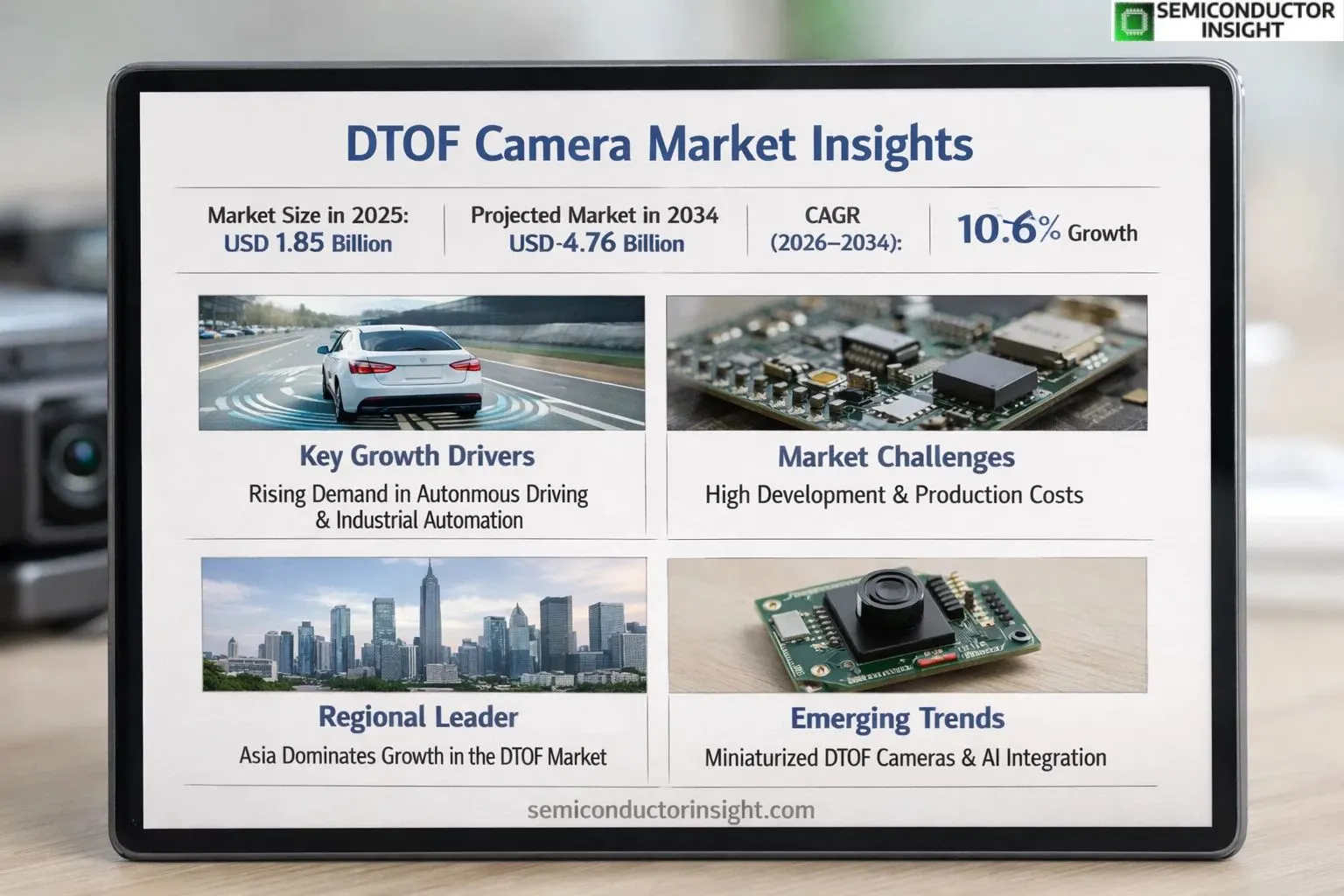
Global DTOF camera market size was valued at USD 1.85 billion in 2025. The market is projected to grow from USD 2.12 billion in 2026 to USD 4.76 billion by 2034, exhibiting a CAGR of 10.6% during the forecast period.
DTOF (Direct Time of Flight) cameras are advanced imaging devices that utilize time-of-flight technology to measure distances by calculating the time taken for light pulses to reflect off objects. These cameras enable high-precision depth sensing and are widely used in applications such as autonomous vehicles, robotics, augmented reality, and industrial automation. Their ability to deliver real-time, accurate depth data makes them indispensable in environments requiring fast and reliable spatial awareness.
The market is experiencing robust growth due to increasing adoption of automation across industries, advancements in LiDAR technology, and rising demand for enhanced safety features in automotive applications. Furthermore, the integration of DTOF cameras in consumer electronics for facial recognition and gesture control is driving expansion. Key players such as Sony, STMicroelectronics, and AMS Osram are investing heavily in R&D to enhance sensor capabilities and reduce costs, further accelerating market penetration.
MARKET DRIVERS
Growing Demand for High-Precision Depth Sensing
The DTOF camera market is experiencing significant growth due to increasing demand for high-precision depth sensing in applications like autonomous vehicles, robotics, and AR/VR. These cameras offer superior accuracy compared to traditional sensing technologies, with error margins below 1% in many applications.
Expansion of 3D Vision Applications
With industries adopting 3D vision technologies for object recognition and spatial mapping, DTOF cameras are becoming essential. Their ability to work in varied lighting conditions and provide real-time depth data makes them ideal for industrial automation and smart surveillance systems.
Global DTOF camera market is projected to grow at 28% CAGR through 2030, driven by automotive LiDAR and consumer electronics integration.
Manufacturers are investing heavily in miniaturized DTOF solutions for smartphones and IoT devices, creating new revenue streams in the consumer electronics segment.
MARKET CHALLENGES
High Development and Production Costs
DTOF camera systems require specialized components like VCSEL arrays and SPAD sensors, leading to higher manufacturing costs compared to conventional cameras. This creates price sensitivity in cost-competitive markets such as consumer electronics.
Other Challenges
Technical Limitations in Outdoor Environments
While DTOF cameras excel indoors, performance can degrade in direct sunlight due to ambient light interference, limiting some automotive and outdoor applications.
MARKET RESTRAINTS
Supply Chain Constraints for Specialized Components
The DTOF camera market faces constraints due to limited global production capacity for time-of-flight sensors and associated optical components. Recent semiconductor shortages have exacerbated lead times, affecting product availability across industries.
MARKET OPPORTUNITIES
Emerging Applications in Healthcare and Biometrics
The healthcare sector presents significant growth potential for DTOF cameras, particularly in patient monitoring systems and touchless biometric authentication. Recent advancements have enabled sub-millimeter accuracy in medical imaging applications.
Integration with Edge AI Processing
Combining DTOF technology with on-device AI processing creates opportunities for real-time depth analysis in smart cities and industrial IoT applications, reducing latency and cloud dependency.
DTOF Camera Market Trends
Growing Adoption in Autonomous Driving Applications
The DTOF camera market is witnessing significant growth due to increasing integration in autonomous vehicles. These cameras provide precise depth sensing and obstacle detection capabilities, critical for advanced driver-assistance systems (ADAS). Major automotive manufacturers are increasingly adopting DTOF technology for its superior performance in varying lighting conditions and long-range detection.
Other Trends
Expansion in Industrial Automation
DTOF cameras are being widely adopted in industrial automation for quality control, robotic navigation, and logistics optimization. Their ability to provide accurate 3D mapping in real-time makes them ideal for smart manufacturing environments where precision and speed are paramount.
Technological Advancements in Consumer Electronics
Recent innovations in DTOF camera technology have enabled their use in smartphones and augmented reality devices. Improved power efficiency and smaller form factors are driving adoption of DTOF cameras in mobile devices for applications like facial recognition and 3D scanning.
Other Trends
Increasing Demand in Security Systems
The security and surveillance sector is increasingly utilizing DTOF cameras for perimeter monitoring and object tracking. Their capability to accurately measure distances in low-light conditions provides enhanced security solutions compared to traditional surveillance systems.
Regional Market Developments
Asia Pacific is emerging as a key growth region for the DTOF camera market, driven by technological advancements in China, Japan, and South Korea. These regions are witnessing substantial investments in autonomous driving and industrial automation sectors, creating significant demand for DTOF camera solutions.
COMPETITIVE LANDSCAPE
Key Industry Players
DTOF Camera Market Dominated by Semiconductor and Imaging Specialists
The DTOF camera market is characterized by the dominance of semiconductor giants and specialized imaging technology providers. AMS Osram and STMicroelectronics lead the market with their advanced 3D sensing solutions, particularly in automotive and industrial applications. Sony has made significant strides in consumer electronics integration, while Velodyne Lidar and Hesai Technology maintain strong positions in autonomous vehicle applications. The competitive landscape shows increasing vertical integration, with companies like Asahi Kasei Microdevices developing complete sensor-to-algorithm solutions.
Niche players are carving out specialized segments, with Adaps Photonics focusing on high-precision industrial applications and Lucid Vision Labs targeting machine vision systems. Chinese manufacturers like Guangyan Technology and Polarisic Microelectronics are rapidly gaining market share through cost-competitive offerings. Emerging startups such as Innoviz Technologies and Ouster are driving innovation in compact, low-power DTOF solutions for mobile and IoT applications, while established players like Delta Electronics leverage their industrial automation expertise.
List of Key DTOF Camera Companies Profiled
- AMS Osram
- STMicroelectronics
- Sony Semiconductor Solutions
- Asahi Kasei Microdevices
- Polarisic Microelectronics
- Adaps Photonics
- Delta Electronics
- Lucid Vision Labs
- Guangyan Technology
- Velodyne Lidar
- Quanergy Systems
- LeddarTech
- Ouster
- Hesai Technology
- Innoviz Technologies
Segment Analysis:
| Segment Category | Sub-Segments | Key Insights |
| By Type |
|
Integrated DTOF Cameras dominate due to their compact form factor and seamless integration capabilities:
|
| By Application |
|
Autonomous Driving represents the highest growth application segment:
|
| By End User |
|
Automotive Manufacturers drive significant adoption of DTOF technology:
|
| By Resolution |
|
High Resolution DTOF cameras show strongest market traction:
|
| By Technology |
|
SPAD Technology emerges as the most innovative solution:
|
Regional Analysis: Global DTOF Camera Market
Asia-Pacific Region
Asia-Pacific accounts for over 60% of global DTOF camera integration in smartphones. Chinese OEMs innovate with under-display and multi-camera configurations while Korean brands lead in premium implementations.
Japanese manufacturers pioneer DTOF applications in robotics and quality control systems. Tight integration with machine vision platforms creates new industrial use cases across the region’s manufacturing base.
Supply Chain Advantages
Proximity to CMOS sensor foundries and optical component suppliers gives Asian manufacturers faster development cycles. Taiwan and South Korea host specialized DTOF module assembly facilities serving global brands.
Southeast Asian startups are adopting DTOF for smart retail and logistics. Government initiatives in Singapore and Malaysia support testbeds for DTOF-based smart city applications and biometric systems.
North America
The North American DTOF camera market thrives on advanced R&D and early adoption in specialized applications. Silicon Valley drives innovation in automotive LiDAR and medical imaging applications. U.S. tech giants invest heavily in DTOF for AR/VR platforms and depth sensing solutions. The region shows strong demand from industrial automation and defense sectors requiring high-precision 3D imaging. Canadian startups pioneer DTOF applications in agricultural technology and drone-based surveying.
Europe
European manufacturers focus on high-performance DTOF solutions for automotive and industrial markets. German automotive suppliers integrate DTOF cameras for advanced driver assistance systems. The region maintains leadership in scientific and medical DTOF applications through specialized optic manufacturers. EU research funding supports DTOF development for robotics and smart infrastructure projects across member states.
Middle East & Africa
The MEA region shows emerging DTOF adoption in security and smart city applications. Gulf states invest in 3D sensing for border control and crowd monitoring systems. South Africa develops niche applications in mining safety and resource management. Limited local manufacturing creates opportunities for international DTOF suppliers across the region.
South America
Brazil leads regional DTOF adoption in agricultural technology and industrial automation. Argentine startups explore DTOF applications in augmented reality education platforms. The region benefits from increasing smartphone penetration driving demand for consumer-grade DTOF cameras. Infrastructure projects create opportunities for construction monitoring and surveying applications.
Report Scope
This market research report provides a comprehensive analysis of the DTOF Camera Market, covering the forecast period 2025–2034. It offers detailed insights into market dynamics, technological advancements, competitive landscape, and key trends shaping the industry.
Key focus areas of the report include:
-
Market Overview: The report begins with an overview outlining its current market scenario, key growth indicators, and industry transformation drivers. It discusses macroeconomic factors, demand–supply balance, regulatory landscape, and the strategic role of DTOF cameras in powering advancements across industries such as autonomous driving, security monitoring, industrial automation, and consumer electronics.
- Market Size & Forecast: Historical data and future projections for revenue, unit shipments, and market value across major regions and segments.
- Segmentation Analysis: Detailed breakdown by product type (Standalone, Integrated), application (Autonomous Driving, Security Monitoring, Industrial Automation, Others), and end-user industry to identify high-growth segments and investment opportunities.
- Regional Insights: Insights into market performance across North America, Europe, Asia, South America, and Middle East & Africa, including country-level analysis where relevant.
- Competitive Landscape: Profiles of leading market participants, including their product offerings, R&D focus, manufacturing capacity, pricing strategies, and recent developments such as mergers, acquisitions, and partnerships.
- Technology Trends & Innovation: Assessment of emerging technologies, integration of AI/3D sensing, semiconductor design trends, and evolving industry standards.
- Market Drivers & Restraints: Evaluation of factors driving market growth along with challenges, supply chain constraints, regulatory issues, and market-entry barriers.
- Stakeholder Insights: Insights for component suppliers, OEMs, system integrators, investors, and policymakers regarding the evolving ecosystem and strategic opportunities.
Primary and secondary research methods are employed, including interviews with industry experts, data from verified sources, and real-time market intelligence to ensure the accuracy and reliability of the insights presented.
FREQUENTLY ASKED QUESTIONS:
What is the current market size of DTOF Camera Market?
-> Global DTOF Camera Market was valued at USD 1.85 billion in 2025 and is projected to reach USD 4.76 billion by 2034.
Which key companies operate in DTOF Camera Market?
-> Key players include AMS Osram, STMicroelectronics, Adaps Photonics, Asahi Kasei Microdevices, Sony, Polarisic Microelectronics, Shenzhen Fushi Technology, and Velodyne Lidar, among others.
What are the key growth drivers?
-> Key growth drivers include rising demand in autonomous driving, expansion of security monitoring systems, and increasing adoption in industrial automation.
Which region dominates the market?
-> Asia is the fastest-growing region, driven by technological advancements in China, Japan, and South Korea.
What are the emerging trends?
-> Emerging trends include integration with AI systems, development of miniaturized DTOF cameras, and expansion in robotics applications.

Get Sample Report PDF for Exclusive Insights
Report Sample Includes
- Table of Contents
- List of Tables & Figures
- Charts, Research Methodology, and more...
 Download Sample Report PDF