DPF Differential Pressure Sensors Market, Trends, Business Strategies 2026-2034

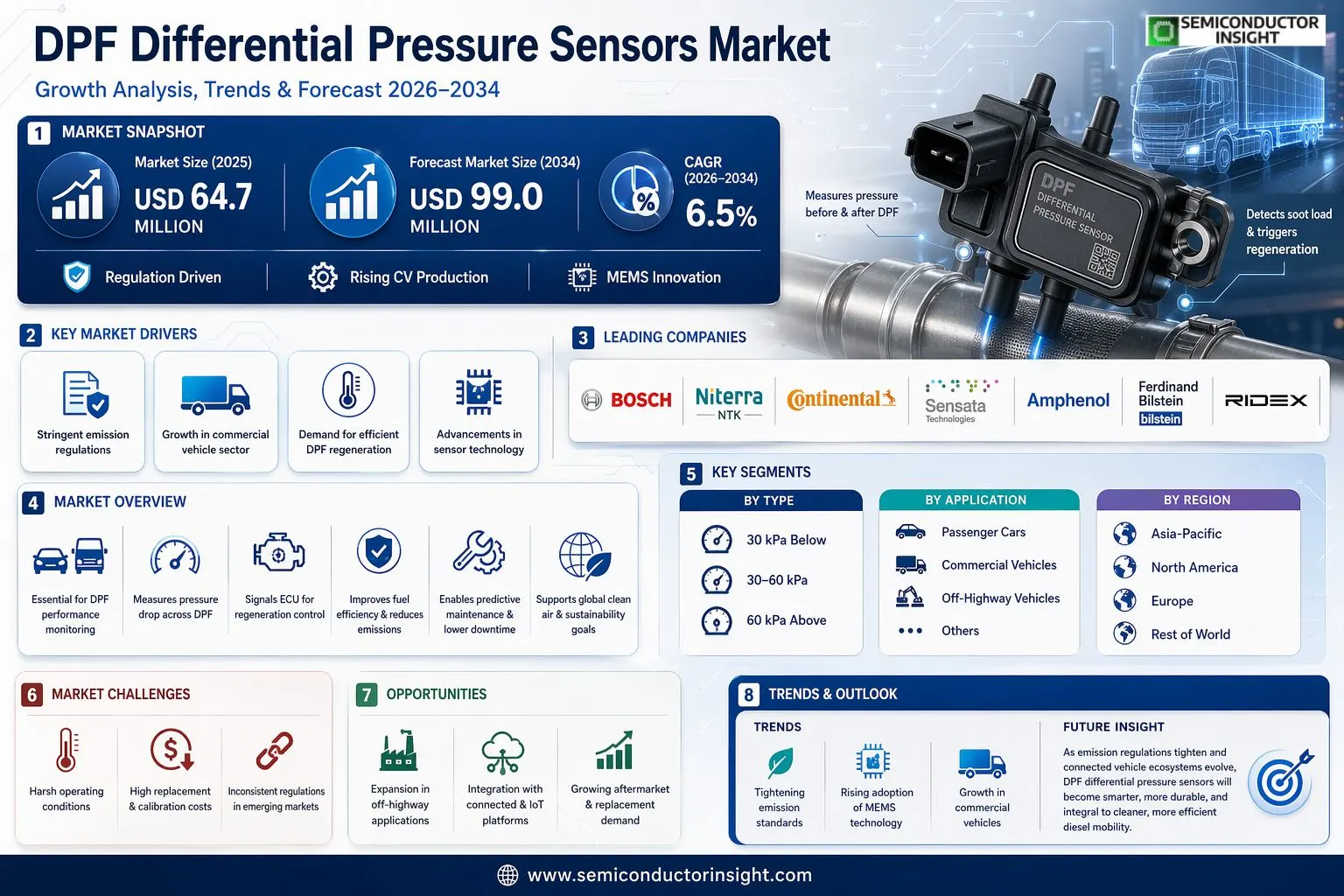
Global DPF Differential Pressure Sensors Market was valued at USD 64.7 million in 2025 and is expected to reach USD 99 million by 2034, growing at a CAGR of 6.5% during the forecast period

PDF Icon Download Sample Report PDF
  • Quick Dispatch

    All Orders

  • Secure Payment

    100% Secure Payment

Price range: $1,500.00 through $4,250.00

Clear

DPF Differential Pressure Sensors Market Insights

Global DPF Differential Pressure Sensors market size was valued at USD 64.7 million in 2025. The market is projected to grow from USD 68.9 million in 2026 to USD 99.0 million by 2034, exhibiting a CAGR of 6.5% during the forecast period.

In diesel engines, differential pressure sensors are installed before and/or after the diesel particulate filter (DPF) to monitor filter performance in real time. These filters operate at an optimum temperature range at which they efficiently combust the fine particulate matter captured during exhaust. A measurable drop in pressure across the filter signals that soot accumulation is beginning to restrict flow. To prevent clogging and ensure continued engine efficiency, the pressure sensor transmits a signal to the Engine Control Unit (ECU), which then raises the exhaust gas temperature to initiate filter regeneration , effectively extending the operational life of the DPF system. Sensors are broadly categorized by pressure range, including 30 kPa Below, 30–60 kPa, and 60 kPa Above variants, serving both passenger cars and commercial vehicles.

The market is driven by increasingly stringent global vehicle emission regulations, including Euro 6 and China 6 standards, which mandate DPF systems across a wide range of diesel-powered vehicles. The growing commercial vehicle fleet in emerging economies , particularly across Asia and South America , further reinforces demand. Key manufacturers active in this space include Bosch, Niterra (NTK), Continental, Amphenol, Sensata, Ferdinand Bilstein, RIDEX, Jiangsu Olive Sensors High-tech, Mobiletron, and Wuhan Fine MEMS, among others, collectively accounting for a significant share of global revenues in 2025.
 

MARKET DRIVERS

Stringent Emission Regulations Accelerating DPF Differential Pressure Sensors Adoption

DPF Differential Pressure Sensors Market is experiencing robust demand primarily due to the tightening of vehicular emission standards across major economies. Regulatory frameworks such as Euro 6 in Europe, EPA Tier standards in North America, and BS6 norms in India have made diesel particulate filter systems mandatory in commercial and passenger vehicles. Since DPF differential pressure sensors are essential for monitoring filter loading and triggering regeneration cycles, compliance with these norms directly drives sensor procurement across automotive OEMs and aftermarket channels. The correlation between emission legislation stringency and sensor adoption is well-established, making regulatory compliance one of the most consistent growth drivers in this market.

Rising Diesel Vehicle Parc and Growing Demand for Aftermarket Replacement Sensors

Despite the gradual shift toward electrification, Global diesel vehicle parc , particularly among commercial vehicles, off-highway equipment, and heavy-duty trucks , remains substantial. This large installed base creates a sustained aftermarket demand for DPF differential pressure sensors, which are subject to wear, contamination, and failure over time. Fleet operators and vehicle service centers increasingly rely on accurate differential pressure data to optimize maintenance schedules and prevent costly DPF failures. The aftermarket replacement segment represents a reliable and growing revenue stream for sensor manufacturers, especially in regions where diesel-powered commercial transportation continues to dominate logistics and infrastructure sectors.

Advancements in Sensor Technology Enhancing Accuracy and Durability

Continuous technological innovation in MEMS-based pressure sensing, digital signal processing, and high-temperature resistant materials has significantly enhanced the performance profile of DPF differential pressure sensors. Modern sensors offer improved measurement accuracy across a wide operating temperature range, greater resistance to vibration and particulate contamination, and compatibility with advanced vehicle diagnostics systems. These improvements have expanded the applicability of DPF differential pressure sensors beyond passenger cars into construction equipment, marine diesel engines, and stationary power generation units, thereby broadening the total addressable market for sensor suppliers.

The integration of DPF differential pressure sensors with onboard diagnostics (OBD) and telematics platforms is enabling real-time filter health monitoring, creating new value propositions for fleet management and predictive maintenance applications.

The convergence of sensor intelligence with connected vehicle ecosystems is further amplifying market growth. As vehicle manufacturers embed DPF differential pressure sensors deeper into engine management architectures, demand for sensors with digital output interfaces, CAN bus compatibility, and self-diagnostic capabilities is rising. This technological evolution is fostering stronger collaboration between sensor manufacturers and automotive electronics suppliers, reinforcing DPF Differential Pressure Sensors Market’s long-term growth trajectory.

MARKET CHALLENGES

Sensor Fouling and Harsh Operating Conditions Posing Reliability Challenges

One of the most persistent technical challenges faced by DPF Differential Pressure Sensors Market is the exposure of sensors to extreme operating environments. High exhaust temperatures, particulate-laden gas streams, condensation, and vibration can compromise sensor accuracy and longevity. Soot accumulation in pressure ports and reference tubes is a known failure mode that leads to signal drift or complete sensor failure, triggering false regeneration events or missed regeneration cycles. Addressing these reliability concerns requires ongoing investment in ruggedized sensor designs and advanced filtration mechanisms, adding to manufacturing complexity and cost for sensor producers.

Other Challenges

Competitive Pricing Pressure from Low-Cost Regional Manufacturers

DPF Differential Pressure Sensors Market faces intensifying price competition, particularly from manufacturers based in Asia-Pacific who offer lower-cost alternatives that may not consistently meet OEM-grade performance specifications. This creates margin pressure for established sensor suppliers and complicates procurement decisions for cost-sensitive fleet operators and independent aftermarket distributors. Differentiating on quality, reliability, and application engineering support remains critical for premium sensor brands seeking to defend market share against low-cost alternatives.

Electrification Trends Creating Long-Term Demand Uncertainty

The accelerating global transition toward battery electric vehicles (BEVs) and hydrogen fuel cell vehicles presents a structural challenge to the long-term growth outlook of DPF Differential Pressure Sensors Market. As diesel engine penetration in passenger cars declines in key markets such as Western Europe, the addressable sensor market in that segment faces gradual contraction. While commercial vehicle electrification is proceeding at a slower pace, sensor manufacturers must strategically diversify into adjacent markets and non-automotive diesel applications to mitigate the impact of long-term powertrain transitions on their DPF sensor business.

MARKET RESTRAINTS

Declining Diesel Passenger Vehicle Sales in Key Markets Constraining OEM Demand

The sustained decline in diesel passenger car sales across Western Europe, historically the largest market for DPF-equipped vehicles, represents a meaningful restraint on OEM-side demand for DPF differential pressure sensors. Consumer and regulatory preference for petrol hybrid and battery electric vehicles has reduced new diesel registrations significantly over the past several years. As a direct consequence, automotive OEM procurement volumes for DPF-related components, including differential pressure sensors, are under downward pressure in these markets. Sensor manufacturers with a heavy reliance on passenger car OEM contracts are particularly exposed to this structural demand shift.

Supply Chain Vulnerabilities and Raw Material Cost Fluctuations

DPF Differential Pressure Sensors Market is not immune to broader supply chain disruptions that have affected the automotive components industry. Shortages of semiconductor chips, specialized piezo-resistive materials, and electronic substrates have at times constrained sensor production capacity. Additionally, fluctuations in the cost of key raw materials such as stainless steel, ceramic substrates, and electronic-grade silicon directly impact manufacturing cost structures. These supply-side constraints can delay product availability, inflate input costs, and compress profit margins, especially for smaller sensor suppliers with limited procurement leverage and inventory buffers.

Counterfeit and Sub-Standard Sensors Undermining Market Integrity

The proliferation of counterfeit and non-certified DPF differential pressure sensors in the aftermarket channel poses a significant restraint on revenue quality and brand trust for legitimate sensor manufacturers. Sub-standard sensors that fail prematurely or deliver inaccurate pressure readings can cause DPF system malfunctions, increased emissions, and potential engine damage, leading to warranty disputes and reputational harm. The challenge is particularly acute in price-sensitive emerging markets where distribution channels are fragmented and quality enforcement mechanisms are limited. Combating this issue requires coordinated efforts across manufacturers, distributors, and regulatory bodies to implement traceability standards and authentic product verification systems.

MARKET OPPORTUNITIES

Expansion of Emission Norms in Emerging Economies Opening New Growth Frontiers

Emerging economies across Asia-Pacific, Latin America, and Africa are progressively adopting more stringent vehicular emission standards, creating significant untapped demand for DPF systems and associated differential pressure sensors. Countries such as India, Brazil, China, and several Southeast Asian nations are at various stages of implementing Euro-equivalent emission norms for commercial vehicles and off-road equipment. As these regulatory transitions unfold, domestic and multinational sensor manufacturers have a compelling opportunity to establish early supply chain relationships with local vehicle manufacturers and build distribution infrastructure ahead of peak demand cycles in these high-growth markets.

Growing Non-Automotive Applications Diversifying DPF Differential Pressure Sensors Market

Beyond automotive applications, DPF Differential Pressure Sensors Market is finding growing relevance in non-road mobile machinery (NRMM), marine diesel engines, agricultural equipment, and industrial power generation units, all of which are increasingly subject to particulate emission regulations. Construction and mining equipment operating in urban environments, as well as diesel generators used in data centers and hospitals, require reliable DPF monitoring systems. This diversification into non-automotive diesel applications provides sensor manufacturers with revenue streams that are less susceptible to passenger vehicle electrification trends, offering a strategic pathway for sustainable growth over the medium to long term.

Integration with Predictive Maintenance and IoT Platforms Creating Value-Added Opportunities

The growing adoption of predictive maintenance strategies in fleet management, supported by Industrial IoT platforms and telematics solutions, is creating a premium demand segment for intelligent DPF differential pressure sensors with enhanced digital communication capabilities. Sensor manufacturers that can offer products with integrated data logging, anomaly detection algorithms, and cloud connectivity stand to capture higher margin business from fleet operators and OEMs investing in connected aftertreatment management systems. This convergence of sensor hardware with data analytics services represents a structural opportunity for DPF Differential Pressure Sensors Market to evolve beyond commodity component supply toward higher-value solution-based business models.

 Trends

Rising Emission Regulations Driving Adoption of DPF Differential Pressure Sensors

Stringent emission norms across major economies have become one of the most influential forces shaping DPF Differential Pressure Sensors Market. Regulatory frameworks such as Euro 6 in Europe and EPA Tier standards in North America mandate the use of diesel particulate filters in both passenger cars and commercial vehicles. As these filters require continuous monitoring to maintain regeneration efficiency, the demand for reliable differential pressure sensors has grown considerably. Automakers and fleet operators are increasingly integrating advanced sensor solutions to ensure compliance and avoid costly penalties, reinforcing the market’s upward trajectory across developed and emerging regions alike.

Other Trends

Electrification and Hybrid Powertrain Coexistence

While electrification is transforming the automotive landscape, internal combustion diesel engines continue to dominate commercial transportation globally. Heavy-duty trucks, construction equipment, and agricultural machinery still rely on diesel powertrains, sustaining consistent demand for DPF differential pressure sensors. Hybrid commercial vehicles that retain diesel engines also require DPF monitoring systems, creating an extended window of relevance for sensor manufacturers. Key players such as Bosch, Continental, and Sensata are developing compact, high-accuracy sensors suited for next-generation hybrid diesel platforms.

Shift Toward MEMS-Based Sensor Technology

Micro-Electro-Mechanical Systems (MEMS) technology is gaining traction within DPF Differential Pressure Sensors Market. MEMS-based sensors offer superior sensitivity, reduced size, and lower power consumption compared to traditional piezoresistive designs. Manufacturers such as Wuhan Fine MEMS and Jiangsu Olive Sensors High-tech are actively advancing MEMS capabilities to address evolving OEM requirements. This technological shift is enabling more precise pressure readings across the 30 kPa below, 30–60 kPa, and 60 kPa above segments, supporting more accurate DPF regeneration cycles and longer filter service life.

Asia-Pacific Emerging as a High-Growth Region

Asia-Pacific, led by China, Japan, South Korea, and India, is witnessing accelerating adoption of DPF differential pressure sensors driven by tightening vehicle emission standards and rapid expansion of commercial vehicle fleets. China’s national emission standards have pushed domestic automakers to integrate DPF systems more broadly, benefiting both global and local sensor suppliers. Regional manufacturers are scaling production capacities to meet rising demand, while international players are establishing local partnerships to strengthen their market presence across Southeast Asia and India.

Aftermarket Expansion Supporting Long-Term Market Stability

The growing vehicle parc of diesel-powered cars and trucks worldwide is fueling a robust aftermarket for DPF differential pressure sensors. As vehicles age, sensor replacement becomes a routine maintenance requirement to sustain DPF performance and meet roadworthiness standards. Aftermarket-focused brands such as RIDEX and Ferdinand Bilstein are expanding their sensor portfolios to cover a wide range of vehicle applications. This aftermarket momentum provides a steady revenue stream that complements OEM supply channels, contributing to the overall resilience of DPF Differential Pressure Sensors Market over the forecast period.

COMPETITIVE LANDSCAPE

Key Industry Players

DPF Differential Pressure Sensors Market , Global Competitive Dynamics and Leading Manufacturer Profiles

Global DPF Differential Pressure Sensors market, valued at USD 64.7 million in 2025 and projected to reach USD 99 million by 2034 at a CAGR of 6.5%, is characterized by a moderately consolidated competitive landscape dominated by a handful of established automotive sensor and electronics manufacturers. Bosch remains the foremost player in this space, leveraging its deep integration within the automotive OEM supply chain, extensive R&D capabilities, and broad product portfolio spanning diesel exhaust aftertreatment systems. Continental and Sensata Technologies also command significant market positions, benefiting from long-standing partnerships with major vehicle manufacturers and a strong foothold in both passenger car and commercial vehicle segments. These top five companies collectively accounted for a substantial share of global revenue in 2025, underscoring the importance of scale, technological expertise, and regulatory compliance in maintaining competitive advantage as increasingly stringent emissions standards worldwide continue to drive adoption of DPF-based filtration systems.

Beyond the top-tier players, the market features several noteworthy niche and regional participants that are gaining traction through cost-competitive manufacturing, specialized MEMS-based sensor technologies, and localized supply chain advantages. Jiangsu Olive Sensors High-tech, Wuhan Fine MEMS, Kesens, and Huasder Electronic Technology represent a growing cohort of Chinese manufacturers capitalizing on robust domestic demand driven by China’s tightening diesel emission regulations, while companies such as Niterra (NTK), Mobiletron, Ferdinand Bilstein, RIDEX, and Amphenol serve diverse global markets with complementary product offerings across varying pressure ranges , including the 30 kPa Below, 30–60 kPa, and 60 kPa Above segments. The competitive intensity in this market is further amplified by ongoing product innovation focused on enhanced sensor accuracy, miniaturization, and durability under high-temperature exhaust conditions, as manufacturers vie to differentiate their offerings and secure long-term supply contracts with both OEM and aftermarket channel partners.

List of Key DPF Differential Pressure Sensors Companies Profiled

Segment Analysis:

Segment Category Sub-Segments Key Insights
By Type
  • 30 kPa Below
  • 30–60 kPa
  • 60 kPa Above
30–60 kPa represents the leading segment in DPF Differential Pressure Sensors Market by type, owing to its broad compatibility with the majority of diesel engine platforms used in both passenger and commercial applications.

  • This pressure range aligns with the standard operating thresholds of most OEM-specified diesel particulate filter systems, making it the preferred choice for automotive manufacturers seeking reliable and cost-effective sensing solutions.
  • Sensors within this range offer an optimal balance between sensitivity and durability, ensuring accurate detection of filter soot accumulation without susceptibility to false triggering from minor pressure fluctuations.
  • The 30 kPa Below sub-segment is gaining traction in next-generation low-emission diesel engines where finer pressure differentials are critical for early-stage DPF regeneration management, reflecting evolving engine design trends toward tighter emission controls.
  • The 60 kPa Above sub-segment caters to heavy-duty and high-performance diesel engines, particularly in commercial trucking and off-highway machinery, where elevated exhaust backpressure demands more robust sensing capabilities.
By Application
  • Passenger Cars
  • Commercial Vehicles
  • Off-Highway Vehicles
  • Others
Commercial Vehicles represent the dominant application segment for DPF Differential Pressure Sensors, driven by the intensive use of diesel powertrains across logistics, public transport, and heavy hauling fleets.

  • Commercial vehicle operators face stringent regulatory requirements regarding particulate emissions, particularly under Euro VI and EPA Phase 2 standards, necessitating continuous and precise DPF monitoring to avoid non-compliance penalties and unplanned downtime.
  • The high mileage and heavy load cycles typical of commercial fleets accelerate filter soot loading, making reliable differential pressure sensing essential for timely regeneration cycles and extended filter service life.
  • Passenger cars, while a considerable segment, are transitioning toward electrification in key markets; however, diesel passenger vehicles in emerging economies and Europe continue to sustain strong demand for DPF sensor integration in aftermarket and OEM channels alike.
  • Off-highway vehicles such as construction equipment, agricultural machinery, and mining vehicles represent a growing niche application, as emission regulations for non-road mobile machinery (NRMM) tighten globally.
By End User
  • Original Equipment Manufacturers (OEMs)
  • Aftermarket Service Providers
  • Fleet Operators
Original Equipment Manufacturers (OEMs) constitute the leading end-user segment, as DPF differential pressure sensors are increasingly integrated at the design and manufacturing stage of diesel-powered vehicles and machinery.

  • OEMs such as major automotive and heavy equipment manufacturers mandate the inclusion of high-precision DPF sensors to comply with emission norms and to deliver enhanced engine management capabilities through integration with the Engine Control Unit (ECU).
  • The deep collaboration between leading sensor manufacturers like Bosch, Continental, and Sensata with global OEM partners ensures that DPF sensors are engineered to exact vehicle platform specifications, creating significant barriers for aftermarket substitutes in primary fitment.
  • Aftermarket service providers represent a rapidly growing end-user category, particularly in regions with large aging diesel vehicle fleets where OEM sensor replacements are sought for vehicle maintenance, emission compliance, and performance restoration.
  • Fleet operators are emerging as a distinct end-user group, increasingly investing in predictive maintenance solutions that incorporate DPF sensor data analytics to optimize regeneration scheduling and reduce operational costs across large vehicle pools.
By Technology
  • MEMS-Based Sensors
  • Piezoresistive Sensors
  • Capacitive Sensors
MEMS-Based Sensors lead the technology segment of DPF Differential Pressure Sensors Market, owing to their miniaturized form factor, high accuracy, and suitability for integration into modern automotive electronic architectures.

  • Micro-Electro-Mechanical Systems (MEMS) technology enables the production of highly compact and lightweight sensors that can be embedded directly within exhaust management systems without adding significant weight or bulk, aligning with automotive lightweighting trends.
  • MEMS-based sensors demonstrate superior thermal resilience and long-term signal stability under the extreme temperature and vibration conditions inherent to diesel exhaust environments, making them the preferred solution for demanding OEM applications.
  • Emerging players from China, such as Wuhan Fine MEMS, are actively advancing MEMS sensor manufacturing capabilities, intensifying competition and driving further innovation in cost-efficient, high-performance DPF sensing solutions for global markets.
  • Piezoresistive sensors remain relevant in cost-sensitive aftermarket applications where proven reliability and lower unit cost outweigh the performance advantages of more advanced MEMS architectures.
By Sales Channel
  • Direct OEM Supply
  • Authorized Distributors
  • Independent Aftermarket Channels
Direct OEM Supply is the predominant sales channel for DPF Differential Pressure Sensors, reflecting the highly integrated nature of sensor procurement within automotive and heavy equipment supply chains.

  • Long-term supply agreements between tier-one sensor manufacturers and major vehicle OEMs create stable, high-volume procurement pipelines that prioritize quality certification, technical compatibility, and just-in-time delivery capabilities over open-market pricing dynamics.
  • Authorized distributors play a critical bridging role in markets where OEM service networks are less developed, ensuring the availability of certified replacement sensors for authorized repair centers and dealership service operations across Europe, Asia, and emerging markets.
  • Independent aftermarket channels are experiencing notable growth as vehicle owners and independent workshops seek cost-effective DPF sensor replacements, particularly for aging diesel fleets in cost-sensitive markets across Southeast Asia, South America, and the Middle East and Africa regions.
  • The rise of e-commerce platforms and digital automotive parts marketplaces is gradually reshaping the independent aftermarket channel landscape, enabling broader geographic reach for both established brands and emerging regional manufacturers.

Regional Analysis: DPF Differential Pressure Sensors Market

Europe

Europe firmly holds the leading position in Global DPF differential pressure sensors market, driven by one of the world’s most rigorous emissions regulatory frameworks. The European Union’s successive Euro emissions standards have made diesel particulate filter systems , and by extension, the differential pressure sensors that monitor their performance , a non-negotiable requirement across both passenger and commercial vehicle segments. Countries such as Germany, France, Italy, and the United Kingdom represent the core demand centers, supported by well-established automotive manufacturing ecosystems and a dense network of Tier-1 sensor suppliers. The region’s heavy-duty trucking and logistics sector, which operates under strict fleet compliance mandates, continues to generate substantial and sustained demand for high-accuracy DPF differential pressure sensing solutions. Furthermore, Europe’s proactive push toward retrofitting older diesel fleets with compliant aftertreatment systems has unlocked a significant aftermarket opportunity. The presence of leading automotive OEMs, coupled with strong investment in sensor miniaturization and digital integration technologies, ensures that Europe remains the benchmark region for quality and innovation in DPF Differential Pressure Sensors Market through the forecast period of 2026–2034.

Regulatory Leadership
Europe’s emission control legislation is among the most stringent globally, compelling vehicle manufacturers and fleet operators to integrate reliable DPF differential pressure sensors across all diesel-powered platforms. The phased tightening of Euro standards has ensured a continuous technology upgrade cycle, consistently expanding the addressable market for advanced sensing components throughout the region’s automotive and industrial sectors.
OEM & Supplier Ecosystem
The region hosts a robust ecosystem of automotive OEMs and specialized sensor manufacturers who collaborate closely to develop next-generation DPF differential pressure sensing technologies. This deep integration between vehicle manufacturers and component suppliers accelerates the adoption of precision sensing solutions, enabling faster design iterations and ensuring that European-produced vehicles consistently meet or exceed prevailing emissions compliance benchmarks.
Aftermarket Growth
Europe’s substantial existing diesel vehicle population, combined with regulatory requirements for ongoing emissions compliance, has generated a thriving aftermarket for DPF differential pressure sensors. Fleet operators and independent workshops are increasingly sourcing replacement sensors to maintain filter efficiency, creating a resilient demand stream that complements new vehicle production and sustains market growth across the forecast horizon.
Innovation & Digitalization
European sensor manufacturers are at the forefront of integrating digital communication protocols and intelligent diagnostic capabilities into DPF differential pressure sensor designs. Innovations such as real-time data transmission, predictive maintenance compatibility, and miniaturized sensing elements are being pioneered in European R&D centers, positioning the region as Global innovation hub for next-generation DPF monitoring technologies.

North America
North America represents a significant and steadily expanding market for DPF differential pressure sensors, underpinned by the United States Environmental Protection Agency’s robust emissions standards for both on-road and non-road diesel engines. The region’s vast commercial trucking network, agricultural machinery sector, and construction equipment fleet collectively generate consistent demand for reliable DPF monitoring solutions. Canada’s aligned emissions regulatory approach further reinforces market growth. As heavy-duty diesel vehicles remain central to North American freight and infrastructure operations, demand for high-durability DPF differential pressure sensors continues to grow. The aftermarket segment is particularly active, with fleet maintenance operators prioritizing sensor replacement to ensure regulatory compliance and avoid costly DPF failures. Additionally, growing interest in connected vehicle technologies is encouraging the adoption of sensors with advanced telematics integration, gradually elevating the technological sophistication of the North American DPF differential pressure sensors market through 2034.

Asia-Pacific
Asia-Pacific is emerging as one of the fastest-growing regions in DPF Differential Pressure Sensors Market, fueled by rapid industrialization, expanding automotive production, and progressively tightening emissions regulations across major economies. China’s stringent China VI emissions standards have dramatically accelerated DPF adoption in passenger and commercial vehicles, creating significant demand for associated differential pressure sensing components. India is following a comparable trajectory, with Bharat Stage VI norms driving similar structural shifts in the domestic automotive aftertreatment landscape. Japan and South Korea, home to globally competitive automotive OEMs and sensor manufacturers, contribute both demand and supply-side depth. The region’s sheer vehicle production volume, combined with improving regulatory enforcement, positions Asia-Pacific as a critical growth engine for DPF Differential Pressure Sensors Market over the coming years.

South America
South America presents a gradually developing opportunity within Global DPF differential pressure sensors market, as several nations advance their emissions regulatory frameworks in line with international best practices. Brazil, as the region’s largest automotive market, has introduced progressively stricter vehicle emissions standards that are beginning to mandate DPF integration across commercial diesel segments, generating foundational demand for differential pressure sensors. While market maturity remains lower compared to Europe or North America, the ongoing expansion of Brazil’s logistics and agribusiness sectors , both heavily reliant on diesel-powered equipment , creates a steadily growing addressable market. Regulatory momentum across neighboring markets, including Argentina and Chile, is expected to further broaden the regional opportunity for DPF differential pressure sensors through the forecast period of 2026–2034.

Middle East & Africa
The Middle East and Africa region currently represents an early-stage but strategically important segment of Global DPF differential pressure sensors market. While emissions regulations across much of the region remain less stringent than in Europe or Asia-Pacific, growing urbanization, rising vehicle fleets, and increasing awareness of air quality challenges are gradually creating conditions that favor DPF adoption. Gulf Cooperation Council nations, particularly the UAE and Saudi Arabia, are leading regional efforts to modernize emissions standards for imported commercial vehicles, providing an initial foothold for DPF differential pressure sensor demand. South Africa remains the most developed automotive market on the African continent and serves as a key entry point for sensor suppliers targeting the broader African market. As regulatory frameworks continue to evolve, the Middle East and Africa are expected to offer incremental growth opportunities within DPF Differential Pressure Sensors Market through 2034.

Report Scope

This market research report provides a comprehensive analysis of DPF Differential Pressure Sensors Market, covering the forecast period 2026–2034. It offers detailed insights into market dynamics, technological advancements, competitive landscape, and key trends shaping the industry.

Key focus areas of the report include:

  • Market Overview: The report begins with an overview outlining its current market scenario, key growth indicators, and industry transformation drivers. It discusses macroeconomic factors, demand–supply balance, regulatory landscape, and the strategic role of DPF differential pressure sensors in powering advancements across industries such as automotive, commercial vehicles, passenger cars, and industrial automation.
  • Market Size & Forecast: Historical data and future projections for revenue, unit shipments, and market value across major regions and segments.
  • Segmentation Analysis: Detailed breakdown by product type (30 kPa Below, 30-60 kPa, 60 kPa Above), application (Passenger Cars, Commercial Vehicles), and end-user industry to identify high-growth segments and investment opportunities.
  • Regional Insights: Insights into market performance across North America, Europe, Asia-Pacific, Latin America, and the Middle East & Africa, including country-level analysis where relevant.
  • Competitive Landscape: Profiles of leading market participants, including their product offerings, R&D focus, manufacturing capacity, pricing strategies, and recent developments such as mergers, acquisitions, and partnerships.
  • Technology Trends & Innovation: Assessment of emerging technologies, integration of AI/IoT, sensor design trends, fabrication techniques, and evolving industry standards.
  • Market Drivers & Restraints: Evaluation of factors driving market growth along with challenges, supply chain constraints, regulatory issues, and market-entry barriers.
  • Stakeholder Insights: Insights for component suppliers, OEMs, system integrators, investors, and policymakers regarding the evolving ecosystem and strategic opportunities.

Primary and secondary research methods are employed, including interviews with industry experts, data from verified sources, and real-time market intelligence to ensure the accuracy and reliability of the insights presented.

FREQUENTLY ASKED QUESTIONS:

What is the current market size of DPF Differential Pressure Sensors Market?

-> Global DPF Differential Pressure Sensors Market was valued at USD 64.7 million in 2025 and is expected to reach USD 99 million by 2034, growing at a CAGR of 6.5% during the forecast period.

Which key companies operate in DPF Differential Pressure Sensors Market?

-> Key players include Bosch, Niterra (NTK), Continental, Ferdinand Bilstein, RIDEX, Amphenol, Sensata, Jiangsu Olive Sensors High-tech, Mobiletron, Wuhan Fine MEMS, Kesens, and Huasder Electronic Technology, among others.

What are the key growth drivers?

-> Key growth drivers include increasingly stringent emission regulations, rising adoption of diesel particulate filters in commercial and passenger vehicles, and growing demand for efficient exhaust aftertreatment systems. DPF pressure sensors play a critical role in signaling the ECU to trigger filter regeneration, thereby preserving filter life and ensuring optimal engine performance.

Which region dominates the market?

-> Asia is a significant and rapidly growing region in DPF Differential Pressure Sensors Market, with key contributions from China, Japan, South Korea, and Southeast Asia, while Europe and North America remain dominant markets driven by stringent emission norms and advanced automotive manufacturing bases.

What are the emerging trends?

-> Emerging trends include miniaturization of MEMS-based pressure sensors, integration of smart sensor technologies, increasing adoption of DPF systems in commercial vehicles, and growing focus on real-time exhaust monitoring to comply with tightening global emission standards.


DPF Differential Pressure Sensors Market, Trends, Business Strategies 2026-2034

Get Sample Report PDF for Exclusive Insights

Report Sample Includes

  • Table of Contents
  • List of Tables & Figures
  • Charts, Research Methodology, and more...

PDF Icon Download Sample Report PDF
SKU: 09720bfd1be4
Category:
License Type

Corporate License, Excel License, PDF and Excel Databook License

Download Sample Report

Table of Content

1 Introduction to Research & Analysis Reports
1.1 DPF Differential Pressure Sensors Market Definition
1.2 Market Segments
1.2.1 Segment by Type
1.2.2 Segment by Application
1.3 Global DPF Differential Pressure Sensors Market Overview
1.4 Features & Benefits of This Report
1.5 Methodology & Sources of Information
1.5.1 Research Methodology
1.5.2 Research Process
1.5.3 Base Year
1.5.4 Report Assumptions & Caveats
2 Global DPF Differential Pressure Sensors Overall Market Size
2.1 Global DPF Differential Pressure Sensors Market Size: 2025 VS 2034
2.2 Global DPF Differential Pressure Sensors Market Size, Prospects & Forecasts: 2021-2034
2.3 Global DPF Differential Pressure Sensors Sales: 2021-2034
3 Company Landscape
3.1 Top DPF Differential Pressure Sensors Players in Global Market
3.2 Top Global DPF Differential Pressure Sensors Companies Ranked by Revenue
3.3 Global DPF Differential Pressure Sensors Revenue by Companies
3.4 Global DPF Differential Pressure Sensors Sales by Companies
3.5 Global DPF Differential Pressure Sensors Price by Manufacturer (2021-2026)
3.6 Top 3 and Top 5 DPF Differential Pressure Sensors Companies in Global Market, by Revenue in 2025
3.7 Global Manufacturers DPF Differential Pressure Sensors Product Type
3.8 Tier 1, Tier 2, and Tier 3 DPF Differential Pressure Sensors Players in Global Market
3.8.1 List of Global Tier 1 DPF Differential Pressure Sensors Companies
3.8.2 List of Global Tier 2 and Tier 3 DPF Differential Pressure Sensors Companies
4 Sights by Type
4.1 Overview
4.1.1 Segment by Type – Global DPF Differential Pressure Sensors Market Size Markets, 2025 & 2034
4.1.2 30 kPa Below
4.1.3 30-60 kPa
4.1.4 60kPa Above
4.2 Segment by Type – Global DPF Differential Pressure Sensors Revenue & Forecasts
4.2.1 Segment by Type – Global DPF Differential Pressure Sensors Revenue, 2021-2026
4.2.2 Segment by Type – Global DPF Differential Pressure Sensors Revenue, 2027-2034
4.2.3 Segment by Type – Global DPF Differential Pressure Sensors Revenue Market Share, 2021-2034
4.3 Segment by Type – Global DPF Differential Pressure Sensors Sales & Forecasts
4.3.1 Segment by Type – Global DPF Differential Pressure Sensors Sales, 2021-2026
4.3.2 Segment by Type – Global DPF Differential Pressure Sensors Sales, 2027-2034
4.3.3 Segment by Type – Global DPF Differential Pressure Sensors Sales Market Share, 2021-2034
4.4 Segment by Type – Global DPF Differential Pressure Sensors Price (Manufacturers Selling Prices), 2021-2034
5 Sights by Application
5.1 Overview
5.1.1 Segment by Application – Global DPF Differential Pressure Sensors Market Size, 2025 & 2034
5.1.2 Passenger Cars
5.1.3 Commercial Vehicles
5.2 Segment by Application – Global DPF Differential Pressure Sensors Revenue & Forecasts
5.2.1 Segment by Application – Global DPF Differential Pressure Sensors Revenue, 2021-2026
5.2.2 Segment by Application – Global DPF Differential Pressure Sensors Revenue, 2027-2034
5.2.3 Segment by Application – Global DPF Differential Pressure Sensors Revenue Market Share, 2021-2034
5.3 Segment by Application – Global DPF Differential Pressure Sensors Sales & Forecasts
5.3.1 Segment by Application – Global DPF Differential Pressure Sensors Sales, 2021-2026
5.3.2 Segment by Application – Global DPF Differential Pressure Sensors Sales, 2027-2034
5.3.3 Segment by Application – Global DPF Differential Pressure Sensors Sales Market Share, 2021-2034
5.4 Segment by Application – Global DPF Differential Pressure Sensors Price (Manufacturers Selling Prices), 2021-2034
6 Sights Region
6.1 By Region – Global DPF Differential Pressure Sensors Market Size, 2025 & 2034
6.2 By Region – Global DPF Differential Pressure Sensors Revenue & Forecasts
6.2.1 By Region – Global DPF Differential Pressure Sensors Revenue, 2021-2026
6.2.2 By Region – Global DPF Differential Pressure Sensors Revenue, 2027-2034
6.2.3 By Region – Global DPF Differential Pressure Sensors Revenue Market Share, 2021-2034
6.3 By Region – Global DPF Differential Pressure Sensors Sales & Forecasts
6.3.1 By Region – Global DPF Differential Pressure Sensors Sales, 2021-2026
6.3.2 By Region – Global DPF Differential Pressure Sensors Sales, 2027-2034
6.3.3 By Region – Global DPF Differential Pressure Sensors Sales Market Share, 2021-2034
6.4 North America
6.4.1 By Country – North America DPF Differential Pressure Sensors Revenue, 2021-2034
6.4.2 By Country – North America DPF Differential Pressure Sensors Sales, 2021-2034
6.4.3 United States DPF Differential Pressure Sensors Market Size, 2021-2034
6.4.4 Canada DPF Differential Pressure Sensors Market Size, 2021-2034
6.4.5 Mexico DPF Differential Pressure Sensors Market Size, 2021-2034
6.5 Europe
6.5.1 By Country – Europe DPF Differential Pressure Sensors Revenue, 2021-2034
6.5.2 By Country – Europe DPF Differential Pressure Sensors Sales, 2021-2034
6.5.3 Germany DPF Differential Pressure Sensors Market Size, 2021-2034
6.5.4 France DPF Differential Pressure Sensors Market Size, 2021-2034
6.5.5 U.K. DPF Differential Pressure Sensors Market Size, 2021-2034
6.5.6 Italy DPF Differential Pressure Sensors Market Size, 2021-2034
6.5.7 Russia DPF Differential Pressure Sensors Market Size, 2021-2034
6.5.8 Nordic Countries DPF Differential Pressure Sensors Market Size, 2021-2034
6.5.9 Benelux DPF Differential Pressure Sensors Market Size, 2021-2034
6.6 Asia
6.6.1 By Region – Asia DPF Differential Pressure Sensors Revenue, 2021-2034
6.6.2 By Region – Asia DPF Differential Pressure Sensors Sales, 2021-2034
6.6.3 China DPF Differential Pressure Sensors Market Size, 2021-2034
6.6.4 Japan DPF Differential Pressure Sensors Market Size, 2021-2034
6.6.5 South Korea DPF Differential Pressure Sensors Market Size, 2021-2034
6.6.6 Southeast Asia DPF Differential Pressure Sensors Market Size, 2021-2034
6.6.7 India DPF Differential Pressure Sensors Market Size, 2021-2034
6.7 South America
6.7.1 By Country – South America DPF Differential Pressure Sensors Revenue, 2021-2034
6.7.2 By Country – South America DPF Differential Pressure Sensors Sales, 2021-2034
6.7.3 Brazil DPF Differential Pressure Sensors Market Size, 2021-2034
6.7.4 Argentina DPF Differential Pressure Sensors Market Size, 2021-2034
6.8 Middle East & Africa
6.8.1 By Country – Middle East & Africa DPF Differential Pressure Sensors Revenue, 2021-2034
6.8.2 By Country – Middle East & Africa DPF Differential Pressure Sensors Sales, 2021-2034
6.8.3 Turkey DPF Differential Pressure Sensors Market Size, 2021-2034
6.8.4 Israel DPF Differential Pressure Sensors Market Size, 2021-2034
6.8.5 Saudi Arabia DPF Differential Pressure Sensors Market Size, 2021-2034
6.8.6 UAE DPF Differential Pressure Sensors Market Size, 2021-2034
7 Manufacturers & Brands Profiles
7.1 Bosch
7.1.1 Bosch Company Summary
7.1.2 Bosch Business Overview
7.1.3 Bosch DPF Differential Pressure Sensors Major Product Offerings
7.1.4 Bosch DPF Differential Pressure Sensors Sales and Revenue in Global (2021-2026)
7.1.5 Bosch Key News & Latest Developments
7.2 Niterra (NTK)
7.2.1 Niterra (NTK) Company Summary
7.2.2 Niterra (NTK) Business Overview
7.2.3 Niterra (NTK) DPF Differential Pressure Sensors Major Product Offerings
7.2.4 Niterra (NTK) DPF Differential Pressure Sensors Sales and Revenue in Global (2021-2026)
7.2.5 Niterra (NTK) Key News & Latest Developments
7.3 Continental
7.3.1 Continental Company Summary
7.3.2 Continental Business Overview
7.3.3 Continental DPF Differential Pressure Sensors Major Product Offerings
7.3.4 Continental DPF Differential Pressure Sensors Sales and Revenue in Global (2021-2026)
7.3.5 Continental Key News & Latest Developments
7.4 Ferdinand Bilstein
7.4.1 Ferdinand Bilstein Company Summary
7.4.2 Ferdinand Bilstein Business Overview
7.4.3 Ferdinand Bilstein DPF Differential Pressure Sensors Major Product Offerings
7.4.4 Ferdinand Bilstein DPF Differential Pressure Sensors Sales and Revenue in Global (2021-2026)
7.4.5 Ferdinand Bilstein Key News & Latest Developments
7.5 RIDEX
7.5.1 RIDEX Company Summary
7.5.2 RIDEX Business Overview
7.5.3 RIDEX DPF Differential Pressure Sensors Major Product Offerings
7.5.4 RIDEX DPF Differential Pressure Sensors Sales and Revenue in Global (2021-2026)
7.5.5 RIDEX Key News & Latest Developments
7.6 Amphenol
7.6.1 Amphenol Company Summary
7.6.2 Amphenol Business Overview
7.6.3 Amphenol DPF Differential Pressure Sensors Major Product Offerings
7.6.4 Amphenol DPF Differential Pressure Sensors Sales and Revenue in Global (2021-2026)
7.6.5 Amphenol Key News & Latest Developments
7.7 Sensata
7.7.1 Sensata Company Summary
7.7.2 Sensata Business Overview
7.7.3 Sensata DPF Differential Pressure Sensors Major Product Offerings
7.7.4 Sensata DPF Differential Pressure Sensors Sales and Revenue in Global (2021-2026)
7.7.5 Sensata Key News & Latest Developments
7.8 Jiangsu Olive Sensors High-tech
7.8.1 Jiangsu Olive Sensors High-tech Company Summary
7.8.2 Jiangsu Olive Sensors High-tech Business Overview
7.8.3 Jiangsu Olive Sensors High-tech DPF Differential Pressure Sensors Major Product Offerings
7.8.4 Jiangsu Olive Sensors High-tech DPF Differential Pressure Sensors Sales and Revenue in Global (2021-2026)
7.8.5 Jiangsu Olive Sensors High-tech Key News & Latest Developments
7.9 Mobiletron
7.9.1 Mobiletron Company Summary
7.9.2 Mobiletron Business Overview
7.9.3 Mobiletron DPF Differential Pressure Sensors Major Product Offerings
7.9.4 Mobiletron DPF Differential Pressure Sensors Sales and Revenue in Global (2021-2026)
7.9.5 Mobiletron Key News & Latest Developments
7.10 Wuhan Fine MEMS
7.10.1 Wuhan Fine MEMS Company Summary
7.10.2 Wuhan Fine MEMS Business Overview
7.10.3 Wuhan Fine MEMS DPF Differential Pressure Sensors Major Product Offerings
7.10.4 Wuhan Fine MEMS DPF Differential Pressure Sensors Sales and Revenue in Global (2021-2026)
7.10.5 Wuhan Fine MEMS Key News & Latest Developments
7.11 Kesens
7.11.1 Kesens Company Summary
7.11.2 Kesens Business Overview
7.11.3 Kesens DPF Differential Pressure Sensors Major Product Offerings
7.11.4 Kesens DPF Differential Pressure Sensors Sales and Revenue in Global (2021-2026)
7.11.5 Kesens Key News & Latest Developments
7.12 Huasder Electronic Technology
7.12.1 Huasder Electronic Technology Company Summary
7.12.2 Huasder Electronic Technology Business Overview
7.12.3 Huasder Electronic Technology DPF Differential Pressure Sensors Major Product Offerings
7.12.4 Huasder Electronic Technology DPF Differential Pressure Sensors Sales and Revenue in Global (2021-2026)
7.12.5 Huasder Electronic Technology Key News & Latest Developments
8 Global DPF Differential Pressure Sensors Production Capacity, Analysis
8.1 Global DPF Differential Pressure Sensors Production Capacity, 2021-2034
8.2 DPF Differential Pressure Sensors Production Capacity of Key Manufacturers in Global Market
8.3 Global DPF Differential Pressure Sensors Production by Region
9 Key Market Trends, Opportunity, Drivers and Restraints
9.1 Market Opportunities & Trends
9.2 Market Drivers
9.3 Market Restraints
10 DPF Differential Pressure Sensors Supply Chain Analysis
10.1 DPF Differential Pressure Sensors Industry Value Chain
10.2 DPF Differential Pressure Sensors Upstream Market
10.3 DPF Differential Pressure Sensors Downstream and Clients
10.4 Marketing Channels Analysis
10.4.1 Marketing Channels
10.4.2 DPF Differential Pressure Sensors Distributors and Sales Agents in Global
11 Conclusion
12 Appendix
12.1 Note
12.2 Examples of Clients
12.3 DisclaimerList of Tables
Table 1. Key Players of DPF Differential Pressure Sensors in Global Market
Table 2. Top DPF Differential Pressure Sensors Players in Global Market, Ranking by Revenue (2025)
Table 3. Global DPF Differential Pressure Sensors Revenue by Companies, (US$, Mn), 2021-2026
Table 4. Global DPF Differential Pressure Sensors Revenue Share by Companies, 2021-2026
Table 5. Global DPF Differential Pressure Sensors Sales by Companies, (K Units), 2021-2026
Table 6. Global DPF Differential Pressure Sensors Sales Share by Companies, 2021-2026
Table 7. Key Manufacturers DPF Differential Pressure Sensors Price (2021-2026) & (US$/Unit)
Table 8. Global Manufacturers DPF Differential Pressure Sensors Product Type
Table 9. List of Global Tier 1 DPF Differential Pressure Sensors Companies, Revenue (US$, Mn) in 2025 and Market Share
Table 10. List of Global Tier 2 and Tier 3 DPF Differential Pressure Sensors Companies, Revenue (US$, Mn) in 2025 and Market Share
Table 11. Segment by Type – Global DPF Differential Pressure Sensors Revenue, (US$, Mn), 2025 & 2034
Table 12. Segment by Type – Global DPF Differential Pressure Sensors Revenue (US$, Mn), 2021-2026
Table 13. Segment by Type – Global DPF Differential Pressure Sensors Revenue (US$, Mn), 2027-2034
Table 14. Segment by Type – Global DPF Differential Pressure Sensors Sales (K Units), 2021-2026
Table 15. Segment by Type – Global DPF Differential Pressure Sensors Sales (K Units), 2027-2034
Table 16. Segment by Application – Global DPF Differential Pressure Sensors Revenue, (US$, Mn), 2025 & 2034
Table 17. Segment by Application – Global DPF Differential Pressure Sensors Revenue, (US$, Mn), 2021-2026
Table 18. Segment by Application – Global DPF Differential Pressure Sensors Revenue, (US$, Mn), 2027-2034
Table 19. Segment by Application – Global DPF Differential Pressure Sensors Sales, (K Units), 2021-2026
Table 20. Segment by Application – Global DPF Differential Pressure Sensors Sales, (K Units), 2027-2034
Table 21. By Region – Global DPF Differential Pressure Sensors Revenue, (US$, Mn), 2025 & 2034
Table 22. By Region – Global DPF Differential Pressure Sensors Revenue, (US$, Mn), 2021-2026
Table 23. By Region – Global DPF Differential Pressure Sensors Revenue, (US$, Mn), 2027-2034
Table 24. By Region – Global DPF Differential Pressure Sensors Sales, (K Units), 2021-2026
Table 25. By Region – Global DPF Differential Pressure Sensors Sales, (K Units), 2027-2034
Table 26. By Country – North America DPF Differential Pressure Sensors Revenue, (US$, Mn), 2021-2026
Table 27. By Country – North America DPF Differential Pressure Sensors Revenue, (US$, Mn), 2027-2034
Table 28. By Country – North America DPF Differential Pressure Sensors Sales, (K Units), 2021-2026
Table 29. By Country – North America DPF Differential Pressure Sensors Sales, (K Units), 2027-2034
Table 30. By Country – Europe DPF Differential Pressure Sensors Revenue, (US$, Mn), 2021-2026
Table 31. By Country – Europe DPF Differential Pressure Sensors Revenue, (US$, Mn), 2027-2034
Table 32. By Country – Europe DPF Differential Pressure Sensors Sales, (K Units), 2021-2026
Table 33. By Country – Europe DPF Differential Pressure Sensors Sales, (K Units), 2027-2034
Table 34. By Region – Asia DPF Differential Pressure Sensors Revenue, (US$, Mn), 2021-2026
Table 35. By Region – Asia DPF Differential Pressure Sensors Revenue, (US$, Mn), 2027-2034
Table 36. By Region – Asia DPF Differential Pressure Sensors Sales, (K Units), 2021-2026
Table 37. By Region – Asia DPF Differential Pressure Sensors Sales, (K Units), 2027-2034
Table 38. By Country – South America DPF Differential Pressure Sensors Revenue, (US$, Mn), 2021-2026
Table 39. By Country – South America DPF Differential Pressure Sensors Revenue, (US$, Mn), 2027-2034
Table 40. By Country – South America DPF Differential Pressure Sensors Sales, (K Units), 2021-2026
Table 41. By Country – South America DPF Differential Pressure Sensors Sales, (K Units), 2027-2034
Table 42. By Country – Middle East & Africa DPF Differential Pressure Sensors Revenue, (US$, Mn), 2021-2026
Table 43. By Country – Middle East & Africa DPF Differential Pressure Sensors Revenue, (US$, Mn), 2027-2034
Table 44. By Country – Middle East & Africa DPF Differential Pressure Sensors Sales, (K Units), 2021-2026
Table 45. By Country – Middle East & Africa DPF Differential Pressure Sensors Sales, (K Units), 2027-2034
Table 46. Bosch Company Summary
Table 47. Bosch DPF Differential Pressure Sensors Product Offerings
Table 48. Bosch DPF Differential Pressure Sensors Sales (K Units), Revenue (US$, Mn) and Average Price (US$/Unit) & (2021-2026)
Table 49. Bosch Key News & Latest Developments
Table 50. Niterra (NTK) Company Summary
Table 51. Niterra (NTK) DPF Differential Pressure Sensors Product Offerings
Table 52. Niterra (NTK) DPF Differential Pressure Sensors Sales (K Units), Revenue (US$, Mn) and Average Price (US$/Unit) & (2021-2026)
Table 53. Niterra (NTK) Key News & Latest Developments
Table 54. Continental Company Summary
Table 55. Continental DPF Differential Pressure Sensors Product Offerings
Table 56. Continental DPF Differential Pressure Sensors Sales (K Units), Revenue (US$, Mn) and Average Price (US$/Unit) & (2021-2026)
Table 57. Continental Key News & Latest Developments
Table 58. Ferdinand Bilstein Company Summary
Table 59. Ferdinand Bilstein DPF Differential Pressure Sensors Product Offerings
Table 60. Ferdinand Bilstein DPF Differential Pressure Sensors Sales (K Units), Revenue (US$, Mn) and Average Price (US$/Unit) & (2021-2026)
Table 61. Ferdinand Bilstein Key News & Latest Developments
Table 62. RIDEX Company Summary
Table 63. RIDEX DPF Differential Pressure Sensors Product Offerings
Table 64. RIDEX DPF Differential Pressure Sensors Sales (K Units), Revenue (US$, Mn) and Average Price (US$/Unit) & (2021-2026)
Table 65. RIDEX Key News & Latest Developments
Table 66. Amphenol Company Summary
Table 67. Amphenol DPF Differential Pressure Sensors Product Offerings
Table 68. Amphenol DPF Differential Pressure Sensors Sales (K Units), Revenue (US$, Mn) and Average Price (US$/Unit) & (2021-2026)
Table 69. Amphenol Key News & Latest Developments
Table 70. Sensata Company Summary
Table 71. Sensata DPF Differential Pressure Sensors Product Offerings
Table 72. Sensata DPF Differential Pressure Sensors Sales (K Units), Revenue (US$, Mn) and Average Price (US$/Unit) & (2021-2026)
Table 73. Sensata Key News & Latest Developments
Table 74. Jiangsu Olive Sensors High-tech Company Summary
Table 75. Jiangsu Olive Sensors High-tech DPF Differential Pressure Sensors Product Offerings
Table 76. Jiangsu Olive Sensors High-tech DPF Differential Pressure Sensors Sales (K Units), Revenue (US$, Mn) and Average Price (US$/Unit) & (2021-2026)
Table 77. Jiangsu Olive Sensors High-tech Key News & Latest Developments
Table 78. Mobiletron Company Summary
Table 79. Mobiletron DPF Differential Pressure Sensors Product Offerings
Table 80. Mobiletron DPF Differential Pressure Sensors Sales (K Units), Revenue (US$, Mn) and Average Price (US$/Unit) & (2021-2026)
Table 81. Mobiletron Key News & Latest Developments
Table 82. Wuhan Fine MEMS Company Summary
Table 83. Wuhan Fine MEMS DPF Differential Pressure Sensors Product Offerings
Table 84. Wuhan Fine MEMS DPF Differential Pressure Sensors Sales (K Units), Revenue (US$, Mn) and Average Price (US$/Unit) & (2021-2026)
Table 85. Wuhan Fine MEMS Key News & Latest Developments
Table 86. Kesens Company Summary
Table 87. Kesens DPF Differential Pressure Sensors Product Offerings
Table 88. Kesens DPF Differential Pressure Sensors Sales (K Units), Revenue (US$, Mn) and Average Price (US$/Unit) & (2021-2026)
Table 89. Kesens Key News & Latest Developments
Table 90. Huasder Electronic Technology Company Summary
Table 91. Huasder Electronic Technology DPF Differential Pressure Sensors Product Offerings
Table 92. Huasder Electronic Technology DPF Differential Pressure Sensors Sales (K Units), Revenue (US$, Mn) and Average Price (US$/Unit) & (2021-2026)
Table 93. Huasder Electronic Technology Key News & Latest Developments
Table 94. DPF Differential Pressure Sensors Capacity of Key Manufacturers in Global Market, 2024-2026 (K Units)
Table 95. Global DPF Differential Pressure Sensors Capacity Market Share of Key Manufacturers, 2024-2026
Table 96. Global DPF Differential Pressure Sensors Production by Region, 2021-2026 (K Units)
Table 97. Global DPF Differential Pressure Sensors Production by Region, 2027-2034 (K Units)
Table 98. DPF Differential Pressure Sensors Market Opportunities & Trends in Global Market
Table 99. DPF Differential Pressure Sensors Market Drivers in Global Market
Table 100. DPF Differential Pressure Sensors Market Restraints in Global Market
Table 101. DPF Differential Pressure Sensors Raw Materials
Table 102. DPF Differential Pressure Sensors Raw Materials Suppliers in Global Market
Table 103. Typical DPF Differential Pressure Sensors Downstream
Table 104. DPF Differential Pressure Sensors Downstream Clients in Global Market
Table 105. DPF Differential Pressure Sensors Distributors and Sales Agents in Global Market

List of Figures
Figure 1. DPF Differential Pressure Sensors Product Picture
Figure 2. DPF Differential Pressure Sensors Segment by Type in 2025
Figure 3. DPF Differential Pressure Sensors Segment by Application in 2025
Figure 4. Global DPF Differential Pressure Sensors Market Overview: 2025
Figure 5. Key Caveats
Figure 6. Global DPF Differential Pressure Sensors Market Size: 2025 VS 2034 (US$, Mn)
Figure 7. Global DPF Differential Pressure Sensors Revenue: 2021-2034 (US$, Mn)
Figure 8. DPF Differential Pressure Sensors Sales in Global Market: 2021-2034 (K Units)
Figure 9. The Top 3 and 5 Players Market Share by DPF Differential Pressure Sensors Revenue in 2025
Figure 10. Segment by Type – Global DPF Differential Pressure Sensors Revenue, (US$, Mn), 2025 & 2034
Figure 11. Segment by Type – Global DPF Differential Pressure Sensors Revenue Market Share, 2021-2034
Figure 12. Segment by Type – Global DPF Differential Pressure Sensors Sales Market Share, 2021-2034
Figure 13. Segment by Type – Global DPF Differential Pressure Sensors Price (US$/Unit), 2021-2034
Figure 14. Segment by Application – Global DPF Differential Pressure Sensors Revenue, (US$, Mn), 2025 & 2034
Figure 15. Segment by Application – Global DPF Differential Pressure Sensors Revenue Market Share, 2021-2034
Figure 16. Segment by Application – Global DPF Differential Pressure Sensors Sales Market Share, 2021-2034
Figure 17. Segment by Application -Global DPF Differential Pressure Sensors Price (US$/Unit), 2021-2034
Figure 18. By Region – Global DPF Differential Pressure Sensors Revenue, (US$, Mn), 2025 & 2034
Figure 19. By Region – Global DPF Differential Pressure Sensors Revenue Market Share, 2021 VS 2025 VS 2034
Figure 20. By Region – Global DPF Differential Pressure Sensors Revenue Market Share, 2021-2034
Figure 21. By Region – Global DPF Differential Pressure Sensors Sales Market Share, 2021-2034
Figure 22. By Country – North America DPF Differential Pressure Sensors Revenue Market Share, 2021-2034
Figure 23. By Country – North America DPF Differential Pressure Sensors Sales Market Share, 2021-2034
Figure 24. United States DPF Differential Pressure Sensors Revenue, (US$, Mn), 2021-2034
Figure 25. Canada DPF Differential Pressure Sensors Revenue, (US$, Mn), 2021-2034
Figure 26. Mexico DPF Differential Pressure Sensors Revenue, (US$, Mn), 2021-2034
Figure 27. By Country – Europe DPF Differential Pressure Sensors Revenue Market Share, 2021-2034
Figure 28. By Country – Europe DPF Differential Pressure Sensors Sales Market Share, 2021-2034
Figure 29. Germany DPF Differential Pressure Sensors Revenue, (US$, Mn), 2021-2034
Figure 30. France DPF Differential Pressure Sensors Revenue, (US$, Mn), 2021-2034
Figure 31. U.K. DPF Differential Pressure Sensors Revenue, (US$, Mn), 2021-2034
Figure 32. Italy DPF Differential Pressure Sensors Revenue, (US$, Mn), 2021-2034
Figure 33. Russia DPF Differential Pressure Sensors Revenue, (US$, Mn), 2021-2034
Figure 34. Nordic Countries DPF Differential Pressure Sensors Revenue, (US$, Mn), 2021-2034
Figure 35. Benelux DPF Differential Pressure Sensors Revenue, (US$, Mn), 2021-2034
Figure 36. By Region – Asia DPF Differential Pressure Sensors Revenue Market Share, 2021-2034
Figure 37. By Region – Asia DPF Differential Pressure Sensors Sales Market Share, 2021-2034
Figure 38. China DPF Differential Pressure Sensors Revenue, (US$, Mn), 2021-2034
Figure 39. Japan DPF Differential Pressure Sensors Revenue, (US$, Mn), 2021-2034
Figure 40. South Korea DPF Differential Pressure Sensors Revenue, (US$, Mn), 2021-2034
Figure 41. Southeast Asia DPF Differential Pressure Sensors Revenue, (US$, Mn), 2021-2034
Figure 42. India DPF Differential Pressure Sensors Revenue, (US$, Mn), 2021-2034
Figure 43. By Country – South America DPF Differential Pressure Sensors Revenue Market Share, 2021-2034
Figure 44. By Country – South America DPF Differential Pressure Sensors Sales, Market Share, 2021-2034
Figure 45. Brazil DPF Differential Pressure Sensors Revenue, (US$, Mn), 2021-2034
Figure 46. Argentina DPF Differential Pressure Sensors Revenue, (US$, Mn), 2021-2034
Figure 47. By Country – Middle East & Africa DPF Differential Pressure Sensors Revenue, Market Share, 2021-2034
Figure 48. By Country – Middle East & Africa DPF Differential Pressure Sensors Sales, Market Share, 2021-2034
Figure 49. Turkey DPF Differential Pressure Sensors Revenue, (US$, Mn), 2021-2034
Figure 50. Israel DPF Differential Pressure Sensors Revenue, (US$, Mn), 2021-2034
Figure 51. Saudi Arabia DPF Differential Pressure Sensors Revenue, (US$, Mn), 2021-2034
Figure 52. UAE DPF Differential Pressure Sensors Revenue, (US$, Mn), 2021-2034
Figure 53. Global DPF Differential Pressure Sensors Production Capacity (K Units), 2021-2034
Figure 54. The Percentage of Production DPF Differential Pressure Sensors by Region, 2025 VS 2034
Figure 55. DPF Differential Pressure Sensors Industry Value Chain
Figure 56. Marketing Channels
