DNA Sequencing Semiconductor Market Insights
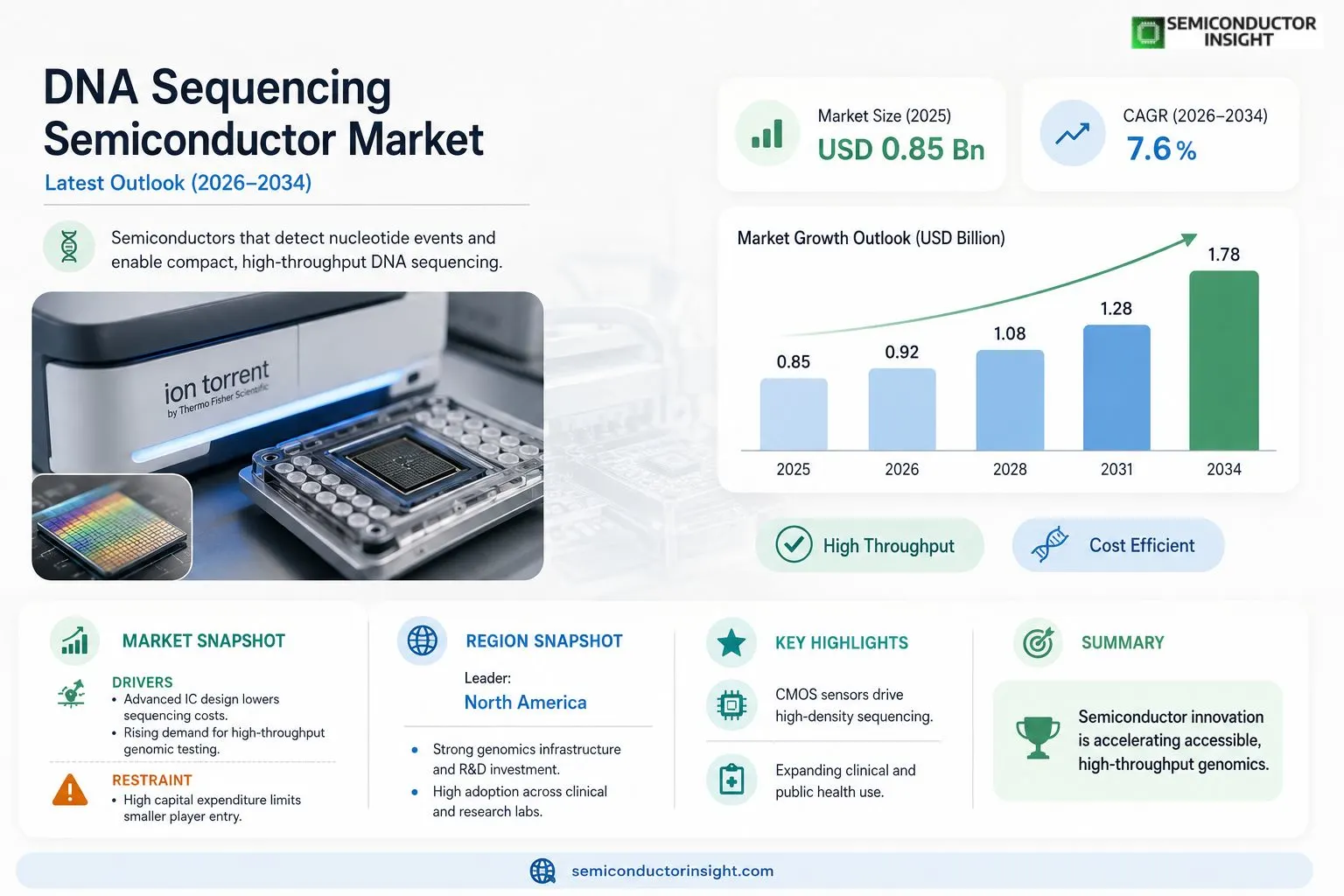
Global DNA Sequencing Semiconductor market size was valued at USD 0.85 billion in 2025. The market is projected to grow from USD 0.92 billion in 2026 to USD 1.78 billion by 2034, exhibiting a CAGR of 7.6% during the forecast period.
DNA sequencing semiconductors are integrated circuits that translate nucleotide incorporation events into electrical signals using ion‑sensitive field‑effect transistors or complementary metal‑oxide‑semiconductor (CMOS) sensors. This technology enables compact, high‑throughput platforms that deliver rapid readouts without bulky optics, making next‑generation sequencing more accessible for clinical and research laboratories.The market is accelerating because rapid throughput, lower capital expenditure, and shrinking cost per genome drive adoption across personalized medicine and infectious disease surveillance.
MARKET DRIVERS
Advancements in Integrated Circuit Design
DNA Sequencing Semiconductor Market is being propelled by rapid mini‑aturization of CMOS chips, which enables higher sensor density and lower power consumption. These technical gains translate into reduced per‑run costs and faster turnaround times for laboratories worldwide.
Rising Demand for High‑Throughput Genomic Testing
Clinical and research institutions are expanding their genomic testing programs to support personalized medicine, population screening, and pathogen surveillance. The need for large‑scale data generation pushes suppliers to adopt semiconductor‑based platforms that can process millions of nucleotides in a single run.
➤ “Semiconductor‑based sequencers now achieve throughput comparable to optical systems at a fraction of the cost,”
Consequently, investment in next‑generation sequencing (NGS) infrastructure is accelerating, creating a virtuous cycle of innovation, adoption, and revenue growth for DNA Sequencing Semiconductor Market.
MARKET CHALLENGES
Technical Complexity and Validation
Designing semiconductor sensors that reliably detect single‑base incorporations demands rigorous validation. Manufacturers must ensure high signal‑to‑noise ratios across diverse sample types, a process that can extend time‑to‑market and increase R&D expenses.
Other Challenges
Regulatory Hurdles
Regulatory agencies require comprehensive clinical evidence for each new chip architecture. Achieving conformity with global standards often necessitates costly multi‑regional trials, slowing commercial rollout.
MARKET RESTRAINTS
High Capital Expenditure
Establishing a semiconductor‑based sequencing line involves substantial upfront investment in clean‑room facilities, lithography equipment, and specialized software. Capital intensity can deter smaller players from entering the market.
Supply Chain Vulnerabilities
Disruptions in the supply of high‑purity silicon wafers or rare‑earth materials can delay production schedules. Recent geopolitical tensions have highlighted the fragility of component sourcing for DNA Sequencing Semiconductor Market.
Limited Skilled Workforce
The intersection of genomics and semiconductor engineering requires interdisciplinary expertise. A shortage of engineers proficient in both fields constrains rapid scaling of manufacturing capacity.
MARKET OPPORTUNITIES
Emergence of Portable Sequencing Devices
Miniaturized semiconductor sequencers are enabling point‑of‑care genetic testing in remote clinics and field research settings. This mobility trend opens new revenue streams beyond traditional laboratory installations.
AI‑Driven Data Analysis Integration
Coupling semiconductor output with AI algorithms accelerates variant calling and reduces bioinformatic bottlenecks. Companies that embed real‑time analytics into their platforms can command premium pricing.
Strategic Partnerships and Alliances
Collaborations between chip manufacturers, genomics service providers, and cloud‑computing firms are fostering ecosystem growth. Joint ventures accelerate product development, expand market reach, and mitigate individual risk.
DNA Sequencing Semiconductor Market Trends
Rapid Throughput and Cost Efficiency Accelerate Adoption
The industry is experiencing a decisive shift toward platforms that couple high‑throughput sequencing with substantially lower capital outlay. Semiconductor‑based detectors convert nucleotide incorporation events directly into electrical signals, eliminating the need for bulky optical components. This simplification reduces system cost, shortens assay cycles, and enables laboratories to scale operations without extensive infrastructure upgrades. As a result, more research institutions and clinical sites are integrating these platforms to meet the growing demand for fast, affordable whole‑genome analyses.
Other Trends
Integration of CMOS Sensor Technology
Advances in complementary metal‑oxide‑semiconductor (CMOS) sensor design have improved signal‑to‑noise ratios and expanded the usable read length of semiconductor sequencers. Engineers are refining ion‑sensitive field‑effect transistors to achieve higher density arrays, which translates into greater parallelism and faster data acquisition. These technical improvements are driving a migration from legacy optical instruments toward compact, solid‑state devices that can be deployed in point‑of‑care environments.
Expansion into Clinical Diagnostics and Public Health Surveillance
Beyond research applications, the market is witnessing broader acceptance in clinical diagnostics, particularly for personalized oncology and infectious disease monitoring. The ability to generate high‑resolution genomic data in a turnaround time of hours supports rapid therapeutic decision‑making. Public health agencies are also leveraging the speed and portability of semiconductor sequencing to conduct real‑time pathogen surveillance, which proved valuable during recent outbreak responses. This diversification of use cases reinforces the strategic importance of DNA Sequencing Semiconductor Market across multiple sectors.
COMPETITIVE LANDSCAPEKey Industry Players
DNA Sequencing Semiconductor Market – Competitive Overview
Thermo Fisher Scientific dominates the DNA sequencing semiconductor segment through its Ion Torrent™ platforms, which leverage ion‑sensitive field‑effect transistor (ISFET) technology to convert nucleotide incorporations directly into electrical signals. This approach has enabled a cost‑effective, high‑throughput alternative to optical‑based sequencers and has secured Thermo Fisher a leading share of the market’s installed base. The company’s vertical integration—from chip design to reagents—creates a defensible ecosystem that limits entry for pure‑play semiconductor firms. Concurrently, Illumina’s strategic partnerships with CMOS foundries are reshaping the competitive landscape, positioning the firm to migrate its sequencing‑by‑synthesis chemistry onto semiconductor chips and potentially challenge Thermo Fisher’s dominance.Beyond the two market leaders, a diverse set of semiconductor manufacturers and genomics specialists are expanding the pool of viable solutions. Samsung Electronics and Intel are investing in advanced CMOS sensor architectures that promise higher signal‑to‑noise ratios, while Taiwan Semiconductor Manufacturing Company (TSMC) and GlobalFoundries provide the high‑volume fabs needed for cost‑effective chip production. Applied Materials and Infineon Technologies contribute specialized process equipment and sensor technologies, respectively. Niche innovators such as BGI‑MGI, Roche Diagnostics, and QIAGEN are exploring hybrid platforms that blend semiconductor detection with established library‑prep chemistries, thereby adding depth to the market’s competitive fabric.
List of Key DNA Sequencing Semiconductor Companies Profiled
- Thermo Fisher Scientific
- Illumina, Inc.
- Samsung Electronics
- Intel Corporation
- Taiwan Semiconductor Manufacturing Company (TSMC)
- GlobalFoundries
- Applied Materials, Inc.
- Infineon Technologies AG
- BGI‑MGI (BGI Group)
- Roche Diagnostics
- QIAGEN
- Oxford Nanopore Technologies
Segment Analysis:
| Segment Category | Sub-Segments | Key Insights |
| By Type |
|
CMOS‑based Sensors are emerging as the dominant type because they leverage mature semiconductor manufacturing, enabling rapid scale‑up and cost efficiencies.
|
| By Application |
|
Clinical Diagnostics drives most of the adoption due to its impact on patient‑centered care and rapid turnaround requirements.
|
| By End User |
|
Hospital Laboratories represent the primary end‑user group because they require rapid, reliable sequencing for diagnostic pathways.
|
| By Technology Integration |
|
Integrated Lab‑on‑a‑Chip Systems are gaining traction as they combine sample preparation, sequencing, and data analysis in a single compact form factor.
|
| By Market Adoption Phase |
|
Early Adopters drive innovation by piloting advanced semiconductor sequencing in highly specialized clinical programs.
|
Regional Analysis: North America
North America
The United States represents the largest single market within North America for DNA sequencing semiconductors. Its extensive research infrastructure, coupled with significant investments in biotechnology and pharmaceuticals, drives substantial demand. The focus on precision medicine and the increasing prevalence of genetic disorders are key factors propelling market growth. The US market is characterized by a highly competitive landscape with numerous players offering specialized semiconductor solutions for various sequencing platforms.
Canada exhibits steady growth in DNA Sequencing Semiconductor Market, supported by a strong academic research sector and a growing biotechnology industry. Government initiatives promoting innovation and attracting foreign investment are contributing to the expansion of this market. While smaller than the US market, Canada presents significant opportunities for niche semiconductor applications and collaborations between research institutions and industry partners.
Mexico’s DNA sequencing semiconductor market is emerging, fueled by increasing investments in life sciences and a growing awareness of genomic medicine. The country benefits from its proximity to the US market and a skilled workforce. However, market growth is currently moderate compared to other regions in North America, with opportunities for expansion driven by advancements in affordable sequencing technologies and the development of local research capabilities.
Puerto Rico has a presence in DNA Sequencing Semiconductor Market, primarily supporting research and development activities. The region benefits from established pharmaceutical and biotechnology infrastructure, although the market size remains relatively small compared to other North American entities. Government incentives and collaborations with international research institutions are key drivers of growth in this segment.
Europe
Europe represents a significant and expanding market for DNA sequencing semiconductors, driven by strong government support for research, a well-established life sciences industry, and increasing investments in personalized medicine. The region is characterized by a diverse ecosystem of semiconductor manufacturers, research institutions, and clinical laboratories. Key trends include the development of miniaturized sequencing devices, advancements in long-read sequencing technologies, and the integration of sequencing data with other omics data. The European Union’s focus on data privacy and ethical considerations in genomics also influences market dynamics.
Asia-Pacific
Asia-Pacific is poised for rapid growth in DNA Sequencing Semiconductor Market, driven by increasing investments in healthcare, a growing population, and expanding research activities. Countries like China, Japan, and South Korea are leading the way in adopting advanced sequencing technologies. The region’s large domestic market and manufacturing capabilities provide significant opportunities for both local and international players. Rapid advancements in genomics research and the increasing demand for genetic testing are key drivers of market expansion.
South America
South America’s DNA sequencing semiconductor market is in its nascent stages, with growth potential tied to increasing investments in healthcare infrastructure and expanding genomic research initiatives. Brazil and Argentina represent the largest markets in the region, with a growing focus on disease diagnosis and personalized medicine. However, challenges such as limited funding and infrastructure constraints hinder significant market development.
Middle East & Africa
DNA Sequencing Semiconductor Market in the Middle East and Africa is emerging, driven by increasing investments in healthcare and a growing awareness of genetic diseases. The region presents significant opportunities for growth as healthcare infrastructure improves and genomic research expands. However, challenges such as limited access to advanced technologies and regulatory hurdles pose obstacles to market development.
Report Scope
This market research report provides a comprehensive analysis of the DNA Sequencing Semiconductor Market , covering the forecast period 2026–2034. It offers detailed insights into market dynamics, technological advancements, competitive landscape, and key trends shaping the industry.
Key focus areas of the report include:
- Market Overview: The report begins with an overview outlining its current market scenario, key growth indicators, and industry transformation drivers. It discusses macroeconomic factors, demand–supply balance, regulatory landscape, and the strategic role of semiconductors in powering advancements across industries such as automotive, telecommunications, consumer electronics, and industrial automation.
- Market Size & Forecast: Historical data and future projections for revenue, unit shipments, and market value across major regions and segments.
- Segmentation Analysis: Detailed breakdown by product type, technology, application, and end-user industry to identify high-growth segments and investment opportunities.
- Regional Insights: Insights into market performance across North America, Europe, Asia-Pacific, Latin America, and the Middle East & Africa, including country-level analysis where relevant.
- Competitive Landscape: Profiles of leading market participants, including their product offerings, R&D focus, manufacturing capacity, pricing strategies, and recent developments such as mergers, acquisitions, and partnerships.
- Technology Trends & Innovation: Assessment of emerging technologies, integration of AI/IoT, semiconductor design trends, fabrication techniques, and evolving industry standards.
- Market Drivers & Restraints: Evaluation of factors driving market growth along with challenges, supply chain constraints, regulatory issues, and market-entry barriers.
- Stakeholder Insights: Insights for component suppliers, OEMs, system integrators, investors, and policymakers regarding the evolving ecosystem and strategic opportunities.
Primary and secondary research methods are employed, including interviews with industry experts, data from verified sources, and real-time market intelligence to ensure the accuracy and reliability of the insights presented.
FREQUENTLY ASKED QUESTIONS:
What is the current market size of DNA Sequencing Semiconductor Market?
-> DNA Sequencing Semiconductor Market was valued at USD 0.85 billion in 2025 and is expected to reach USD 1.78 billion by 2034.
Which key companies operate in DNA Sequencing Semiconductor Market?
-> Key players include Illumina, Thermo Fisher Scientific, Oxford Nanopore Technologies, BGI Group, and Roche, among others.
What are the key growth drivers?
-> Key growth drivers include rapid throughput, lower capital expenditure, decreasing cost per genome, and rising demand for personalized medicine and infectious disease surveillance.
Which region dominates the market?
-> Asia‑Pacific is the fastest‑growing region, while North America remains a dominant market in terms of overall revenue.
What are the emerging trends?
-> Emerging trends include integration of AI‑driven data analysis, miniaturized CMOS sensor designs, and hybrid platforms that combine semiconductor sequencing with microfluidic sample preparation.
Get Sample Report PDF for Exclusive Insights
Report Sample Includes
- Table of Contents
- List of Tables & Figures
- Charts, Research Methodology, and more...
 Download Sample Report PDF