
Market Insights
Global DLP Adaptive Headlight Market size was valued at USD 641 million in 2025. The market is projected to grow from USD 879 million in 2026 to USD 8.79 billion by 2034, exhibiting a CAGR of 39.9% during the forecast period.
DLP adaptive headlights are high-resolution intelligent lighting systems that utilize Texas Instruments’ digital light processing (DLP) technology to modulate LED or laser light through an optical engine, projecting precise illumination onto the road. These systems employ automotive-grade digital micromirror devices (DMDs) with over one million individually controllable mirrors per headlamp, enabling superior beam-shaping accuracy compared to conventional matrix LED solutions.
The market growth is driven by increasing demand for advanced driver assistance systems (ADAS), regulatory support for adaptive lighting technologies, and premium vehicle manufacturers incorporating projection-based communication features. While currently limited to luxury segments due to high system costs, technological advancements in semiconductor components and optical designs are expected to gradually improve cost structures. Key applications include dynamic beam patterning, hazard projection, and integration with navigation systems for enhanced nighttime visibility.
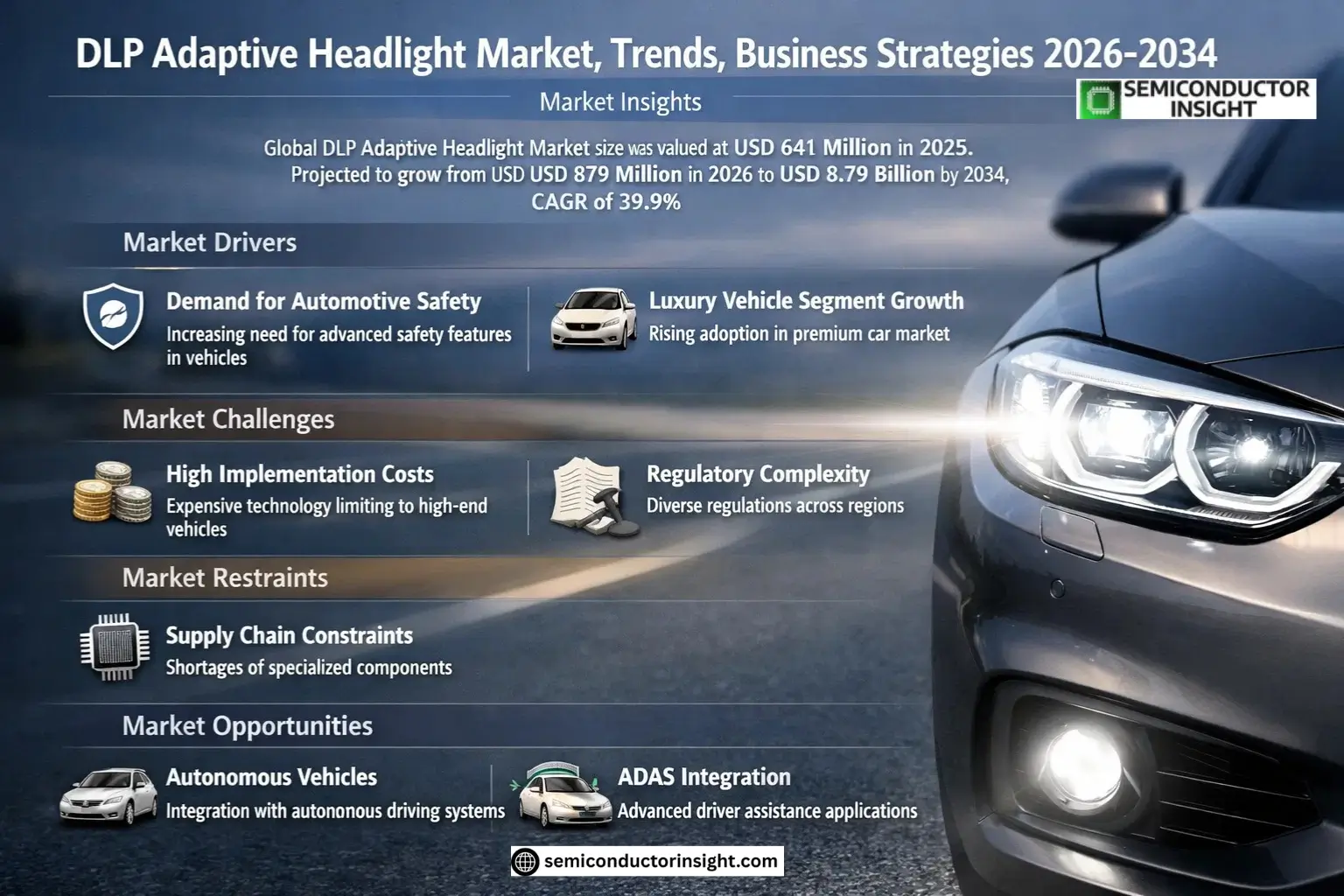
MARKET DRIVERS
Growing Demand for Advanced Automotive Safety Features
DLP Adaptive Headlight Market is witnessing significant growth due to increasing consumer demand for advanced safety technologies in vehicles. These headlights enhance nighttime visibility by adapting to driving conditions, reducing glare for oncoming traffic while improving illumination for drivers. Stringent government regulations regarding vehicle safety are further boosting adoption.
Luxury Vehicle Segment Expansion
Major automotive manufacturers are incorporating DLP adaptive headlights as premium features in luxury vehicles. The technology’s ability to project high-resolution lighting patterns and communicate with drivers through road projections is creating competitive differentiation in the premium vehicle segment. The global luxury car market growth of approximately 5% annually is directly benefiting DLP adaptive headlight adoption.
Automakers are investing heavily in DLP adaptive headlight R&D to integrate features like lane marking illumination, pedestrian warning projections, and adverse weather condition adaptations.
MARKET CHALLENGES
High Implementation Costs
The sophisticated technology behind DLP adaptive headlights, including micro-mirror arrays and high-resolution projection systems, results in significantly higher costs compared to conventional lighting solutions. This price premium limits market penetration to luxury and high-end vehicle segments only.
Other Challenges
Regulatory Approval Complexity
Different regional regulations for adaptive lighting systems create compliance challenges for global automakers implementing DLP headlight technology across markets.
MARKET RESTRAINTS
Supply Chain Constraints for Specialized Components
DLP Adaptive Headlight Market faces production limitations due to the specialized semiconductor components required, with current global supply chain bottlenecks affecting manufacturing capacity. The complex optical systems rely on precision components that have long lead times and limited supplier options.
MARKET OPPORTUNITIES
Emerging Applications in Autonomous Vehicles
The evolution of autonomous driving systems presents significant growth potential for DLP adaptive headlights, as the technology can integrate with ADAS sensors to create dynamic lighting scenarios. Automakers are exploring using DLP projections to communicate vehicle intentions to pedestrians and other road users in driverless vehicle scenarios.
Emerging DLP Adaptive Headlight Market Trends
Integration with ADAS and Autonomous Driving Systems
DLP adaptive headlights are increasingly being designed to integrate with advanced driver-assistance systems (ADAS) and autonomous driving platforms. These intelligent lighting systems now communicate directly with vehicle sensors to project real-time navigation cues and hazard warnings onto the road. The precision of DLP technology allows for dynamic beam shaping that adapts not just to traffic conditions but also to road geometry and detected obstacles.
Other Trends
Resolution Advancements in DMD Technology
Manufacturers are transitioning from 1.3-megapixel to 2.6-megapixel DMD chips, enabling sharper projections and more detailed road illumination patterns. This advancement allows for clearer symbol projection and more precise light cutoffs around detected vehicles while maintaining automotive-grade reliability requirements.
Expansion into Premium EV Segments
Electric vehicle manufacturers are adopting DLP adaptive headlights as signature technology differentiators, with systems increasingly incorporating brand-specific welcome animations and charging status indicators. The technology’s energy efficiency aligns well with EV architectures, though thermal management remains a key engineering focus area.
Other Trends
Optical System Miniaturization
Recent developments in compact optical engines and heat dissipation solutions are enabling slimmer DLP headlight designs. This addresses previous packaging challenges that limited adoption in vehicles with tight front-end styling constraints.
Enhanced V2X Communication Capabilities
Next-generation DLP systems are incorporating vehicle-to-everything (V2X) communication features, allowing headlights to display road condition warnings received from infrastructure and other connected vehicles. This transforms lighting systems into active safety communication interfaces beyond their traditional illumination function.
COMPETITIVE LANDSCAPE
Key Industry Players
Technological Leadership and Strategic Alliances Define DLP Adaptive Headlight Market
DLP Adaptive Headlight Market is dominated by leading automotive lighting suppliers with strong technological partnerships. Texas Instruments maintains absolute control of the core DMD chip supply, requiring headlamp manufacturers to build systems around their automotive-qualified DLP semiconductors. This creates a highly specialized supplier ecosystem where Tier-1 lighting companies must master complex optical engineering and thermal management to implement DLP systems effectively.
Beyond the major players, specialized automotive electronics firms play crucial support roles in controller development and system integration. The market sees increasing vertical integration as lighting suppliers acquire optics expertise to reduce reliance on third-party component manufacturers. Competition intensifies as Chinese suppliers accelerate R&D investments to challenge established European and Japanese brands in premium automotive lighting segments.
List of Key DLP Adaptive Headlight Companies Profiled
- Koito Manufacturing Co., Ltd.
- Valeo
- MARELLI Automotive Lighting
- Hella GmbH & Co. KGaA
- Stanley Electric Co., Ltd.
- Xingyu Automotive Lighting Systems
- SL Corporation
- HASCO Vision Technology Co., Ltd.
- ZKW Group GmbH
- Varroc Lighting Systems
- Lumileds Holding B.V.
- Fudi Vision Technology
- Texas Instruments (DMD Chip Supplier)
- Osram Licht AG (Light Source Supplier)
- Nichia Corporation (LED Component Supplier)
Segment Analysis:
| Segment Category | Sub-Segments | Key Insights |
| By Type |
|
2.0–2.6 Mp DLP Headlights represent the premium segment with superior resolution:
|
| By Application |
|
New Energy Vehicles show strongest adoption potential:
|
| By End User |
|
Premium Luxury Vehicles dominate current adoption:
|
| By Technology Integration |
|
ADAS-Integrated Systems show strongest growth trajectory:
|
| By Sales Channel |
|
OEM Integration represents nearly all current implementations:
|
Regional Analysis: Global DLP Adaptive Headlight Market
Europe
European Union’s comprehensive vehicle lighting regulations set global benchmarks, pushing OEMs to adopt DLP adaptive headlight technology faster than other regions.
Luxury automotive brands headquartered in Europe integrate DLP systems as standard in high-end models, creating substantial market demand from affluent consumers.
European suppliers lead in developing integrated lighting systems that combine DLP technology with other ADAS features, creating comprehensive safety solutions.
Strong aftermarket channels for advanced automotive lighting in Europe facilitate DLP technology adoption beyond factory-installed systems in the retrofit segment.
North America
The North American DLP Adaptive Headlight Market experiences steady growth, particularly in the U.S. where premium vehicle sales remain robust. Stringent NHTSA regulations and consumer awareness about advanced safety features drive adoption. Automotive manufacturers increasingly offer DLP systems as optional upgrades, though market penetration lags behind Europe. The technology finds particular favor in commercial fleets where operators value its predictive lighting capabilities. Collaboration between U.S.-based tech firms and automakers accelerates localized system development tailored for North American road conditions.
Asia-Pacific
Asia-Pacific emerges as the fastest-growing DLP Adaptive Headlight Market, fueled by expanding luxury vehicle sales in China and adoption by Japanese premium brands. While cost sensitivity remains a challenge, government initiatives promoting vehicle safety and smart transportation infrastructure support market expansion. The region benefits from established electronics manufacturing ecosystems that supply components to global automotive lighting systems. Local OEMs increasingly partner with international technology providers to develop cost-optimized DLP solutions for emerging markets.
Middle East & Africa
The MEA region shows selective adoption of DLP adaptive headlights, primarily in premium imported vehicles and luxury SUVs favored in GCC countries. Extreme weather conditions highlight the technology’s value in maintaining visibility during sandstorms and heavy rains. Limited local manufacturing and reliance on imports constrain widespread adoption, though economic diversification programs in Gulf states may stimulate future production capabilities for advanced automotive lighting systems.
South America
South America represents a developing market for DLP adaptive headlights, with Brazil and Argentina showing strongest demand among luxury vehicle buyers. Economic volatility affects market growth, but high-end import vehicles continue featuring the technology. Local automotive manufacturers begin exploring partnerships to integrate advanced lighting systems in premium models targeting regional consumers seeking European-level vehicle technologies.
Report Scope
This market research report provides a comprehensive analysis of the DLP Adaptive Headlight Market , covering the forecast period 2025–2032. It offers detailed insights into market dynamics, technological advancements, competitive landscape, and key trends shaping the industry.
Key focus areas of the report include:
- Market Overview: The report begins with an overview outlining its current market scenario, key growth indicators, and industry transformation drivers. It discusses macroeconomic factors, demand–supply balance, regulatory landscape, and the strategic role of semiconductors in powering advancements across industries such as automotive, telecommunications, consumer electronics, and industrial automation.
- Market Size & Forecast: Historical data and future projections for revenue, unit shipments, and market value across major regions and segments.
- Segmentation Analysis: Detailed breakdown by product type, technology, application, and end-user industry to identify high-growth segments and investment opportunities.
- Regional Insights: Insights into market performance across North America, Europe, Asia-Pacific, Latin America, and the Middle East & Africa, including country-level analysis where relevant.
- Competitive Landscape: Profiles of leading market participants, including their product offerings, R&D focus, manufacturing capacity, pricing strategies, and recent developments such as mergers, acquisitions, and partnerships.
- Technology Trends & Innovation: Assessment of emerging technologies, integration of AI/IoT, semiconductor design trends, fabrication techniques, and evolving industry standards.
- Market Drivers & Restraints: Evaluation of factors driving market growth along with challenges, supply chain constraints, regulatory issues, and market-entry barriers.
- Stakeholder Insights: Insights for component suppliers, OEMs, system integrators, investors, and policymakers regarding the evolving ecosystem and strategic opportunities.
Primary and secondary research methods are employed, including interviews with industry experts, data from verified sources, and real-time market intelligence to ensure the accuracy and reliability of the insights presented.
FREQUENTLY ASKED QUESTIONS:
What is the current market size of DLP Adaptive Headlight Market?
-> DLP Adaptive Headlight Market size was valued at USD 641 million in 2025. The market is projected to grow from USD 879 million in 2026 to USD 8.79 billion by 2034, exhibiting a CAGR of 39.9% during the forecast period.
What is the expected CAGR of the DLP Adaptive Headlight Market?
-> The market is expected to grow at a CAGR of 39.9% during the forecast period (2025-2032).
Which key companies operate in DLP Adaptive Headlight Market?
-> Key players include Koito, Valeo, MARELLI, Hella, Stanley Electric, Xingyu Automotive Lighting Systems, SL Corporation, HASCO Vision, ZKW Group, Varroc Lighting Systems, Lumileds, and Fudi Vision.
What are the key components of DLP adaptive headlights?
-> Core components include automotive-grade DMDs (digital micromirror devices), DLP optical engines, LED/laser light sources, and dedicated controllers.
What are the major applications of DLP adaptive headlights?
-> Major applications include adaptive driving beams, curve lighting, navigation projection, safety signaling, and brand-specific graphic projections on road surfaces.
Which regions dominate the DLP Adaptive Headlight Market?
-> The market is dominated by Europe (home to premium automotive brands adopting this technology), with Asia-Pacific showing rapid growth due to increasing EV adoption.

Get Sample Report PDF for Exclusive Insights
Report Sample Includes
- Table of Contents
- List of Tables & Figures
- Charts, Research Methodology, and more...
 Download Sample Report PDF


