
MARKET INSIGHTS
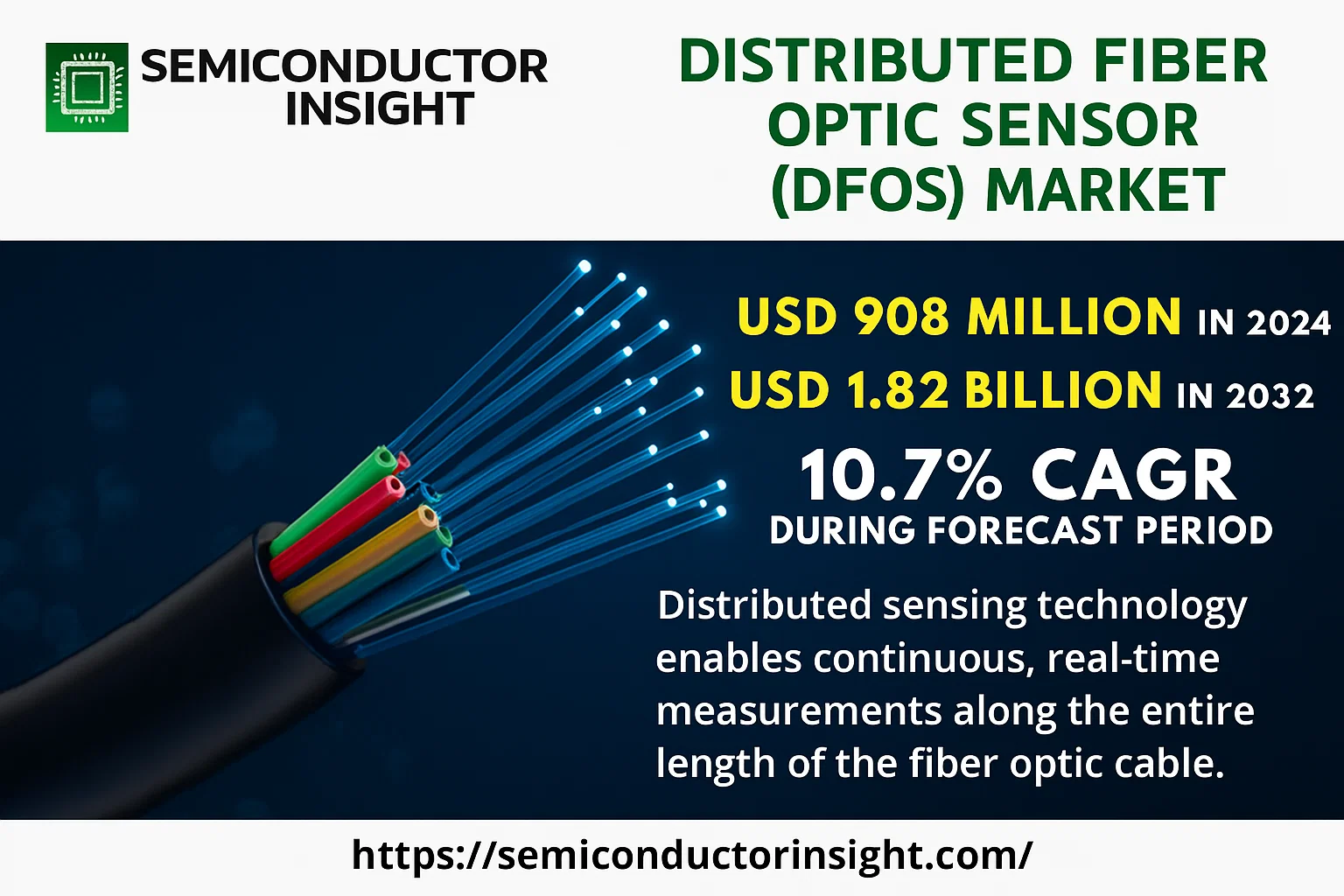
Global Distributed Fiber Optic Sensor (DFOS) Market was valued at USD 908 million in 2024 and is projected to reach USD 1.82 billion by 2032, exhibiting a CAGR of 10.7% during the forecast period.
Distributed sensing technology enables continuous, real-time measurements along the entire length of the fiber optic cable. Unlike traditional sensors, which rely on discrete sensors measured at predetermined points, distributed sensing does not rely on manufactured sensors but uses the optical fiber itself as the sensing element.
Distributed fiber optic sensors (DFOS) are an ideal choice for monitoring critical infrastructure or facilities. These sensors are small in size, low in cost, impervious to electromagnetic interference, and mechanically and chemically compatible with most building materials, making them ideal for building very large monitoring networks. However, Distributed Optical Fiber Sensing (DOFS) is commonly used to measure parameters in real time and is difficult to obtain at high resolution over long distances. This limitation can be overcome by using distributed sensors.
A distributed optical fiber sensing system usually consists of a laser light source, a sensing optical fiber (cable), and a detection unit. It is an automatic monitoring system. The measurement is based on the principle of backscattering of light transmitted in the optical fiber. Into a certain energy in the optical fiber and the width of the laser pulse, it while they are in the optical fiber transmission to the scattering light, after the creation of the state of light scattering in optical fiber damage and the influence of the change, will not be back scattering of light after WDM, detection, demodulation, into the signal is real-time signal processing system can be displayed, and consists of light waves in optical fiber transmission speed and back light echo time for these information. The distributed optical fiber sensing (DFOS) counted in this report only includes the host system, not the sensing optical fiber (cable) and display equipment.
Global core distributed fiber optic sensor (DFOS) players include Schlumberger, Halliburton and Baker Hughes etc. The top 3 companies hold a share above 30%. North America is the largest producing area, with a share over 40% , followed by China and Europe with the share about 30% and 15%. In terms of type, DTS has a market share of about 55%. In the application field, the market share of petroleum and petrochemical reached more than 45%.
MARKET DRIVERS
Growing Demand for Infrastructure Health Monitoring
The global Distributed Fiber Optic Sensor (DFOS) market is experiencing significant growth driven by the increasing need for continuous structural health monitoring of critical infrastructure. Aging assets in sectors like oil & gas pipelines, power transmission cables, and civil structures require real-time strain and temperature monitoring to prevent failures. DFOS technology provides unparalleled advantages over traditional point sensors by enabling measurement along the entire length of a fiber optic cable, offering a complete spatial picture of the monitored asset.
Expansion in Oil & Gas and Energy Sectors
Enhanced oil recovery techniques and the development of unconventional resources necessitate advanced downhole monitoring. DFOS systems are critical for real-time monitoring of well integrity, flow profiling, and seismic imaging. Furthermore, the global push for renewable energy is driving the deployment of DFOS for condition monitoring of wind turbine blades and the thermal monitoring of vast solar farms, ensuring operational efficiency and safety.
➤ The ability to detect minute changes in temperature or strain over几十公里 distances with high accuracy is a key differentiator for DFOS technology.
Stringent government regulations mandating safety and environmental protection, particularly in the pipeline and energy sectors, are compelling operators to adopt advanced monitoring solutions like DFOS. This regulatory push, combined with the declining cost of optical components, is making DFOS technology more accessible and driving its adoption across a wider range of applications.
MARKET CHALLENGES
High Initial Investment and Integration Complexity
A primary challenge hindering wider adoption is the significant upfront cost associated with DFOS systems. This includes the cost of the interrogation unit, specialized sensing cables, and the expertise required for installation and data interpretation. Integrating DFOS data with existing asset management and control systems can be complex, requiring specialized software and skilled personnel, which adds to the total cost of ownership.
The technology also faces challenges related to data management and interpretation. DFOS systems generate vast amounts of data along the sensing fiber. Extracting actionable insights from this continuous data stream requires sophisticated algorithms and analytics platforms, which can be a barrier for some end-users without the necessary technical capabilities.
Other Challenges
Technical Limitations in Harsh Environments
While robust, the performance of standard optical fibers can be degraded by extreme temperatures, high radiation, or chemical exposure, limiting applications in certain harsh industrial or downhole environments without specialized and costly cabling.
Lack of Standardization
The absence of universally accepted standards for DFOS system performance, data formats, and installation practices can lead to interoperability issues and make it difficult for end-users to compare solutions from different vendors.
MARKET RESTRAINTS
Economic Volatility and Capital Expenditure Constraints
Market growth is restrained by economic cycles that impact industrial capital expenditure. Industries such as oil and gas, which are major end-users of DFOS, are highly sensitive to fluctuations in global commodity prices. During periods of low prices, companies often defer or cancel investments in new monitoring technologies, directly affecting the DFOS market.
Competition from Established Alternative Technologies
The DFOS market faces competition from well-established point sensor technologies and other distributed sensing methods. For applications where continuous monitoring along a line is not critical, the lower initial cost of traditional point sensors can be a deciding factor. Convincing potential customers of the superior long-term value proposition of DFOS over these entrenched alternatives remains a key challenge.
MARKET OPPORTUNITIES
Emerging Applications in Security and Border Control
A significant growth opportunity lies in the expansion into perimeter security and intrusion detection systems. DFOS can be buried along borders or critical facility perimeters to detect and locate ground disturbances, climbing, or cutting attempts with high accuracy over long distances, offering a robust and covert security solution.
Advancements in Smart Cities and IoT Integration
The development of smart city infrastructure presents a massive opportunity. DFOS can be embedded in bridges, tunnels, and buildings to provide real-time structural health monitoring. Integration with the Internet of Things (IoT) platforms allows for predictive maintenance, enhancing urban safety and optimizing infrastructure management lifecycle costs.
Miniaturization and Development of Cost-Effective Interrogators
Ongoing R&D focused on miniaturizing interrogation units and reducing their cost is expected to open new market segments. Smaller, more affordable systems will make DFOS technology viable for smaller-scale applications and for use by small and medium-sized enterprises, significantly broadening the potential customer base.
Distributed Fiber Optic Sensor (DFOS) Market Trends
Strong Market Expansion
The global Distributed Fiber Optic Sensor (DFOS) market is experiencing robust growth, driven by its critical role in infrastructure monitoring. Valued at $908 million in 2024, the market is projected to reach $1.819 billion by 2032, growing at a compound annual growth rate (CAGR) of 10.7%. This expansion is largely fueled by the superior advantages of DFOS technology over traditional discrete sensors, including its ability to provide continuous, real-time measurements along the entire length of the fiber optic cable without relying on manufactured sensor points.
Other Trends
Technological Dominance of DTS Systems
Within the DFOS market, Distributed Temperature Sensing (DTS) is the dominant technology, holding a market share of approximately 55%. This dominance is attributed to the widespread application of temperature monitoring in key sectors. The system’s core components—a laser light source, sensing optical fiber, and detection unit—utilize light backscattering principles to deliver high-resolution data over long distances, overcoming limitations of traditional methods.
Application Concentration in Oil & Gas
The petroleum and petrochemical sector remains the largest application segment, accounting for over 45% of the market. DFOS is an ideal choice for this industry due to its immunity to electromagnetic interference, small size, and mechanical and chemical compatibility with materials used in harsh environments. This enables the creation of large-scale monitoring networks for pipelines, wells, and refineries, enhancing safety and operational efficiency.
Supply Chain and Regional Landscape
The market is characterized by the strong presence of major oilfield service companies. The top three players—Schlumberger, Halliburton, and Baker Hughes—collectively hold over 30% of the market share. Geographically, North America is the largest market, with a production share exceeding 40%, followed by China and Europe, which hold shares of approximately 30% and 15%, respectively. This regional concentration reflects the high adoption rate in established energy and infrastructure sectors, while Asia-Pacific shows significant growth potential driven by increasing investments in critical infrastructure projects.
COMPETITIVE LANDSCAPE
Key Industry Players
A Market Characterized by Dominant Service Giants and Innovative Technology Specialists
The global Distributed Fiber Optic Sensor (DFOS) market is led by major oilfield service conglomerates, with Schlumberger, Halliburton, and Baker Hughes collectively holding a dominant share of over 30% of the global market. These companies leverage their extensive presence in the oil and gas industry, the largest application segment for DFOS, to provide integrated monitoring solutions for pipeline integrity, downhole reservoir monitoring, and flow assurance. The market structure is moderately concentrated, with North America being the largest production and consumption region, accounting for over 40% of the market, driven by significant shale gas and pipeline infrastructure activities. The key technology, Distributed Temperature Sensing (DTS), holds the largest product segment share at approximately 55%, further cementing the position of players with strong offerings in this area for the energy sector.
Beyond the dominant trio, a diverse landscape of specialized technology firms has carved out significant niches. European companies like Fotech Solutions, Silixa, and LIOS (NKT Photonics) are recognized for their technological innovation, particularly in Distributed Acoustic Sensing (DAS) for security, perimeter intrusion detection, and industrial process monitoring. Similarly, AP Sensing and Omnisens are established providers of high-performance DFOS systems for critical infrastructure monitoring in power cables, traffic tunnels, and fire detection. In the Asia-Pacific region, particularly in China, a number of domestic players such as Shanghai Huawei Technology and Hunan Guangsheng Optical Fiber Sensing Company are growing rapidly, supported by government investments in infrastructure and industrial modernization. These niche players compete on technological specialization, application-specific solutions, and regional market expertise.
List of Key Distributed Fiber Optic Sensor (DFOS) Companies Profiled
- Schlumberger
- Halliburton
- Baker Hughes
- Fotech Solutions
- Silixa
- OptaSense (QinetiQ)
- AP Sensing
- OZ Optics
- LIOS (NKT Photonics)
- Omnisens
- Hifi Engineering
- Future Fibre Technologies (Ava Group)
- Bandweaver
- Shanghai Huawei Technology
- AGIOE
Segment Analysis:
| Segment Category | Sub-Segments | Key Insights |
| By Type |
|
DTS represents a foundational and widely adopted segment due to its critical role in temperature monitoring for industrial safety and process optimization, particularly in the oil and gas sector. The maturity and reliability of DTS technology make it a cornerstone for preventive maintenance and leak detection systems. Meanwhile, DAS is experiencing significant growth, driven by its advanced capabilities in security, perimeter intrusion detection, and pipeline monitoring, offering a higher degree of situational awareness. The Others category, which includes Distributed Strain Sensing (DSS), caters to specialized applications in structural health monitoring, though its adoption is currently more niche compared to the dominant DTS and emerging DAS segments. |
| By Application |
|
Petroleum and Petrochemical is the dominant application area, leveraging DFOS extensively for pipeline integrity monitoring, flow assurance, and wellbore monitoring due to the technology’s ability to withstand harsh environments and provide real-time data over vast distances. The Security Monitoring sector exhibits strong growth potential, utilizing DAS for perimeter protection of critical infrastructure like airports and national borders. The Traffic Tunnel Bridge application is also a key growth area, as governments increasingly invest in structural health monitoring of aging infrastructure to ensure public safety, while the Electricity sector relies on DFOS for hotspot detection in power cables and transformer monitoring. |
| By End User |
|
Oilfield Service Companies are the leading end-user segment, driven by the critical need for real-time monitoring in upstream and midstream oil and gas operations to enhance safety and operational efficiency. Utility Providers represent a rapidly expanding segment, adopting DFOS for monitoring electrical grids and water pipelines to improve reliability and prevent failures. Government & Defense Agencies are significant users for border security and monitoring critical national infrastructure, creating a stable demand base. Meanwhile, Infrastructure Owners/Operators are increasingly recognizing the long-term cost benefits of predictive maintenance for assets like tunnels and bridges. |
| By Operating Principle |
|
Raman Scattering is the leading principle for Distributed Temperature Sensing (DTS) systems, favored for its high accuracy and stability in temperature measurement, which is crucial for fire detection and pipeline monitoring. Rayleigh Scattering is the foundational principle for most Distributed Acoustic Sensing (DAS) systems, enabling highly sensitive vibration and acoustic detection over long distances for security and infrastructure monitoring. Brillouin Scattering technology, while capable of measuring both temperature and strain simultaneously, tends to be applied in more specialized scenarios such as geotechnical monitoring and structural health assessment of large civil structures, where its dual-parameter capability provides distinct advantages. |
| By Sensing Fiber Type |
|
Single-Mode Fiber dominates the market as it is the standard choice for long-range sensing applications exceeding several kilometers, which is typical for pipeline monitoring and perimeter security, due to its low signal attenuation. Multimode Fiber is often preferred for shorter-distance, high-spatial-resolution applications where its larger core diameter can be advantageous. The emergence of Specialty Coated Fibers represents an important innovation segment, with fibers featuring enhanced coatings for improved sensitivity to specific parameters like strain or chemical presence, or for increased durability in extreme temperature and corrosive environments, opening up new application possibilities in harsh industrial settings. |
Regional Analysis: Distributed Fiber Optic Sensor (DFOS) Market
Unprecedented urban and industrial infrastructure development across the Asia-Pacific region is a primary catalyst for DFOS market growth. Governments are heavily investing in large-scale projects like smart grids, high-speed rail networks, and pipeline systems, where the unique capabilities of DFOS for long-distance, real-time monitoring are indispensable for ensuring safety, efficiency, and predictive maintenance of critical national assets.
The region’s powerful electronics and telecommunications manufacturing sector provides a significant competitive advantage for the DFOS market. Local production of optical fibers, lasers, and detection units reduces costs and lead times, making DFOS solutions more accessible. This ecosystem supports not only domestic consumption but also positions the region as a key exporter of DFOS components and integrated systems to the global market.
Proactive government policies and national strategies focused on industrial safety, energy security, and technological sovereignty are accelerating DFOS adoption. Initiatives promoting the Industrial Internet of Things (IIoT) and critical infrastructure protection provide a strong regulatory and financial framework that encourages industries to implement advanced sensing technologies like DFOS for enhanced operational intelligence and risk management.
The DFOS market in Asia-Pacific is characterized by its penetration into a wide array of sectors beyond traditional oil and gas. Applications are rapidly expanding into power cable monitoring, border security, environmental sensing, and aerospace. This diversification mitigates market risk and creates multiple, sustained growth vectors, ensuring the region’s leadership is built on a broad and resilient foundation of demand.
North America
North America represents a mature and technologically advanced market for Distributed Fiber Optic Sensors, characterized by high adoption in the oil and gas, security, and power utility sectors. The region benefits from stringent safety and environmental regulations that mandate advanced monitoring solutions for pipelines, power transmission lines, and critical infrastructure. A strong presence of major DFOS technology providers and extensive R&D activities, particularly in the United States and Canada, drives continuous innovation. The market is seeing growing integration of DFOS with data analytics and machine learning platforms to transform raw sensor data into actionable operational intelligence. While infrastructure spending is significant, it is often focused on upgrading and securing existing assets rather than new greenfield projects, shaping a demand profile that prioritizes sophisticated, high-value DFOS solutions.
Europe
The European DFOS market is driven by a strong emphasis on renewable energy integration, industrial safety standards, and the monitoring of aging infrastructure. The region sees significant application in offshore wind farms for turbine blade and cable monitoring, as well as in the transportation sector for railways and tunnels. Strict EU regulations concerning environmental protection and industrial safety create a favorable environment for the adoption of advanced sensing technologies. European market dynamics are influenced by a collaborative ecosystem involving research institutions, technology providers, and end-users, fostering the development of specialized DFOS applications. A key trend is the use of DFOS for smart grid applications and for ensuring the integrity of carbon capture and storage infrastructure, aligning with the region’s decarbonization goals.
Middle East & Africa
The Middle East & Africa region presents a market with high growth potential, primarily driven by the extensive oil and gas industry, which utilizes DFOS for wellbore monitoring, pipeline leakage detection, and flow assurance. The Middle East, in particular, with its vast energy infrastructure, is a significant adopter. There is also growing interest in using DFOS for perimeter security of critical facilities and infrastructure projects associated with economic diversification initiatives in Gulf Cooperation Council countries. In Africa, the market is more nascent but is expected to grow with investments in power transmission infrastructure and resource extraction. The regional market is characterized by a need for robust and reliable sensing solutions that can endure harsh environmental conditions.
South America
The South American DFOS market is emerging, with its growth closely tied to the oil and gas and mining sectors. Countries like Brazil are leading the adoption, using DFOS for pipeline monitoring in pre-salt oil fields and for structural health monitoring of dams associated with mining operations. The region faces challenges related to economic volatility, which can impact large-scale infrastructure investments. However, the inherent benefits of DFOS for improving safety and operational efficiency in key industries are driving gradual adoption. The market potential is significant, particularly for applications in environmental monitoring and securing critical energy infrastructure, but it requires continued economic stability and targeted investment to fully realize its growth.
Report Scope
This market research report provides a comprehensive analysis of the Distributed Fiber Optic Sensor (DFOS) Market , covering the forecast period 2025–2032. It offers detailed insights into market dynamics, technological advancements, competitive landscape, and key trends shaping the industry.
Key focus areas of the report include:
- Market Overview: The report begins with an overview outlining its current market scenario, key growth indicators, and industry transformation drivers. It discusses macroeconomic factors, demand–supply balance, regulatory landscape, and the strategic role of semiconductors in powering advancements across industries such as automotive, telecommunications, consumer electronics, and industrial automation.
- Market Size & Forecast: Historical data and future projections for revenue, unit shipments, and market value across major regions and segments.
- Segmentation Analysis: Detailed breakdown by product type, technology, application, and end-user industry to identify high-growth segments and investment opportunities.
- Regional Insights: Insights into market performance across North America, Europe, Asia-Pacific, Latin America, and the Middle East & Africa, including country-level analysis where relevant.
- Competitive Landscape: Profiles of leading market participants, including their product offerings, R&D focus, manufacturing capacity, pricing strategies, and recent developments such as mergers, acquisitions, and partnerships.
- Technology Trends & Innovation: Assessment of emerging technologies, integration of AI/IoT, semiconductor design trends, fabrication techniques, and evolving industry standards.
- Market Drivers & Restraints: Evaluation of factors driving market growth along with challenges, supply chain constraints, regulatory issues, and market-entry barriers.
- Stakeholder Insights: Insights for component suppliers, OEMs, system integrators, investors, and policymakers regarding the evolving ecosystem and strategic opportunities.
Primary and secondary research methods are employed, including interviews with industry experts, data from verified sources, and real-time market intelligence to ensure the accuracy and reliability of the insights presented.
FREQUENTLY ASKED QUESTIONS:
What is the current market size of Distributed Fiber Optic Sensor (DFOS) Market?
->Distributed Fiber Optic Sensor (DFOS) Market was valued at USD 908 million in 2024 and is projected to reach USD 1.82 billion by 2032, exhibiting a CAGR of 10.7% during the forecast period.
Which key companies operate in Distributed Fiber Optic Sensor (DFOS) Market?
-> Key players include Schlumberger, Halliburton, Baker Hughes, Fotech Solutions, Silixa, OptaSense (QinetiQ), and AP Sensing, among others. The top 3 companies hold a share above 30%.
What are the key growth drivers?
-> Key growth drivers include the demand for infrastructure monitoring, the advantages of DFOS (small size, low cost, impervious to electromagnetic interference), and its application in critical sectors like petroleum and petrochemicals.
Which region dominates the market?
-> North America is the largest market, with a share over 40%, followed by China and Europe.
What are the emerging trends?
-> Emerging trends include the adoption of distributed sensing for large monitoring networks, real-time parameter measurement over long distances, and technological advancements in optical fiber sensing systems.

Get Sample Report PDF for Exclusive Insights
Report Sample Includes
- Table of Contents
- List of Tables & Figures
- Charts, Research Methodology, and more...


