
Display Timing Controllers (TCON) Market Insights
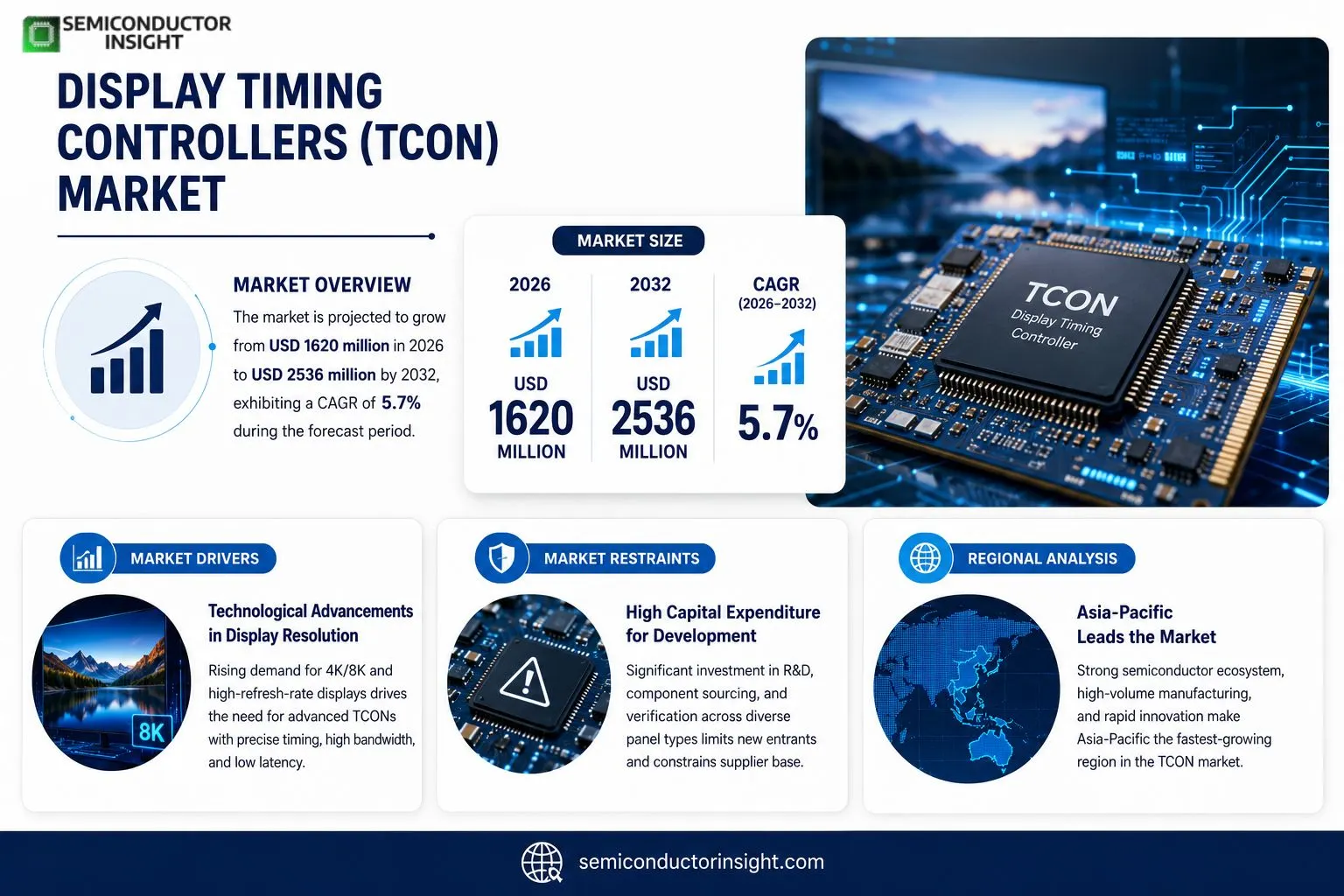
Display Timing Controllers (TCON) market was valued at USD 1620 million in 2026. The market is projected to reach USD 2536 million by 2032, exhibiting a CAGR of 5.7% during the forecast period.
A Display Timing Controller (TCON) is the central processing unit within a display panel (LCD or OLED), often referred to as the “brain” of the display. Its primary function is to receive raw video data from the system’s main controller via interfaces such as LVDS or eDP and convert it into timing signals compatible with source drivers and gate drivers, orchestrating pixel opening/closing while performing image enhancement tasks such as color calibration and motion compensation.
MARKET DRIVERS
Technological Advancements in Display Resolution
Display Timing Controllers (TCON) are pivotal for delivering the precise pixel synchronization demanded by monitors that target 4K/8K resolutions. As panel densities climb, the pixel clock rises sharply, forcing vendors to encode timing signals with microsecond accuracy. The resulting demand for more sophisticated TCON ASICs is a clear growth lever for the market.
Rise of Edge‑to‑Edge and Ultra‑Wide Panels
Manufacturers are pushing the edges of panels to achieve slimmer bezels and curved displays, which add complexity to the timing network. The need to maintain uniform backlight and reduce keystone distortion heightens the role of TCONs. This trend drives adoption across consumer electronics, from laptops to automotive infotainment.
➤ Planning for 240Hz displays requires 400 MHz pixel clocks, elevating TCON’s prominence
In addition, the convergence of high-refresh-rate gaming and professional graphics workloads fuels the necessity for low-latency, high-bandwidth TCON solutions. Consequently, Display Timing Controllers (TCON) Market is poised for sustained advancement as display technologies evolve.
MARKET CHALLENGES
Integration Complexity with Emerging Digital Interfaces
As display ecosystems embrace newer protocols such as DisplayPort 2.0 and embedded Multi‑Media Interface (eMMI), TCON manufacturers must align phase‑alignment and data‑streaming features with strict latency budgets. The resulting engineering cost can dampen profit margins, especially for mid‑tier producers.
Other Challenges
Supply Chain Disruption
Frequent shortages of high‑precision oscillators and silicon IP raise lead times and push prices upward, constraining rapid delivery to OEMs.
MARKET RESTRAINTS
High Capital Expenditure for Development
Developing cutting‑edge TCONs demands substantial investment in mask sets, fabrication partnerships, and extensive verification across diverse panel types. Limited square footage of wafer fabs and the concentration of IP ownership in a few large foundries intensify the entry barrier, narrowing the pool of suppliers able to compete at volume.
MARKET OPPORTUNITIES
Expansion into Automotive Cockpits and 5G Infrastructure
The proliferation of high‑definition digital dashboards in vehicles introduces stringent TCON reliability and thermal management requirements. Simultaneously, 5G base stations necessitate high‑speed data conversion modules where TCON technology can be leveraged to meet stringent jitter tolerances. These verticals represent early‑mover advantages for agile TCON vendors who can tailor solutions to automotive safety standards and the evolving telecom landscape.
Display Timing Controllers (TCON) Market Trends
Escalating Integration of Advanced Image Processing in TCON Design
As display technologies evolve toward higher brightness, sharper contrast, and more complex back‑lighting schemes, TCON architectures are shifting from simple timing logic to sophisticated image‑processing engines. Contemporary panels demand dynamic framerate management, sub‑pixel multiplexing, and real‑time color calibration—all tasks that traditionally resided in the display controller or GPU. By embedding these functions within the TCON, manufacturers can reduce latency, lower power draw and streamline the overall panel design. The transition is driven by the need for smoother motion rendering in gaming, cinematic content, and AI‑enhanced graphics, where any delay or color shift can compromise the consumer experience. Consequently, suppliers that can offer flexible yet high‑performance image‑processing cores within the TCON position themselves as indispensable partners for next‑generation display producers.
Other Trends
Manufacturing Collaboration between TCON Suppliers and Panel OEMs
The interdependency between TCON designers and panel integrators has intensified. Custom‑tailored TCON solutions that mirror a panel’s specific driving architecture reduce interface mismatches and improve yield. Close design cycles enable simultaneous optimization of driver circuitry and panel layout, cutting development time and aligning production shifts. This collaboration also delivers a locked‑in customer base for vendors, as OEMs rarely switch suppliers without extensive redesign. In an environment where margin compression is common, such long‑term relationships create a buffer against price wars and provide a channel for incremental innovations.
Growing Adoption of Ultra‑High‑Definition and High‑Refresh‑Rate Displays Requires Robust TCON Solutions
Market momentum is gravitating toward 8K resolution and 240Hz refresh rates in flagship televisions, premium monitors, and in‑vehicle infotainment systems. These specifications impose stringent timing precision, demanding higher data throughput and lower jitter tolerance from the TCON. Moreover, the proliferation of local dimming and high‑dynamic‑range modes calls for precise voltage mapping capabilities. Suppliers who innovate in multi‑lane eDP and LVDS support, and incorporate adaptive common‑mode filtering, will be better positioned to capture this premium segment. The business implication is clear: firms that invest in higher‑pin‑count, low‑skew TCON dies will command premium pricing and secure a larger share of high‑margin products.
COMPETITIVE LANDSCAPE
Key Industry Players
Display Timing Controllers (TCON) Competitive Landscape
At the core of the TCON ecosystem, Samsung Electronics dominates through its vertically integrated portfolio that merges display ICs with advanced driver solutions, rallying a substantial share of premium OLED panels and high‑refresh‑rate automotive displays. Analogix International anchors the mid‑segment with its patented LVDS and eDP bridge technologies, streamlining timing control for OEMs and reducing time‑to‑market for HDTV and monitor production. Novatek, headquartered in Taiwan, supplies cost‑effective, high‑throughput TCONs that frequently become the default choice for large‑screen TVs and projections, cementing its position among panel assemblers. This concentration weds the market through a network of loyal panel customers—LG Display, Samsung LCD, and AU Optronics—whose purchasing decisions hinge on performance, reliability, and the ability to integrate panel‑specific calibrations. The resulting structure is three‑tiered: high‑end with deep silicon and process tech, mid‑range with plug‑and‑play solutions, and low‑cost units that address mass‑market TV and monitor volumes.Complementing this ecosystem are a constellation of niche suppliers that inject specialization into the value chain. Parade Technologies, a Singaporean spin‑out, focuses on low‑latency TCONs for gaming monitors, exploiting its low‑power design ethos. LX Semiconductor leverages its domestic fabrication capabilities to offer robust, temperature‑tolerant chips suited for automotive displays. Himax Technologies, originally a sensor maker, has broadened into display drivers, delivering advanced image‑enhancement features tailored for 4K/8K panels. FocalTech, THine Electronics, Magnachip, Raydium, and Hi‑image Tech, alongside Analogix’s OEM partners collectively support mid‑range panels across regions, enabling a network of localized supply that balances cost with performance. Their collective footprint underscores a trend toward tailored, application‑specific TCONs that align with panel evolution, pushing smaller players to innovate to stay relevant.
List of Key TCON Companies Profiled
- Samsung Electronics
- Analogix International
- Novatek
- Himax Technologies
- Parade Technologies
- LX Semiconductor
- FocalTech
- THine Electronics
- Magnachip
- Raydium
- Hi‑image Tech
- Synaptics
Segment Analysis:
| Segment Category | Sub-Segments | Key Insights |
| By Type |
|
Integrated TCON focuses on seamless panel interfacing, low‑power operation, dynamic refresh control, and advanced gamma correction. • Enhances 8K and 4K image quality. • Facilitates high‑refresh gaming displays. • Enables rapid product roll‑outs for OEMs. |
| By Application |
|
Television drives the demand for high‑resolution, high‑refresh TCONs that support 4K/8K and mini‑LED backlighting. • Requires precise timing for HDR rendering. • Demands widespread compatibility across panel media. • Pushes the integration of local dimming coordination. |
| By End User |
|
Consumer Electronics drives portable device TCONs that prioritize power efficiency and small footprint. • Requires robust signal conversion for multiple interfaces. • Supports rapid refresh for immersive mobile gaming. • Enables rich audio‑visual experiences in compact form factors. |
| By Display Technology |
|
LCD remains the backbone for cost‑effective displays requiring reliable signal timing. • Encapsulates traditional gamma and pixel synchronization. • Allows straightforward integration with established panel producers. • Acts as baseline for newer high‑brightness technologies. |
| By Interface Standard |
|
LVDS continues to dominate high‑bandwidth panels while offering low heat dissipation. • Supports legacy bulk displays. • Provides stable timing for large‑format screens. • Serves as a bridge to newer digital interfaces. |
Regional Analysis: Display Timing Controllers (TCON) Market
Asia‑Pacific
The rapid evolution of HDR and 8K panels compels TCON modules to adopt miniature, high‑speed switching architectures. Incorporating adaptive clock multipliers keeps frame timing consistent across variable bandwidths, thereby improving signal fidelity and reducing eye‑strain in consumer devices.
Shifting design ownership to region‑based fabrication plants has lessened exposure to transport bottlenecks. Tier‑2 vendors now deliver programmable silicon cores, enabling quicker turn‑around for feature‑rich TCON suites and lower first‑time‑throughput costs.
Energy‑efficiency directives target TCONs that support dynamic back‑light control. Green certification programs drive firmware optimisation that cuts average power draw by a few percentage points without compromising performance.
Niche players with specialized analog‑to‑digital conversion techniques maintain upper hand in niche automotive displays, while large integrators focus on mass‑production lines for consumer televisions and wearables.
North America
In North America, the TCON market caters strongly to the smart‑phone and wearable sectors, where refresh‑rate stability is a premium. The region blends legacy production capacity with advanced research into low‑power drivers for foldable displays, positioning firms to tap into emerging market segments while balancing cost efficiency.
Europe
European operators emphasize stringent input‑output compliance and are increasingly adopting TCON chips that support variable refresh rates to comply with eco‑regulations. The allure lies in precision‑timed back‑light management integrated with advanced HDR pipelines, offering a competitive edge for high‑definition broadcasting equipment.
South America
South America presents a disciplined growth focus, driven by consumer electronics imports that require compatible timing solutions. Local assembly plants are exploring cost‑effective TCON units with enhanced thermal handling that cater to the rising adoption of 4K and 8K content in the region.
Middle East & Africa
The Middle East and Africa combine automotive infotainment demand with rugged documentary displays for industrial applications. TCON systems with high‑temperature resilience and simplified firmware updates align well with the region’s push for smart mobility infrastructure and local distribution networks.
Report Scope
This market research report provides a comprehensive analysis of the Display Timing Controllers (TCON) Market , covering the forecast period 2026–2034. It offers detailed insights into market dynamics, technological advancements, competitive landscape, and key trends shaping the industry.
Key focus areas of the report include:
- Market Overview: The report begins with an overview outlining its current market scenario, key growth indicators, and industry transformation drivers. It discusses macroeconomic factors, demand–supply balance, regulatory landscape, and the strategic role of semiconductors in powering advancements across industries such as automotive, telecommunications, consumer electronics, and industrial automation.
- Market Size & Forecast: Historical data and future projections for revenue, unit shipments, and market value across major regions and segments.
- Segmentation Analysis: Detailed breakdown by product type, technology, application, and end-user industry to identify high-growth segments and investment opportunities.
- Regional Insights: Insights into market performance across North America, Europe, Asia-Pacific, Latin America, and the Middle East & Africa, including country-level analysis where relevant.
- Competitive Landscape: Profiles of leading market participants, including their product offerings, R&D focus, manufacturing capacity, pricing strategies, and recent developments such as mergers, acquisitions, and partnerships.
- Technology Trends & Innovation: Assessment of emerging technologies, integration of AI/IoT, semiconductor design trends, fabrication techniques, and evolving industry standards.
- Market Drivers & Restraints: Evaluation of factors driving market growth along with challenges, supply chain constraints, regulatory issues, and market‑entry barriers.
- Stakeholder Insights: Insights for component suppliers, OEMs, system integrators, investors, and policymakers regarding the evolving ecosystem and strategic opportunities.
Primary and secondary research methods are employed, including interviews with industry experts, data from verified sources, and real‑time market intelligence to ensure the accuracy and reliability of the insights presented.
FREQUENTLY ASKED QUESTIONS:
What is the current market size of Display Timing Controllers (TCON) Market?
-> Display Timing Controllers (TCON) Market was valued at USD 1620 million in 2026 and is projected to reach USD 2536 million by 2032 at a CAGR of 5.7% during the forecast period.
Which key companies operate in Display Timing Controllers (TCON) Market?
-> Key players include Samsung, Novatek, Himax Technologies, Parade Technologies, LX Semicon, and Himax Inc.
What are the key growth drivers?
-> Key growth drivers include adoption of high‑refresh‑rate and high‑resolution displays, integration of Mini LED and Micro LED technologies, and digitalization of automotive displays.
Which region dominates the market?
-> Asia‑Pacific is the fastest‑growing region, while Europe remains a dominant market.
What are the emerging trends?
-> Emerging trends include AI‑driven image processing, dynamic refresh rate control, and custom‑designed TCON solutions for specific panel architectures.
Get Sample Report PDF for Exclusive Insights
Report Sample Includes
- Table of Contents
- List of Tables & Figures
- Charts, Research Methodology, and more...
 Download Sample Report PDF




