Discrete Device High-Speed Test System Market Insights
Global Discrete Device High-Speed Test System market size was valued at USD 167 million in 2025. The market is projected to grow from USD 180.5 million in 2026 to USD 358 million by 2034, exhibiting a CAGR of 8.9% during the forecast period.
A Discrete Device High-Speed Test System is an advanced testing platform designed for the rapid evaluation and validation of discrete semiconductor devices. These systems combine high-speed measurement capabilities with automation and precision to support high-throughput testing in manufacturing environments. The systems are engineered to test a broad range of discrete components, including Diodes, IGBTs, MOSFETs, BJTs, and Thyristors, and are typically categorized by maximum output voltage specifications such as Max Output Voltage 600V, Max Output Voltage 1200V, and others.
The market is witnessing robust expansion driven by the accelerating global demand for power semiconductors, particularly in electric vehicles, renewable energy infrastructure, and industrial automation. Furthermore, the rising complexity of discrete device specifications has intensified the need for high-precision, high-throughput test solutions. Key global manufacturers operating in this space include Advantest, Teradyne, Cohu, Inc., NI (SET GmbH), TESEC Corporation, SHibaSoku, STATEC, Macrotest, PowerTECH, and Beijing Huafeng, collectively representing a significant share of global market revenue in 2025.
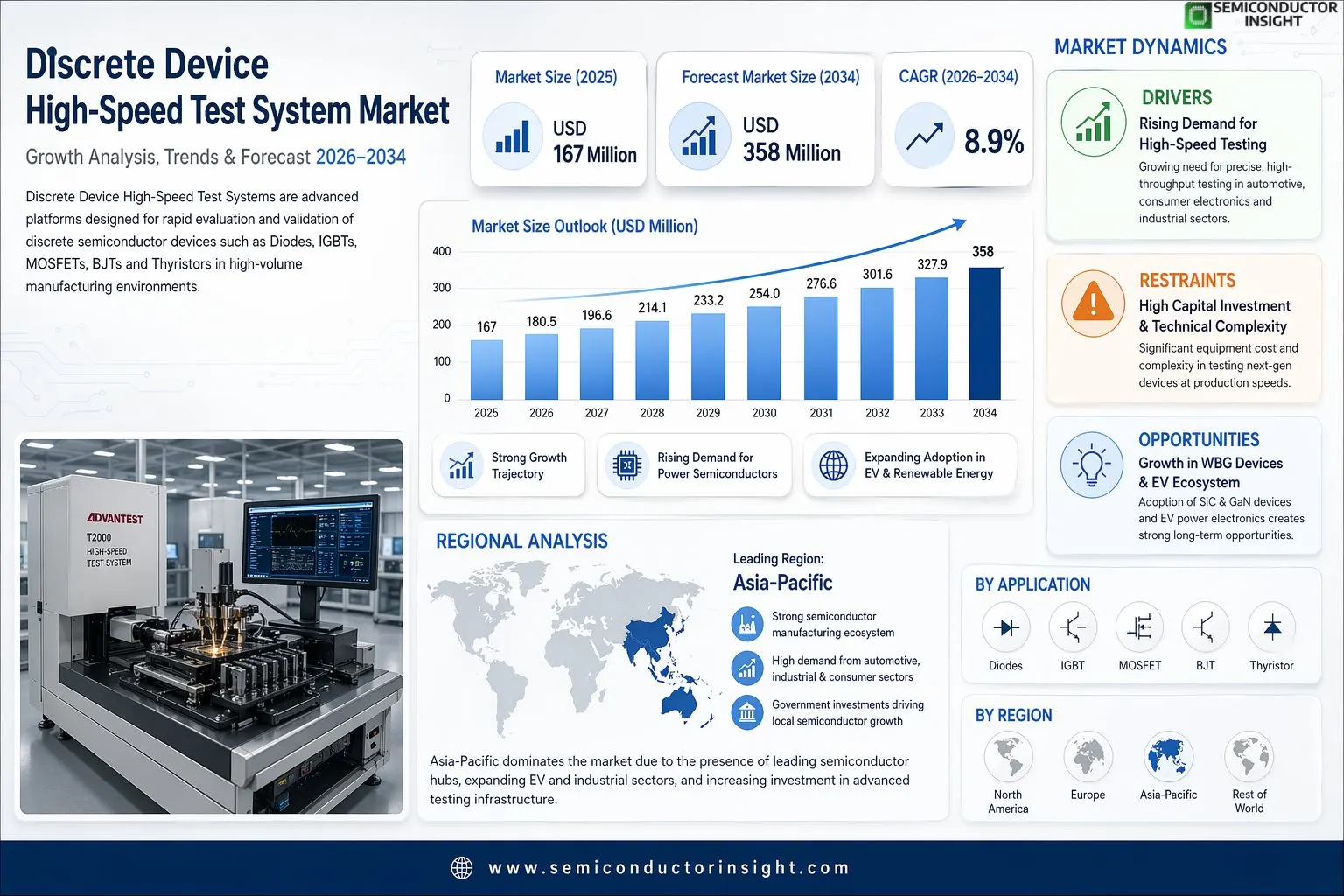
MARKET DRIVERS
Rising Demand for High-Speed Semiconductor Testing in Consumer Electronics and Automotive Applications
Discrete Device High-Speed Test System Market is experiencing sustained growth driven by the accelerating adoption of discrete semiconductor components across consumer electronics, automotive electronics, and industrial automation sectors. As device miniaturization intensifies and operating frequencies climb, manufacturers require increasingly sophisticated test systems capable of characterizing transistors, diodes, MOSFETs, and IGBTs at speeds that mirror real-world operating conditions. The proliferation of electric vehicles (EVs), in particular, has significantly elevated demand for power discrete devices, making rigorous high-speed testing a non-negotiable step in the production workflow.
Expansion of Wide-Bandgap Semiconductor Adoption Fueling Test System Upgrades
The rapid commercialization of silicon carbide (SiC) and gallium nitride (GaN) wide-bandgap (WBG) discrete devices is serving as a critical driver for the high-speed test system market for discrete devices. These next-generation semiconductors operate at higher voltages, temperatures, and switching frequencies compared to traditional silicon-based components, demanding test infrastructure that can handle their unique electrical characteristics without compromising measurement accuracy. Semiconductor manufacturers and IDMs are actively investing in upgraded parametric and functional test platforms to accommodate WBG device portfolios, creating a sustained capital expenditure cycle within the test and measurement industry.
➤ Global transition toward electrification and energy-efficient power conversion is directly translating into higher volumes of discrete power devices entering production lines, where high-speed test systems serve as the critical quality gate ensuring reliability, performance consistency, and regulatory compliance across high-volume manufacturing environments.
Furthermore, the expansion of 5G infrastructure and advanced telecom hardware has introduced a new class of RF and microwave discrete components that require high-frequency parametric testing at production scale. This diversification of end-use applications is broadening the addressable market for discrete device high-speed test systems, prompting test equipment vendors to develop multi-application platforms capable of serving both power electronics and RF discrete device segments within a single, flexible test architecture.
MARKET CHALLENGES
Technical Complexity of Testing Next-Generation Discrete Devices at Production Speeds
One of the foremost challenges confronting Discrete Device High-Speed Test System Market is the growing technical difficulty of accurately characterizing advanced discrete components at the speeds demanded by high-volume manufacturing. As switching frequencies for power MOSFETs and GaN transistors push into the multi-megahertz range, test systems must achieve sub-nanosecond timing resolution while maintaining measurement repeatability across millions of devices. This places extreme demands on signal integrity, fixture design, and calibration methodologies , areas where even minor engineering oversights can produce systematic test escapes or yield loss misattribution.
Other Challenges
High Capital Investment and Total Cost of Ownership
The procurement and ongoing maintenance of high-speed test systems for discrete devices represent a substantial capital commitment for semiconductor manufacturers and outsourced semiconductor assembly and test (OSAT) providers. State-of-the-art automated test equipment (ATE) platforms designed for discrete power devices involve significant upfront hardware costs compounded by expenses related to device-specific test fixtures, handler integration, and periodic software licensing renewals. For smaller manufacturers and emerging market participants, this financial barrier can constrain adoption and delay technology refresh cycles, limiting operational competitiveness.
Skilled Workforce Shortage in Test Engineering
The increasing complexity of discrete device high-speed test systems demands a workforce with specialized expertise spanning semiconductor physics, high-frequency electronics, and ATE software programming. Global semiconductor industry is currently navigating a well-documented talent shortage in test engineering disciplines, creating bottlenecks in test program development, system qualification, and capacity ramp-up. This skills gap is particularly acute in emerging semiconductor manufacturing hubs where local technical education infrastructure has not yet matured to meet industry demand.
MARKET RESTRAINTS
Supply Chain Disruptions and Semiconductor Capital Expenditure Volatility
Discrete Device High-Speed Test System Market remains susceptible to cyclical fluctuations in semiconductor capital expenditure, which directly influence procurement decisions for test equipment. During periods of inventory correction or demand softness in end markets such as consumer electronics and industrial automation, semiconductor manufacturers typically defer or reduce test infrastructure investments, creating revenue headwinds for test system suppliers. The capital-intensive nature of ATE procurement means that even modest downturns in fab utilization rates can trigger meaningful contractions in new system orders, introducing revenue volatility that is structurally difficult to hedge.
Geopolitical Trade Restrictions Impacting Test Equipment Access in Key Manufacturing Regions
Evolving geopolitical tensions and export control frameworks are emerging as meaningful restraints on the high-speed discrete device test system market, particularly as leading ATE vendors are headquartered in regions subject to technology export regulations. Restrictions affecting the transfer of advanced semiconductor manufacturing and test equipment to certain geographies complicate market access strategies for global vendors and may fragment the competitive landscape along regional lines. Additionally, semiconductor manufacturers operating in restricted geographies may face delays in accessing state-of-the-art test platforms, potentially affecting their product quality assurance capabilities and time-to-market for advanced discrete devices.
MARKET OPPORTUNITIES
Growing Electric Vehicle and Renewable Energy Sectors Creating Sustained Demand for Power Discrete Test Capabilities
The accelerating global transition toward electric mobility and renewable energy generation represents a compelling long-term opportunity for Discrete Device High-Speed Test System Market. Power discrete components , including high-voltage MOSFETs, IGBTs, SiC diodes, and GaN transistors , are foundational to EV powertrains, onboard charging systems, and grid-connected inverters. As annual EV production volumes scale globally and renewable energy installations continue their upward trajectory, the corresponding increase in power discrete device output will drive proportional demand for high-throughput, high-accuracy test systems capable of 100% production screening at competitive cost-per-test metrics.
Integration of Artificial Intelligence and Machine Learning in Test System Platforms
The incorporation of AI and machine learning capabilities into discrete device high-speed test systems presents a significant market opportunity for vendors seeking differentiation in an increasingly competitive landscape. Intelligent test platforms can leverage real-time data analytics to dynamically optimize test sequences, predict equipment maintenance requirements, and correlate test results with upstream process parameters to enable adaptive yield management. These capabilities are particularly valuable for high-volume discrete device production environments where marginal improvements in test efficiency and yield enhancement directly translate into measurable cost savings and competitive advantages for device manufacturers.
Expansion of OSAT Capacity in Asia-Pacific Driving Regional Test Equipment Investments
Asia-Pacific continues to dominate global discrete semiconductor assembly and test activity, and ongoing capacity expansion by major OSAT providers across China, Malaysia, Vietnam, and the Philippines is generating substantial regional demand for high-speed test systems tailored to discrete device manufacturing. Government-backed semiconductor self-sufficiency initiatives in several Asia-Pacific economies are further accelerating domestic fab and test capacity build-out, creating greenfield procurement opportunities for both established ATE vendors and emerging regional test equipment developers. This regional investment wave is expected to sustain above-average growth in the Asia-Pacific segment of Discrete Device High-Speed Test System Market through the near-to-medium term horizon.
Discrete Device High-Speed Test System Market Trends
Rising Demand for High-Throughput Semiconductor Testing Drives Market Expansion
Discrete Device High-Speed Test System Market is experiencing significant momentum as semiconductor manufacturers increasingly prioritize precision, speed, and automation in their device validation workflows. The growing complexity of discrete semiconductor components , including MOSFETs, IGBTs, diodes, and thyristors , has intensified the need for advanced test platforms capable of delivering accurate, high-speed evaluations at scale. As global electronics production continues to expand, manufacturers are investing heavily in test infrastructure to meet stringent quality standards and reduce time-to-market. This trend is particularly evident in power electronics applications, where device reliability under high-voltage conditions is a critical performance requirement.
Other Trends
Shift Toward Higher Voltage Testing Capabilities
Within Discrete Device High-Speed Test System Market, there is a growing transition toward test systems capable of handling higher maximum output voltages. The Max Output Voltage 1200V segment is gaining traction alongside the established 600V category, driven by increasing adoption of high-power discrete semiconductors in electric vehicles, industrial motor drives, and renewable energy inverters. Manufacturers such as Advantest, Teradyne, and Cohu, Inc. are developing next-generation platforms that support broader voltage ranges without compromising test throughput or measurement accuracy.
Integration of Automation and AI-Assisted Testing
Automation is rapidly reshaping Discrete Device High-Speed Test System Market. Leading players including NI (SET GmbH), TESEC Corporation, and Macrotest are incorporating intelligent test sequencing and adaptive algorithms into their systems. This reduces human intervention in test floor operations while improving defect detection rates. AI-assisted diagnostics are enabling predictive maintenance of test equipment, minimizing downtime in high-volume production environments. The convergence of automation with high-speed measurement is becoming a key differentiator among top competitors.
Asia-Pacific Emerging as a Key Regional Growth Hub
Asia-Pacific, led by China, Japan, and South Korea, is emerging as a dominant regional market within the Discrete Device High-Speed Test System landscape. China-based manufacturers such as Beijing Huafeng and PowerTECH are expanding their domestic capabilities, reflecting broader national investments in semiconductor self-sufficiency. South Korea and Japan continue to anchor regional demand through their established semiconductor fabrication ecosystems, where high-speed test systems for IGBT and MOSFET components remain in strong and consistent demand.
Growing Application Across Power Device Segments Reinforces Long-Term Market Outlook
Discrete Device High-Speed Test System Market is benefiting from diversified application demand spanning diodes, BJTs, thyristors, IGBTs, and MOSFETs. Each application segment presents distinct test requirements, pushing system vendors to develop versatile, multi-device platforms. As wide-bandgap semiconductors such as silicon carbide and gallium nitride gain adoption in power conversion applications, Discrete Device High-Speed Test System Market is expected to evolve further, with test platforms adapting to the unique electrical characteristics of these next-generation materials. Key global players, including SHibaSoku, STATEC, and others, are aligning their product roadmaps to address these emerging testing requirements.
COMPETITIVE LANDSCAPE
Key Industry Players
Discrete Device High-Speed Test System Market – Competitive Dynamics and Leading Manufacturer Analysis
Global Discrete Device High-Speed Test System market, valued at approximately USD 167 million in 2025 and projected to reach USD 284 million by 2032 at a CAGR of 8.1%, is characterized by a moderately consolidated competitive landscape dominated by a handful of technologically advanced players. Advantest and Teradyne remain the foremost global leaders in this space, leveraging decades of expertise in semiconductor test equipment, broad product portfolios, and extensive global service networks. These companies benefit from strong R&D capabilities and long-standing relationships with major semiconductor manufacturers across North America, Europe, and Asia. Cohu, Inc. further strengthens the competitive top tier through its focus on high-throughput handler and test solutions tailored for discrete devices such as MOSFETs, IGBTs, diodes, and thyristors , components that are central to power electronics and automotive applications. The top five global players collectively accounted for a significant share of total market revenue in 2025, underscoring the importance of scale, precision engineering, and automation in winning large-volume manufacturing contracts.
Beyond the market leaders, several specialized and regional players contribute meaningfully to the competitive ecosystem of Discrete Device High-Speed Test System Market. NI (SET GmbH) offers modular, software-defined test architectures that appeal to customers seeking flexibility across multiple discrete device types, including BJTs and thyristors. TESEC Corporation and SHibaSoku are well-regarded Japanese manufacturers with deep expertise in high-speed parametric testing for discrete semiconductors, catering heavily to the Asia-Pacific semiconductor supply chain. STATEC and Macrotest serve niche segments with cost-competitive solutions, while PowerTECH and Beijing Huafeng have established a strong foothold in the rapidly growing Chinese market, benefiting from domestic semiconductor manufacturing expansion and government-backed initiatives to localize test equipment production. The competitive intensity is further amplified by ongoing investments in higher voltage test capabilities , particularly in the Max Output Voltage 1200V segment , as demand from electric vehicle and industrial power electronics applications continues to accelerate globally.
List of Key Discrete Device High-Speed Test System Companies Profiled
- Advantest
- Teradyne
- Cohu, Inc.
- NI (SET GmbH)
- TESEC Corporation
- SHibaSoku
- STATEC
- Macrotest
- PowerTECH
- Beijing Huafeng
Segment Analysis:
| Segment Category | Sub-Segments | Key Insights |
| By Type |
|
Max Output Voltage 600V holds a dominant position in Discrete Device High-Speed Test System Market, driven by its broad compatibility with conventional discrete semiconductor devices widely deployed across consumer electronics and industrial automation segments.
|
| By Application |
|
MOSFET represents the leading application segment within Discrete Device High-Speed Test System Market, propelled by the explosive proliferation of power management ICs across automotive electrification, data centers, and portable consumer devices.
|
| By End User |
|
Semiconductor Manufacturers constitute the dominant end-user category, as the need for wafer-level and package-level validation of discrete devices at high throughput remains a fundamental requirement in the production cycle of leading semiconductor fabs and integrated device manufacturers (IDMs).
|
| By Automation Level |
|
Fully Automated Test Systems lead this segment by a considerable margin, as large-scale semiconductor fabs increasingly prioritize zero-touch testing workflows to achieve the throughput levels demanded by global supply chain requirements.
|
| By Device Technology |
|
Silicon-Based Discrete Devices currently represent the largest technology segment tested by high-speed systems, owing to the vast and deeply entrenched installed base of silicon MOSFETs, IGBTs, diodes, and BJTs across virtually every power electronics application domain worldwide.
|
Regional Analysis: Discrete Device High-Speed Test System Market
Asia-Pacific
Asia-Pacific’s deeply integrated semiconductor supply chain provides a natural foundation for widespread adoption of discrete device high-speed test systems. The region’s vertically integrated manufacturing clusters , spanning wafer fabrication, packaging, and final assembly , create consistent, high-volume demand for advanced testing solutions, enabling suppliers to develop tailored offerings that address the unique throughput and precision requirements of regional manufacturers.
The region’s aggressive adoption of next-generation device architectures , including wide bandgap semiconductors, high-electron-mobility transistors, and advanced power discretes , is compelling manufacturers to invest in more sophisticated discrete device high-speed test systems. Rising device miniaturization and tighter performance tolerances are accelerating demand for test platforms capable of operating at increasingly elevated signal frequencies and reduced cycle times.
Strategic government initiatives across China, South Korea, and Japan are channeling significant capital into domestic semiconductor capacity expansion. These policy frameworks not only support fabrication investment but also drive procurement of supporting infrastructure, including discrete device high-speed test systems. Incentive structures and national semiconductor development programs are accelerating technology upgrades across testing operations throughout the region.
Explosive growth in electric vehicles, industrial automation, and 5G telecommunications infrastructure within Asia-Pacific is generating sustained demand for high-performance discrete semiconductor devices, which in turn elevates the strategic importance of discrete device high-speed test systems. Automotive-grade reliability standards and telecom-driven performance requirements are pushing manufacturers to modernize and scale their test capabilities continuously.
North America
North America represents a highly mature and technology-forward market for discrete device high-speed test systems, shaped by the presence of globally prominent semiconductor design firms, defense electronics contractors, and advanced research institutions. The United States, as the region’s core contributor, houses numerous fabless semiconductor companies and integrated device manufacturers whose stringent quality and performance benchmarks necessitate sophisticated test infrastructure. The region’s strong orientation toward aerospace, defense, and automotive applications demands test systems capable of validating discrete devices under extreme operating conditions and to exceptionally tight tolerances. Additionally, North America’s leadership in developing next-generation computing architectures and communications technologies sustains consistent investment in high-speed test capability upgrades. Government-backed semiconductor reshoring initiatives and domestic chip manufacturing incentives are further stimulating local demand for discrete device high-speed test systems, as newly established and expanded fabs require comprehensive test infrastructure to support high-mix, high-complexity production environments.
Europe
Europe occupies a strategically significant position in Discrete Device High-Speed Test System Market, underpinned by its strong industrial electronics, automotive semiconductor, and power electronics sectors. Germany, the Netherlands, and France are among the region’s most active contributors, with a pronounced focus on automotive-grade and industrial-grade discrete semiconductor components that demand rigorous validation protocols. European semiconductor manufacturers and Tier-1 automotive suppliers are increasingly investing in advanced discrete device high-speed test systems to meet the exacting reliability and safety standards required for electric vehicle powertrains, advanced driver-assistance systems, and smart manufacturing applications. The European Chips Act and associated funding programs are reinforcing regional semiconductor ambitions, stimulating both capacity expansion and the modernization of test infrastructure. Furthermore, Europe’s emphasis on energy efficiency and green technology is driving adoption of wide bandgap power devices, which require specialized high-speed test capabilities to ensure performance compliance.
South America
South America represents an emerging and progressively developing market within Global discrete device high-speed test system landscape. Brazil serves as the region’s principal electronics manufacturing and technology adoption hub, with a growing base of consumer electronics assembly operations and an expanding automotive production sector that collectively drive modest but steadily increasing demand for discrete device testing solutions. The region’s test system adoption is currently concentrated among multinational manufacturers and larger domestic firms seeking to align with global quality standards and supply chain expectations. Infrastructure development constraints and economic variability have historically tempered the pace of technology investment; however, improving industrial policies and increasing foreign direct investment in electronics manufacturing are gradually elevating the region’s engagement with advanced test technologies. As regional electronics production scales and supply chain integration deepens, South America is expected to gain incremental relevance in Discrete Device High-Speed Test System Market over the forecast period.
Middle East & Africa
The Middle East and Africa region currently occupies an early-stage position in Discrete Device High-Speed Test System Market, with adoption primarily concentrated in a limited number of technologically advanced economies. The United Arab Emirates, Israel, and South Africa represent the most active markets within the region, driven by investments in defense electronics, telecommunications infrastructure, and emerging technology sectors. Israel’s established semiconductor and defense electronics industry provides a focused demand base for high-speed test systems, while Gulf Cooperation Council nations are progressively building out technology and electronics manufacturing capabilities as part of broader economic diversification strategies. Africa’s expanding telecommunications network rollout , particularly the deployment of mobile broadband and digital infrastructure , is creating nascent demand for discrete components that, over time, may necessitate localized testing capabilities. While the region’s overall market share remains limited relative to more mature geographies, long-term infrastructure investment trends and technology sector development initiatives position the Middle East and Africa for gradual but sustained market participation in the discrete device high-speed test system space.
Report Scope
This market research report provides a comprehensive analysis of Discrete Device High-Speed Test System Market, covering the forecast period 2026–2034. It offers detailed insights into market dynamics, technological advancements, competitive landscape, and key trends shaping the industry.
Key focus areas of the report include:
- Market Overview: The report begins with an overview outlining its current market scenario, key growth indicators, and industry transformation drivers. It discusses macroeconomic factors, demand–supply balance, regulatory landscape, and the strategic role of semiconductors in powering advancements across industries such as automotive, telecommunications, consumer electronics, and industrial automation.
- Market Size & Forecast: Historical data and future projections for revenue, unit shipments, and market value across major regions and segments.
- Segmentation Analysis: Detailed breakdown by product type, technology, application, and end-user industry to identify high-growth segments and investment opportunities.
- Regional Insights: Insights into market performance across North America, Europe, Asia-Pacific, Latin America, and the Middle East & Africa, including country-level analysis where relevant.
- Competitive Landscape: Profiles of leading market participants, including their product offerings, R&D focus, manufacturing capacity, pricing strategies, and recent developments such as mergers, acquisitions, and partnerships.
- Technology Trends & Innovation: Assessment of emerging technologies, integration of AI/IoT, semiconductor design trends, fabrication techniques, and evolving industry standards.
- Market Drivers & Restraints: Evaluation of factors driving market growth along with challenges, supply chain constraints, regulatory issues, and market-entry barriers.
- Stakeholder Insights: Insights for component suppliers, OEMs, system integrators, investors, and policymakers regarding the evolving ecosystem and strategic opportunities.
Primary and secondary research methods are employed, including interviews with industry experts, data from verified sources, and real-time market intelligence to ensure the accuracy and reliability of the insights presented.
FREQUENTLY ASKED QUESTIONS:
What is the current market size of Discrete Device High-Speed Test System Market?
-> Global Discrete Device High-Speed Test System Market was valued at USD 167 million in 2025 and is projected to reach USD 284 million by 2032, growing at a CAGR of 8.1% during the forecast period.
Which key companies operate in Discrete Device High-Speed Test System Market?
-> Key players include Advantest, Teradyne, Cohu, Inc., NI (SET GmbH), TESEC Corporation, SHibaSoku, STATEC, Macrotest, PowerTECH, and Beijing Huafeng, among others.
What are the key growth drivers?
-> Key growth drivers include rising demand for high-throughput semiconductor testing, rapid expansion of electric vehicles and power electronics, increasing adoption of IGBT and MOSFET devices, and growing investments in semiconductor manufacturing automation.
Which region dominates the market?
-> Asia is a dominant and fast-growing region, driven by strong semiconductor manufacturing activity in China, Japan, South Korea, and Southeast Asia, while North America also holds a significant market share.
What are the emerging trends?
-> Emerging trends include integration of AI-driven test automation, high-speed parametric testing for wide-bandgap semiconductors, increased demand for testing systems supporting Diodes, IGBT, MOSFET, BJT, and Thyristor applications, and the development of systems supporting Max Output Voltage up to 1200V.

Get Sample Report PDF for Exclusive Insights
Report Sample Includes
- Table of Contents
- List of Tables & Figures
- Charts, Research Methodology, and more...
 Download Sample Report PDF