MARKET INSIGHTS
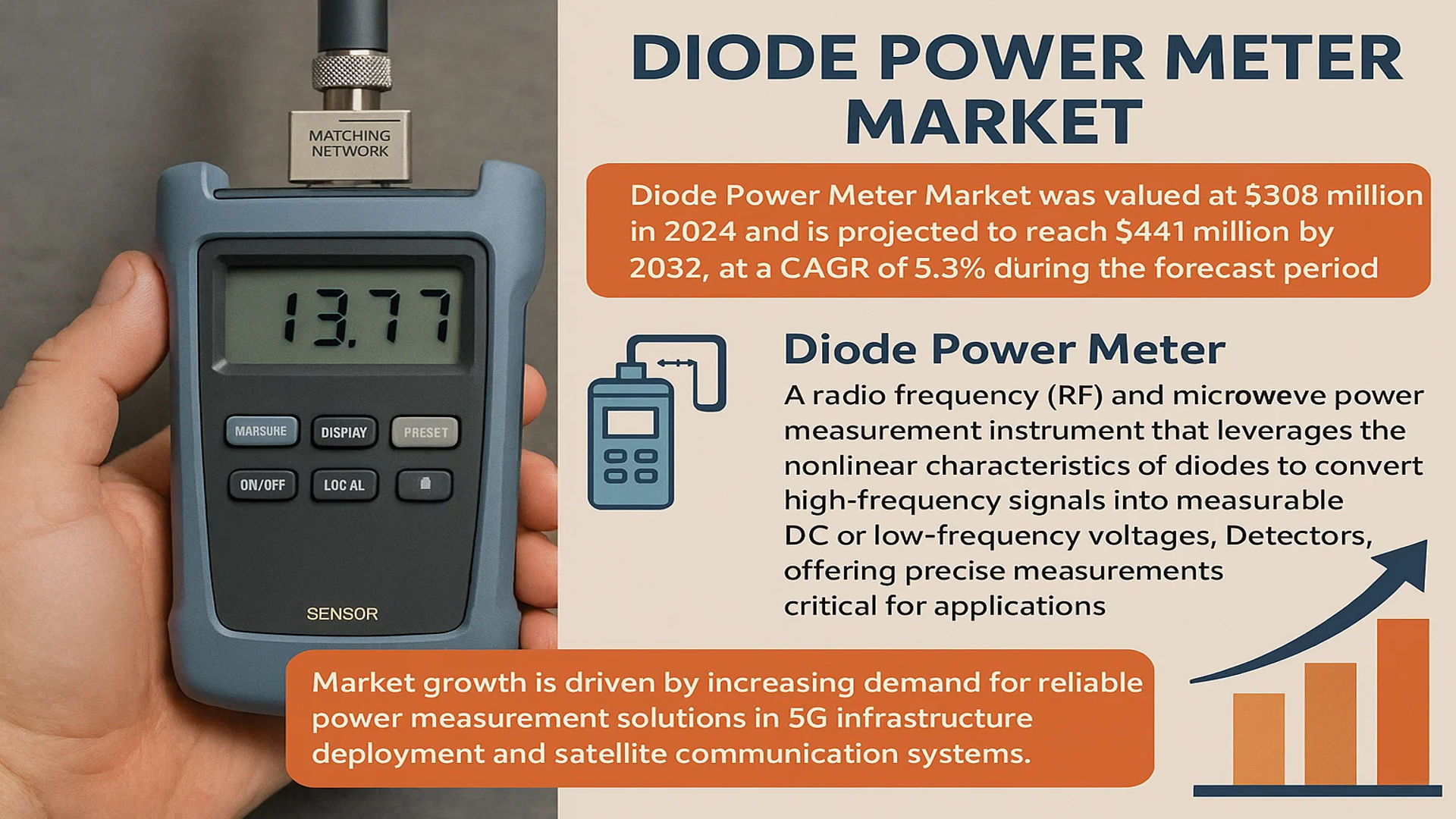
The global Diode Power Meter Market was valued at 308 million in 2024 and is projected to reach US$ 441 million by 2032, at a CAGR of 5.3% during the forecast period.
A diode power meter is a radio frequency (RF) and microwave power measurement instrument that leverages the nonlinear characteristics of diodes to convert high-frequency signals into measurable DC or low-frequency voltages. These devices typically utilize Schottky diodes or thermistor diodes as detectors, offering precise measurements critical for applications ranging from telecommunications to aerospace. The diode power meter operates by rectifying input signals through a matching network, with output voltage proportional to input power for accurate indirect measurements.
Market growth is driven by increasing demand for reliable power measurement solutions in 5G infrastructure deployment and satellite communication systems. However, technological complexities in high-frequency applications present ongoing challenges. Key players including Keysight Technologies and Rohde & Schwarz dominate the competitive landscape, collectively holding significant market share through continuous innovation in measurement accuracy and frequency range capabilities.
MARKET DYNAMICS
MARKET DRIVERS
Expansion of 5G and Radar Technologies to Accelerate Diode Power Meter Adoption
The global rollout of 5G networks is significantly driving demand for diode power meters, as these instruments are essential for testing and maintaining RF transmission accuracy. With over 300 commercial 5G networks deployed worldwide, power measurement precision has become critical for ensuring optimal signal strength and network reliability. Diode power meters provide the necessary accuracy for high-frequency signal measurement in these advanced communication systems. Military radar modernization programs, with defense budgets exceeding $2 trillion globally, further contribute to market expansion as these systems require precise power measurement capabilities.
Growth in Satellite Communication Infrastructure to Support Market Expansion
The satellite communication sector is experiencing unprecedented growth, with over 6,000 active satellites currently orbiting Earth and thousands more planned. Diode power meters play a crucial role in ground station installations and satellite payload verification, ensuring proper signal transmission power levels. The emergence of low-earth orbit (LEO) constellations has particularly increased demand for portable, high-accuracy power measurement solutions that can operate across multiple frequency bands.
Moreover, the transition toward more compact and energy-efficient communication systems is prompting innovations in diode power meter technology. Recent advancements include integrated solutions combining power measurement with signal analysis capabilities, reducing test complexity for engineers while improving measurement reliability.
MARKET RESTRAINTS
High Initial Costs to Limit Adoption Among Small Enterprises
Premium diode power meter solutions often carry substantial price tags, with high-end models exceeding $15,000. This significant capital investment creates barriers for small and medium-sized enterprises, particularly in price-sensitive markets. Many organizations consequently delay upgrades or opt for less precise measurement alternatives, potentially compromising measurement accuracy in critical applications.
Additionally, the specialized nature of these instruments leads to extended product lifecycles, reducing replacement frequency. Manufacturers must balance technological advancement with pricing strategies to maintain market competitiveness while ensuring profitability.
MARKET CHALLENGES
Measurement Accuracy Challenges at Higher Frequencies to Impact Market Growth
As communication technologies push into millimeter-wave frequencies, diode power meters face inherent measurement accuracy limitations. The nonlinear response characteristics of detection diodes become particularly challenging above 40 GHz, with measurement uncertainty potentially exceeding acceptable thresholds for critical applications. This technical constraint forces users to implement complex calibration routines or supplement diode meters with alternative measurement technologies.
Competitive Pricing Pressure
The market faces increasing competition from alternative power measurement technologies, particularly thermal-based solutions that offer superior accuracy in certain applications. While diode power meters provide faster response times, price competition from emerging manufacturers has created margin pressures for established brands.
MARKET OPPORTUNITIES
Integration of AI and IoT Capabilities to Open New Market Potential
The convergence of diode power measurement technology with artificial intelligence presents transformative opportunities. Smart power meters capable of predictive maintenance and automated calibration are emerging, reducing downtime in critical communication infrastructure. Network operators increasingly prefer solutions that integrate with IoT platforms for remote monitoring, creating demand for connected measurement devices.
Furthermore, the growing adoption of advanced driver assistance systems (ADAS) and autonomous vehicle technology will require specialized power measurement solutions. Automotive radar systems operating at 77 GHz represent a significant growth avenue for high-frequency diode power meter applications.
DIODE POWER METER MARKET TRENDS
Rising Demand for High-Frequency Testing Drives Diode Power Meter Market Growth
The global diode power meter market is witnessing robust growth due to increasing demand for high-frequency testing in telecommunications and aerospace applications. The market, valued at $308 million in 2024, is projected to expand at a 5.3% CAGR through 2032, driven by advancements in 5G infrastructure and satellite communication technologies. These high-frequency applications require precise power measurement capabilities that only diode-based solutions can provide. The superior dynamic range and fast response time of Schottky diode power meters make them particularly valuable for modern RF testing scenarios.
Other Trends
Expansion in Automotive Radar Applications
The automotive sector’s rapid adoption of advanced driver-assistance systems (ADAS) is creating significant opportunities for diode power meter manufacturers. With radar systems operating in the 77-81 GHz frequency range becoming standard in modern vehicles, the need for accurate power measurement tools has never been greater. Automotive radar testing now accounts for approximately 18% of diode power meter applications as manufacturers strive to ensure compliance with stringent safety regulations. This growth is further amplified by the transition towards autonomous vehicles requiring multiple radar arrays per vehicle.
Miniaturization and Enhanced Functionality Driving Product Innovation
Leading manufacturers are focusing on developing compact, multi-functional diode power meters that can handle broader frequency ranges while maintaining measurement accuracy. Recent product launches feature integrated USB connectivity and real-time data analysis capabilities, allowing seamless integration with automated test environments. The growing demand for portable testing solutions in field applications has led to a 12% year-over-year increase in sales of handheld diode power meters. This trend is particularly evident in military communications and aerospace applications where field testing is critical for operational readiness.
Increasing Adoption in Emerging 5G Infrastructure
The global rollout of 5G networks is creating unprecedented demand for diode power meters capable of operating at millimeter-wave frequencies. As telecom operators expand their infrastructure to support 5G NR (New Radio) standards, testing requirements have become more stringent. Diode power meters offering frequency coverage up to 110 GHz are seeing rapid adoption for base station installation and maintenance. Market analysis indicates that applications in 5G infrastructure now represent nearly 35% of total diode power meter usage, with China and the United States leading in deployment-related testing equipment purchases.
COMPETITIVE LANDSCAPE
Key Industry Players
Market Leaders Focus on Precision Measurement & Expanding Applications to Accelerate Growth
The global diode power meter market exhibits a moderately consolidated competitive structure, with multinational corporations dominating the high-end segment while regional players cater to specialized applications. Keysight Technologies and Rohde & Schwarz collectively held over 30% of the market share in 2024, owing to their established position in RF measurement instruments and continuous innovation in microwave power sensing technologies.
Meanwhile, Anritsu Corporation has been gaining market traction through its compact diode power sensor series, particularly in 5G network testing applications. Their focus on millimeter-wave compatibility (up to 110 GHz) gives them an edge in next-generation communication infrastructure deployments.
The competitive intensity is further heightened by increasing R&D investments from Chinese manufacturers like Shanghai Bo Ming Scientific Instruments, who are challenging traditional players with cost-optimized solutions for industrial applications while maintaining ±5% measurement accuracy – a key performance parameter in the industry.
Strategic Developments Shaping Competition
Recent months have witnessed several strategic moves:
- Keysight launched the N8480 Series in Q1 2024 featuring enhanced thermal compensation algorithms
- Rohde & Schwarz expanded its NRX power meter portfolio with 50 GHz models targeting satellite communication applications
- Teledyne acquired a minority stake in Chengdu Xinrui Electronics to strengthen its presence in Southwest China’s growing aerospace sector
While North American and European firms lead in technological sophistication, Asian manufacturers are rapidly closing the gap through:
- Localized production reducing lead times
- Custom calibration services for regional frequency bands
- Strategic partnerships with base station manufacturers
List of Key Diode Power Meter Manufacturers
- Keysight Technologies (U.S.)
- Rohde & Schwarz (Germany)
- Anritsu Corporation (Japan)
- Teledyne Technologies (U.S.)
- Giga-tronics (U.S.)
- Boonton Electronics (U.S.)
- Tektronix (U.S.)
- Bird Electronics (U.S.)
- Shanghai Bo Ming Scientific Instruments (China)
- Shanghai Frequency Standard Technology (China)
- Nanjing Shengbo Electronics (China)
- Beijing Puyuan Jingdian Technology (China)
- Xi’an Aerospace Huaxun Technology (China)
- Chengdu Xinrui Electronics (China)
The market’s future trajectory will be shaped by the convergence of two trends: established players enhancing their products’ frequency range and accuracy, while challengers focus on industry-specific solutions and competitive pricing – particularly in emerging 5G and satellite communication markets across Asia-Pacific.
Segment Analysis:
By Type
Schottky Diode Power Meter Leads the Market Due to High-Speed RF and Microwave Applications
The market is segmented based on type into:
- Schottky Diode Power Meter
- Subtypes: Single-channel, Multi-channel, Portable, Benchtop
- Thermistor Diode Power Meter
- Subtypes: Broadband, Narrowband, High-power models
By Application
Communication Base Station Segment Shows Strong Growth Potential Driven by 5G Network Expansion
The market is segmented based on application into:
- Radar Systems
- Communication Base Stations
- Satellite Communication
- Research and Development Labs
- Others
By End User
Telecommunications Sector Accounts for Significant Market Share Owing to Infrastructure Modernization
The market is segmented based on end user into:
- Telecommunication Service Providers
- Defense and Aerospace Organizations
- Electronics Manufacturing Companies
- Research Institutions
By Measurement Range
High-Power Measurement Segment Gains Traction for Industrial and Defense Applications
The market is segmented based on measurement range into:
- Low-Power Meters
- Medium-Power Meters
- High-Power Meters
Regional Analysis: Diode Power Meter Market
Asia-Pacific
The Asia-Pacific region dominates the global diode power meter market, accounting for the largest share due to rapid technological advancements in telecommunications and defense sectors. China leads the regional market with heavy investments in 5G infrastructure and satellite communication projects, supported by government initiatives like the “Made in China 2025” program. India and Japan follow closely, with increasing demand for RF testing equipment in aerospace and automotive industries. Local manufacturers such as Shanghai Bo Ming Scientific Instruments and Nanjing Shengbo Electronics are gaining traction by offering cost-effective solutions. The region’s growth is further fueled by rising R&D expenditures and the adoption of IoT-enabled devices across industrial applications.
North America
North America represents the second-largest market for diode power meters, driven by cutting-edge innovations in radar systems and advanced communication technologies. The U.S. holds a dominant position, with key players like Keysight Technologies and Tektronix developing high-precision measurement solutions for military and commercial applications. Growing investments in space exploration programs (NASA’s Artemis missions) and 5G network deployments are creating substantial demand. Strict regulatory standards for RF equipment certification ensure product quality but increase compliance costs. Canada’s emerging quantum computing research sector presents new opportunities for specialized power measurement devices.
Europe
Europe maintains steady growth in the diode power meter market, characterized by strong emphasis on research-intensive applications. Germany and the UK lead with their robust automotive radar testing requirements and aerospace sector needs. EU regulations on electromagnetic compatibility (EMC Directive 2014/30/EU) drive demand for compliant testing equipment. Companies like Rohde & Schwarz and Anritsu benefit from increasing 5G infrastructure projects across the region. The market faces challenges from high competition and price sensitivity, but innovations in satellite communication testing equipment provide growth avenues. Collaborative research initiatives between universities and manufacturers support technological advancements.
Middle East & Africa
This emerging market shows promising growth potential, particularly in Gulf Cooperation Council (GCC) countries where telecommunications infrastructure development is prioritized. Saudi Arabia and the UAE lead regional adoption, investing in smart city projects and satellite communication systems. Limited local manufacturing capabilities create reliance on imports from Europe and Asia. Military modernization programs across North African nations are driving demand for RF testing equipment. While economic diversification efforts support market growth, political instability in some areas and lack of standardization pose challenges for widespread adoption.
South America
South America presents moderate growth opportunities, with Brazil and Argentina being the primary markets. Expanding telecommunications networks and increasing satellite TV penetration drive demand for basic power measurement devices. Economic volatility and currency fluctuations hinder large-scale investments in advanced testing equipment. Local manufacturers focus on cost-effective solutions for consumer electronics testing, while industrial applications remain underserved. Growing interest in renewable energy systems creates niche opportunities for power measurement in solar and wind energy projects. The market suffers from fragmented distribution channels and limited technical expertise in some countries.
Report Scope
This market research report provides a comprehensive analysis of the global and regional Diode Power Meter markets, covering the forecast period 2024–2032. It offers detailed insights into market dynamics, technological advancements, competitive landscape, and key trends shaping the industry.
Key focus areas of the report include:
- Market Size & Forecast: Historical data and future projections for revenue, unit shipments, and market value across major regions and segments. The Global Diode Power Meter market was valued at USD 308 million in 2024 and is projected to reach USD 441 million by 2032, growing at a CAGR of 5.3%.
- Segmentation Analysis: Detailed breakdown by product type (Schottky Diode Power Meter, Thermistor Diode Power Meter), application (Radar System, Communication Base Station, Satellite Communication, Others), and end-user industry to identify high-growth segments.
- Regional Outlook: Insights into market performance across North America (U.S. estimated at significant market share), Europe, Asia-Pacific (China emerging as key market), Latin America, and Middle East & Africa.
- Competitive Landscape: Profiles of leading participants including Keysight Technologies, Rohde & Schwarz, Anritsu, Teledyne, and Giga-tronics, covering their product portfolios, R&D focus, and strategic developments.
- Technology Trends & Innovation: Assessment of emerging measurement technologies, integration with advanced RF systems, and evolving industry standards for power measurement accuracy.
- Market Drivers & Restraints: Evaluation of factors including growing demand for RF power measurement in telecom infrastructure, defense applications, and challenges related to high-frequency measurement accuracy.
- Stakeholder Analysis: Strategic insights for test equipment manufacturers, component suppliers, system integrators, and investors in the RF measurement ecosystem.
The research employs primary and secondary methodologies including interviews with industry experts, manufacturer data analysis, and validation through verified market intelligence sources.
FREQUENTLY ASKED QUESTIONS:
What is the current market size of Global Diode Power Meter Market?
-> Diode Power Meter Market was valued at 308 million in 2024 and is projected to reach US$ 441 million by 2032, at a CAGR of 5.3% during the forecast period.
Which key companies operate in Global Diode Power Meter Market?
-> Key players include Keysight Technologies, Rohde & Schwarz, Anritsu, Teledyne, Giga-tronics, Boonton Electronics, and Tektronix, with the top five players holding significant market share in 2024.
What are the key growth drivers?
-> Growth is driven by increasing demand for RF power measurement in 5G infrastructure, satellite communications, and defense applications, along with advancements in diode detector technology.
Which region dominates the market?
-> North America currently leads in market share, while Asia-Pacific is experiencing the fastest growth, particularly in China and Japan.
What are the emerging trends?
-> Emerging trends include development of broadband diode power sensors, integration with automated test systems, and increasing adoption in quantum computing research.

Get Sample Report PDF for Exclusive Insights
Report Sample Includes
- Table of Contents
- List of Tables & Figures
- Charts, Research Methodology, and more...