MARKET INSIGHTS
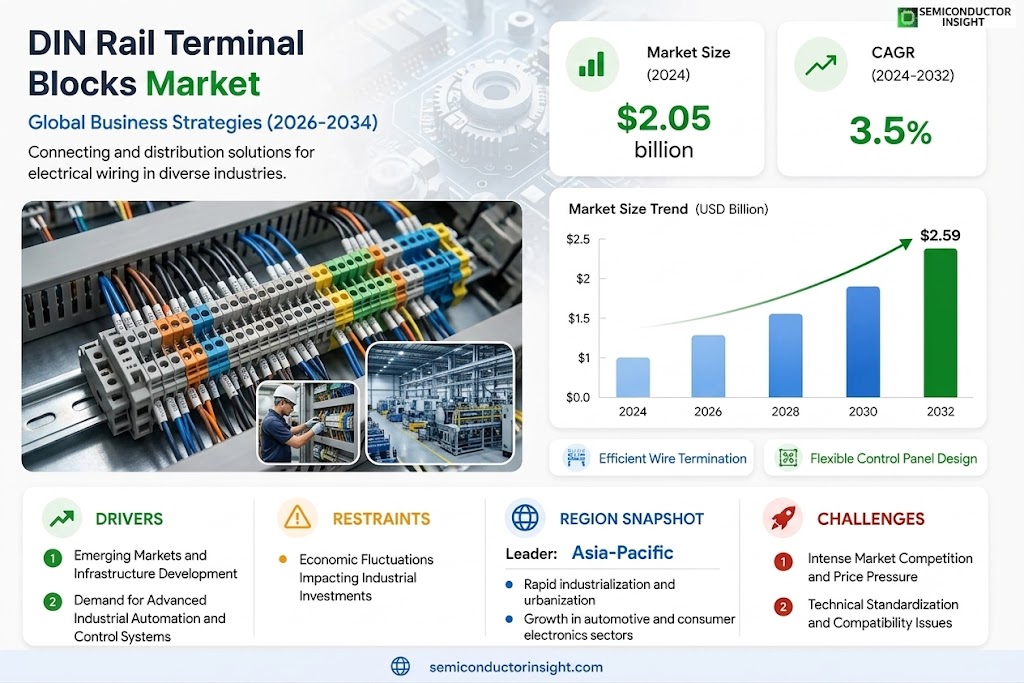
Global DIN Rail Terminal Blocks Market was valued at USD 2.05 billion in 2024 to USD 2.59 billion by 2032, exhibiting a CAGR of 3.5% during the forecast period.
DIN Rail Terminal Blocks are modular, insulated devices that facilitate the secure and organized connection of electrical wires. They are mounted on a standard DIN rail, which is a metal rail of a standard type widely used for mounting circuit breakers and industrial control equipment inside equipment racks. These blocks consist of a metal frame, typically enclosed in insulating plastic, featuring clamping elements—such as screws, spring cages, or push-in mechanisms—that allow wires to be inserted and securely fastened or released, ensuring a reliable electrical connection.
The market growth is primarily driven by the ongoing global industrialization and automation, particularly in manufacturing and process industries. The expansion of renewable energy infrastructure and the modernization of power distribution systems also contribute significantly to demand. However, the market faces challenges from price competition and the increasing adoption of wireless connectivity solutions. Europe currently dominates the market, holding a share of nearly 35%, because of its strong industrial base and stringent safety regulations. Key players like WAGO, Phoenix Contact, and Weidmüller collectively hold a significant portion of the market share, driving innovation with products that offer higher density, tool-less installation, and enhanced safety features.
 MARKET DRIVERS
Industrial Automation and Electrification Trends
The global push towards Industry 4.0 and smart manufacturing has significantly increased the adoption of DIN rail terminal blocks. These components are essential for creating modular and scalable electrical systems in automated production lines, robotics, and smart infrastructure projects worldwide.
Infrastructure Development and Urbanization
Rapid urbanization in developing economies has created massive demand for electrical infrastructure, including DIN rail terminal blocks. Major infrastructure projects in transportation, energy, and construction sectors continue to drive market growth as countries invest in modernizing their infrastructure networks.
➤ The global DIN Rail Terminal Blocks market was valued at US$ 2050 million in 2024 and is projected to reach US$ 2587 million by 2032, growing at a CAGR of 3.5% during the forecast period.
Increasing investments in renewable energy projects, particularly in solar and wind power installations, have created substantial demand for reliable electrical connection solutions. DIN rail terminal blocks provide the necessary reliability and safety in these applications, driving their adoption across energy sectors.
MARKET CHALLENGES
Intense Market Competition and Price Pressure
The DIN Rail Terminal Blocks market faces significant price competition, particularly from Asian manufacturers offering lower-cost alternatives. This pressure forces established players to continuously innovate while maintaining competitive pricing, creating challenges in maintaining profit margins while delivering high-quality products.
Other Challenges
Technical Standardization and Compatibility Issues
With multiple manufacturers offering different product specifications, achieving industry-wide standardization remains challenging. Compatibility issues between different brands’ products can create installation and maintenance challenges, particularly in complex electrical systems where components from multiple manufacturers are used.
MARKET RESTRAINTS
Economic Fluctuations Impacting Industrial Investments
Global economic uncertainties and fluctuations significantly impact industrial investments, which directly affects the DIN Rail Terminal Blocks market. During economic downturns, manufacturing and infrastructure projects often face budget constraints, leading to delayed or canceled projects that would otherwise require these components.
MARKET OPPORTUNITIES
Emerging Markets and Infrastructure Development
Rapid industrialization in emerging economies presents significant growth opportunities for the DIN Rail Terminal Blocks market. Countries in Asia, Latin America, and Africa are investing heavily in their industrial and infrastructure sectors, creating new demand for high-quality electrical components and connection solutions.
DIN Rail Terminal Blocks Market Trends
Market Growth Driven by Industrial Automation and Smart Grid Infrastructure
The global DIN Rail Terminal Blocks market continues to expand, with demand increasing across multiple industries. The market was valued at $2050 million in 2024 and is projected to reach $2587 million by 2032, representing a compound annual growth rate (CAGR) of 3.5%. This growth is primarily attributed to increased automation in manufacturing, expansion of renewable energy infrastructure, and the ongoing modernization of power distribution systems worldwide.
Other Trends
Regional Market Dynamics and Manufacturing Hubs
Europe remains the largest market for DIN Rail Terminal Blocks, holding approximately 35% of the global market share. This dominance is attributed to the region’s strong manufacturing base, stringent safety regulations, and extensive industrial infrastructure. Asia-Pacific follows as the second largest market, with rapid growth driven by industrialization initiatives in China, India, and Southeast Asian countries.
Technological Advancements and Product Innovation
Recent developments in DIN Rail Terminal Blocks include the introduction of higher density configurations, improved fire-retardant materials, and enhanced connection technologies that reduce installation time while maintaining safety standards. Manufacturers are focusing on developing products that meet international standards (IEC, UL, CSA) while offering better performance in harsh environments.
Market analysis indicates that the screw-type terminal blocks continue to dominate with approximately 60% market share due to their reliability and ease of installation. However, spring-cage and push-in types are gaining traction, particularly in applications where vibration resistance and quick installation are prioritized.
The electrical segment remains the largest application area, accounting for over 65% of total consumption. However, the rail transport segment shows the fastest growth rate, driven by global investments in railway infrastructure and urban transit systems.
Leading manufacturers continue to invest in research and development, with recent innovations focusing on miniaturization without compromising current-carrying capacity, improved insulation materials for higher temperature ratings, and the integration of smart monitoring capabilities for predictive maintenance applications.
COMPETITIVE LANDSCAPE
Key Industry Players
[Industry Analysis: DIN Rail Terminal Blocks Market]
The global DIN Rail Terminal Blocks market is characterized by the presence of several established players and emerging competitors. WAGO, Phoenix Contact, and Weidmuller lead the market with significant technological advancements and global distribution networks. These companies have established strong brand recognition and customer loyalty through decades of operation.
Other significant players include ABB, Amphenol (FCI), Omron, Wieland Electric, and Dinkle, who compete through specialized product offerings and regional market expertise. Chinese manufacturers such as CHNT, Yaowa, and Sailing-on have gained substantial market share through competitive pricing and expanding distribution channels.
List of Key DIN Rail Terminal Blocks Companies
- WAGO GmbH & Co. KG
- Phoenix Contact GmbH & Co. KG
- Weidmüller GmbH & Co. KG
- ABB Ltd.
- Amphenol Corporation (FCI)
- Omron Corporation
- Wieland Electric GmbH
- Dinkle Electric Co. Ltd.
- Reliance Group
- UPUN
- Yaowa Electric Co. Ltd.
- CHNT Group
- Gonqi Electric
- SUPU Electronic Co. Ltd.
- Sailing-on Electric Co. Ltd.
- Leipole
- CNNT
Segment Analysis:
| Segment Category | Sub-Segments | Key Insights |
| By Type |
|
Multi-Level segment dominates due to higher circuit density requirements in compact installations, offering superior organization and reduced wiring complexity for industrial applications. |
| By Application |
|
Industrial Machinery leads due to extensive wiring requirements in manufacturing equipment, machinery control panels, and automation systems requiring reliable and organized connection points. |
| By End User |
|
OEMs (Original Equipment Manufacturers) lead as they incorporate terminal blocks directly into their equipment designs during manufacturing, requiring standardized and reliable connection solutions across diverse machinery and systems. |
| By Material |
|
Copper-based segments dominate due to superior conductivity and reliability in high-current applications, though aluminum variants gain traction in cost-sensitive projects with proper engineering considerations. |
| By Connection Technology |
|
Screw Type connections remain preferred for high-current applications due to superior mechanical stability and proven reliability, though spring cage variants gain popularity where vibration resistance and rapid installation are prioritized. |
Regional Analysis: DIN Rail Terminal Blocks Market
Europe
Europe’s leadership in industrial automation directly drives demand for high-performance DIN rail terminal blocks used in control panels, motor control centers, and automated production lines. The region’s manufacturing sector demands terminal blocks with high current ratings, superior vibration resistance, and ease of maintenance – features that European manufacturers excel at providing. The presence of global automation giants like Siemens and Schneider Electric ensures continuous innovation in terminal block technology.
European IEC and EN standards for electrical components create a demanding market where only high-quality terminal blocks succeed. Manufacturers must comply with strict regulations regarding flame retardancy, insulation resistance, and environmental performance. This has pushed European manufacturers to develop advanced terminal blocks with superior insulation materials, better clamping mechanisms, and higher temperature ratings. The emphasis on workplace safety also drives adoption of terminal blocks with better protection against accidental contact.
Europe’s commitment to renewable energy has accelerated demand for specialized terminal blocks used in solar inverters, wind turbine control systems, and energy storage systems. European manufacturers lead in developing UV-resistant and weather-resistant terminal blocks for outdoor renewable applications. The green transition also drives demand for terminal blocks in electric vehicle charging infrastructure, which is particularly strong in Western European markets.
Europe’s well-established electrical component distribution network ensures wide availability of both standard and specialized terminal blocks. The region’s influence on international standards (ISO, IEC) means European-designed terminal blocks often become the global benchmark. European engineering tradition emphasizes both performance and safety, resulting in terminal blocks that offer the best balance of these factors. The region’s focus on ergonomics has also influenced terminal block design toward tool-less operation and visual status indicators.
North America
North America represents the second largest market for DIN rail terminal blocks, driven by robust industrial and construction sectors. The region benefits from harmonization of US and Canadian electrical standards, allowing manufacturers to produce compliant products for both markets. The emphasis on workplace safety in OSHA regulations drives demand for high-quality terminal blocks with clear markings and secure connections. The region’s growing data center industry creates substantial demand for specialized terminal blocks used in power distribution units and server rack installations. The ongoing infrastructure investments in the US also contribute to steady demand across industrial and construction segments.
Asia-Pacific
Asia-Pacific is the fastest growing market for DIN rail terminal blocks, driven by rapid industrialization and infrastructure development. China’s position as both major manufacturer and consumer creates a dynamic market with strong domestic production capabilities. The region’s growing manufacturing sector demands reliable electrical components for factory automation and machinery. India’s rapid infrastructure development drives demand for electrical distribution components including terminal blocks. The region’s cost-competitive manufacturing also positions it as major exporter to other regions.
Latin America
Latin America shows steady growth in DIN rail terminal block consumption, particularly in countries with strong industrial sectors like Brazil and Mexico. The region’s growing energy infrastructure projects drive demand for both standard and specialized terminal blocks. Economic development and urbanization continue to drive electrical infrastructure investments. However, the market remains more price-sensitive compared to North America and Europe.
Middle East & Africa
The Middle East shows strong demand from large-scale infrastructure projects and growing industrial sectors, particularly in Gulf countries with extensive industrial city developments. Africa shows potential for future growth as electrification projects expand, though the market currently remains more fragmented. The region’s growing energy sector investments also drive demand for electrical components including terminal blocks used in power distribution and renewable energy projects.
Report Scope
This market research report provides a comprehensive analysis of the DIN Rail Terminal Blocks Market , covering the forecast period 2025–2032. It offers detailed insights into market dynamics, technological advancements, competitive landscape, and key trends shaping the industry.
Key focus areas of the report include:
- Market Overview: The report begins with an overview outlining its current market scenario, key growth indicators, and industry transformation drivers. It discusses macroeconomic factors, demand–supply balance, regulatory landscape, and the strategic role of semiconductors in powering advancements across industries such as automotive, telecommunications, consumer electronics, and industrial automation.
- Market Size & Forecast: Historical data and future projections for revenue, unit shipments, and market value across major regions and segments.
- Segmentation Analysis: Detailed breakdown by product type, technology, application, and end-user industry to identify high-growth segments and investment opportunities.
- Regional Insights: Insights into market performance across North America, Europe, Asia-Pacific, Latin America, and the Middle East & Africa, including country-level analysis where relevant.
- Competitive Landscape: Profiles of leading market participants, including their product offerings, R&D focus, manufacturing capacity, pricing strategies, and recent developments such as mergers, acquisitions, and partnerships.
- Technology Trends & Innovation: Assessment of emerging technologies, integration of AI/IoT, semiconductor design trends, fabrication techniques, and evolving industry standards.
- Market Drivers & Restraints: Evaluation of factors driving market growth along with challenges, supply chain constraints, regulatory issues, and market-entry barriers.
- Stakeholder Insights: Insights for component suppliers, OEMs, system integrators, investors, and policymakers regarding the evolving ecosystem and strategic opportunities.
Primary and secondary research methods are employed, including interviews with industry experts, data from verified sources, and real-time market intelligence to ensure the accuracy and reliability of the insights presented.
FREQUENTLY ASKED QUESTIONS:
What is the current market size of DIN Rail Terminal Blocks Market?
-> DIN Rail Terminal Blocks Market was valued at USD 2.05 billion in 2024 to USD 2.59 billion by 2032, exhibiting a CAGR of 3.5% during the forecast period.
What is the growth rate of DIN Rail Terminal Blocks Market?
-> The market is expected to grow at a CAGR of 3.5% during the forecast period 2024-2032.
Which are the key companies in DIN Rail Terminal Blocks Market?
-> Key players include WAGO, Phoenix Contact, Weidmuller, Amphenol (FCI), Omron, Wieland Electric, Dinkle, Reliance, UPUN, Yaowa, CHNT, Gonqi, SUPU, Sailing-on, Leipole, CNNT, among others.
Which region dominates the DIN Rail Terminal Blocks Market?
-> Europe is the largest market, with a share nearly 35%.
What are the major application segments?
-> Major applications include Electricity, Mechanical Equipment, Rail Transmit, and others.

Get Sample Report PDF for Exclusive Insights
Report Sample Includes
- Table of Contents
- List of Tables & Figures
- Charts, Research Methodology, and more...
 Download Sample Report PDF