Digital Turbidity Sensor Market Insights
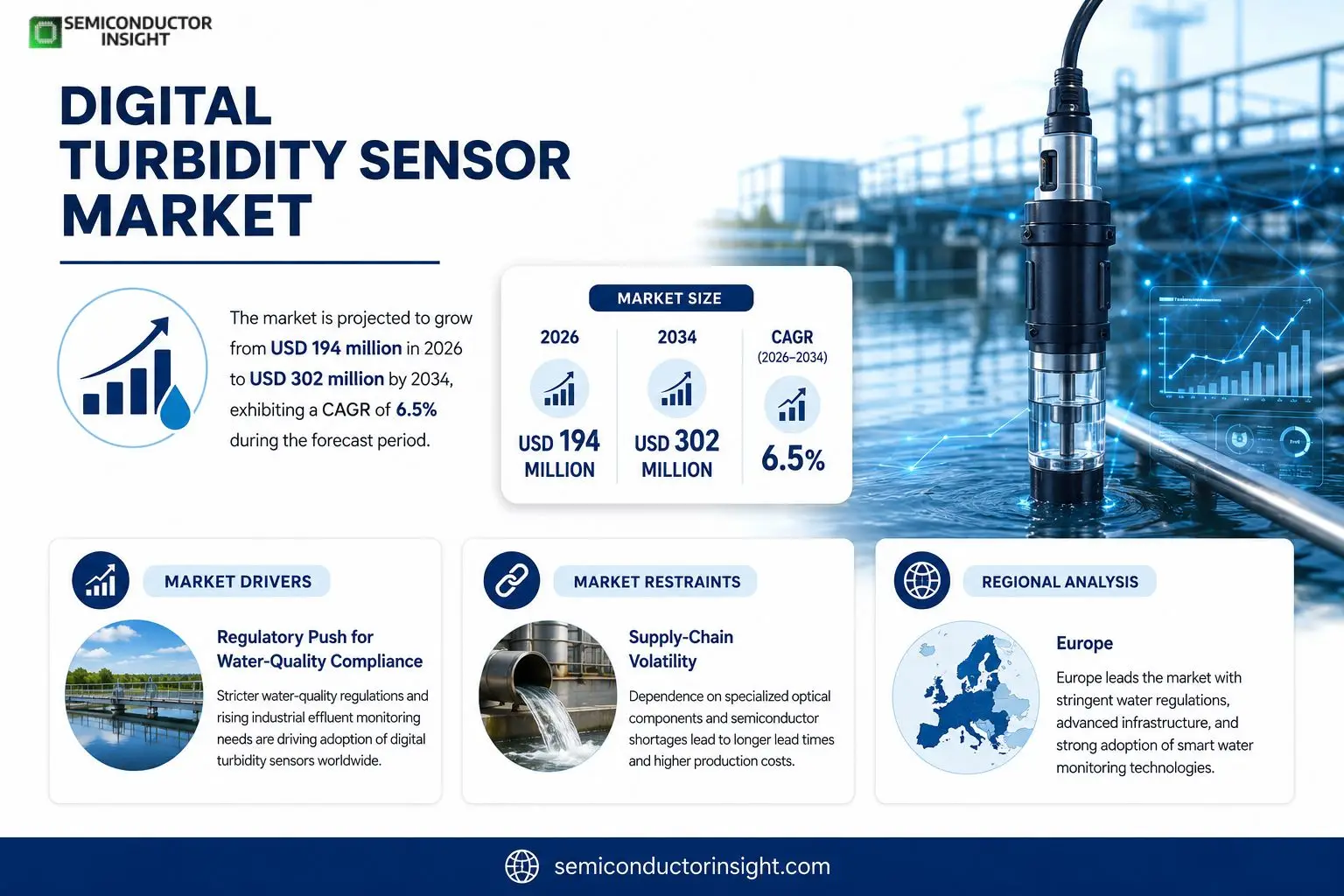
Digital Turbidity Sensor market size was valued at USD 194 million in 2025. The market will grow from USD 194 million in 2025 to USD 302 million by 2034, exhibiting a CAGR of 6.5 % during the forecast period.
Digital turbidity sensors measure suspended‑particle concentration in liquids and support water‑quality monitoring and environmental management. They rely on optical detection technology to deliver accurate, real‑time readings, making them essential for municipal water treatment, industrial wastewater discharge, environmental surveillance and laboratory testing.The expansion is fueled by stricter water‑quality regulations, rising demand for industrial effluent monitoring, and continuous improvements in microelectronics and digital signal processing that boost sensor accuracy and durability. Moreover, integration with smart‑water platforms and real‑time data analytics encourages broader adoption across utilities and research institutions.
MARKET DRIVERS
Regulatory Push for Water‑Quality Compliance
Across North America and Europe, tightening limits on permissible turbidity in drinking‑water and wastewater streams compel municipalities and industrial plants to upgrade their monitoring infrastructure. Digital Turbidity Sensor Market benefits because optical‑based sensors can deliver real‑time data that satisfy audit requirements without the labor of manual sampling.
Industrial Automation and IoT Integration
Manufacturers in food processing, pharmaceuticals, and petrochemicals are embedding turbidity sensors into wider SCADA and cloud platforms. This connectivity reduces downtime by flagging fouling events instantly, a capability that traditional nephelometers cannot match. Consequently, procurement budgets are increasingly earmarked for digital solutions that speak the same protocol language as other line‑monitoring devices.
➤ Operators report up to a 30 % reduction in manual labor when digital turbidity systems replace periodic grab sampling.
Another catalyst is the growing emphasis on sustainability reporting. Companies are required to disclose water‑use efficiency and pollutant discharge metrics to stakeholders. Digital turbidity sensors provide the traceable, high‑frequency data needed to substantiate those claims, turning compliance into a competitive differentiator.
MARKET CHALLENGES
Technical and Integration Barriers
Despite clear advantages, many end‑users hesitate because the calibration process for optical sensors can be more complex than for analog counterparts. Legacy control systems often lack the necessary interfaces, forcing firms to invest in additional middleware, which inflates total ownership cost.
Other Challenges
Cost Sensitivity
Small‑scale water utilities operate on thin margins and view the upfront capital expense of digital units as a risk. Even when the lifetime cost of ownership is lower, the initial outlay can stall adoption cycles, especially in emerging economies.
MARKET RESTRAINTS
Supply‑Chain Volatility
Key components such as high‑purity LEDs and photodiodes depend on a limited number of semiconductor manufacturers. Recent geopolitical tensions and semiconductor shortages have led to longer lead times and price spikes, curbing the speed at which new digital turbidity solutions can be deployed.
MARKET OPPORTUNITIES
Emerging Applications in Aquaculture
The aquaculture sector is rapidly scaling to meet protein demand, and water clarity directly influences fish health and growth rates. Deploying Digital Turbidity Sensor Market products in recirculating aquaculture systems enables operators to fine‑tune filtration cycles, reduce disease incidence, and improve feed conversion efficiency. This niche presents a promising avenue for manufacturers willing to tailor sensor housings and data dashboards to aquaculture-specific parameters.
Digital Turbidity Sensor Market Trends
Regulatory Pressure Elevates Demand
Heightened scrutiny of drinking‑water standards and tighter discharge limits have pushed municipal utilities and industrial operators to replace legacy measurement tools with digital turbidity sensors. In 2025 the sector produced roughly 202 000 units, reflecting a capacity that outstrips current shipments and signalling that manufacturers are positioning inventory for a surge in retrofit projects. The average selling price hovers around US$1 050 per unit, granting major players gross margins between 40 % and 60 %. This profitability cushion encourages firms to expand calibration services and field‑installation support, turning compliance‑driven purchases into longer‑term service contracts across Digital Turbidity Sensor Market.
Other Trends
Technological Advances in Optical Detection
Recent refinements in LED emitters, photodiode arrays and on‑chip microcontrollers have trimmed response times and boosted measurement repeatability. Digital signal processing algorithms now filter ambient light interference, allowing sensors to operate reliably in turbid rivers and high‑temperature effluents alike. The cost of these components has fallen enough to keep unit prices stable despite richer feature sets, prompting OEMs to bundle cloud‑ready firmware and remote‑diagnostic tools as standard. As a result, end users gain real‑time visibility into particle loads without the need for frequent manual sampling, a shift that reshapes maintenance budgets and operational workflows in Digital Turbidity Sensor Market.
Integration with Smart Water Networks
Utilities are increasingly embedding digital turbidity sensors within SCADA and IoT platforms, leveraging edge analytics to trigger automated valve closures or treatment adjustments. This connectivity transforms a simple concentration reading into actionable intelligence, reducing the lag between detection and remediation. Service providers are therefore bundling subscription‑based data‑hosting and predictive‑maintenance packages, converting hardware sales into recurring revenue streams. The strategic focus on interoperable hardware aligns with broader municipal goals of energy efficiency and resource optimisation, reinforcing the competitive edge of firms that can deliver both precision hardware and integrated software solutions within Digital Turbidity Sensor Market.
COMPETITIVE LANDSCAPE
Key Industry Players
Digital Turbidity Sensor Market – Competitive Overview
The market is anchored by a handful of multinational OEMs that leverage extensive R&D budgets and service networks to capture the bulk of revenue. Endress+Hauser, for instance, combines a deep water‑quality portfolio with a reputation for calibrated precision, allowing it to secure long‑term contracts with municipal utilities and large‑scale industrial plants. Its ability to bundle sensors with process‑control software creates a sticky value proposition that few rivals can match. Mettler Toledo similarly commands premium pricing through integrated laboratory solutions and a strong presence in regulated environments. These leaders benefit from economies of scale in component sourcingoptical transmitters, photodetectors, microcontrollersand can sustain gross margins well above the industry average. The overall structure therefore resembles a tiered pyramid: a dominant upper tier of players, a middle tier of regionally strong manufacturers, and a fragmented base of specialist firms.
Below the top tier, a diverse set of companies occupies niche segments, often differentiating on sensor architecture or application focus. Aanderaa concentrates on offshore and marine monitoring, while Process Instruments (PI) tailors its offerings to high‑precision laboratory settings. The Krohne Group and OTT HydroMet carve out market share in process‑industry and hydrological research, respectively, by emphasizing robustness and long‑term stability. Asian manufacturers such as Shanghai BOQU and Chunye exploit cost‑advantage positions to serve rapidly expanding water‑treatment projects across China and Southeast Asia. Smaller innovatorsOptek, Daruifuno, Turtle Tough, Renke, Supmea, and PASCOtarget emerging smart‑city initiatives and academic research where modularity and rapid integration are prized. Competitive pressure is intensifying as these firms launch optical‑scattering and UV/Vis‑based variants that promise faster response times, prompting larger players to accelerate product refresh cycles and explore strategic acquisitions.
List of Key Digital Turbidity Sensor Companies Profiled
- Aanderaa
- Endress+Hauser
- Process Instruments (PI)
- Krohne Group
- Shanghai BOQU
- Mettler Toledo
- OTT HydroMet
- Optek
- Campbell Scientific
- PASCO
- Daruifuno
- Turtle Tough
- Renke
- Chunye
- Supmea
Segment Analysis:
| Segment Category | Sub-Segments | Key Insights |
| By Type |
|
Digital Signal Sensors
|
| By Application |
|
Environmental Monitoring
|
| By End User |
|
Water Utilities
|
| By Measurement Principle |
|
Nephelometric Sensors
|
| By Accuracy & Range |
|
Multi‑Range Adjustable Sensors
|
Regional Analysis: Digital Turbidity Sensor Market
Europe
The EU’s Water Framework Directive and country‑specific discharge limits compel utilities to adopt continuous turbidity monitoring, creating a persistent demand for digital sensors that meet compliance thresholds and reporting standards across the region.
Food‑and‑beverage processors in France and Italy are integrating turbidity sensors into hygiene verification steps, leveraging real‑time data to tighten quality controls and reduce batch rework.
German research institutes and Dutch start‑ups are pioneering AI‑enhanced turbidity analytics, positioning the continent at the forefront of next‑generation water‑quality intelligence.
Close proximity to optical component manufacturers and MEMS foundries reduces lead times, enabling European vendors to iterate designs faster than competitors reliant on distant suppliers.
North America
In North America, Digital Turbidity Sensor Market is driven by a patchwork of state‑level water‑quality mandates that emphasize data transparency for public utilities. Large‑scale infrastructure renewal programs in the United States and Canada create openings for sensor providers that can integrate with existing plant control systems. Utilities are increasingly favoring cloud‑enabled turbidity devices that support centralized dashboards, allowing environmental regulators to monitor compliance across dispersed catchments. The region’s deep pool of venture capital also nurtures niche firms developing low‑cost, battery‑free sensors targeting remote monitoring stations in the Rocky Mountain watershed. Vendors that align their offerings with the growing emphasis on cybersecurity and data integrity will find the most fertile ground for expansion.
Asia‑Pacific
Asia‑Pacific presents a contrasting dynamic where rapid urbanization fuels a surge in new water‑treatment facilities, yet fragmented regulatory frameworks create uneven adoption rates. Countries such as China, India, and Indonesia are investing heavily in smart‑city initiatives, and digital turbidity sensors are positioned as critical enablers for flood‑early‑warning systems and industrial effluent tracking. However, price sensitivity remains acute; manufacturers that can balance affordability with reliable optical performance will capture market share. Collaborative pilots between government agencies and local technology parks are beginning to illustrate the operational savings possible from real‑time turbidity alerts, nudging public‑sector budgets toward digital solutions.
South America
South America’s water‑resource challengesparticularly in the Amazon basin and along the Andean highlandsdrive a pragmatic approach to turbidity monitoring. National water‑management agencies are increasingly mandating continuous data streams to guide sediment‑control projects, especially in mining‑intensive economies like Brazil and Chile. Digital Turbidity Sensor Market here is characterized by a reliance on rugged, low‑maintenance units that can withstand high humidity and temperature swings. Partnerships between multinational sensor firms and regional distributors are essential to navigate import tariffs and provide localized after‑sales support, a factor that heavily influences purchasing decisions among municipal operators.
Middle East & Africa
In the Middle East & Africa, water scarcity amplifies the importance of precise turbidity measurement for desalination plants and reclaimed‑water schemes. Gulf Cooperation Council nations are deploying digital sensors to fine‑tune membrane filtration processes, seeking to maximize yield while minimizing energy consumption. African nations, meanwhile, are leveraging donor‑funded pilot projects that demonstrate how low‑cost turbidity monitoring can safeguard drinking‑water quality in peri‑urban settlements. The market’s growth hinges on scalable sensor platforms that can be serviced remotely, given the region’s vast distances and limited technical workforce. Companies offering robust training programs and remote diagnostics are poised to become preferred partners across this diverse landscape.
Report Scope
This market research report provides a comprehensive analysis of the Digital Turbidity Sensor Market , covering the forecast period 2026–2034. It offers detailed insights into market dynamics, technological advancements, competitive landscape, and key trends shaping the industry.
Key focus areas of the report include:
- Market Overview: The report begins with an overview outlining its current market scenario, key growth indicators, and industry transformation drivers. It discusses macroeconomic factors, demand–supply balance, regulatory landscape, and the strategic role of semiconductors in powering advancements across industries such as automotive, telecommunications, consumer electronics, and industrial automation.
- Market Size & Forecast: Historical data and future projections for revenue, unit shipments, and market value across major regions and segments.
- Segmentation Analysis: Detailed breakdown by product type, technology, application, and end-user industry to identify high-growth segments and investment opportunities.
- Regional Insights: Insights into market performance across North America, Europe, Asia-Pacific, Latin America, and the Middle East & Africa, including country-level analysis where relevant.
- Competitive Landscape: Profiles of leading market participants, including their product offerings, R&D focus, manufacturing capacity, pricing strategies, and recent developments such as mergers, acquisitions, and partnerships.
- Technology Trends & Innovation: Assessment of emerging technologies, integration of AI/IoT, semiconductor design trends, fabrication techniques, and evolving industry standards.
- Market Drivers & Restraints: Evaluation of factors driving market growth along with challenges, supply chain constraints, regulatory issues, and market-entry barriers.
- Stakeholder Insights: Insights for component suppliers, OEMs, system integrators, investors, and policymakers regarding the evolving ecosystem and strategic opportunities.
Primary and secondary research methods are employed, including interviews with industry experts, data from verified sources, and real-time market intelligence to ensure the accuracy and reliability of the insights presented.
FREQUENTLY ASKED QUESTIONS:
What is the current market size of Digital Turbidity Sensor Market?
-> Digital Turbidity Sensor Market was valued at USD 194 million in 2025 and is expected to reach USD 302 million by 2034, growing at a CAGR of 6.5% during the forecast period.
Which key companies operate in Digital Turbidity Sensor Market?
-> Key players include Aanderaa, Endress+Hauser, Process Instruments (PI), KROHNE Group, Shanghai BOQU, Mettler Toledo, OTT HydroMet, Optek, Campbell Scientific, PASCO, Daruifuno, Turtle Tough, Renke, Chunye, Supmea, among others.
What are the key growth drivers?
-> Key growth drivers include growing concerns over water quality, stricter environmental regulations, increasing industrial effluent monitoring requirements, advances in optical detection, microelectronics, and digital signal processing, as well as the adoption of smart water management and real‑time monitoring solutions.
Which region dominates the market?
-> The reference does not specify a single dominant region; the market is ly distributed across North America, Europe, Asia, South America, and the Middle East & Africa.
What are the emerging trends?
-> Emerging trends include enhanced sensor accuracy through optical and micro‑electronic innovations, integration with IoT platforms for real‑time data analytics, and the development of multi‑range adjustable turbidity sensors for diverse industrial applications.

Get Sample Report PDF for Exclusive Insights
Report Sample Includes
- Table of Contents
- List of Tables & Figures
- Charts, Research Methodology, and more...