MARKET INSIGHTS
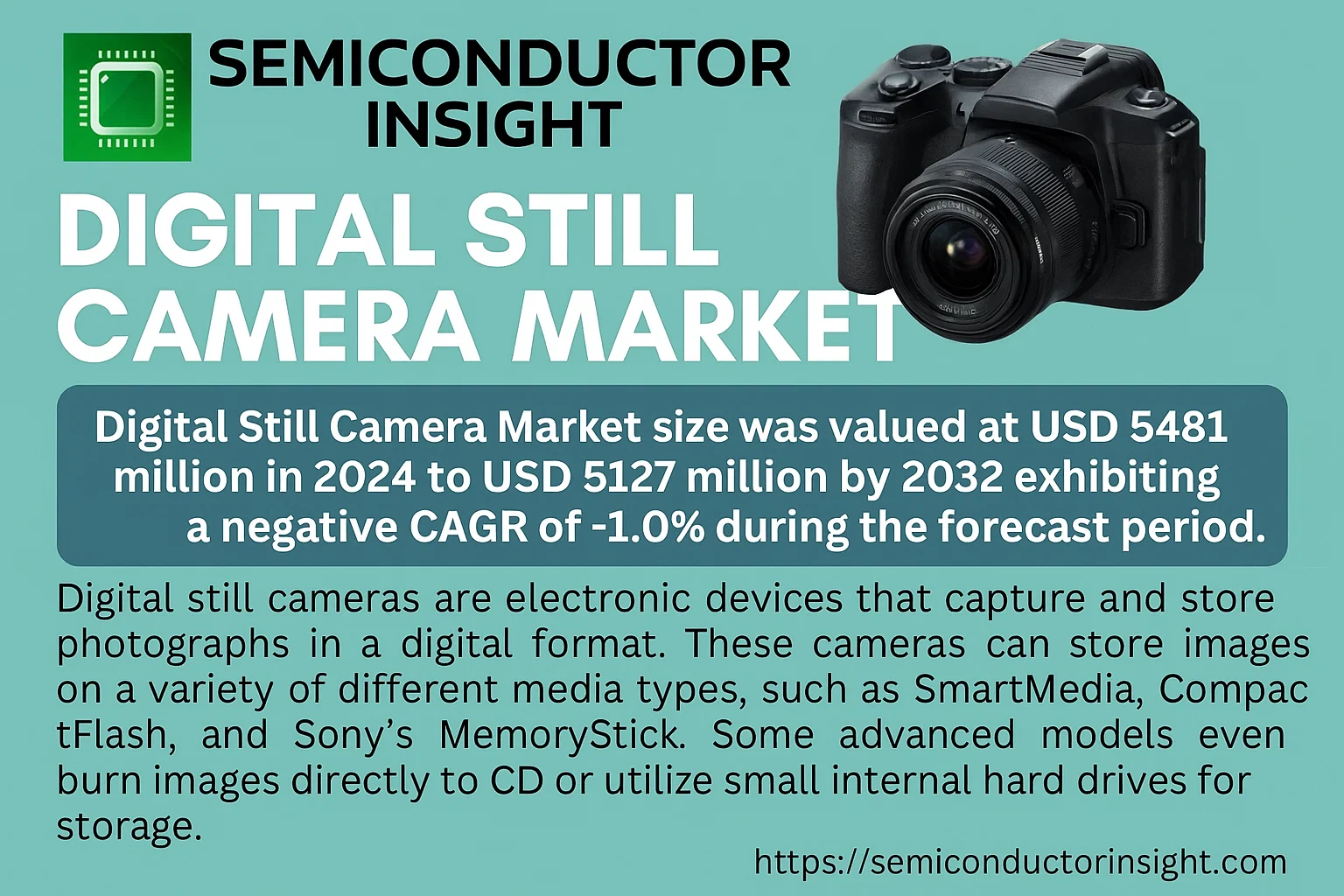
Global Digital Still Camera Market size was valued at USD 5481 million in 2024 to USD 5127 million by 2032, exhibiting a negative CAGR of -1.0% during the forecast period.
Digital still cameras are electronic devices that capture and store photographs in a digital format. These cameras can store images on a variety of different media types, such as SmartMedia, CompactFlash, and Sony’s MemoryStick. Some advanced models even burn images directly to CD or utilize small internal hard drives for storage.
The Market is experiencing a gradual contraction primarily due to the pervasive adoption of smartphones with increasingly sophisticated built-in cameras. However, demand persists in specific segments driven by professional photographers, serious hobbyists, and applications requiring high image quality. For instance, Canon Inc., the Market leader, occupied about 20% of the global revenue share in 2024. Geographically, North America was the largest consumption Market with a value share of 32%, while Europe ranked second with a 23% share. Canon, Nikon, and Sony are the dominant key players that operate in the Market with extensive product portfolios.
MARKET DRIVERS
Demand for High-Quality Imaging and Content Creation
The persistent consumer and professional desire for superior image quality continues to propel the Market. Despite smartphone dominance, dedicated digital still cameras (DSCs) remain the tool of choice for serious photographers, vloggers, and content creators who require high-resolution sensors, optical zoom capabilities, and advanced manual controls. The growth of social media platforms that reward high-fidelity visual content further sustains demand for devices that can produce professional-grade still images.
Technological Advancements in Sensor and Imaging Technology
Continuous innovation is a primary driver. Manufacturers are focusing on developing larger sensors (such as full-frame and medium format), improved autofocus systems with AI-based subject recognition, and higher resolution capabilities exceeding 50 megapixels. The integration of computational photography features, once exclusive to smartphones, into dedicated cameras is also expanding their appeal and functionality.
Furthermore, the rise of vlogging and professional videography has driven demand for hybrid cameras that excel at both high-resolution still photography and 4K/8K video recording, making them versatile tools for modern creators.
MARKET CHALLENGES
Intense Competition from Smartphone Cameras
The most significant challenge facing the Digital Still Camera Market is the relentless improvement of smartphone cameras. For the vast majority of consumers, the convenience, connectivity, and “good enough” quality of smartphone cameras have made dedicated cameras a niche product. This has led to a dramatic decline in the volume of entry-level and compact camera sales, forcing DSC manufacturers to focus almost exclusively on the mid-range and professional segments.
Other Challenges
Supply Chain Constraints and Component Shortages
Global electronics supply chain has faced disruptions, affecting the availability of key components like image sensors and processors. This has led to production delays and increased costs, challenging manufacturers’ ability to meet demand for new models in a timely manner.
Market Saturation and Lengthening Replacement Cycles
The high quality and durability of modern cameras mean consumers and professionals hold onto their equipment for longer periods. The incremental nature of recent technological improvements often does not provide a compelling reason for frequent upgrades, leading to a longer replacement cycle and a more challenging sales environment.
MARKET RESTRAINTS
High Cost of Advanced Equipment
The premium price point of high-end digital still cameras, particularly full-frame mirrorless and DSLR models, along with their expensive lenses, acts as a major barrier to entry for amateur photographers. This high cost restricts the Market’s growth to a more affluent and professional consumer base, limiting mass-Market adoption.
The Learning Curve and Skill Requirement
Dedicated cameras often have a steeper learning curve compared to the point-and-shoot simplicity of smartphones. The need to understand concepts like aperture, shutter speed, and ISO can be intimidating for casual users, reinforcing the preference for the automated, AI-enhanced photography experience offered by mobile devices.
MARKET OPPORTUNITIES
Growth in Niche and Specialty Markets
There is significant opportunity in catering to specialized applications where smartphone cameras are insufficient. This includes Markets for wildlife photography, astrophotography, sports photography, and high-end portraiture. Developing cameras and lenses optimized for these specific use cases can drive sales among enthusiast and professional communities.
Integration with Emerging Technologies
The integration of AI and machine learning for enhanced autofocus, scene recognition, and automated image editing presents a major opportunity. Additionally, improving connectivity features like cloud backup, seamless transfer to mobile devices, and robust Wi-Fi/Bluetooth can enhance the user experience and bridge the gap between dedicated cameras and the smartphone ecosystem.
Expansion in Emerging Economies
As disposable incomes rise in emerging economies, a new generation of photography enthusiasts is emerging. This creates a potential growth Market for mid-range DSLR and mirrorless cameras, provided manufacturers can offer products at competitive price points tailored to these regions.
Digital Still Camera Market Trends
Market Concentration and Regional Dynamics
Global Digital Still Camera Market is experiencing a period of consolidation and transition. Valued at $5481 million in 2024, the Market is projected to adjust to approximately $5127 million by 2032, representing a compound annual growth rate (CAGR) of -1.0%. This overall contraction masks significant underlying shifts in Market leadership and regional consumption. The industry is dominated by Japanese manufacturers, with Canon, Nikon, and Sony leading the pack. Canon holds a commanding position, accounting for approximately 20% of the global revenue Market share. Regionally, North America represents the largest consumption Market with a 32% share, followed by Europe at 23%, indicating that mature Markets continue to drive a significant portion of demand despite the overall Market slowdown.
Other Trends
Product Segment Evolution
A key trend is the definitive Market shift from Built-in Lens Cameras (point-and-shoot) towards more advanced Interchangeable Lens Cameras, including DSLRs and Mirrorless Interchangeable-Lens Cameras (MILCs). This reflects a growing consumer preference for higher image quality and creative control over convenience, a change accelerated by the improving capabilities of smartphone cameras which have largely cannibalized the entry-level point-and-shoot segment. The Market is thus bifurcating into amateur users, who primarily use smartphones, and professional or enthusiast users who drive demand for advanced interchangeable-lens systems.
Competitive Landscape and Strategic Responses
In response to these pressures, leading companies are focusing on technological innovation and specialization to maintain Market share. Strategies include developing advanced sensor technology, enhancing in-body image stabilization, and improving autofocus systems, particularly for mirrorless cameras. Manufacturers are also exploring growth in specific end-user segments, with professional applications in areas like journalism, sports, and wildlife photography providing more stable revenue streams. The competitive analysis of key players, including Pentax, Olympus, Fujifilm, Casio, Panasonic, and Samsung, highlights a continuous effort to differentiate through unique color science, lens ecosystems, and ruggedized camera bodies tailored to niche professional needs.
COMPETITIVE LANDSCAPE
Key Industry Players
A Market Dominated by Established Japanese Imaging Giants
Global Digital Still Camera Market is characterized by a high degree of concentration, with Japanese manufacturers holding a commanding leadership position. Canon Inc. stands as the unequivocal Market leader, accounting for approximately 20% of global revenue. Nikon Corporation and Sony Group Corporation are the other dominant forces, forming a powerful triumvirate that defines the competitive dynamics. These companies leverage their extensive expertise in optics, sensor technology, and brand legacy to cater to both amateur and professional segments, primarily through their interchangeable lens camera systems (DSLR and MILC). The Market structure is mature, with competition intensifying as smartphone photography encroaches on the entry-level segment, compelling incumbents to focus on innovation in high-resolution sensors, advanced autofocus systems, and connectivity features to maintain relevance and value proposition.
Beyond the top three, several other significant players maintain strong positions in specific niches. Pentax (under Ricoh Imaging), Olympus (now part of OM Digital Solutions), and Fujifilm are renowned for their distinctive camera systems, such as Fujifilm’s X-series and GFX medium format cameras, which appeal to enthusiasts and professionals seeking unique image aesthetics. Casio and Panasonic have historically been key players in the compact camera segment. While companies like Samsung have significantly reduced their presence in the dedicated camera Market, they remain notable in the industry’s history. The competitive landscape is further shaped by the strategic focus of these players on differentiating through specialized features, robust lens ecosystems, and targeting specific use cases where smartphone cameras are insufficient.
List of Key Digital Still Camera Companies Profiled
- Canon
- Nikon
- Sony
- Pentax (Ricoh Imaging)
- Olympus (OM Digital Solutions)
- Fujifilm
- Casio
- Panasonic
- Samsung
- Leica Camera AG
- Sigma Corporation
- Hasselblad
- GoPro
Segment Analysis:
| Segment Category | Sub-Segments | Key Insights |
| By Type |
|
Interchangeable Lens Cameras represent the segment with the strongest strategic focus, driven by professional and advanced amateur demand for superior image quality, creative control, and versatility. Despite the overall Market contraction, this segment maintains resilience as manufacturers continuously innovate with mirrorless technology, which offers a compelling blend of high performance and portability. The enduring appeal of DSLRs for certain professional applications also contributes to this segment’s leadership, as photographers prioritize optical viewfinders and extensive lens ecosystems for specialized work. |
| By Application |
|
Professional Photography is the cornerstone application driving high-value sales and innovation in the Market. Professionals in fields such as journalism, wedding, and portrait photography demand the highest levels of image fidelity, robust build quality, and reliable performance under demanding conditions. This creates a cycle of continuous technological advancement, as makers like Canon and Nikon compete to deliver cutting-edge features that justify premium pricing. The reliance on professional-grade equipment for commercial outcomes ensures this segment remains a critical and stable revenue driver, even as smartphone cameras satisfy more casual imaging needs. |
| By End User |
|
Professional users constitute the most influential end-user segment, characterized by high purchasing power, brand loyalty, and specific technical requirements. Their purchasing decisions are based on a camera system’s ability to deliver consistent, high-quality results for commercial purposes, making them less sensitive to overall Market fluctuations than casual users. The professional segment also fuels growth in the adjacent prosumer category, as enthusiasts aspire to professional-grade features, creating a lucrative Market for high-end amateur models that bridge the gap between simplicity and advanced functionality. |
| By Technology |
|
Mirrorless Interchangeable-Lens Camera (MILC) technology is the unequivocal leader in terms of growth momentum and future development focus. This segment benefits from significant R&D investment as it represents the modern evolution of digital photography, offering advantages in size, weight, and silent shooting that are highly valued. The transition from DSLR to MILC systems is a dominant industry trend, with manufacturers strategically pivoting their product lines to capture this shift. The technological race in areas like autofocus performance, electronic viewfinders, and lens design is most intense within the MILC segment, solidifying its position as the primary engine of innovation. |
| By Price Point |
|
Professional / Premium price points dominate the Market’s value, as this tier captures the high-margin sales of flagship camera bodies and professional lenses. While volume may be higher in lower segments, the premium segment’s resilience is notable; professionals and serious enthusiasts are willing to invest significantly in equipment that offers a tangible competitive or creative advantage. This segment is less susceptible to displacement by smartphones and is characterized by long product lifecycles and strong brand ecosystems. The strategic focus of leading Japanese manufacturers is intensely concentrated on competing within this high-value segment to secure profitability and Market leadership. |
Regional Analysis: Digital Still Camera Market
Asia-Pacific
The region’s strength is rooted in its unparalleled manufacturing ecosystem. Japan’s legacy brands set the global benchmark for optical and sensor technology, while other countries provide extensive supply chains. This concentration of production expertise allows for rapid iteration and cost-effective manufacturing of both high-end professional gear and mass-Market models, giving the region a significant competitive advantage in the global Marketplace.
Market demand is multifaceted, ranging from professional photographers and serious enthusiasts in mature Markets like Japan and Australia to first-time buyers in emerging economies. This diversity necessitates a wide product portfolio. Manufacturers successfully cater to this spectrum, from advanced full-frame mirrorless cameras for professionals to feature-rich entry-level models designed for the aspiring photographer, ensuring broad Market penetration.
In response to smartphone competition, the region is spearheading a shift towards specialization. Innovation is focused on areas where smartphones cannot easily compete, such as superior low-light performance, advanced autofocus systems for action photography, and high-quality optical zoom lenses. This strategy is effectively creating distinct value propositions that justify the investment in a dedicated camera for specific use cases.
The explosion of social media and content creation platforms is a major growth driver. A significant portion of demand, particularly among younger demographics, is linked to the desire to produce high-quality content for platforms like YouTube, Instagram, and TikTok. This trend supports sales of vlogging-centric cameras with features like flip-out screens, excellent video capabilities, and lightweight designs.
North America
The North American Market for digital still cameras is a mature but significant segment, characterized by a high rate of product replacement and a strong emphasis on advanced features. Consumers in this region, particularly in the United States and Canada, are typically well-informed and value technological innovation, weather sealing, and high-performance autofocus systems. The Market is largely driven by upgrade cycles from existing photography enthusiasts and professionals seeking the latest sensor technology and video capabilities. There is a notable trend towards mirrorless systems, which are increasingly favored over traditional DSLRs for their compact size and electronic viewfinder advantages. While overall volume has been tempered by smartphone ubiquity, the region maintains robust sales in the mid-to-high-end segments, with a keen interest in full-frame cameras and specialized lenses for genres like wildlife, sports, and portrait photography.
Europe
Europe represents a sophisticated and diverse Market for digital still cameras, with demand patterns varying significantly between Western and Eastern European countries. Mature Markets such as Germany, the United Kingdom, and France have a strong base of photography purists and professionals who demand high build quality and optical excellence. Tourism plays a substantial role, driving demand for high-quality travel and compact zoom cameras. In Southern Europe, there is a pronounced interest in cameras suited for lifestyle and street photography. Across the continent, environmental consciousness is influencing purchasing decisions, with a growing appreciation for durable, repairable products. The European Market has also been quick to adopt mirrorless technology, with consumers showing a strong preference for systems that offer a blend of classic handling with modern digital features.
South America
The Digital Still Camera Market in South America is an emerging landscape with growth potential concentrated in key economies like Brazil and Argentina. The Market is price-sensitive, with a significant portion of demand focused on entry-level and mid-range bridge cameras that offer versatility and ease of use. The region’s vibrant culture, Carnival festivals, and stunning natural landscapes create a natural demand for photography equipment. However, economic volatility and import restrictions can sometimes hinder Market growth and affect pricing. Despite these challenges, there is a growing community of photography enthusiasts, and social media influence is beginning to drive interest in better quality imaging tools beyond smartphones, particularly among urban, younger consumers seeking to improve their content creation capabilities.
Middle East & Africa
This region presents a dualistic Market structure. In the affluent Gulf Cooperation Council (GCC) countries, there is a strong Market for luxury and high-end photographic equipment, driven by hobbyists with high disposable income and a demand for the latest professional gear. The Market here is characterized by a preference for premium brands and models. In contrast, other parts of the Middle East and Africa are primarily focused on the entry-level segment, where affordability is the key concern. The vast and diverse landscapes, alongside growing tourism in certain areas, underpin a steady demand for durable cameras capable of capturing safari, desert, and coastal scenery. Overall, the Market is nascent but growing, with potential tied to economic development and the expanding influence of digital media.
Report Scope
This Market research report provides a comprehensive analysis of the Digital Still Camera Market, covering the forecast period 2025–2032. It offers detailed insights into Market dynamics, technological advancements, competitive landscape, and key trends shaping the industry.
Key focus areas of the report include:
- Market Overview: The report begins with an overview outlining its current Market scenario, key growth indicators, and industry transformation drivers. It discusses macroeconomic factors, demand–supply balance, regulatory landscape, and the strategic role of semiconductors in powering advancements across industries such as automotive, telecommunications, consumer electronics, and industrial automation.
- Market Size & Forecast: Historical data and future projections for revenue, unit shipments, and Market value across major regions and segments.
- Segmentation Analysis: Detailed breakdown by product type, technology, application, and end-user industry to identify high-growth segments and investment opportunities.
- Regional Insights: Insights into Market performance across North America, Europe, Asia-Pacific, Latin America, and the Middle East & Africa, including country-level analysis where relevant.
- Competitive Landscape: Profiles of leading Market participants, including their product offerings, R&D focus, manufacturing capacity, pricing strategies, and recent developments such as mergers, acquisitions, and partnerships.
- Technology Trends & Innovation: Assessment of emerging technologies, integration of AI/IoT, semiconductor design trends, fabrication techniques, and evolving industry standards.
- Market Drivers & Restraints: Evaluation of factors driving Market growth along with challenges, supply chain constraints, regulatory issues, and Market-entry barriers.
- Stakeholder Insights: Insights for component suppliers, OEMs, system integrators, investors, and policymakers regarding the evolving ecosystem and strategic opportunities.
Primary and secondary research methods are employed, including interviews with industry experts, data from verified sources, and real-time Market intelligence to ensure the accuracy and reliability of the insights presented.
FREQUENTLY ASKED QUESTIONS:
What is the current Market size of Digital Still Camera Market?
-> Digital Still Camera Market size was valued at USD 5481 million in 2024 to USD 5127 million by 2032, exhibiting a negative CAGR of -1.0% during the forecast period.
Which key companies operate in Digital Still Camera Market?
-> Key players include Canon, Nikon, Sony, Pentax, Olympus, Fujifilm, Casio, Panasonic, Samsung, among others. Canon is the biggest manufacturer globally, occupying about 20% of the global revenue Market.
What are the key growth drivers?
-> Key growth drivers include evolving imaging technologies, demand for high-resolution photography, and the integration of advanced features in consumer electronics.
Which region dominates the Market?
-> North America was the largest consumption Market with a Market share of 32%, while Europe ranked second with a 23% Market share.
What are the emerging trends?
-> Emerging trends include advancements in interchangeable lens cameras (DSLR and MILC), increased demand from professional users, and innovations in image storage media.

Get Sample Report PDF for Exclusive Insights
Report Sample Includes
- Table of Contents
- List of Tables & Figures
- Charts, Research Methodology, and more...
 Download Sample Report PDF