Market Insights
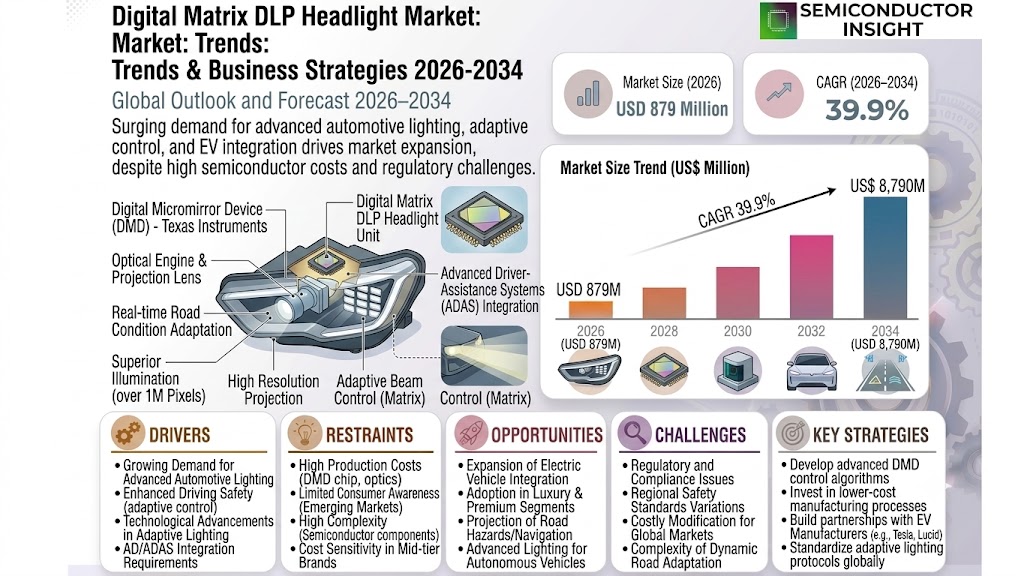
Global Digital Matrix DLP Headlight Market size was valued at USD 641 million in 2025. The market is projected to grow from USD 879 million in 2026 to USD 8.79 billion by 2034, exhibiting a CAGR of 39.9% during the forecast period.
Digital Matrix DLP Headlight Market is a high-resolution automotive lighting system that utilizes digital light processing (DLP) technology with micro-mirror arrays to project adaptive, pixel-precise beams. Each headlamp integrates over one million individually controllable micromirrors, enabling dynamic light patterns for glare-free illumination, lane guidance, and road projection of symbols. This advanced technology represents the next evolution in adaptive driving beam (ADB) systems, offering superior functionality compared to conventional LED matrix solutions.
The market growth is driven by increasing demand for premium lighting features in luxury vehicles, stringent safety regulations mandating adaptive headlights, and technological advancements in automotive projection systems. Leading automakers such as Audi and Mercedes-Benz have pioneered implementations using Texas Instruments’ DLP chipsets, with production units reaching approximately 800 thousand globally in 2025 at an average price point of USD 880 per unit.
MARKET DRIVERS
Growing Demand for Advanced Automotive Lighting
Digital Matrix DLP Headlight Market is experiencing strong growth due to increasing consumer demand for innovative automotive lighting solutions. These headlights provide superior illumination, adaptive beam control, and energy efficiency, which enhances driving safety. Adoption is highest in luxury and premium vehicle segments, where advanced driver-assistance systems (ADAS) are standard.
Technological Advancements in Adaptive Lighting
Manufacturers are investing heavily in R&D to improve Digital Matrix DLP headlight technology, including high-resolution projection, real-time road condition adaptation, and integration with vehicle sensors. The shift toward autonomous driving has further accelerated development, as precise lighting is crucial for sensor-based navigation.
Premium automakers such as Audi, BMW, and Mercedes-Benz are leading adoption, while mid-tier brands are gradually incorporating the technology into their lineups.
MARKET CHALLENGES
High Production Costs and Complexity
The sophisticated design and semiconductor components of Digital Matrix DLP headlights result in manufacturing costs significantly higher than conventional LED alternatives. This pricing barrier limits mass-market adoption, restricting growth to the premium segment.
Other Challenges
Regulatory and Compliance Issues
Different regional safety standards for adaptive lighting technology create complexities for automakers in global markets, requiring costly modifications to meet local regulations.
MARKET RESTRAINTS
Limited Consumer Awareness in Emerging Markets
Despite growing awareness in North America and Europe, emerging markets show lower adoption rates due to limited understanding of Digital Matrix DLP benefits and higher cost sensitivity. This hinders expansion as automakers hesitate to introduce high-end lighting systems in price-sensitive regions.
MARKET OPPORTUNITIES
Expansion of Electric Vehicle Integration
The rise of electric vehicles (EVs) presents a major opportunity for Digital Matrix DLP Headlight Market growth. EV manufacturers prefer energy-efficient lighting solutions that align with sustainability goals while enhancing vehicle aesthetics. Companies like Tesla and Lucid Motors are incorporating adaptive lighting in new models, setting industry trends.
Digital Matrix DLP Headlight Market Trends
Pixel-Level Precision Driving Adoption
Digital Matrix DLP Headlight Market is seeing increased adoption due to its unparalleled pixel-level control, with approximately 1.3 million micromirrors per headlamp enabling ultra-precise adaptive driving beams. Leading luxury automakers like Audi and Mercedes-Benz are incorporating this technology in flagship models to provide advanced features such as glare-free high beams, lane illumination, and road projection of navigation cues.
Other Trends
Technology Stack Integration
Digital Matrix DLP systems are becoming more integrated with vehicle ADAS and infotainment platforms, allowing synchronized light projections for enhanced safety and driver communication. The technology’s ability to project dynamic content on the road surface positions it as a key element in future vehicle-to-everything (V2X) ecosystems.
Regional Market Development
Europe currently leads in Digital Matrix DLP Headlight adoption, with Asian markets showing the fastest growth as premium vehicle sales increase in China. The technology remains concentrated in high-end segments due to its complex supply chain and premium pricing, though production scales are gradually improving.
Thermal and Regulatory Advancements
Recent engineering breakthroughs in thermal management systems allow Digital Matrix DLP headlights to maintain stable performance under extreme conditions. Regulatory frameworks are also evolving to accommodate advanced adaptive lighting features across key automotive markets worldwide.
Supply Chain Consolidation
Digital Matrix DLP Headlight Market supply chain remains concentrated with Texas Instruments as the primary DMD chipset supplier. However, increased competition is emerging in optical engine development as Tier-1 suppliers expand their production capabilities to meet growing OEM demand for this advanced lighting technology.
COMPETITIVE LANDSCAPE
Key Industry Players
Technological Leaders Driving the Digital Matrix DLP Headlight Revolution
Digital Matrix DLP Headlight Market is dominated by established automotive lighting giants and specialized technology providers. Texas Instruments maintains absolute control over the critical DMD chip supply chain with its automotive-grade DLP5530/5531 chipsets. At the OEM integration level, Koito Manufacturing leads with its partnerships with luxury automakers like Audi for their Digital Matrix LED systems. Valeo and Marelli follow closely, having developed proprietary optical engines that combine TI’s DLP technology with high-power LED light sources.
Several Chinese suppliers are making significant strides in this high-tech segment. Xingyu Automotive Lighting has developed competitive DLP solutions through joint ventures with international partners, while HASCO Vision and Fudi Vision are focusing on cost-optimized variants for premium Chinese EVs. Smaller players like SL Corporation and ZKW Group specialize in niche applications, offering customized projection patterns and thermal solutions for different vehicle platforms.
List of Key Digital Matrix DLP Headlight Companies Profiled
- Koito Manufacturing Co., Ltd.
- Valeo SA
- MARELLI Automotive Lighting
- HELLA GmbH & Co. KGaA
- Stanley Electric Co., Ltd.
- Xingyu Automotive Lighting Systems
- SL Corporation
- HASCO Vision Technology Co., Ltd.
- ZKW Group GmbH
- Varroc Lighting Systems
- Lumileds Holding B.V.
- Fudi Vision Technology
- Texas Instruments (DLP chipsets)
- Osram Opto Semiconductors GmbH
- Magneti Marelli S.p.A.
Segment Analysis:
| Segment Category | Sub-Segments | Key Insights |
| By Type |
|
1.0–1.3 Mp DLP Headlights dominate as the current industry standard with perfect balance of resolution and cost-effectiveness.
|
| By Application |
|
New Energy Vehicles are driving adoption through advanced lighting integration strategies.
|
| By End User |
|
Premium/Luxury Vehicle Brands account for overwhelming majority of current implementations.
|
| By Technology Integration |
|
V2X-Connected Smart Lighting represents the future evolution path despite current niche status.
|
| By Pricing Tier |
|
Ultra-Premium maintains clear dominance due to system complexity and cost structure.
|
Regional Analysis: Digital Matrix DLP Headlight Market
North America
U.S. automakers lead in integrating Digital Matrix DLP systems with ADAS, creating seamless lighting-to-safety system integration that enhances night driving safety and reduces glare for oncoming traffic.
North America’s progressive lighting regulations allow dynamic beam patterns and adaptive functionalities that give Digital Matrix DLP technologies significant market advantages over conventional systems.
Well-established semiconductor and automotive supplier networks in the region enable faster time-to-market for new Digital Matrix DLP headlight models compared to other global markets.
High concentration of luxury vehicle sales creates ideal conditions for Digital Matrix DLP adoption, with consumers willing to pay premium prices for advanced lighting features and brand differentiation.
Europe
Europe represents a high-growth market for Digital Matrix DLP Headlights, supported by strong automotive safety standards and premium vehicle production. German automakers are driving innovation in adaptive lighting systems, with several luxury brands offering Digital Matrix DLP as standard equipment in flagship models. The region’s focus on pedestrian safety and night visibility regulations creates favorable conditions for adoption. European suppliers are developing compact DLP solutions tailored for smaller premium vehicles common in urban markets. Cross-industry collaborations between lighting specialists and automotive OEMs are yielding customized solutions with unique light signatures.
Asia-Pacific
Asia-Pacific shows accelerating demand for Digital Matrix DLP Headlights, particularly in China’s premium EV segment. Japanese automakers are pioneering cost-optimized versions suitable for mid-range vehicles. South Korea’s automotive electronics leaders are integrating DLP systems with advanced driver interfaces. While adoption currently concentrates on luxury imports, domestic Chinese brands are rapidly incorporating the technology to enhance product competitiveness. Infrastructure challenges in emerging markets drive demand for adaptive systems that perform well in diverse road conditions.
South America
South America’s Digital Matrix DLP Headlight Market remains nascent but shows growth potential in Brazil and Argentina’s luxury segments. Market development is constrained by economic volatility but benefits from strong import demand for premium vehicles with advanced lighting. Regional automakers are exploring partnerships to develop affordable DLP solutions suitable for local road conditions. Growing awareness of road safety benefits may drive future adoption, though market penetration lags behind more developed regions.
Middle East & Africa
The Middle East represents a specialty market for ultra-premium Digital Matrix DLP systems favored by luxury SUV buyers. Harsh desert driving conditions create unique requirements for adaptive lighting performance. Africa shows limited current adoption outside South Africa’s luxury import market, though long-distance driving conditions suggest future potential for advanced lighting solutions as infrastructure improves and premium vehicle sales grow.
Report Scope
This market research report provides a comprehensive analysis of the Digital Matrix DLP Headlight Market, covering the forecast period 2025–2032. It offers detailed insights into market dynamics, technological advancements, competitive landscape, and key trends shaping the industry.
Key focus areas of the report include:
- Market Overview: The report begins with an overview outlining its current market scenario, key growth indicators, and industry transformation drivers. It discusses macroeconomic factors, demand–supply balance, regulatory landscape, and the strategic role of semiconductors in powering advancements across industries such as automotive, telecommunications, consumer electronics, and industrial automation.
- Market Size & Forecast: Historical data and future projections for revenue, unit shipments, and market value across major regions and segments.
- Segmentation Analysis: Detailed breakdown by product type, technology, application, and end-user industry to identify high-growth segments and investment opportunities.
- Regional Insights: Insights into market performance across North America, Europe, Asia-Pacific, Latin America, and the Middle East & Africa, including country-level analysis where relevant.
- Competitive Landscape: Profiles of leading market participants, including their product offerings, R&D focus, manufacturing capacity, pricing strategies, and recent developments such as mergers, acquisitions, and partnerships.
- Technology Trends & Innovation: Assessment of emerging technologies, integration of AI/IoT, semiconductor design trends, fabrication techniques, and evolving industry standards.
- Market Drivers & Restraints: Evaluation of factors driving market growth along with challenges, supply chain constraints, regulatory issues, and market-entry barriers.
- Stakeholder Insights: Insights for component suppliers, OEMs, system integrators, investors, and policymakers regarding the evolving ecosystem and strategic opportunities.
Primary and secondary research methods are employed, including interviews with industry experts, data from verified sources, and real-time market intelligence to ensure the accuracy and reliability of the insights presented.
FREQUENTLY ASKED QUESTIONS:
What is the current market size of Digital Matrix DLP Headlight Market?
-> Digital Matrix DLP Headlight Market size was valued at USD 641 million in 2025. The market is projected to grow from USD 879 million in 2026 to USD 8.79 billion by 2034, exhibiting a CAGR of 39.9% during the forecast period.
Which key companies operate in Digital Matrix DLP Headlight Market?
-> Key players include Koito, Valeo, MARELLI, Hella, Stanley Electric, Xingyu Automotive Lighting Systems, SL Corporation, HASCO Vision, ZKW Group, Varroc Lighting Systems, Lumileds, and Fudi Vision.
What are the key growth drivers?
-> Key growth drivers include demand for advanced automotive lighting, increasing adoption in premium EVs and luxury vehicles, and technological advancements in DLP technology.
Which region dominates the market?
-> Asia is a major market, with leading production in countries like China, Japan, and South Korea.
What are the emerging trends?
-> Emerging trends include integration with V2X systems, ultra-precise adaptive beam control, and projection of navigation/guidance information.
Get Sample Report PDF for Exclusive Insights
Report Sample Includes
- Table of Contents
- List of Tables & Figures
- Charts, Research Methodology, and more...