Digital Compass MEMS Foundry Service Market Insights
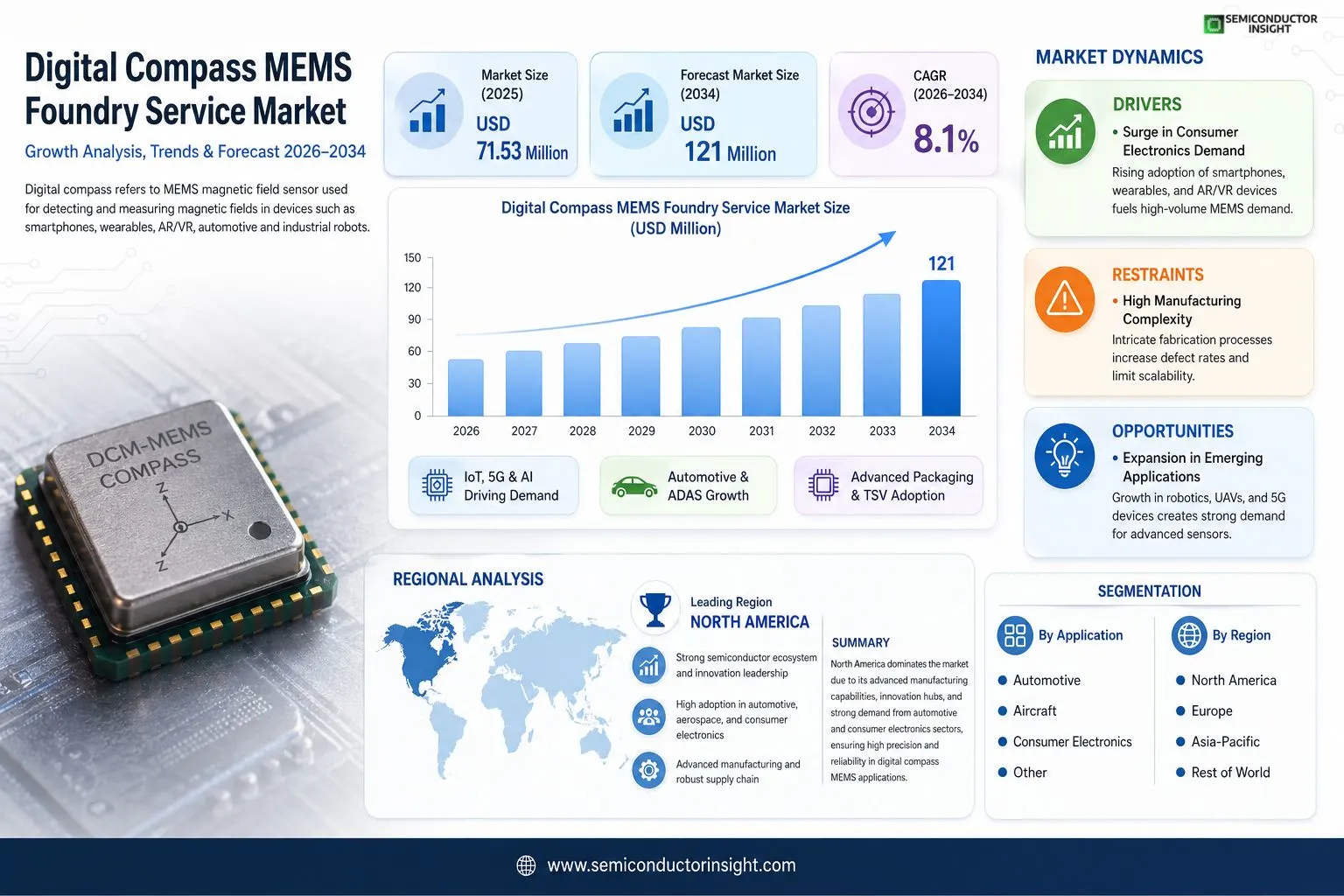
Global Digital Compass MEMS Foundry Service market size was valued at USD 71.53 million in 2025. The market is projected to reach USD 121 million by 2034, exhibiting a CAGR of 8.1% during the forecast period.
Digital compass refers to MEMS magnetic field sensor. A MEMS magnetic field sensor is a small-scale microelectromechanical systems (MEMS) device for detecting and measuring magnetic fields (Magnetometer). Many of these operate by detecting effects of the Lorentz force: a change in voltage or resonant frequency may be measured electronically, or a mechanical displacement may be measured optically. Compensation for temperature effects is necessary. Digital Compass MEMS Foundry Service offers prototype fabrication through to mass production from leaders in MEMS devices manufacturing, providing high quality and reliability including advanced process development, prototyping, and low to medium volume manufacturing. The industry’s average gross profit margin typically ranges from 35% to 50%.
The market is experiencing rapid growth due to emerging technology convergence such as IoT, 5G, and AI driving demand for intelligent low-power digital compass MEMS sensors in AR/VR, autonomous vehicles, and industrial robots. Automotive electronics upgrades for new energy vehicles demand AEC-Q100 certified sensors stable from -40°C to 125°C, while domestic substitution and vertical integration reshape competition through advanced packaging like TSV. Key players including Silex Microsystems, Teledyne Technologies, TSMC, Sony, X-Fab, Atomica Corp., and UMC operate with comprehensive portfolios fueling expansion.
MARKET DRIVERS
Surge in Consumer Electronics Demand
Digital Compass MEMS Foundry Service Market is propelled by the escalating integration of digital compass sensors in smartphones, wearables, and AR/VR devices. These compact MEMS magnetometers enable precise orientation tracking, fueling a market expansion projected at over 11% CAGR through 2030. Foundry services provide scalable production for high-volume needs.
Automotive and Aerospace Advancements
Advancements in autonomous vehicles and drones drive demand for reliable digital compass MEMS, where foundry services ensure customized fabrication for harsh environments. The automotive sector alone accounts for nearly 25% of current MEMS sensor deployments, enhancing navigation accuracy in ADAS systems.
➤ Increased IoT proliferation boosts need for cost-effective foundry solutions in edge devices.
Global IoT connections surpassing 15 billion units amplify the role of specialized foundries, supporting miniaturized designs for smart homes and industrial automation. This dynamic fosters innovation in Digital Compass MEMS Foundry Service Market processes.
MARKET CHALLENGES
Technical Precision Hurdles
Maintaining calibration accuracy in digital compass MEMS during foundry fabrication poses significant challenges, with offset errors impacting up to 5% of produced units. Yield rates hover around 85-90% for complex geometries in Digital Compass MEMS Foundry Service Market.
Other Challenges
Supply chain volatility disrupts raw material availability for silicon substrates, delaying production cycles by 20-30% amid geopolitical tensions.
Cost Pressures
High upfront investments in cleanroom facilities strain smaller foundries, pushing consolidation and raising service fees by 10-15% annually. Intense competition from integrated device manufacturers further erodes margins.
MARKET RESTRAINTS
High Manufacturing Complexity
The intricate multi-layer etching and deposition processes in Digital Compass MEMS Foundry Service Market demand ultra-precise control, limiting scalability and increasing defect rates to 2-4%. This complexity deters entry by new players.Regulatory standards for automotive-grade MEMS impose stringent testing protocols, extending time-to-market by 6-12 months and elevating compliance costs by 15%.Intellectual property barriers protect proprietary designs, restricting technology transfer and fostering dependency on established foundries like those serving Bosch and STMicroelectronics ecosystems.
MARKET OPPORTUNITIES
Expansion in Emerging Applications
Growth in robotics and UAV sectors offers substantial opportunities for Digital Compass MEMS Foundry Service Market, with drone shipments expected to exceed 10 million units yearly by 2028, necessitating advanced navigation sensors.Custom foundry services for 5G-enabled devices enable low-power compass integration, targeting a 20% efficiency gain in battery-constrained wearables.Strategic partnerships with fabless designers can capture 30% of the burgeoning smart agriculture market, where precise geo-orientation enhances automated machinery performance.
Digital Compass MEMS Foundry Service Market Trend
Emerging Technology Convergence Drives Explosive Demand
Digital Compass MEMS Foundry Service Market is experiencing robust growth propelled by the convergence of technologies like Internet of Things (IoT), 5G, and artificial intelligence. These advancements are pushing digital compass MEMS sensors toward greater intelligence and lower power consumption. For instance, AR/VR devices depend on high-precision digital compasses for accurate head tracking, while autonomous vehicles integrate them in multi-sensor fusion for precise path planning. Industrial robots leverage these sensors for vibration monitoring and fault warning, highlighting their critical role in emerging applications.
Other Trends
Automotive Electronics and High-End Manufacturing Upgrades
In the automotive sector, the rise of new energy vehicles and intelligent driving technologies demands superior sensor accuracy and reliability. Digital Compass MEMS Foundry Services must deliver automotive-grade components meeting AEC-Q100 certification, ensuring stable performance across extreme temperatures from -40°C to 125°C. High-end manufacturing, including industrial robots and drones, is fueling demand for six-axis Inertial Measurement Units (IMUs), prompting foundries to innovate in high-precision and low-power solutions. Applications span automotive, aircraft, consumer electronics, and other areas, with multi-axis combined sensors gaining prominence over single-axis types.
Domestic Substitution and Vertical Integration Reshaping Landscape
Global supply chain restructuring is accelerating domestic substitution in Digital Compass MEMS Foundry Service Market, as companies pursue technological breakthroughs and capacity expansion. Leading foundries adopt vertical integration, extending into upstream design for enhanced process synergy. Advanced packaging like through-silicon vias (TSV) boosts product value. Local governments support this through industrial funds and tax incentives, attracting international players such as Silex Microsystems, Teledyne Technologies, TSMC, and X-Fab to establish R&D centers, fostering technology diffusion. Foundry models split between pure play and IDM approaches, primarily serving physical sensors. This shift strengthens competitive positioning amid diverse product forms including chemical and biosensors, though magnetic field detection remains core via Lorentz force principles with temperature compensation.
COMPETITIVE LANDSCAPE
Key Industry Players
Dominant Foundries Driving Digital Compass MEMS Innovation
Digital Compass MEMS Foundry Service Market features a concentrated competitive landscape led by established semiconductor giants like TSMC and UMC, which command substantial shares through their pure-play foundry models and advanced manufacturing capabilities. These leaders excel in scaling from prototype fabrication to high-volume production, supporting critical applications in automotive electronics and IoT devices. The market structure is bifurcated into pure-play and IDM models, with top players leveraging vertical integration, TSV technologies, and AEC-Q100 compliance to meet demands for high-precision magnetometers. Gross margins averaging 35-50% reflect technological barriers and capacity utilization, while domestic substitution trends bolster Asian dominance, particularly in China and Taiwan.
Complementing the frontrunners, niche players such as Silex Microsystems and X-FAB provide specialized MEMS processes for low-to-medium volume needs in AR/VR head tracking and industrial robotics. Teledyne Technologies and Atomica Corp. emphasize reliable magnetic field sensor fabrication, while VIS, Asia Pacific Microsystems, and Philips Engineering Solutions focus on multi-axis IMUs for drones and consumer electronics. Emerging challengers accelerate through R&D localization and partnerships, reshaping supply chains amid IoT/5G convergence and automotive upgrades, fostering a dynamic ecosystem projected to grow at 8.1% CAGR to US$121 million by 2034.
List of Key Digital Compass MEMS Foundry Service Companies Profiled
- Silex Microsystems
- Teledyne Technologies
- TSMC
- Sony
- X-Fab
- Atomica Corp.
- VIS
- Asia Pacific Microsystems, Inc.
- Philips Engineering Solutions
- UMC
- GlobalFoundries
- Tower Semiconductor
- STMicroelectronics
- Soitec
- IMEC
Segment Analysis:
| Segment Category | Sub-Segments | Key Insights |
| By Type |
|
Pure Play Model
|
| By Application |
|
Automotive
|
| By End User |
|
Automotive Manufacturers
|
| By Sensor Configuration |
|
Multi-axis Combined Sensor
|
| By Product Form |
|
Physical Sensors
|
Regional Analysis: Digital Compass MEMS Foundry Service Market
North America
North American foundries leverage state-of-the-art equipment for Digital Compass MEMS fabrication, achieving exceptional yield rates and precision calibration. Focus on automotive-grade sensors supports ADAS integration, while consumer electronics demand drives volume scaling.
Silicon Valley and Boston ecosystems foster breakthroughs in MEMS design tools and simulation software, enhancing Digital Compass sensor performance. Collaborations with universities accelerate prototyping for aerospace and IoT applications.
Localized wafer processing and packaging reduce latency in Digital Compass MEMS Foundry Service Market, enabling agile responses to client specifications and minimizing geopolitical risks.
Tailored foundry offerings for niche applications like AR/VR headsets dominate, with flexible process nodes supporting hybrid integration for next-generation Digital Compass MEMS devices.
Europe
Europe exhibits steady growth in Digital Compass MEMS Foundry Service Market, underpinned by established semiconductor clusters in Germany and France. Foundries prioritize automotive and industrial applications, producing robust sensors compliant with stringent EU safety norms. Emphasis on energy-efficient designs aligns with green initiatives, enhancing appeal for smart city infrastructure and robotics. Cross-border consortia drive technology transfer, while precision engineering heritage ensures high drift resistance in harsh environments. Challenges include higher labor costs, prompting strategic offshoring of back-end processes, yet Europe’s focus on value-added services like testing and qualification maintains competitiveness in premium segments of the Digital Compass MEMS Foundry Service domain.
Asia-Pacific
Asia-Pacific emerges as a dynamic contender in Digital Compass MEMS Foundry Service Market, fueled by expansive manufacturing capacities in Taiwan and South Korea. Cost-effective high-volume production caters to consumer electronics giants, enabling rapid scaling for smartphone compasses and wearables. Rapid infrastructure buildup supports advanced nodes, bridging quality gaps with Western peers. Government incentives bolster local content in defense and telecom sectors, while skilled workforce excels in assembly and yield optimization. However, IP concerns and supply volatility pose hurdles, though deepening alliances with global firms enhance technology access and market penetration in this high-growth Digital Compass MEMS Foundry Service landscape.
South America
South America trails in Digital Compass MEMS Foundry Service Market maturity but shows potential through emerging electronics hubs in Brazil and Mexico. Foundries focus on import substitution for automotive and agriculture machinery, adapting North American designs for tropical conditions. Partnerships with multinational players introduce process technologies, fostering local talent development. Infrastructure limitations hinder scale, yet proximity to Latin American markets reduces logistics costs. Policy support for tech parks accelerates adoption in IoT and telemetry, positioning the region for gradual integration into global Digital Compass MEMS Foundry Service supply chains.
Middle East & Africa
The Middle East & Africa region lags in Digital Compass MEMS Foundry Service Market, with nascent capabilities centered in Israel and South Africa. Innovation in defense and oil & gas navigation drives selective foundry investments, emphasizing ruggedized sensors for extreme climates. Knowledge transfer via FDI builds foundational expertise, while free trade zones attract pilot lines. Challenges like skill shortages persist, but strategic diversification from hydrocarbons spurs growth in smart infrastructure. Collaborative ventures promise niche positioning in specialized Digital Compass MEMS Foundry Service applications over the longer term.
Report Scope
This market research report provides a comprehensive analysis of Digital Compass MEMS Foundry Service Market, covering the forecast period 2026–2034. It offers detailed insights into market dynamics, technological advancements, competitive landscape, and key trends shaping the industry.
Key focus areas of the report include:
- Market Overview: The report begins with an overview outlining its current market scenario, key growth indicators, and industry transformation drivers. It discusses macroeconomic factors, demand–supply balance, regulatory landscape, and the strategic role of semiconductors in powering advancements across industries such as automotive, telecommunications, consumer electronics, and industrial automation.
- Market Size & Forecast: Historical data and future projections for revenue, unit shipments, and market value across major regions and segments.
- Segmentation Analysis: Detailed breakdown by product type, technology, application, and end-user industry to identify high-growth segments and investment opportunities.
- Regional Insights: Insights into market performance across North America, Europe, Asia-Pacific, Latin America, and the Middle East & Africa, including country-level analysis where relevant.
- Competitive Landscape: Profiles of leading market participants, including their product offerings, R&D focus, manufacturing capacity, pricing strategies, and recent developments such as mergers, acquisitions, and partnerships.
- Technology Trends & Innovation: Assessment of emerging technologies, integration of AI/IoT, semiconductor design trends, fabrication techniques, and evolving industry standards.
- Market Drivers & Restraints: Evaluation of factors driving market growth along with challenges, supply chain constraints, regulatory issues, and market-entry barriers.
- Stakeholder Insights: Insights for component suppliers, OEMs, system integrators, investors, and policymakers regarding the evolving ecosystem and strategic opportunities.
Primary and secondary research methods are employed, including interviews with industry experts, data from verified sources, and real-time market intelligence to ensure the accuracy and reliability of the insights presented.
FREQUENTLY ASKED QUESTIONS:
What is the current market size of Digital Compass MEMS Foundry Service Market?
-> Digital Compass MEMS Foundry Service Market was valued at USD 71.53 million in 2025 and is expected to reach USD 121 million by 2034, at a CAGR of 8.1% during the forecast period.
Which key companies operate in Digital Compass MEMS Foundry Service Market?
-> Key players include Silex Microsystems, Teledyne Technologies, TSMC, Sony, X-Fab, Atomica Corp., VIS, Asia Pacific Microsystems, Inc., Philips Engineering Solutions, UMC, among others.
What are the key growth drivers?
-> Key growth drivers include emerging technology convergence (IoT, 5G, AI), automotive electronics and high-end manufacturing upgrades, and domestic substitution with vertical integration.
Which region dominates the market?
-> Asia is the fastest-growing region, while North America remains a dominant market.
What are the emerging trends?
-> Emerging trends include intelligence and low power consumption in sensors, AEC-Q100 certified automotive-grade devices, and advanced packaging technologies such as TSV.

Get Sample Report PDF for Exclusive Insights
Report Sample Includes
- Table of Contents
- List of Tables & Figures
- Charts, Research Methodology, and more...
 Download Sample Report PDF