Desktop Intelligent Security Gateways Market Insights
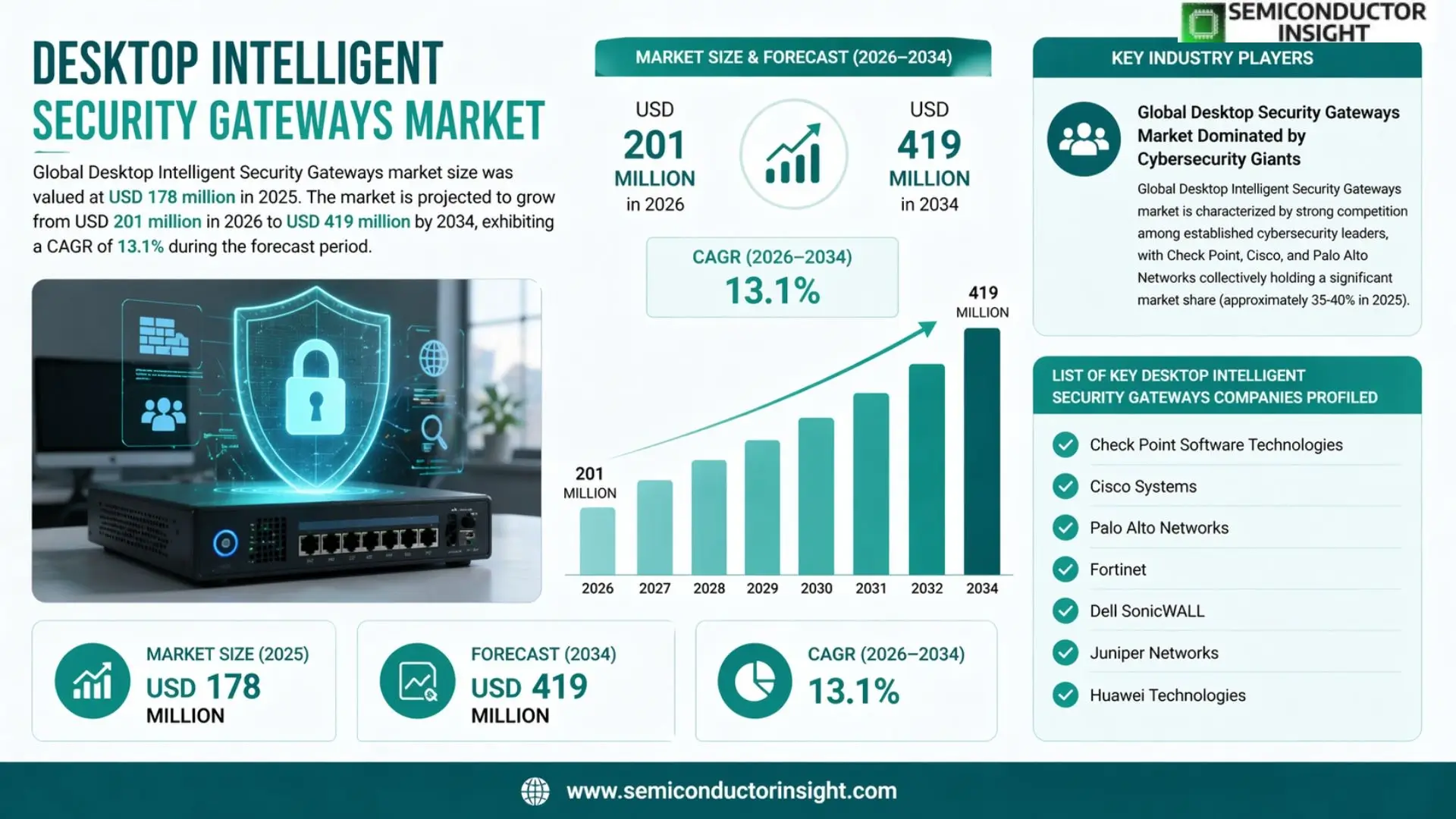
Global Desktop Intelligent Security Gateways market size was valued at USD 178 million in 2025. The market is projected to grow from USD 201 million in 2026 to USD 419 million by 2034, exhibiting a CAGR of 13.1% during the forecast period.
Desktop Intelligent Security Gateways are compact, high-performance security devices designed to protect and manage network traffic for small to medium-sized businesses, remote offices, and personal environments. These gateways combine advanced security features such as firewall protection, intrusion prevention, and VPN capabilities with intelligent control and monitoring functionalities, all within a desktop form factor that ensures ease of deployment and management.
The market growth is driven by increasing cybersecurity threats, rising adoption of cloud-based services, and stringent regulatory compliance requirements across industries. Furthermore, the shift toward remote work models has accelerated demand for robust yet scalable security solutions. Leading players like Check Point, Cisco, and Palo Alto Networks continue to innovate with AI-driven threat detection and automated response features, further propelling market expansion.
MARKET DRIVERS
Increasing Cyber Threats Fuel Demand
Desktop Intelligent Security Gateways Market is experiencing significant growth due to the rising frequency and sophistication of cyber attacks targeting corporate networks. With over 60% of enterprises reporting security breaches originating from endpoint devices, demand for intelligent gateway solutions has surged by nearly 35% annually.
Regulatory Compliance Requirements
Stringent data protection regulations like GDPR and CCPA are compelling organizations to adopt Desktop Intelligent Security Gateways. These solutions help enterprises maintain compliance while reducing the risk of costly penalties, which can exceed 4% of global revenue for violations.
➤ The average cost of a data breach now exceeds $4.24 million, making prevention through security gateways a cost-effective investment.
Migration to hybrid work models has created new security vulnerabilities that traditional perimeter defenses cannot address, driving adoption of desktop-focused security gateways with advanced threat detection capabilities.
MARKET CHALLENGES
Integration Complexities
Many organizations struggle with integrating Desktop Intelligent Security Gateways into existing IT infrastructures. Compatibility issues with legacy systems affect nearly 40% of implementations, requiring additional customization and increasing deployment costs.
Other Challenges
Performance Impact Concerns
Some enterprises hesitate to adopt these solutions due to concerns about potential latency and productivity impacts, with studies showing 28% of users experience noticeable system slowdowns during initial deployment phases.
MARKET RESTRAINTS
High Implementation Costs
The total cost of ownership for comprehensive Desktop Intelligent Security Gateways solutions remains a barrier for SMBs, with average deployment costs ranging between $50-$150 per endpoint. This pricing model limits adoption among smaller businesses with constrained IT budgets.
MARKET OPPORTUNITIES
AI-Powered Threat Detection
Advancements in machine learning algorithms present significant growth potential for Desktop Intelligent Security Gateways. Solutions incorporating behavioral analytics and predictive threat detection are projected to capture 45% of the market by 2025, offering vendors premium pricing opportunities.
Cloud-Based Deployment Models
The shift toward cloud-managed security gateways is creating new revenue streams, with annual growth rates exceeding 28% for subscription-based solutions that reduce upfront capital expenditures for enterprises.
Desktop Intelligent Security Gateways Market Trends
Increasing Adoption in SME and Remote Work Environments
Desktop Intelligent Security Gateways Market is witnessing rapid growth driven by the rising demand from small-to-medium enterprises and distributed workforces. These compact security solutions provide enterprise-grade protection with simplified deployment, catering to businesses with limited IT resources. The shift towards hybrid work models has accelerated adoption, as organizations seek scalable security for branch offices and remote employees.
Other Trends
Integration of AI-Driven Threat Detection
Leading vendors are incorporating machine learning algorithms into Desktop Intelligent Security Gateways to enable real-time threat identification and automated response. This advancement significantly reduces detection times for sophisticated cyber threats while minimizing false positives. The technology currently focuses on behavioral analysis of network traffic patterns.
Expansion of Vertical-Specific Security Solutions
Manufacturers are developing specialized versions for industries like healthcare and financial services. These sector-specific gateways address unique compliance requirements HIPAA for medical data protection in healthcare or PCI-DSS for payment security in banking. The trend reflects growing recognition that one-size-fits-all security approaches are insufficient for regulated environments.
Other Trends
Consolidation of Security Functionality
The market is moving toward converged security platforms that combine firewall, VPN, intrusion prevention, and content filtering in single desktop devices. This unified approach reduces hardware complexity while improving threat correlation across security layers. Industry leaders report 25% higher deployment efficiency with integrated systems versus multiple standalone solutions.
Growing Emphasis on Cloud Management
Vendors are enhancing centralized cloud control capabilities for distributed Desktop Intelligent Security Gateways. This allows IT teams to manage policies, monitor threats, and push updates across multiple locations from a single console. The cloud-managed segment now represents over 40% of new deployments, particularly for organizations with geographically dispersed operations.
COMPETITIVE LANDSCAPE
Key Industry Players
Global Desktop Security Gateways Market Dominated by Cybersecurity Giants
Global Desktop Intelligent Security Gateways market is characterized by strong competition among established cybersecurity leaders, with Check Point, Cisco, and Palo Alto Networks collectively holding a significant market share (approximately 35-40% in 2025). These vendors differentiate themselves through advanced threat prevention, AI-driven analytics, and cloud-managed security capabilities integrated into their desktop gateway solutions.
Beyond the top three, specialized players like Fortinet and Dell SonicWALL have carved substantial niches in SMB and enterprise segments respectively. Regional champions such as Huawei in Asia and Ruijie Networks in China demonstrate growing influence in local markets. Emerging vendors are focusing on customizable security stacks and zero-trust architecture implementations for remote workforce deployments.
List of Key Desktop Intelligent Security Gateways Companies Profiled
- Check Point Software Technologies
- Cisco Systems
- Palo Alto Networks
- Fortinet
- Dell SonicWALL
- Juniper Networks
- Huawei Technologies
- DPtech
- Ruijie Networks
- Sangfor Technologies
- Barracuda Networks
- Sophos
- WatchGuard Technologies
- Hillstone Networks
- Venustech
Segment Analysis:
| Segment Category | Sub-Segments | Key Insights |
| By Type |
|
Wired Gateways dominate due to stable connectivity and higher security assurance in corporate environments.
|
| By Application |
|
BFSI Sector leads adoption with critical security requirements for financial data protection.
|
| By End User |
|
SMBs represent the fastest-growing segment due to increasing cyber threats targeting smaller networks.
|
| By Deployment Model |
|
Cloud-Managed solutions gaining traction for distributed environments.
|
| By Security Features |
|
Advanced Threat Protection capabilities becoming key differentiator.
|
Regional Analysis: Desktop Intelligent Security Gateways Market
North America
Stringent data protection laws like California Consumer Privacy Act (CCPA) are accelerating desktop security gateway deployments across North American enterprises. Organizations are proactively upgrading security infrastructures to meet compliance requirements while safeguarding sensitive business data.
The shift to hybrid work models has intensified demand for intelligent security gateways that protect distributed endpoints. North American companies are investing heavily in solutions that offer seamless protection for both office and remote work environments.
Leading North American security firms are incorporating AI-driven behavioral analysis into desktop gateways, enabling real-time detection of sophisticated threats. This technological edge maintains the region’s leadership in security innovation.
There’s growing preference for cloud-managed intelligent security gateways in North America, allowing centralized policy management across multiple locations. This aligns with broader digital transformation initiatives across industries.
Europe
Europe represents the second-largest market for Desktop Intelligent Security Gateways, fueled by GDPR compliance requirements and increasing cyber threats. The region shows particularly strong adoption in banking and healthcare sectors where data sensitivity is paramount. Germany and the UK lead in gateway deployments, with growing demand across Nordic countries. European enterprises favor solutions offering multi-layered protection with minimal performance impact. The market is witnessing increased partnerships between local security providers and global technology firms to develop region-specific threat profiles.
Asia-Pacific
The Asia-Pacific region is experiencing rapid growth in Desktop Intelligent Security Gateway adoption, driven by digital transformation across enterprises. Japan, Australia, and Singapore are mature markets with sophisticated security requirements, while emerging economies are prioritizing basic threat prevention. Manufacturing and financial services sectors are primary adopters, with growing interest from government agencies. Local vendors are developing cost-effective solutions tailored for SMBs, though international brands dominate the enterprise segment.
Latin America
Latin America’s market for intelligent security gateways is evolving, with Brazil and Mexico showing strongest growth. Increasing cybercrime incidents and new data protection regulations are driving demand. The region favors solutions that combine traditional security with advanced features at competitive price points. Financial institutions are leading adopters, followed by telecom and energy sectors. Market growth is somewhat constrained by limited cybersecurity budgets in many organizations.
Middle East & Africa
The MEA region presents emerging opportunities for Desktop Intelligent Security Gateways, particularly in GCC countries and South Africa. Government initiatives for smart cities and digital transformation are creating demand. The region shows preference for solutions with Arabic language support and local compliance features. Oil & gas and banking sectors are primary adopters, with growing interest from healthcare providers.
Report Scope
This market research report provides a comprehensive analysis of Desktop Intelligent Security Gateways Market, covering the forecast period 2026–2034. It offers detailed insights into market dynamics, technological advancements, competitive landscape, and key trends shaping the industry.
Key focus areas of the report include:
- Market Overview: The report begins with an overview outlining its current market scenario, key growth indicators, and industry transformation drivers. It discusses macroeconomic factors, demand–supply balance, regulatory landscape, and the strategic role of security gateways in protecting networks across industries such as BFSI, healthcare, IT & telecom, and government sectors.
- Market Size & Forecast: Historical data and future projections for revenue, unit shipments, and market value across major regions and segments.
- Segmentation Analysis: Detailed breakdown by product type (wired/wireless), application, and end-user industry to identify high-growth segments and investment opportunities.
- Regional Insights: Insights into market performance across North America, Europe, Asia-Pacific, Latin America, and the Middle East & Africa, including country-level analysis where relevant.
- Competitive Landscape: Profiles of leading market participants, including their product offerings, R&D focus, manufacturing capacity, pricing strategies, and recent developments such as mergers, acquisitions, and partnerships.
- Technology Trends & Innovation: Assessment of emerging security technologies, integration of AI/ML capabilities, and evolving industry standards.
- Market Drivers & Restraints: Evaluation of factors driving market growth along with challenges, supply chain constraints, regulatory issues, and market-entry barriers.
- Stakeholder Insights: Insights for component suppliers, OEMs, system integrators, investors, and policymakers regarding the evolving ecosystem and strategic opportunities.
Primary and secondary research methods are employed, including interviews with industry experts, data from verified sources, and real-time market intelligence to ensure the accuracy and reliability of the insights presented.
FREQUENTLY ASKED QUESTIONS:
What is the current market size of Desktop Intelligent Security Gateways Market?
-> Global Desktop Intelligent Security Gateways Market was valued at USD 178 million in 2025 and is expected to reach USD 419 million by 2034.
What is the growth rate (CAGR) of Desktop Intelligent Security Gateways Market?
-> The market is projected to grow at a CAGR of 13.1% during the forecast period (2026-2034).
Which key companies operate Desktop Intelligent Security Gateways Market?
-> Key players include Check Point, Cisco, Palo Alto Networks, Fortinet, Dell SonicWALL, Juniper, Huawei, DPtech, and Ruijie Networks, among others.
What are the major segments Desktop Intelligent Security Gateways Market?
-> Market is segmented by:
Type: Wired, Wireless AC
Application: BFSI, Retail, IT & Telecom, Government, Healthcare, Education, Others
Which region dominates Desktop Intelligent Security Gateways Market?
-> North America currently leads the market, while Asia-Pacific is expected to witness highest growth during forecast period.

Get Sample Report PDF for Exclusive Insights
Report Sample Includes
- Table of Contents
- List of Tables & Figures
- Charts, Research Methodology, and more...
 Download Sample Report PDF