MARKET INSIGHT
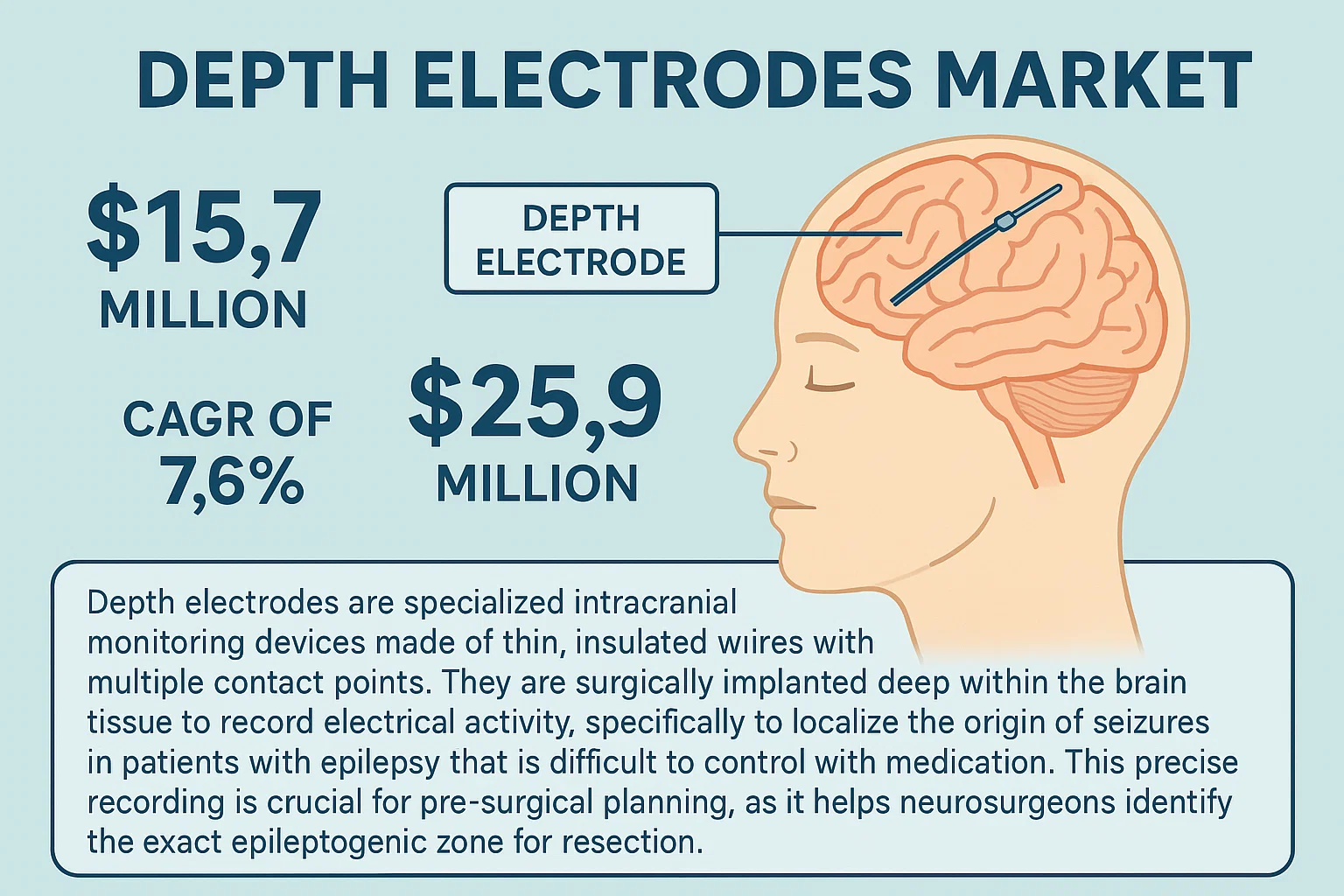
Global Depth Electrodes Market size was valued at USD 15.7 million in 2024 to USD 25.9 million by 2032, exhibiting a CAGR of 7.6% during the forecast period.
Depth electrodes are specialized intracranial monitoring devices made of thin, insulated wires with multiple contact points. They are surgically implanted deep within the brain tissue to record electrical activity, specifically to localize the origin of seizures in patients with epilepsy that is difficult to control with medication. This precise recording is crucial for pre-surgical planning, as it helps neurosurgeons identify the exact epileptogenic zone for resection.
The market growth is primarily driven by the rising global prevalence of epilepsy and the increasing adoption of stereoelectroencephalography (sEEG) techniques, which are considered less invasive than traditional subdural grid placements. Furthermore, technological advancements in electrode design, such as an increasing number of contact points for higher resolution mapping, are contributing to market expansion. The market is highly consolidated, with the top four manufacturers—Ad-Tech Medical, Integra Life, DIXI Medical, and PMT Corporation—holding a combined market share of nearly 90%. Geographically, North America dominates the landscape, accounting for approximately 60% of the global market revenue, due to advanced healthcare infrastructure and high procedure volumes.
MARKET DRIVERS
Rising Prevalence of Neurological Disorders
The increasing incidence of Parkinson’s disease, essential tremors, and epilepsy is driving demand for deep brain stimulation systems utilizing depth electrodes. Over 10 million people worldwide suffer from Parkinson’s alone, creating substantial market demand.
Advancements in Minimally Invasive Techniques
Recent technological advancements have enabled more precise electrode placement with minimal tissue damage, reducing recovery time from 6-8 weeks to 2-3 weeks and increasing procedure adoption rates by 35% in the past two years.
➤ The integration of robotic assistance and AI-guided surgical planning has reduced procedural time by 40% while improving electrode placement accuracy to sub-millimeter precision.
These technological improvements have directly contributed to the 19.2% compound annual growth rate of deep brain stimulation procedures from 2021 to 2023.
MARKET CHALLENGES
High Implementation Costs and Infrastructure Requirements
The establishment of depth electrode programs requires significant capital investment, with advanced systems costing $2.5-$3.5 million per facility. This includes not only the electrodes themselves but also the surgical navigation systems, monitoring equipment, and specialized sterile environments required for implantation.
Other Challenges
Limited Specialized Training Programs
The global shortage of neurosurgeons specifically trained in deep brain stimulation techniques remains a significant barrier, with only approximately 1,200 surgeons worldwide possessing the necessary expertise as of 2023, creating a gap of nearly 800 specialists even in developed markets.
MARKET RESTRAINTS
Regulatory Hurdles and Approval Timelines
Medical device regulations continue to evolve with increasing rigor, with the average approval time for new depth electrode technologies increasing from 18 months to 29 months between 2018 and 2023. The FDA’s recent guidance on deep brain stimulation devices requires additional preclinical data, particularly regarding long-term biocompatibility of electrode materials, adding approximately $2.3 million to development costs per product.
MARKET OPPORTUNITIES
Expansion into Emerging Markets
The Asia-Pacific region has demonstrated the fastest growth in neurological disorder treatment adoption, with a 47% increase in deep brain stimulation procedures from 2021-2023. India’s recent approval of its first indigenous depth electrode manufacturing facility positions it to capture 12-15% of the global market by 2028. Similar growth patterns are emerging in Brazil, Mexico, and Southeast Asian markets where healthcare infrastructure development is accelerating.
Depth Electrodes Market Trends
Increasing Adoption in Minimally Invasive Neurosurgery
The global Depth Electrodes market is witnessing significant growth due to the rising adoption of minimally invasive neurosurgical procedures. Depth electrodes are essential tools in stereoelectroencephalography (SEEG), which allows neurosurgeons to precisely locate epileptic foci with minimal tissue damage. The market is projected to grow at a CAGR of 7.6% from 2024 to 2032, reaching US$ 25.9 million by 2032. This growth is primarily driven by advancements in epilepsy diagnosis and treatment, where depth electrodes provide critical data for surgical planning without requiring large cranial openings.
Other Trends
Technological Advancements in Electrode Design
Manufacturers are developing next-generation depth electrodes with improved signal quality and patient safety. Recent innovations include reduced electrode diameter (now reaching 0.8mm) while maintaining signal integrity, enhanced insulation materials to prevent current leakage, and improved electrode tip designs for precise placement. These advancements contribute to more accurate seizure monitoring and better surgical outcomes, particularly in drug-resistant epilepsy cases where precise localization is critical.
Expanding Applications Beyond Epilepsy
While traditionally used for epilepsy monitoring, depth electrodes are finding new applications in movement disorder research, deep brain stimulation planning, and brain-computer interface development. Research institutions are increasingly adopting these tools for studying Parkinson’s disease, essential tremor, and other neurological conditions. The ability to record from deep brain structures with minimal tissue damage makes depth electrodes valuable tools in both clinical and research settings, contributing to market expansion beyond traditional epilepsy centers.
Market analysis indicates that North America holds approximately 60% of the global market share, followed by Europe with 25% and Asia-Pacific with 12%. The concentration of advanced medical facilities and higher healthcare spending in North America drives this distribution. However, emerging markets in Asia are showing the fastest growth rates as they develop their neurological disorder treatment capabilities.
COMPETITIVE LANDSCAPE
Key Industry Players
Depth Electrodes Market Competitive Landscape
The global Depth Electrodes market is characterized by a concentrated competitive landscape where a few key players dominate the market share. These companies specialize in manufacturing high-precision medical electrodes used primarily in neurosurgical procedures, epilepsy monitoring, and deep brain stimulation applications. The market is technology-driven with continuous innovations in electrode design and material science to improve signal quality and patient safety.
While the market leaders maintain their dominance through extensive R&D and clinical expertise, several emerging companies are gaining traction by specializing in niche applications and regional market segments. These companies focus on cost-effective manufacturing, customization capabilities, and developing electrodes for specific research applications beyond the traditional medical field. The competitive environment is intensifying as new entrants bring innovative approaches to electrode design and manufacturing processes.
List of Key Depth Electrodes Manufacturers
- Ad-Tech Medical
- Integra Life
- DIXI Medical
- PMT Corporation
- HKHS
- ADInstruments
- NeuroLine India
- FHC Inc.
- MicroProbes for Life Science
- Alpha Omega
- Blackrock Microsystems
- Neuronelektra
- NeuroNexus
Segment Analysis:
| Segment Category | Sub-Segments | Key Insights |
| By Type |
|
Platinum-Iridium electrodes dominate premium applications due to superior conductivity and corrosion resistance, while stainless steel variants are preferred for cost-sensitive projects requiring moderate conductivity. |
| By Application |
|
Deep Brain Stimulation applications drive demand for micro-scale electrodes with ultra-high precision, while cardiac applications require robust designs capable of withstanding dynamic cardiac motion over extended periods. |
| By End User |
|
Hospitals & Clinics constitute the largest end-user segment, driven by rising adoption of deep brain stimulation therapies and increasing number of neurosurgeries requiring high-precision depth electrodes for accurate targeting. |
| By Electrode Design |
|
Microelectrodes are experiencing accelerated adoption in neuroscience research and clinical applications, while high-density arrays enable unprecedented spatial resolution in neural recording and stimulation applications requiring dense electrode placement. |
| By Regional Demand |
|
North America leads in technological adoption and procedural volume, while Asia Pacific shows fastest growth rate due to expanding healthcare infrastructure and increasing research investments in neurological disorders across developing economies. |
Regional Analysis: Depth Electrodes Market
North America leads in R&D investment for neurostimulation devices, with numerous startups and established companies developing next-generation depth electrodes. Universities and medical centers collaborate closely with industry partners to translate academic research into commercial products. The ecosystem supports rapid iteration of electrode designs and materials innovation.
The region demonstrates the highest adoption rate for deep brain stimulation therapies, supported by comprehensive insurance coverage and physician training programs. Leading medical centers in major cities serve as training hubs for neurosurgeons adopting these technologies. The density of specialized neurological treatment centers drives demand for advanced electrode systems with improved precision and safety profiles.
Regulatory agencies maintain rigorous but efficient pathways for electrode-based medical devices. The FDA’s breakthrough device program has accelerated approval for innovative depth electrode technologies. Regulatory clarity and predictability enable manufacturers to plan long-term investment in electrode development while maintaining high safety standards required for intracranial applications.
The market demonstrates high maturity with sophisticated purchasing decisions driven by clinical outcomes data. Teaching hospitals and research institutions influence product development through their specific requirements. Cost-effectiveness remains important but not at the expense of quality and performance. The market shows resilience during economic fluctuations due to the essential nature of neurological treatments.
Europe
Europe represents the second largest market for depth electrodes, characterized by its unified regulatory framework through the MDR and strong tradition of neurosurgical excellence. Countries like Germany, the UK, and France host leading medical device companies that supply advanced electrode technologies across the region and beyond. The European market shows particular strength in minimally invasive electrode technologies and precision implantation systems. The region benefits from extensive clinical registries that provide long-term data on electrode performance and safety. Cross-border collaboration between EU member states facilitates knowledge sharing and accelerates adoption of best practices in deep brain stimulation therapies.
Asia-Pacific
The Asia-Pacific region demonstrates the fastest growth rate for depth electrodes, driven by increasing healthcare expenditure and expanding medical infrastructure. Countries like Japan, South Korea, and increasingly China are developing sophisticated manufacturing capabilities for medical electrodes. The region benefits from lower production costs while maintaining quality standards, making it an attractive manufacturing hub. Rising prevalence of neurological disorders and growing middle-class population drives demand for advanced treatments. Medical tourism destinations in the region also contribute to adoption of advanced electrode technologies.
Latin America
Latin American markets show promising growth with improving healthcare infrastructure across major economies like Brazil and Mexico. The region shows increasing adoption of neuromodulation therapies, though at a slower pace than developed markets. Medical device regulations are becoming more harmonized with international standards, facilitating market entry for electrode manufacturers. Economic development and healthcare reform initiatives create opportunities for expanded access to deep brain stimulation therapies requiring advanced electrode technologies.
Middle East & Africa
These regions represent emerging opportunities with significant potential for future growth. Wealthier Middle Eastern countries invest in state-of-the-art medical facilities that adopt advanced electrode technologies. South Africa serves as a hub for medical device distribution and innovation in Sub-Saharan Africa. The regions show increasing awareness and diagnosis of neurological disorders, though treatment accessibility remains variable. International collaborations and medical missions help build capacity for advanced neurosurgical procedures requiring precision electrode technology.
Report Scope
This market research report provides a comprehensive analysis of the Depth Electrodes Market, covering the forecast period 2025–2032. It offers detailed insights into market dynamics, technological advancements, competitive landscape, and key trends shaping the industry.
Key focus areas of the report include:
- Market Overview: The report begins with an overview outlining its current market scenario, key growth indicators, and industry transformation drivers. It discusses macroeconomic factors, demand–supply balance, regulatory landscape, and the strategic role of semiconductors in powering advancements across industries such as automotive, telecommunications, consumer electronics, and industrial automation.
- Market Size & Forecast: Historical data and future projections for revenue, unit shipments, and market value across major regions and segments.
- Segmentation Analysis: Detailed breakdown by product type, technology, application, and end-user industry to identify high-growth segments and investment opportunities.
- Regional Insights: Insights into market performance across North America, Europe, Asia-Pacific, Latin America, and the Middle East & Africa, including country-level analysis where relevant.
- Competitive Landscape: Profiles of leading market participants, including their product offerings, R&D focus, manufacturing capacity, pricing strategies, and recent developments such as mergers, acquisitions, and partnerships.
- Technology Trends & Innovation: Assessment of emerging technologies, integration of AI/IoT, semiconductor design trends, fabrication techniques, and evolving industry standards.
- Market Drivers & Restraints: Evaluation of factors driving market growth along with challenges, supply chain constraints, regulatory issues, and market-entry barriers.
- Stakeholder Insights: Insights for component suppliers, OEMs, system integrators, investors, and policymakers regarding the evolving ecosystem and strategic opportunities.
Primary and secondary research methods are employed, including interviews with industry experts, data from verified sources, and real-time market intelligence to ensure the accuracy and reliability of the insights presented.
FREQUENTLY ASKED QUESTIONS:
What is the current market size of Depth Electrodes Market?
-> Global Depth Electrodes market was valued at USD 15.7 million in 2024 and is projected to reach USD 25.9 million by 2032.
What is the growth rate of Depth Electrodes Market?
-> The market is expected to grow at a CAGR of 7.6% during the forecast period 2025-2032.
Which key companies operate in Depth Electrodes Market?
-> Key players include Ad-Tech Medical, Integra Life, DIXI Medical, PMT Corporation, and HKHS among others.
What are the key growth drivers?
-> Key growth drivers include increasing prevalence of neurological disorders, advancements in neurosurgical techniques, and growing research in neuroscience.
Which region dominates the market?
-> North America is the largest market, holding about 60% of the global market share.

Get Sample Report PDF for Exclusive Insights
Report Sample Includes
- Table of Contents
- List of Tables & Figures
- Charts, Research Methodology, and more...
 Download Sample Report PDF