Deep UV (DUV) Fiber Laser Market Insights
Global Deep UV (DUV) Fiber Laser market size was valued at USD 57.5 million in 2025. The market is projected to grow from USD 64.1 million in 2026 to USD 123 million by 2034, exhibiting a CAGR of 11.3% during the forecast period.
A Deep UV (DUV) Fiber Laser is a type of laser that generates ultraviolet light with wavelengths in the deep-ultraviolet range, typically from 100 to 280 nanometers, using a fiber-based gain medium. This technology combines the inherent advantages of fiber lasers,such as high beam quality, excellent stability, and robust flexibility,with the unique properties of deep-ultraviolet light, which include high photon energy and minimal diffraction limits.
The market is experiencing significant growth due to several key factors, primarily driven by escalating demand from the semiconductor industry for advanced lithography and precision micromachining applications. Furthermore, increasing investments in scientific research for spectroscopy and bio-imaging are contributing to market expansion. Initiatives by leading players are also expected to fuel growth; for instance, companies are continuously innovating to improve power output and reliability. Key manufacturers operating in this market with diverse portfolios include IPG Photonics, OXIDE Corporation, Xiton Photonics, Inno Laser Technology, Advanced Optowave Corporation, and Suzhou Delphi Laser.
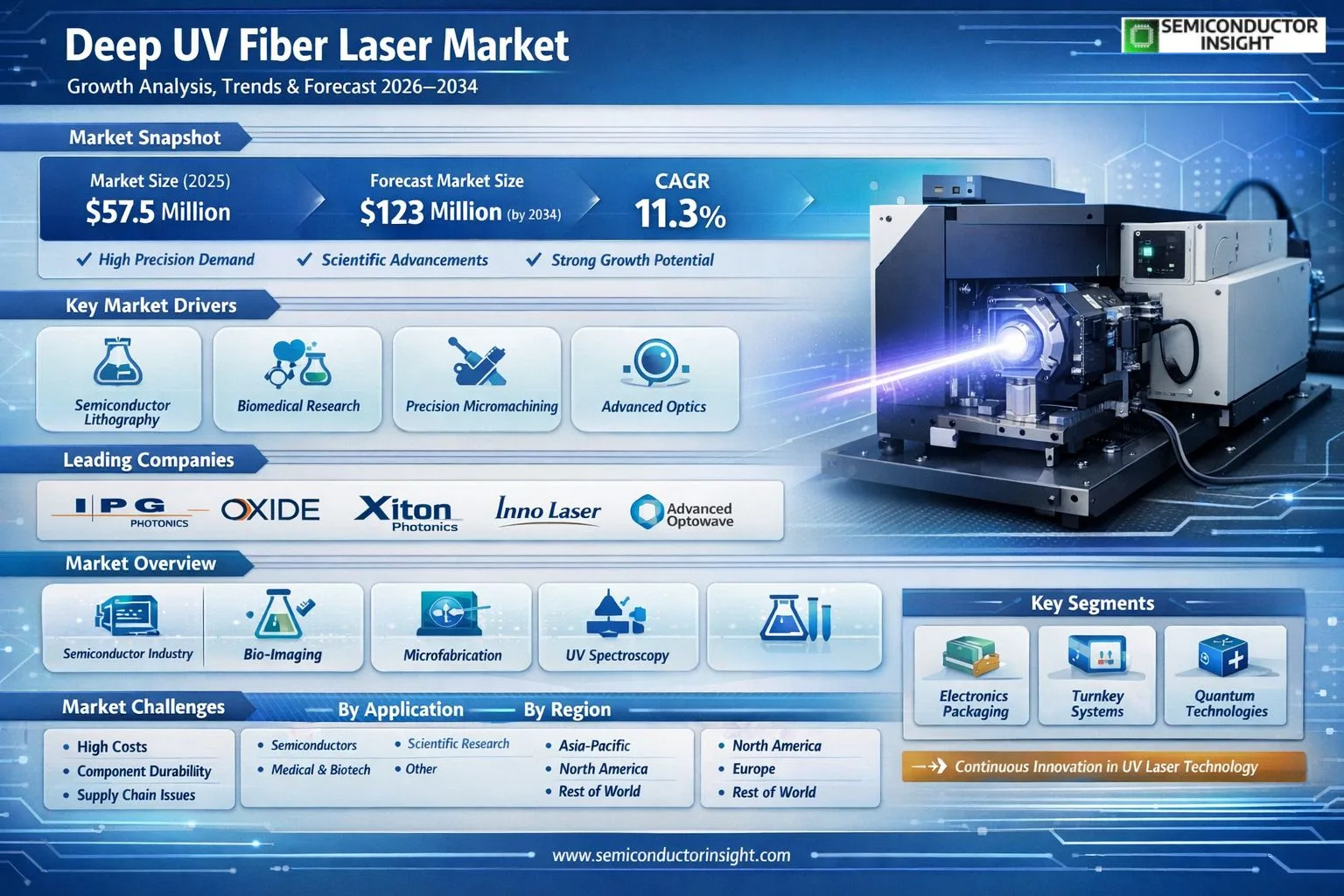
MARKET DRIVERS
Demand Surge from High-Precision Manufacturing
The primary driver for the Deep UV (DUV) Fiber Laser Market is the escalating need for extreme precision in microfabrication. These lasers, operating at wavelengths below 400 nm, enable resolution and feature sizes unattainable with infrared or visible lasers. Industries such as semiconductor manufacturing for advanced node chip production and the creation of microfluidic devices rely heavily on Deep UV (DUV) technology. The fiber-based architecture offers superior beam quality and stability, which is critical for consistent, high-throughput processing in these sensitive applications, creating robust market demand.
Growth in Scientific Research & Biomedical Applications
Beyond industrial manufacturing, the Deep UV (DUV) Fiber Laser Market is propelled by its expanding role in scientific research and life sciences. These lasers are indispensable tools for Raman spectroscopy, fluorescence microscopy, and photolithography in research laboratories. Their ability to precisely interact with biological molecules and materials without causing thermal damage opens significant opportunities. The development of next-generation diagnostic equipment and biochips increasingly specifies Deep UV (DUV) fiber lasers as a key enabling component, further stimulating market growth.
➤ The transition towards more compact and maintenance-free laser sources is a significant trend, with fiber laser technology in the Deep UV spectrum offering operational advantages over traditional bulky systems like excimer lasers.
Finally, technological advancements in pulsed fiber laser systems and frequency conversion techniques are enhancing the power, efficiency, and reliability of Deep UV outputs. These improvements are lowering the total cost of ownership, making the technology more accessible to a broader range of end-users and accelerating adoption across multiple sectors.
MARKET CHALLENGES
Technical Complexity and High Initial Costs
A core challenge in the Deep UV (DUV) Fiber Laser Market is the significant technical and financial barrier to entry. Generating high-power, stable Deep UV light requires sophisticated frequency conversion stages, such as harmonic generation, within the fiber laser system. This adds complexity, increases susceptibility to damage from high peak powers, and elevates manufacturing costs. Consequently, the high initial price point can limit adoption, particularly for small and medium-sized enterprises or research groups with constrained capital budgets.
Other Challenges
Component Durability and Lifetime
The optical components critical for generating and delivering Deep UV light, including specialty fibers, nonlinear crystals, and mirrors, degrade faster under high-energy UV photons. This degradation can lead to reduced output power, beam quality issues, and frequent, costly replacements, impacting system reliability and uptime for end-users in the Deep UV (DUV) Fiber Laser Market.
Supply Chain for Specialized Materials
The market faces constraints related to the supply of advanced materials required for both the laser medium and the frequency conversion optics. Dependence on specialized crystals and ultra-low-OH silica fibers creates potential bottlenecks, affecting production scalability and leading to price volatility for core components.
MARKET RESTRAINTS
Competition from Alternative Lithography Technologies
A major restraint on the Deep UV (DUV) Fiber Laser Market is the competitive pressure from alternative light sources, particularly in the semiconductor lithography sector. While Deep UV fiber lasers are advancing, established technologies like excimer lasers (e.g., ArF at 193 nm) currently dominate high-volume manufacturing for certain nodes. The proven track record, extreme power levels, and established infrastructure of these alternatives create inertia, slowing the adoption rate of newer Deep UV (DUV) fiber laser solutions for some high-end applications.
Stringent Certification and Integration Hurdles
Integrating new laser sources into certified manufacturing lines, especially in regulated industries like semiconductors and medical devices, is a lengthy and costly process. The qualification and validation requirements for a new Deep UV (DUV) Fiber Laser system to meet stringent yield and reliability standards act as a significant brake on rapid market penetration, favoring incremental upgrades to existing systems over wholesale replacement.
MARKET OPPORTUNITIES
Expansion into Advanced Electronics Packaging
The rise of advanced electronics packaging, including 2.5D/3D integration and fan-out wafer-level packaging (FOWLP), presents a substantial opportunity for the Deep UV (DUV) Fiber Laser Market. These processes require precise laser drilling for through-silicon vias (TSVs) and ablation for micro-bump formation. Deep UV wavelengths provide the fine focus and minimal thermal impact needed for these delicate interconnects, positioning Deep UV (DUV) fiber lasers as a key enabling technology for next-generation electronic devices.
Development of Turnkey System Solutions
There is a growing market opportunity for suppliers to move beyond selling standalone lasers to providing complete, application-specific workstations. By integrating Deep UV (DUV) Fiber Laser sources with precision motion stages, beam delivery optics, and process control software, vendors can offer turnkey solutions for microfabrication, marking, and cutting. This approach reduces integration complexity for customers, unlocks new application areas, and creates higher-value products with improved margins for manufacturers in the market.
Emerging Applications in Quantum Technology
Emerging fields such as quantum computing and quantum sensing present a forward-looking opportunity. The precise wavelength control and stability offered by Deep UV (DUV) fiber lasers make them ideal candidates for manipulating ions or atoms in quantum systems, as well as for fabricating the nanostructured photonic components essential for quantum devices. Early-stage research and development in this sector could drive specialized, high-value demand within the Deep UV laser market.
Deep UV (DUV) Fiber Laser Market Trends
Accelerated Demand From Advanced Semiconductor Fabrication
The paramount trend within the Deep UV (DUV) Fiber Laser market is its increasing criticality in semiconductor manufacturing. The push for smaller transistor nodes and enhanced integrated circuit performance continues, creating robust demand for high-precision, high-throughput micromachining and inspection tools. DUV fiber lasers provide the necessary short wavelengths for superb resolution and minimal heat-affected zones, which is essential for scribing, cutting, and drilling of advanced semiconductor materials. This application constitutes a major and growing segment, with the semiconductor industry being a primary adopter. Equipment integration for photolithography mask repair and wafer inspection further solidifies this high-value application segment.
Other Trends
Diversification into Scientific and Bio-Photonics Research
Beyond industrial manufacturing, significant growth is observed in scientific research applications. Universities and research institutions are increasingly adopting DUV fiber lasers for experimental setups in spectroscopy, fluorescence microscopy, and photochemistry. Their advantages, including compact footprint, excellent beam quality, and operational stability, make them preferable to traditional bulkier UV laser sources. This trend is expanding the total addressable market for DUV fiber lasers beyond the traditional manufacturing base, fostering new product innovations tailored for laboratory environments.
Continuous Wave (CW) Segment Gaining Momentum
Analysis of type segments indicates growing traction for Deep UV CW Fiber Lasers. While pulsed variants remain vital for high-power material processing, the demand for stable, narrow-linewidth continuous wave output is rising. This is particularly driven by requirements in high-resolution spectroscopy and certain metrology applications where constant, precise UV illumination is necessary. The development of more powerful and efficient CW DUV fiber laser sources by key manufacturers reflects this market trend, indicating targeted technological advancement to capture emerging opportunities in precision measurement fields.
COMPETITIVE LANDSCAPE
Key Industry Players
An Evolving Market Dominated by Photonics Specialists
Global Deep UV (DUV) Fiber Laser market is characterized by a concentrated competitive structure, where technological expertise and specialization in photonics are critical. According to recent market analysis, a small cohort of key manufacturers, led by IPG Photonics, commands a significant portion of Global revenue, with the top five players holding a notable collective market share. IPG Photonics leverages its extensive fiber laser portfolio to establish a strong foothold. Other established players like Germany’s Xiton Photonics and Japan’s OXIDE Corporation contribute substantially, focusing on high-precision applications crucial to the semiconductor industry and scientific research. The market’s growth, projected at a CAGR of 11.3%, is intensifying competition around product reliability, output power stability in the 100-280 nm range, and system integration for advanced manufacturing workflows.
Beyond the revenue leaders, the landscape includes several significant niche and regional players that add depth and specialization. Companies like Advanced Optowave Corporation (AOC) and Inno Laser Technology are pivotal in advancing specific laser parameters for micromachining and inspection tasks. Emerging manufacturers, particularly in Asia, such as Suzhou Delphi Laser, are enhancing their capabilities, contributing to a more diversified supply chain. These players often compete by offering tailored solutions, competitive pricing, and strong technical support for emerging applications in sectors like electronics and biomedicine. Ongoing R&D in both continuous-wave (CW) and pulsed DUV fiber laser segments is a primary competitive battleground, with mergers, acquisitions, and strategic partnerships being common strategies to consolidate technological advantages and expand geographic reach.
List of Key Deep UV (DUV) Fiber Laser Companies Profiled
- IPG Photonics
- OXIDE Corporation
- Xiton Photonics
- Inno Laser Technology
- Advanced Optowave Corporation (AOC)
- Suzhou Delphi Laser
- NKT Photonics
- MKS Instruments (Newport Corporation)
- Coherent, Inc. (formerly RPMC Lasers)
- TOPTICA Photonics AG
- Lumentum Holdings Inc.
- Cybel LLC
- FiberLAST, Inc.
- AdValue Photonics
- AMPLITUDE Systèmes
Segment Analysis:
| Segment Category | Sub-Segments | Key Insights |
| By Type |
|
Deep UV CW Fiber Laser is the primary segment, favored for its stable output critical in precision applications. The continuous wave operation provides consistent, high-quality ultraviolet light ideal for intricate semiconductor lithography and delicate scientific experiments. Its superior beam quality and thermal management are significant advantages over pulsed variants for long-duration industrial processes. The alignment with industry’s shift towards miniaturization and higher resolution underpins its dominant market position. |
| By Application |
|
Semiconductor Industry is the undisputed leading application area, driving advanced manufacturing capabilities. The unique wavelength properties of DUV fiber lasers are essential for next-generation photolithography, enabling the production of smaller, more powerful integrated circuits. This segment demands exceptionally high reliability, precision, and beam stability, which these lasers provide. The relentless innovation in chip manufacturing and the push towards extreme ultraviolet (EUV) adjacent technologies solidify this segment’s dominance. |
| By End User |
|
Foundries & IDMs (Integrated Device Manufacturers) represent the core end-user segment, characterized by high-volume, capital-intensive production environments. These users prioritize laser systems that offer operational longevity, minimal maintenance, and seamless integration into complex fabrication lines to maximize wafer yield. The technology’s adoption is closely tied to their roadmap for producing cutting-edge semiconductors, creating a high barrier to entry and fostering long-term partnerships with established laser manufacturers to ensure supply chain stability. |
| By Operational Power |
|
High Power DUV fiber lasers are leading this segment, driven by industrial needs for faster processing speeds and deeper material penetration in applications like advanced packaging and macro-processing. These systems are engineered for robustness in demanding production settings, offering a compelling balance between power output and the inherent beam quality advantages of fiber laser architecture. The trend towards higher power density for improved throughput in semiconductor fabrication is a key growth driver for this sub-segment. |
| By Integration Level |
|
Integrated Sub-Systems / Modules constitute the most dynamic and valued segment, as the market increasingly demands turnkey solutions. These pre-aligned, tested modules reduce integration complexity and time-to-market for equipment manufacturers, particularly in the semiconductor sector. The value proposition lies in providing a complete photonic engine that includes cooling, control electronics, and beam delivery, ensuring optimal performance and reliability which are non-negotiable in precision manufacturing environments, thus commanding significant strategic focus from leading suppliers. |
Regional Analysis: Deep UV (DUV) Fiber Laser Market
Asia-Pacific
The concentration of leading-edge semiconductor fabs and assembly facilities in countries like Taiwan, South Korea, and China creates a captive, high-volume market for Deep UV (DUV) fiber lasers, used extensively in lithography and precision patterning essential for chip production.
National strategies, such as China’s Made in China 2025 and similar initiatives in Japan and South Korea, directly fund and prioritize advancements in photonics and laser technology, accelerating the development and adoption of high-performance Deep UV (DUV) laser systems.
The region benefits from a dense network of specialized component suppliers, optics manufacturers, and system integrators, which reduces lead times and costs for Deep UV laser solutions, fostering rapid innovation and scalability for manufacturers.
While semiconductors are the primary driver, the Asia-Pacific market is rapidly expanding the use of Deep UV (DUV) fiber lasers into new applications like advanced display manufacturing for OLEDs and micro-LEDs, and high-resolution scientific instrumentation, ensuring sustained demand.
North America
North America remains a critical innovation and high-value application center for the Deep UV (DUV) fiber laser market. The region’s strength lies in its robust R&D infrastructure, with leading universities, national laboratories, and corporate R&D centers pioneering advancements in laser physics and nonlinear optics. This ecosystem fuels the development of next-generation Deep UV sources with improved beam quality and reliability. Demand is primarily driven by the defense and aerospace sectors for specialized manufacturing and sensing, as well as by leading semiconductor equipment companies based in the U.S. that require cutting-edge DUV technology for their tools. While not the volume manufacturing hub, North America’s focus on proprietary, high-specification Deep UV fiber laser technology secures its role as a key influencer of global product roadmaps and performance standards.
Europe
Europe holds a strong position in the Deep UV (DUV) fiber laser market, characterized by a focus on precision engineering and high-quality industrial manufacturing. The region is home to several world-leading manufacturers of laser systems and photonics components, particularly in Germany, which supply critical subsystems to Global market. Demand stems from its advanced automotive industry, where DUV lasers are used for manufacturing sensors and fine electronics, and from a thriving research community in biophotonics and metrology. Furthermore, European consortiums and publicly funded projects actively support the development of industrial laser technologies, including DUV, ensuring a steady pipeline of innovation. The market dynamics here emphasize reliability, precision, and integration into automated Industry 4.0 production lines.
South America
The Deep UV (DUV) fiber laser market in South America is in a nascent but developing stage, with growth primarily linked to industrialization efforts and academic research. Brazil and Argentina show the most activity, where investments in scientific infrastructure are creating initial demand for DUV laser systems in university and government research labs for materials science and physics experiments. Industrial adoption is slowly emerging in niche manufacturing sectors, such as specialized electronics and medical device production, though it is not yet a volume driver. The regional market dynamics are influenced by the need for technology transfer and partnerships with established global suppliers to build local expertise and service capabilities for these sophisticated laser systems.
Middle East & Africa
The Deep UV (DUV) fiber laser market in the Middle East & Africa region is currently defined by selective, high-investment applications rather than broad industrial adoption. In the Middle East, particularly in Gulf nations, demand is emerging from investments in high-tech economic diversification, with potential applications in semiconductor research facilities and advanced material processing linked to energy and aerospace projects. In Africa, the market is largely confined to major research universities and a few industrial hubs in South Africa and North Africa, focusing on analytical instrumentation and scientific research. Overall, the market dynamics are shaped by strategic government investments in technology and a growing recognition of lasers as tools for advanced manufacturing and research, though it remains a relatively small segment of Global Deep UV laser landscape.
Report Scope
This market research report provides a comprehensive analysis of the Deep UV (DUV) Fiber Laser Market , covering the forecast period 2026–2034. It offers detailed insights into market dynamics, technological advancements, competitive landscape, and key trends shaping the industry.
Key focus areas of the report include:
- Market Overview: The report begins with an overview outlining its current market scenario, key growth indicators, and industry transformation drivers. It discusses macroeconomic factors, demand–supply balance, regulatory landscape, and the strategic role of semiconductors in powering advancements across industries such as automotive, telecommunications, consumer electronics, and industrial automation.
- Market Size & Forecast: Historical data and future projections for revenue, unit shipments, and market value across major regions and segments.
- Segmentation Analysis: Detailed breakdown by product type, technology, application, and end-user industry to identify high-growth segments and investment opportunities.
- Regional Insights: Insights into market performance across North America, Europe, Asia-Pacific, Latin America, and the Middle East & Africa, including country-level analysis where relevant.
- Competitive Landscape: Profiles of leading market participants, including their product offerings, R&D focus, manufacturing capacity, pricing strategies, and recent developments such as mergers, acquisitions, and partnerships.
- Technology Trends & Innovation: Assessment of emerging technologies, integration of AI/IoT, semiconductor design trends, fabrication techniques, and evolving industry standards.
- Market Drivers & Restraints: Evaluation of factors driving market growth along with challenges, supply chain constraints, regulatory issues, and market-entry barriers.
- Stakeholder Insights: Insights for component suppliers, OEMs, system integrators, investors, and policymakers regarding the evolving ecosystem and strategic opportunities.
Primary and secondary research methods are employed, including interviews with industry experts, data from verified sources, and real-time market intelligence to ensure the accuracy and reliability of the insights presented.
FREQUENTLY ASKED QUESTIONS:
What is the current market size of Deep UV (DUV) Fiber Laser Market?
-> Global Deep UV (DUV) Fiber Laser market was valued at USD 57.5 million in 2025 and is projected to reach USD 123 million by 2034, growing at a CAGR of 11.3% during the forecast period.
Which key companies operate in Deep UV (DUV) Fiber Laser Market?
-> Key players include IPG Photonics, OXIDE Corporation, Xiton Photonics, Inno Laser Technology, Advanced Optowave Corporation, and Suzhou Delphi Laser, among others.
What are the key growth drivers?
-> Key growth drivers include advancements in semiconductor manufacturing, demand from scientific research, and the unique properties of DUV light for high-precision applications.
Which region dominates the market?
-> The report provides detailed regional analysis covering North America, Europe, Asia, South America, and the Middle East & Africa, with country-level insights for markets like the US and China.
What are the emerging trends?
-> Emerging trends include technological advancements in fiber laser design, increasing adoption in the semiconductor industry, and development of both CW and Pulsed DUV fiber laser types.

Get Sample Report PDF for Exclusive Insights
Report Sample Includes
- Table of Contents
- List of Tables & Figures
- Charts, Research Methodology, and more...
 Download Sample Report PDF