MARKET INSIGHTS
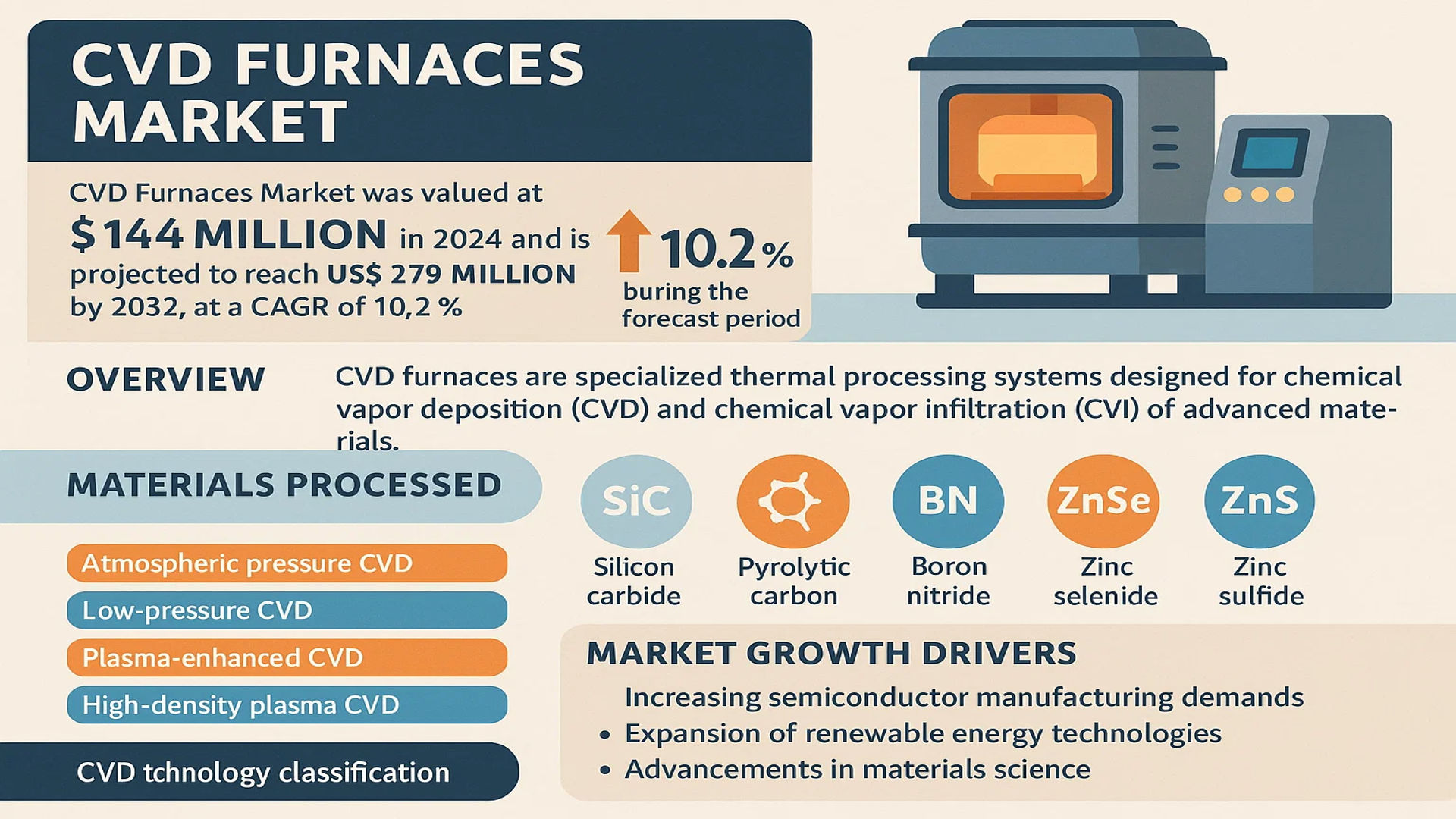
The global CVD Furnaces Market was valued at 144 million in 2024 and is projected to reach US$ 279 million by 2032, at a CAGR of 10.2% during the forecast period.
CVD furnaces are specialized thermal processing systems designed for chemical vapor deposition (CVD) and chemical vapor infiltration (CVI) of advanced materials. These high-precision systems enable the deposition of thin films and coatings on substrates at elevated temperatures, processing materials such as silicon carbide, pyrolytic carbon, boron nitride, zinc selenide, and zinc sulfide. The technology is classified into atmospheric pressure CVD (APCVD), low-pressure CVD (LPCVD), plasma-enhanced CVD (PECVD), and high-density plasma CVD (HDPCVD) variants, each serving specific industrial requirements.
The market growth is primarily driven by increasing semiconductor manufacturing demands, expansion of renewable energy technologies, and advancements in materials science. While North America currently leads in technological adoption, Asia-Pacific is emerging as the fastest-growing region due to semiconductor industry expansion in China and South Korea. Key players including ECM Group, RotaLab, and Across International are driving innovation through strategic collaborations and enhanced furnace capabilities for next-generation applications.
MARKET DYNAMICS
MARKET DRIVERS
Growing Semiconductor Industry to Fuel CVD Furnace Demand
The global semiconductor industry’s expansion is the primary driver for CVD furnace market growth, with compound annual growth projections exceeding 8% through 2030. These specialized furnaces are indispensable for depositing thin films in semiconductor manufacturing, enabling precise layer-by-layer material growth essential for advanced chips. The transition to smaller node sizes (now reaching 3nm and below) requires increasingly sophisticated CVD technologies capable of atomic-level precision. Recent innovations in APCVD (Atmospheric Pressure Chemical Vapor Deposition) systems now allow for better uniformity in large-scale wafer processing, directly addressing manufacturers’ need for higher yields.
Renewable Energy Sector Expansion Accelerates Adoption
Solar panel manufacturing is creating significant demand for LPCVD (Low Pressure Chemical Vapor Deposition) furnaces, particularly for silicon nitride anti-reflective coatings that improve photovoltaic efficiency by 15-20%. The global push for renewable energy solutions has led to record solar installations exceeding 250 GW annually, with manufacturers requiring high-throughput CVD systems to meet production targets. Recent advances in PECVD (Plasma Enhanced CVD) technology now enable faster deposition rates while maintaining film quality, directly benefiting solar cell production lines where throughput directly impacts profitability.
Furthermore, the electric vehicle revolution is driving demand for specialized CVD applications in battery production. Lithium-ion battery component manufacturing increasingly relies on CVD processes for creating uniform electrode coatings and separator films.
➤ For instance, contemporary CVD furnace designs now integrate multiple process chambers with advanced gas distribution systems, allowing sequential deposition of different materials without breaking vacuum.
Additionally, the widening application spectrum for CVD-fabricated materials in aerospace and defense sectors continues to propel the market forward. These industries require specialized coatings for thermal protection and wear resistance that can only be achieved through advanced CVD processes.
MARKET RESTRAINTS
High Initial Costs and Operational Complexity Limit Market Penetration
The substantial capital investment required for industrial-scale CVD furnace installations presents a significant barrier to market growth, with complete system costs ranging from $500,000 to several million dollars depending on configuration and capabilities. This pricing structure places the technology beyond reach for many small and medium enterprises, particularly in developing regions. Operational expenses further compound the challenge, as CVD processes consume large amounts of specialty gases and require meticulous maintenance. The typical total cost of ownership for a production-scale CVD system over five years often exceeds the initial purchase price by 250-300%.
Other Restraints
Energy Intensive Processes
CVD furnace operations are notoriously energy-hungry, requiring sustained high temperatures (often 800-1200°C) for extended periods. In an era of rising energy costs and sustainability concerns, this presents both financial and environmental challenges that manufacturers must address through expensive efficiency upgrades or alternative processes.
Technical Limitations
While CVD excels at producing high-purity coatings, certain material combinations remain difficult to deposit uniformly over complex geometries. The industry continues to struggle with step coverage issues and defect densities in some applications, requiring expensive rework or limiting potential applications in advanced packaging technologies.
MARKET CHALLENGES
Technical Specialization Creates Skilled Labor Shortage
The specialized nature of CVD furnace operation and maintenance presents an ongoing challenge, with industry surveys indicating 35-40% of manufacturers report difficulties finding adequately trained personnel. Modern CVD systems combine expertise in materials science, vacuum technology, thermal engineering, and process chemistry, creating a skills gap that lengthens equipment deployment timelines. The problem intensifies with newer hybrid systems incorporating multiple deposition technologies, where cross-disciplinary knowledge becomes essential for optimal operation.
Additionally, the rapid pace of technological advancement means existing expertise becomes obsolete quickly. Many technicians trained on legacy systems struggle to adapt to smart furnace technologies incorporating IoT monitoring and AI-driven process optimization, requiring expensive retraining programs.
Furthermore, the industry faces challenges in standardizing processes across different equipment manufacturers. Each vendor’s proprietary system architectures and control interfaces create operational silos that limit workforce mobility and increase training overhead for companies operating mixed fleets of CVD equipment.
MARKET OPPORTUNITIES
Emerging Materials and Applications Create New Market Frontiers
The accelerated development of two-dimensional materials like graphene and transition metal dichalcogenides presents transformative opportunities for CVD furnace manufacturers. These advanced materials require precisely controlled deposition conditions currently only achievable through specialized CVD configurations, creating demand for next-generation systems. The market for graphene production alone is projected to require over 1,200 specialized CVD systems by 2030, representing a potential $1.8 billion equipment opportunity.
Medical device manufacturing is emerging as another high-growth application area. CVD-coated implants and surgical tools demonstrate significantly improved biocompatibility and longevity, with the global market for medical device coatings projected to grow at 13.5% CAGR. Recent innovations in low-temperature PECVD processes now enable deposition on temperature-sensitive polymer substrates commonly used in medical applications.
Additionally, the semiconductor industry’s transition to advanced packaging technologies like 3D IC integration is driving demand for specialized conformal deposition capabilities. Modern through-silicon via (TSV) and redistribution layer (RDL) processes require CVD solutions capable of uniform coverage in high-aspect-ratio features, creating opportunities for equipment vendors offering innovative gas delivery and plasma enhancement solutions.
CVD FURNACES MARKET TRENDS
Demand for High-Performance Materials Drives CVD Furnace Market Growth
The global CVD furnace market is experiencing robust growth, driven by increasing demand for advanced materials in semiconductor manufacturing, aerospace, and energy storage applications. CVD furnaces are critical for producing high-purity materials such as silicon carbide, boron nitride, and zinc selenide, which are essential in high-performance electronic components. The market is projected to grow from USD 144 million in 2024 to USD 279 million by 2032, reflecting a CAGR of 10.2%. The expanding semiconductor industry, particularly in regions like Asia-Pacific, is significantly contributing to this upward trajectory.
Other Trends
Expansion of Semiconductor and Thin-Film Applications
The semiconductor sector remains the largest consumer of CVD furnaces, with manufacturers increasingly adopting CVD techniques for depositing thin films on wafers. The rise of 5G technology, IoT devices, and electric vehicles has intensified the demand for high-efficiency semiconductors, further boosting market growth. The APCVD (Atmospheric Pressure CVD) segment is set to experience notable expansion, particularly in foundry applications, where precision and throughput are critical. Additionally, the growing adoption of PECVD (Plasma-Enhanced CVD) in microelectronics is enabling thinner, more uniform coatings, aligning with the industry’s shift toward miniaturization.
Advancements in CVD Technology and Automation
Technological advancements in CVD furnace design, including improved temperature control and automation, are enhancing process efficiency and reducing operational costs. Manufacturers are integrating AI-driven monitoring systems to optimize deposition rates and minimize material wastage, which is particularly beneficial for high-throughput environments. Furthermore, the development of multi-zone furnaces allows for better control over film uniformity, addressing critical challenges in large-scale semiconductor production. Leading suppliers such as ECM Group and Across International have introduced modular furnace designs that improve scalability, catering to both research labs and industrial-scale production.
COMPETITIVE LANDSCAPE
Key Industry Players
Technological Advancements and Strategic Expansion Drive Market Competition
The global CVD Furnaces market exhibits a dynamic competitive landscape, with key players focusing on innovation, product differentiation, and regional expansion to solidify their market positions. The market, which was valued at $144 million in 2024 and is projected to reach $279 million by 2032, is witnessing intensified competition due to rising demand across semiconductor, aerospace, and materials science applications.
ECM Group and Across International currently dominate the market, leveraging their expertise in Atmospheric Pressure Chemical Vapor Deposition (APCVD) and Low-Pressure Chemical Vapor Deposition (LPCVD) technologies. These companies have established strong supply chains across North America and Asia-Pacific, allowing them to cater to the growing demands of integrated device manufacturers (IDMs) and foundries.
Meanwhile, emerging players like Zhengzhou Kejia Furnace Co. and Nanjing Laibu are gaining traction through competitive pricing and localized manufacturing in China. Their growth is further propelled by the country’s booming semiconductor industry and government initiatives supporting domestic equipment manufacturing.
The competitive intensity is further heightened by strategic collaborations between established players and research institutions. TevTech, for instance, recently partnered with leading semiconductor research centers to develop next-generation High-Density Plasma CVD (HDPCVD) systems, addressing the industry’s need for advanced thin-film deposition solutions.
List of Key CVD Furnace Manufacturers Profiled
- ECM Group (France)
- Across International (U.S.)
- Labec (Australia)
- TevTech (U.S.)
- Brother Furnace (China)
- Signature Vacuum Systems (U.K.)
- Program Thermal Tech (Taiwan)
- Zhengzhou Kejia Furnace Co. (China)
- ZhuZhou ChenXin Induction Equipment (China)
- Nanjing Laibu (China)
- Hefei Kejing (China)
Segment Analysis:
By Type
APCVD Segment Leads Due to its Cost-Effectiveness and Wide Adoption in Semiconductor Manufacturing
The market is segmented based on type into:
- APCVD (Atmospheric Pressure Chemical Vapor Deposition)
- Subtypes: Horizontal APCVD, Vertical APCVD, and others
- LPCVD (Low Pressure Chemical Vapor Deposition)
- PECVD (Plasma Enhanced Chemical Vapor Deposition)
- Subtypes: RF PECVD, Microwave PECVD, and others
- HDPCVD (High Density Plasma Chemical Vapor Deposition)
- Others
By Application
Foundry Segment Dominates Due to Increasing Demand for Custom Semiconductor Manufacturing
The market is segmented based on application into:
- IDM (Integrated Device Manufacturers)
- Foundry
- Research Institutions
- Others
By Material Type
Silicon Carbide Segment Leads Due to Growing Demand in Power Electronics
The market is segmented based on material type into:
- Silicon Carbide
- Pyrolytic Carbon
- Boron Nitride
- Zinc Selenide
- Zinc Sulfide
- Others
By Temperature Range
Medium Temperature Segment Dominates Due to Balanced Performance and Energy Efficiency
The market is segmented based on temperature range into:
- Low Temperature (Below 800°C)
- Medium Temperature (800°C – 1200°C)
- High Temperature (Above 1200°C)
Regional Analysis: CVD Furnaces Market
Asia-Pacific
The Asia-Pacific region dominates the global CVD furnace market, accounting for the highest revenue share due to rapid semiconductor and electronics manufacturing growth. China leads regional demand, driven by its $150 billion semiconductor self-sufficiency initiative and expanding foundry capacities from companies like SMIC. Japan maintains strong CVD furnace adoption in advanced material research, particularly for silicon carbide applications in electric vehicles. While cost sensitivity remains a factor across developing markets, increasing R&D investments and government subsidies for domestic semiconductor production are accelerating market expansion. South Korea’s position as a memory chip manufacturing hub further reinforces regional demand for advanced LPCVD and PECVD systems.
North America
North America represents the second-largest CVD furnace market, underpinned by substantial semiconductor industry investments and defense-related material research. The U.S. CHIPS Act’s $52 billion funding for domestic semiconductor manufacturing has spurred demand for both production-scale and R&D furnaces. Key applications include gallium nitride deposition for 5G infrastructure and silicon carbide processing for electric vehicle power electronics. However, longer equipment replacement cycles and higher adoption of used systems temper market growth compared to Asia. Major manufacturers are increasingly focusing on specialized CVD solutions for aerospace and medical applications, creating niche growth opportunities.
Europe
Europe maintains a steady CVD furnace market characterized by high-value applications in renewable energy and automotive sectors. Stringent environmental regulations are driving adoption of cleaner CVD technologies with reduced greenhouse gas emissions. Germany’s strong industrial base supports demand for precision coating systems, particularly for cutting tools and optical components. The EU’s focus on building sovereign semiconductor capabilities through the European Chips Act is expected to boost foundry investments, subsequently increasing CVD furnace requirements. However, slower decision cycles in academic and government research procurements create distinct demand patterns compared to commercial markets.
Middle East & Africa
The MEA region shows emerging potential in CVD furnace applications, primarily focused on oil & gas-related coatings and basic semiconductor packaging. Limited semiconductor manufacturing presence has constrained market size, though growing investments in research institutions are creating pockets of demand. Countries with sovereign wealth funds, particularly Saudi Arabia and UAE, are establishing material science research centers that incorporate CVD technologies. The market remains price-sensitive, with a preference for refurbished or entry-level systems. Long-term growth potential exists as regional economic diversification strategies increasingly incorporate advanced manufacturing.
South America
South America represents the smallest CVD furnace market globally, constrained by economic volatility and limited high-tech manufacturing infrastructure. Brazil accounts for the majority of regional demand, primarily for academic research and small-scale industrial applications. Recent developments in Argentina’s lithium battery supply chain may drive future CVD adoption for electrode material processing. The market faces structural challenges including import dependency, foreign exchange limitations, and competition from alternative deposition technologies. Despite this, selective opportunities exist in mining-related wear-resistant coatings and biomedical implant surface treatments.
Report Scope
This market research report provides a comprehensive analysis of the global and regional CVD Furnaces markets, covering the forecast period 2024–2032. It offers detailed insights into market dynamics, technological advancements, competitive landscape, and key trends shaping the industry.
Key focus areas of the report include:
- Market Size & Forecast: Historical data and future projections for revenue, unit shipments, and market value across major regions and segments. The global CVD Furnaces market was valued at USD 144 million in 2024 and is projected to reach USD 279 million by 2032, growing at a CAGR of 10.2%.
- Segmentation Analysis: Detailed breakdown by product type (APCVD, LPCVD, PECVD, HDPCVD, Others) and application (IDM, Foundry) to identify high-growth segments and investment opportunities.
- Regional Outlook: Insights into market performance across North America, Europe, Asia-Pacific, Latin America, and the Middle East & Africa. The U.S. market size is estimated at USD million in 2024, while China is projected to reach USD million by 2032.
- Competitive Landscape: Profiles of leading market participants including ECM Group, RotaLab, Across International, Labec, and TevTech, covering their product offerings, R&D focus, manufacturing capacity, and recent developments.
- Technology Trends & Innovation: Assessment of emerging CVD technologies, semiconductor fabrication techniques, and evolving industry standards for materials like silicon carbide and boron nitride.
- Market Drivers & Restraints: Evaluation of factors driving market growth along with challenges, supply chain constraints, regulatory issues, and market-entry barriers.
- Stakeholder Analysis: Insights for component suppliers, OEMs, system integrators, investors, and policymakers regarding the evolving CVD furnace ecosystem.
Primary and secondary research methods are employed, including interviews with industry experts, data from verified sources, and real-time market intelligence to ensure the accuracy and reliability of the insights presented.
FREQUENTLY ASKED QUESTIONS:
What is the current market size of Global CVD Furnaces Market?
-> CVD Furnaces Market was valued at 144 million in 2024 and is projected to reach US$ 279 million by 2032, at a CAGR of 10.2% during the forecast period.
Which key companies operate in Global CVD Furnaces Market?
-> Key players include ECM Group, RotaLab, Across International, Labec, TevTech, Brother Furnace, Signature Vacuum Systems, and Program Thermal Tech, among others.
What are the key growth drivers?
-> Key growth drivers include increasing demand for semiconductor manufacturing, advancements in CVD technology, and growing applications in electronics and materials science.
Which region dominates the market?
-> Asia-Pacific is the fastest-growing region due to semiconductor industry expansion, while North America remains a key technological hub.
What are the emerging trends?
-> Emerging trends include automation in CVD processes, development of energy-efficient furnaces, and increasing adoption of PECVD technology.

Get Sample Report PDF for Exclusive Insights
Report Sample Includes
- Table of Contents
- List of Tables & Figures
- Charts, Research Methodology, and more...
 Download Sample Report PDF