
MARKET INSIGHTS
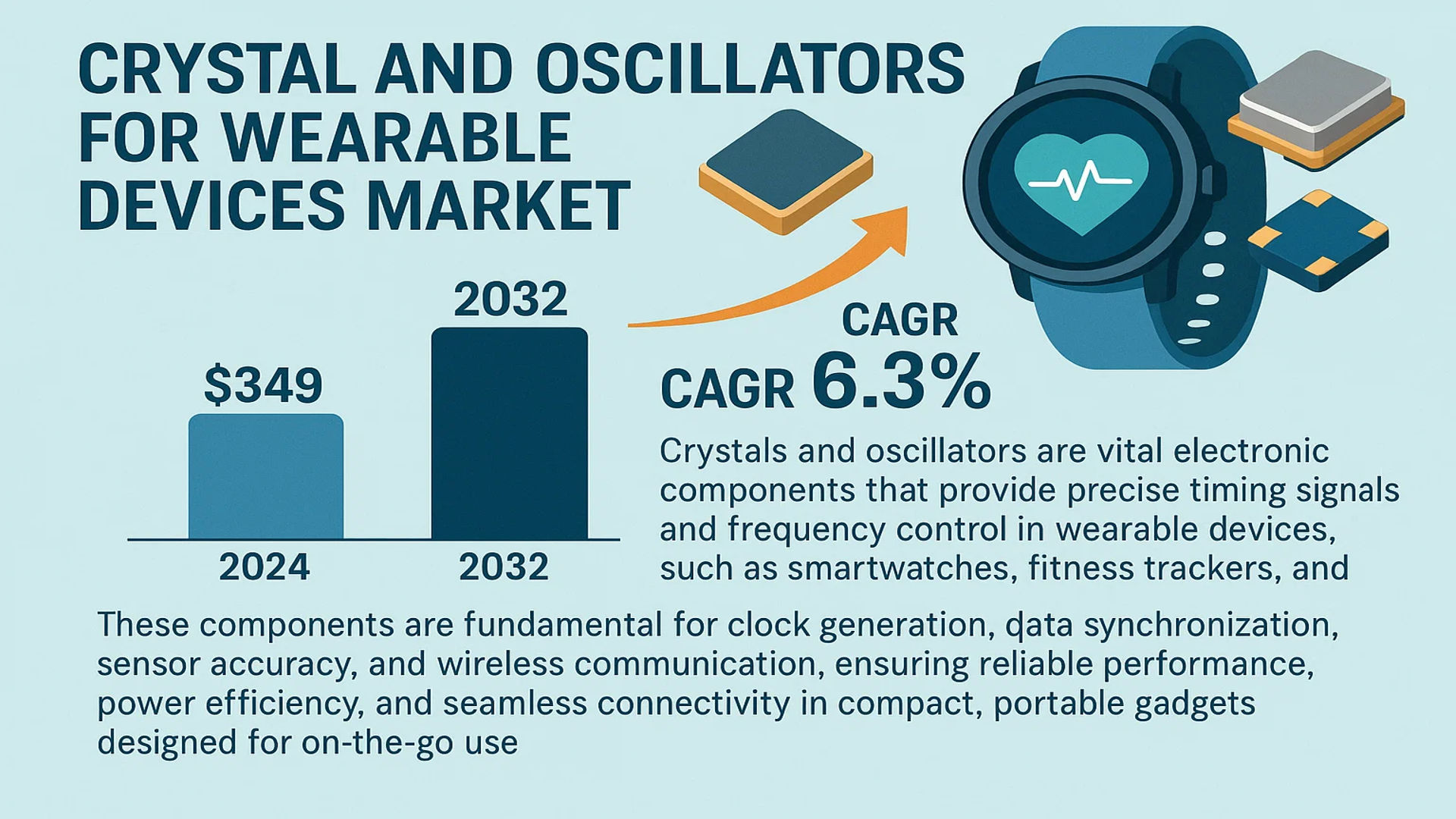
The global Crystal and Oscillators for Wearable Devices Market was valued at 349 million in 2024 and is projected to reach US$ 531 million by 2032, at a CAGR of 6.3% during the forecast period.
Crystals and oscillators are vital electronic components that provide precise timing signals and frequency control in wearable devices, such as smartwatches, fitness trackers, and hearables. These components are fundamental for clock generation, data synchronization, sensor accuracy, and wireless communication, ensuring reliable performance, power efficiency, and seamless connectivity in compact, portable gadgets designed for on-the-go use.
The market growth is primarily driven by the expanding adoption of wearable technology, increasing health and fitness monitoring features, and the integration of advanced wireless connectivity. However, the industry faces challenges related to maintaining frequency stability under varying conditions and optimizing power consumption to extend battery life. Key players, including Seiko Epson Corp, Murata Manufacturing, and Microchip Technology, are actively developing miniaturized, low-power solutions to meet the stringent design and performance requirements of next-generation wearable devices.
MARKET DYNAMICS
MARKET DRIVERS
Rising Adoption of Wearable Technology to Drive Market Growth
The global wearable technology market continues to expand rapidly, with shipments projected to exceed 650 million units annually by 2027. This growth is primarily driven by increasing consumer demand for smartwatches, fitness trackers, and health monitoring devices. Crystals and oscillators serve as critical timing components in these devices, ensuring precise synchronization for data processing, sensor operations, and wireless communication. The proliferation of wearable devices across consumer electronics, healthcare, and sports applications creates substantial demand for high-precision timing solutions. Manufacturers are responding by developing specialized crystals and oscillators that meet the stringent requirements of wearable applications, including miniaturization, low power consumption, and enhanced frequency stability.
Advancements in Health Monitoring Capabilities to Boost Demand
Wearable devices are increasingly incorporating sophisticated health monitoring features such as continuous heart rate tracking, blood oxygen saturation monitoring, electrocardiogram (ECG) functionality, and sleep pattern analysis. These medical-grade applications require extremely accurate timing references provided by crystals and oscillators to ensure reliable sensor data acquisition and processing. The global market for medical wearables is expected to grow at a compound annual growth rate of over 22% through 2030, creating significant opportunities for timing component manufacturers. The transition from basic fitness tracking to advanced health monitoring necessitates higher precision crystals with improved temperature stability and lower phase noise characteristics, driving innovation and market expansion.
Integration of Multiple Wireless Technologies to Fuel Market Expansion
Modern wearable devices incorporate multiple wireless connectivity options including Bluetooth Low Energy, Wi-Fi, GPS, NFC, and cellular connectivity. Each wireless technology requires specific frequency references provided by crystals and oscillators to maintain proper communication protocols and data synchronization. The complexity of managing multiple wireless interfaces within compact wearable devices drives demand for advanced timing solutions that can support various frequency bands while minimizing interference. The increasing adoption of 5G connectivity in premium wearable devices further amplifies this demand, as 5G requires more precise timing synchronization compared to previous wireless generations.
Furthermore, the development of ultra-low power wireless technologies specifically designed for wearable applications creates additional opportunities for specialized crystal and oscillator solutions that optimize power consumption while maintaining communication reliability.
MARKET RESTRAINTS
Technical Challenges in Miniaturization to Limit Market Growth
The relentless drive toward smaller wearable device form factors presents significant technical challenges for crystal and oscillator manufacturers. As wearable devices become increasingly compact, timing components must shrink accordingly while maintaining performance characteristics. Traditional quartz crystals face physical limitations regarding how small they can be manufactured while still providing stable frequency output. The industry standard for wearable applications has shifted to packages measuring 2.0mm x 1.6mm and smaller, with some applications requiring components as small as 1.2mm x 1.0mm. At these dimensions, maintaining frequency stability, especially under varying temperature conditions and mechanical stress, becomes increasingly difficult. Manufacturing yields tend to decrease as component sizes reduce, leading to higher production costs and potential supply constraints.
Power Consumption Constraints to Hinder Market Development
Wearable devices operate under severe power constraints due to their small battery capacities, making power efficiency a critical design parameter. While crystals themselves consume minimal power, the associated oscillator circuits can contribute significantly to overall device power consumption. Traditional oscillator designs often struggle to meet the ultra-low power requirements of modern wearable devices, particularly those that operate for extended periods between charges. The industry faces the challenge of developing timing solutions that provide the necessary frequency stability and accuracy while consuming minimal power. This requires innovative circuit designs, advanced semiconductor processes, and sometimes compromises in performance characteristics, creating technical barriers that limit market growth in certain application segments.
Supply Chain Vulnerabilities to Restrict Market Expansion
The global crystal and oscillator market for wearable devices faces ongoing supply chain challenges that restrict consistent market growth. The manufacturing of precision quartz crystals requires specialized equipment, high-purity materials, and extensive quality control processes. Recent global events have highlighted vulnerabilities in the supply chain, including dependencies on specific geographical regions for raw materials and manufacturing capabilities. Additionally, the automotive and industrial sectors compete for similar timing components, creating allocation challenges during periods of high demand. These supply chain constraints can lead to extended lead times, price volatility, and potential shortages that hinder the ability of wearable device manufacturers to scale production rapidly in response to market opportunities.
MARKET CHALLENGES
Maintaining Frequency Stability in Dynamic Environments Presents Significant Challenges
Wearable devices operate in highly dynamic environments subject to temperature variations, mechanical shocks, and electromagnetic interference. Maintaining frequency stability under these conditions represents a major challenge for crystal and oscillator manufacturers. Traditional quartz crystals exhibit frequency variations with temperature changes, requiring sophisticated compensation techniques. The typical frequency stability requirement for wearable applications ranges from ±10 ppm to ±20 ppm over the operating temperature range, but advanced applications demand stabilities of ±5 ppm or better. Achieving this level of performance in miniature packages while managing power consumption and cost constraints requires advanced materials, innovative packaging techniques, and sophisticated compensation algorithms that add complexity to both design and manufacturing processes.
Other Challenges
Electromagnetic Compatibility Issues
The compact nature of wearable devices creates electromagnetic compatibility challenges as components are placed in close proximity. Crystals and oscillators can both generate and be affected by electromagnetic interference, potentially disrupting device operation. Managing these interference issues requires careful circuit layout, shielding techniques, and sometimes additional filtering components that increase design complexity and cost. The challenge intensifies as device sizes decrease and wireless functionality becomes more sophisticated.
Reliability and Durability Concerns
Wearable devices experience mechanical stress from daily wear, including impacts, vibrations, and flexing. These stresses can affect crystal performance and potentially cause failures. Ensuring long-term reliability while maintaining miniature form factors requires robust packaging designs, careful material selection, and thorough testing protocols. The industry must balance reliability requirements with the constant pressure to reduce component sizes and costs, creating ongoing engineering challenges.
MARKET OPPORTUNITIES
Emergence of MEMS Technology to Create New Growth Opportunities
Micro-Electro-Mechanical Systems (MEMS) technology represents a significant opportunity for the wearable timing components market. MEMS-based oscillators offer advantages over traditional quartz crystals, including smaller size, better shock resistance, and lower power consumption. The global MEMS oscillator market is projected to grow at approximately 15% annually, with wearable applications representing a substantial portion of this growth. MEMS technology enables the development of timing solutions that can be integrated directly into semiconductor packages, further reducing the footprint and improving reliability. Several leading manufacturers have already introduced MEMS-based timing solutions specifically designed for wearable applications, and adoption rates are increasing as the technology matures and costs decrease.
Expansion into Medical and Healthcare Applications to Drive Future Growth
The healthcare sector presents substantial growth opportunities for advanced timing components in wearable devices. Medical-grade wearables require higher precision and reliability compared to consumer fitness devices, creating demand for specialized crystals and oscillators with enhanced performance characteristics. The global market for medical wearables is expected to exceed 85 billion dollars by 2030, driven by aging populations, increasing healthcare costs, and the shift toward preventive medicine. Timing components that can meet the stringent requirements of medical applications, including regulatory certifications and long-term reliability, command premium prices and create opportunities for manufacturers to differentiate their products through superior performance and reliability.
Development of Ultra-Low Power Solutions to Enable New Applications
The ongoing challenge of extending battery life in wearable devices creates opportunities for innovative low-power timing solutions. New applications such as continuous health monitoring, always-on displays, and advanced sensor functionality require timing components that minimize power consumption without compromising performance. Several manufacturers are developing specialized low-power oscillators that consume less than 100 microamps while maintaining adequate frequency stability. These advancements enable new wearable applications that were previously impractical due to power constraints. The market for ultra-low-power timing components is expected to grow significantly as wearable devices incorporate more sophisticated features and users demand longer battery life between charges.
Additionally, the integration of energy harvesting technologies in wearable devices creates complementary opportunities for timing components optimized for intermittent operation and rapid startup characteristics, further expanding the potential application space for advanced timing solutions.
CRYSTAL AND OSCILLATORS FOR WEARABLE DEVICES MARKET TRENDS
Miniaturization and Low-Power Design Emerge as Dominant Trends
The relentless drive toward smaller, more power-efficient wearable devices has fundamentally reshaped crystal and oscillator requirements across the industry. Manufacturers are increasingly demanding components with ultra-compact footprints, often below 1.6mm x 1.2mm, while simultaneously achieving power consumption as low as 0.5µA in standby modes. This trend is directly fueled by consumer expectations for sleek, lightweight devices that maintain extended battery life despite incorporating multiple sensors and connectivity features. While traditional quartz crystals remain prevalent, the market is witnessing accelerated adoption of MEMS-based oscillators which offer superior shock resistance, faster startup times, and better integration capabilities. The integration of these components directly into system-on-chip (SoC) designs is becoming more common, particularly in premium wearable segments, reducing board space requirements by up to 30% compared to discrete solutions. Furthermore, advancements in packaging technologies, including wafer-level packaging and chip-scale packaging, are enabling thinner profiles that align with the sub-8mm thickness targets of modern smartwatches and fitness trackers.
Other Trends
Enhanced Frequency Stability for Advanced Connectivity
The proliferation of multi-protocol connectivity in wearable devices is driving demand for crystals and oscillators with exceptional frequency stability and phase noise performance. Modern wearables increasingly incorporate Bluetooth 5.3, Wi-Fi 6, ultra-wideband (UWB), and cellular connectivity (4G/LTE and emerging 5G RedCap), each requiring precise timing references with stability often exceeding ±10ppm across operating temperatures. The transition to Bluetooth Low Energy Audio (LE Audio) and Auracast broadcasting capabilities in hearables has particularly intensified requirements for low-jitter clock sources to maintain audio quality during multi-stream scenarios. Additionally, the integration of dual-frequency global navigation satellite system (GNSS) support in outdoor and fitness wearables necessitates highly stable timing references with accuracy within ±0.5ppm to ensure rapid time-to-first-fix and positional accuracy below 3 meters. These connectivity advancements are pushing component manufacturers to develop solutions that maintain signal integrity despite the electromagnetic interference challenges inherent in densely packed wearable designs.
Thermal Compensation and Environmental Robustness
Wearable devices operate across extreme environmental conditions, from sub-zero outdoor temperatures to body-worn scenarios reaching 40°C, creating significant challenges for timing component stability. This has driven substantial innovation in temperature-compensated crystal oscillators (TCXOs) and oven-controlled crystal oscillators (OCXOs) adapted for wearable applications. Modern TCXOs achieve frequency stability within ±0.5ppm across the -40°C to 85°C range while consuming less than 1.2mA operating current, representing a 40% improvement over solutions available five years ago. The market is also seeing increased adoption of silicon-based oscillators with built-in digital compensation algorithms that automatically adjust for temperature variations and aging effects. These advancements are particularly critical for medical-grade wearables where timing inaccuracies could affect vital sign monitoring reliability. Furthermore, components are being designed to withstand mechanical stresses including drops, vibrations, and constant motion, with many manufacturers implementing reinforced packaging and shock-resistant designs that maintain performance under 5,000G shock scenarios.
COMPETITIVE LANDSCAPE
Key Industry Players
Companies Focus on Miniaturization and Power Efficiency to Gain Competitive Edge
The global crystal and oscillators market for wearable devices is characterized by a highly competitive and fragmented landscape, with numerous established electronics component manufacturers and specialized frequency control solution providers vying for market share. While large multinational corporations leverage their scale and R&D capabilities, smaller, agile firms often compete by offering highly customized, application-specific solutions. This dynamic is driven by the stringent technical requirements of wearable applications, where miniaturization, ultra-low power consumption, and high frequency stability are non-negotiable.
Seiko Epson Corp and Murata Manufacturing are recognized as dominant players, collectively holding a significant portion of the market. Their leadership is largely attributed to their extensive manufacturing expertise, robust global supply chains, and comprehensive product portfolios that include everything from fundamental crystal units to highly integrated MEMS oscillators. Both companies have made substantial investments in developing ultra-small, low-power components specifically designed for the constraints of smartwatches and fitness trackers.
Meanwhile, SiTime Corporation has carved out a strong position through its focus on MEMS-based silicon oscillators, which offer advantages in shock resistance, miniaturization, and programmability compared to traditional quartz crystals. Their technology is particularly well-suited for the demanding environmental conditions often experienced by wearable devices. Similarly, TXC Corporation and NDK (Nihon Dempa Kogyo Co., Ltd.) maintain significant market presence due to their technological prowess in producing high-stability, miniature quartz crystals that meet the precise timing needs of Bluetooth and other wireless connectivity chipsets.
The competitive intensity is further amplified by continuous innovation. Companies are aggressively pursuing advancements in power-saving technologies, such as improved low-power design architectures, to extend battery life in wearables. Furthermore, strategic partnerships with leading wearable OEMs and chipset manufacturers are common, as these collaborations are crucial for developing bespoke timing solutions that are optimized for specific device architectures and performance profiles.
List of Key Crystal and Oscillator Companies Profiled
- Seiko Epson Corp (Japan)
- TXC Corporation (Taiwan)
- NDK (Japan)
- KCD (U.S.)
- KDS (Japan)
- Microchip Technology Inc. (U.S.)
- SiTime Corporation (U.S.)
- TKD Science (China)
- Rakon Limited (New Zealand)
- Murata Manufacturing Co., Ltd. (Japan)
- Harmony Electronics Corp. (Taiwan)
- Hosonic Electronic Co., Ltd. (Taiwan)
- Siward Crystal Technology Co., Ltd. (Taiwan)
- Micro Crystal AG (Switzerland)
- Failong Crystal Technologies Co., Ltd. (China)
- River Eletec Corporation (Japan)
- ZheJiang East Crystal Electronic Co., Ltd. (China)
- Guoxin Micro (China)
Segment Analysis:
By Type
Crystal Oscillators Segment Leads Due to Superior Frequency Stability and Integration in Complex Wearable Systems
The market is segmented based on type into:
- Crystal Units
- Subtypes: SMD Crystal Units, Through-Hole Crystal Units
- Crystal Oscillators
- Subtypes: Temperature-Compensated Crystal Oscillators (TCXO), Oven-Controlled Crystal Oscillators (OCXO), Voltage-Controlled Crystal Oscillators (VCXO), and others
By Application
Smartwatches Segment Dominates the Market Owing to High Volume Production and Advanced Connectivity Requirements
The market is segmented based on application into:
- Fitness Trackers
- Smartwatches
- Hearables
- Smart Glasses and AR/VR Headsets
- Medical and Health Monitoring Wearables
- Others
By Frequency Range
32.768 kHz Segment Holds Significant Share for Real-Time Clock (RTC) Applications in Power-Sensitive Devices
The market is segmented based on frequency range into:
- 32.768 kHz
- MHz Range (e.g., 16 MHz, 26 MHz, 48 MHz)
- High-Frequency Range (>100 MHz)
By Power Consumption
Ultra-Low Power Segment is Critical for Maximizing Battery Life in Energy-Constrained Wearable Applications
The market is segmented based on power consumption into:
- Standard Power
- Low Power
- Ultra-Low Power
Regional Analysis: Crystal and Oscillators for Wearable Devices Market
Asia-Pacific
The Asia-Pacific region dominates the global market, accounting for over 45% of total demand, driven by its position as the world’s primary manufacturing hub for consumer electronics and wearables. China, Japan, South Korea, and Taiwan host major production facilities for leading wearable brands and component manufacturers, creating a robust ecosystem for crystal and oscillator suppliers. The region benefits from extensive supply chain integration, cost-competitive manufacturing, and rapid adoption of new technologies. However, intense price competition and the need for continuous miniaturization pose challenges. The growing middle class and increasing health consciousness are fueling domestic demand for fitness trackers and smartwatches, further strengthening the region’s market position.
North America
North America represents a significant high-value market characterized by technological innovation and early adoption of advanced wearable devices. The region is home to several leading wearable technology companies whose stringent quality requirements drive demand for high-performance, ultra-stable crystals and oscillators. The market emphasizes miniaturization, power efficiency, and reliability to meet consumer expectations for premium devices. Regulatory standards for medical-grade wearables also influence component specifications. While manufacturing is limited compared to Asia, the region excels in R&D, semiconductor innovation, and system design, creating sustained demand for advanced timing components despite higher cost sensitivity for end products.
Europe
Europe maintains a strong position in the premium and specialized wearable segment, particularly in health monitoring, medical devices, and high-end smartwatches. The region’s emphasis on quality, precision engineering, and regulatory compliance drives demand for highly accurate and stable timing components. European manufacturers focus on low-power consumption and environmental sustainability in component design. The presence of several automotive and industrial companies expanding into wearable technology creates additional opportunities for robust, high-reliability crystals and oscillators. While manufacturing costs are higher than in Asia, Europe’s strength in precision engineering and niche applications ensures a stable market for quality-focused component suppliers.
South America
The South American market is emerging but growing steadily, driven by increasing smartphone penetration and rising health awareness. Brazil and Argentina represent the largest markets, though economic volatility sometimes affects consumer purchasing power and device adoption rates. The region shows preference for mid-range wearable devices, creating demand for cost-effective yet reliable timing components. Local manufacturing remains limited, with most components imported from Asian suppliers. Infrastructure challenges and distribution networks sometimes affect supply chain efficiency. However, the young demographic and growing urban population present long-term growth opportunities as disposable incomes rise and wearable technology becomes more accessible.
Middle East & Africa
This region represents an emerging market with growing potential, particularly in urban centers and among affluent populations. The United Arab Emirates, Saudi Arabia, and South Africa show increasing adoption of wearable technology, driven by health consciousness and luxury smartwatch preferences. The market faces challenges related to distribution networks, after-sales support, and consumer awareness. Most components are imported, and price sensitivity varies significantly across different countries and consumer segments. While current market size is modest compared to other regions, increasing technology adoption, growing youth population, and rising disposable incomes indicate potential for future growth in the wearable devices sector and consequently for timing components.
Report Scope
This market research report provides a comprehensive analysis of the global and regional Crystal and Oscillators for Wearable Devices markets, covering the forecast period 2025–2032. It offers detailed insights into market dynamics, technological advancements, competitive landscape, and key trends shaping the industry.
Key focus areas of the report include:
- Market Size & Forecast: Historical data and future projections for revenue, unit shipments, and market value across major regions and segments.
- Segmentation Analysis: Detailed breakdown by product type, technology, application, and end-user industry to identify high-growth segments and investment opportunities.
- Regional Outlook: Insights into market performance across North America, Europe, Asia-Pacific, Latin America, and the Middle East & Africa, including country-level analysis where relevant.
- Competitive Landscape: Profiles of leading market participants, including their product offerings, R&D focus, manufacturing capacity, pricing strategies, and recent developments such as mergers, acquisitions, and partnerships.
- Technology Trends & Innovation: Assessment of emerging technologies, integration of AI/IoT, semiconductor design trends, fabrication techniques, and evolving industry standards.
- Market Drivers & Restraints: Evaluation of factors driving market growth along with challenges, supply chain constraints, regulatory issues, and market-entry barriers.
- Stakeholder Analysis: Insights for component suppliers, OEMs, system integrators, investors, and policymakers regarding the evolving ecosystem and strategic opportunities.
Primary and secondary research methods are employed, including interviews with industry experts, data from verified sources, and real-time market intelligence to ensure the accuracy and reliability of the insights presented.
FREQUENTLY ASKED QUESTIONS:
What is the current market size of Global Crystal and Oscillators for Wearable Devices Market?
-> Crystal and Oscillators for Wearable Devices Market was valued at 349 million in 2024 and is projected to reach US$ 531 million by 2032, at a CAGR of 6.3% during the forecast period.
Which key companies operate in Global Crystal and Oscillators for Wearable Devices Market?
-> Key players include Seiko Epson Corp, TXC Corporation, NDK, Microchip, SiTime, Murata Manufacturing, Rakon, Hosonic Electronic, and Siward Crystal Technology, among others.
What are the key growth drivers?
-> Key growth drivers include rising wearable technology adoption, increasing health and fitness monitoring functionalities, demand for miniaturized components, and the need for enhanced battery life optimization.
Which region dominates the market?
-> Asia-Pacific is the dominant and fastest-growing region, driven by strong manufacturing presence and high consumer adoption rates.
What are the emerging trends?
-> Emerging trends include development of ultra-low power oscillators, increased integration of MEMS technology, and advanced temperature compensation techniques for improved frequency stability.

Get Sample Report PDF for Exclusive Insights
Report Sample Includes
- Table of Contents
- List of Tables & Figures
- Charts, Research Methodology, and more...
 Download Sample Report PDF


