MARKET INSIGHTS
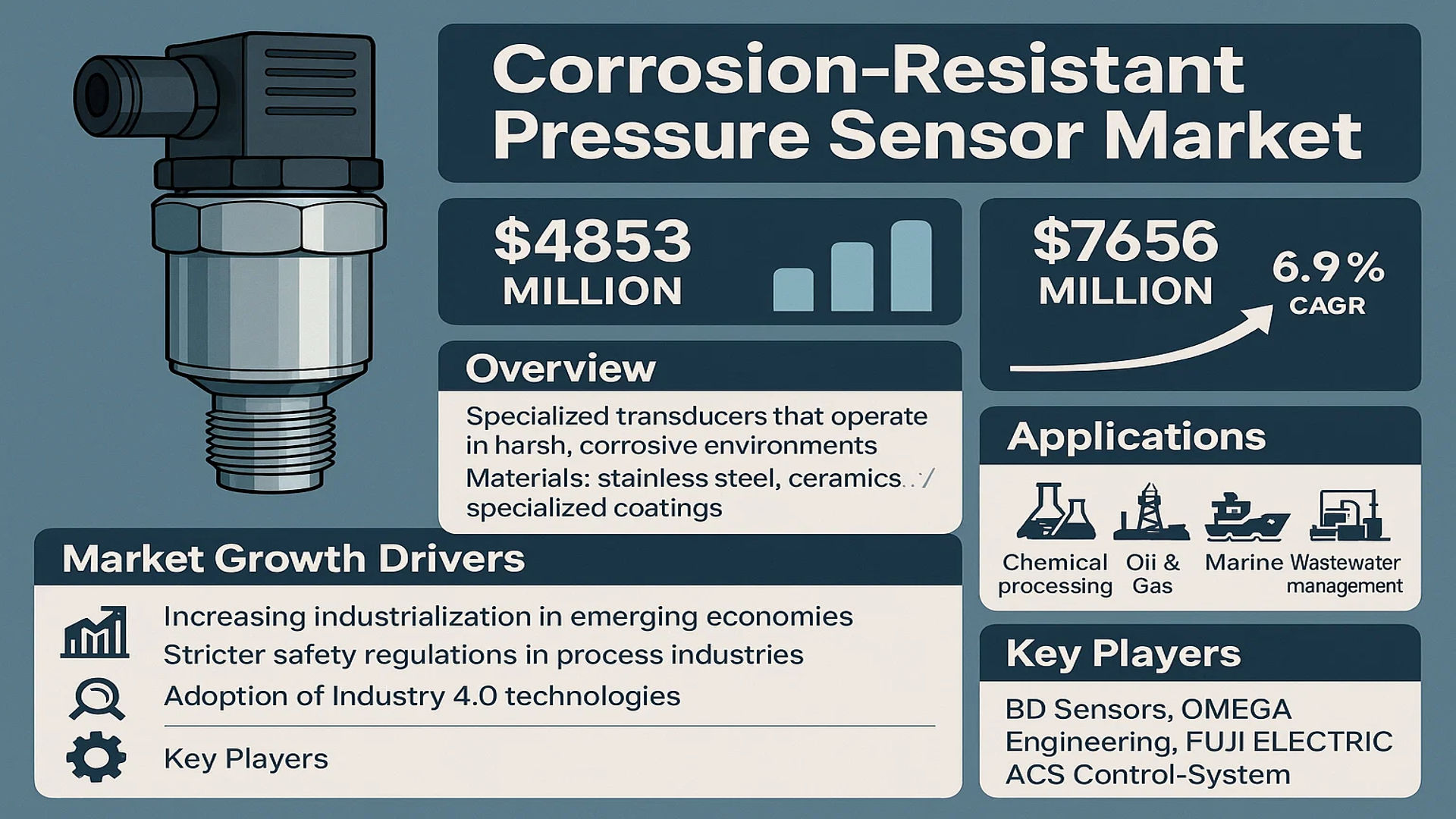
The global Corrosion-resistant Pressure Sensor Market was valued at 4853 million in 2024 and is projected to reach US$ 7656 million by 2032, at a CAGR of 6.9% during the forecast period.
Corrosion-resistant pressure sensors are specialized transducers designed to operate in harsh environments where exposure to corrosive media could degrade standard sensors. These devices convert mechanical pressure into electrical signals while maintaining structural integrity through materials like stainless steel, ceramics, or specialized coatings. Their applications span critical industries including chemical processing, oil & gas, marine, and wastewater management.
The market growth is driven by increasing industrialization in emerging economies, stricter safety regulations in process industries, and adoption of Industry 4.0 technologies requiring robust sensing solutions. Key players are expanding their portfolios through technological innovations – for instance, in 2023, BD Sensors launched a new series featuring titanium housings for extreme corrosion resistance. Other major manufacturers include OMEGA Engineering, FUJI ELECTRIC, and ACS Control-System, who collectively hold over 40% market share through diversified product offerings.
MARKET DYNAMICS
MARKET DRIVERS
Industry 4.0 and IoT Integration Fueling Market Expansion
The global push toward Industry 4.0 and IoT adoption is significantly driving demand for corrosion-resistant pressure sensors. These sensors play a critical role in smart manufacturing environments where they monitor equipment health in real-time, enabling predictive maintenance. In harsh industrial environments where chemicals and corrosive substances are present, standard sensors fail quickly, creating strong demand for specialized corrosion-resistant variants. The industrial IoT market, which exceeded $250 billion in 2023, has created substantial need for durable sensing solutions that can operate reliably in challenging conditions while transmitting critical data for process optimization.
Stringent Safety Regulations Accelerate Adoption Across Industries
Increasing safety standards in oil & gas, chemical processing, and power generation sectors are mandating the use of specialized pressure monitoring equipment. Regulatory bodies worldwide are implementing stricter equipment durability requirements, particularly for applications involving corrosive media. In the oil and gas sector alone, corrosion-related failures account for approximately 25% of all equipment failures, driving the need for more reliable sensor solutions. This has led to widespread adoption of corrosion-resistant pressure sensors that can withstand harsh operational environments while providing accurate measurements over extended periods.
Furthermore, the expansion of chemical processing capacity globally, particularly in emerging markets, continues to create new demand. The Asia-Pacific chemical industry is projected to grow at over 6% annually through 2030, requiring substantial investments in process instrumentation including corrosion-resistant sensors.
➤ For instance, recent updates to process safety management standards now require continuous pressure monitoring in critical chemical processes, with explicit recommendations for corrosion-resistant sensor deployment in aggressive media applications.
The convergence of regulatory requirements with technological advancements in sensor materials is creating a robust growth environment for market participants.
MARKET CHALLENGES
High Procurement Costs Create Adoption Barriers
While demand grows, the corrosion-resistant pressure sensor market faces significant cost-related challenges. These specialized sensors typically cost 40-60% more than standard pressure sensors due to advanced materials like Hastelloy, titanium, or specialized ceramic coatings required for corrosive environments. For small and medium enterprises operating in cost-sensitive markets, these premium prices can be prohibitive, delaying adoption even when technical requirements exist. The situation is particularly acute in developing regions where budget constraints often take priority over long-term equipment durability.
Other Key Challenges
Material Compatibility Complexities
Selecting appropriate materials for specific corrosive environments remains technically challenging. No single corrosion-resistant material performs ideally across all chemical exposures, requiring manufacturers to maintain extensive product variants. This complexity increases inventory costs and complicates the sensor selection process for end-users.
Installation and Maintenance Expertise Gap
Proper installation and maintenance of corrosion-resistant sensors requires specialized knowledge that is often in short supply. Field personnel unfamiliar with the nuances of exotic material handling can inadvertently damage sensors during installation or fail to identify early signs of degradation, compromising system reliability.
MARKET RESTRAINTS
Supply Chain Vulnerabilities Limit Market Potential
The corrosion-resistant pressure sensor market continues to face constraints from global supply chain disruptions affecting critical raw material availability. Many high-performance alloys used in sensor manufacturing originate from limited geographic sources, creating potential bottlenecks. Recent geopolitical tensions have exacerbated these vulnerabilities, with lead times for certain specialty metals extending to 6-9 months in some cases. This situation forces manufacturers to either maintain large inventories (increasing costs) or risk production delays.
Additionally, the complexity of coating technologies and precision manufacturing requirements for these sensors creates production capacity limitations. Establishing new manufacturing lines for corrosion-resistant sensors requires substantial capital investment and specialized equipment, making rapid capacity expansion challenging even in response to growing demand.
MARKET OPPORTUNITIES
Emerging Applications in Renewable Energy Create New Growth Avenues
The rapid expansion of renewable energy infrastructure presents significant opportunities for corrosion-resistant pressure sensor manufacturers. In concentrated solar power plants, geothermal energy systems, and offshore wind farms, equipment faces extreme environmental conditions requiring durable sensing solutions. The global renewable energy sector is projected to invest over $1.7 trillion annually by 2030, with substantial portions allocated to supporting infrastructure including pressure monitoring systems.
Advanced material science breakthroughs also create possibilities for next-generation sensors. Novel nanocomposite coatings and ceramic materials under development promise improved corrosion resistance at lower costs than traditional alloys. Early-stage testing indicates some new materials could reduce sensor costs by up to 30% while maintaining or improving performance in harsh environments.
Strategic partnerships between sensor manufacturers and material science innovators are accelerating these developments, positioning the industry for potential cost breakthroughs that could dramatically expand market accessibility.
CORROSION-RESISTANT PRESSURE SENSOR MARKET TRENDS
Industry 4.0 and Smart Manufacturing Drive Demand for Advanced Pressure Sensors
The Industry 4.0 revolution has significantly increased the adoption of corrosion-resistant pressure sensors in smart manufacturing environments. These sensors play a crucial role in real-time monitoring and predictive maintenance, enabling industries to optimize operational efficiency while minimizing downtime. With IoT integration, these sensors now facilitate remote diagnostics and automated process control, particularly in harsh industrial environments with corrosive media. Nearly 35% of industrial manufacturers have incorporated smart sensors into their operations, with pressure sensors accounting for a substantial portion due to their critical role in ensuring process reliability and safety. The ability of corrosion-resistant variants to withstand aggressive chemicals allows seamless deployment in oil & gas, chemical processing, and wastewater treatment applications.
Other Trends
Expansion in Automotive and Electric Vehicle Applications
The automotive sector continues to drive growth, particularly with the rising adoption of corrosion-resistant pressure sensors in electric vehicles (EVs) and advanced driver assistance systems (ADAS). These sensors ensure accurate pressure monitoring in battery thermal management and hydraulic braking systems. Traditional combustion engine vehicles also rely on these sensors for exhaust gas recirculation and fuel injection systems. With the global EV market projected to grow at a CAGR of over 22% through 2030, the need for durable, high-performance sensors compatible with corrosive coolants and refrigerants will rise sharply.
Medical and IoT Applications Create New Growth Opportunities
In the medical sector, corrosion-resistant pressure sensors are increasingly vital for diagnostic and therapeutic devices exposed to bodily fluids and sterilization processes. Applications include ventilators, dialysis machines, and minimally invasive surgical tools where sensor longevity is critical. Meanwhile, IoT adoption across smart cities and industrial automation is pushing demand for robust pressure sensors in environmental monitoring systems. These sensors must endure exposure to corrosive gases and liquids while maintaining precision. Wireless sensor networks for leak detection in chemical plants and pipelines further highlight the market’s expansion beyond traditional applications. Manufacturers are responding with thinner, more energy-efficient designs that integrate seamlessly with IoT platforms.
COMPETITIVE LANDSCAPE
Key Industry Players
Innovation and Durability Drive Competition in the Corrosion-resistant Pressure Sensor Market
The global corrosion-resistant pressure sensor market exhibits a moderately fragmented competitive landscape, dominated by established sensor manufacturers alongside emerging specialized players. OMEGA Engineering leads the market with an estimated 18% revenue share in 2024, owing to its comprehensive product range spanning industrial-grade to high-precision sensors for corrosive environments. Their patented stainless steel isolation technology gives them a competitive edge in harsh chemical processing applications.
BD Sensors and FUJI ELECTRIC collectively account for nearly 22% of the market, with strength in European and Asian markets respectively. BD Sensors has particularly strengthened its position through recent acquisitions in the oil & gas sector, while FUJI ELECTRIC’s ceramic sensor technology shows strong adoption in semiconductor manufacturing applications where chemical resistance is critical.
Strategic collaborations are reshaping market dynamics. Avnet recently partnered with three major IoT platform providers in 2023 to integrate corrosion-resistant sensors into smart factory solutions, reflecting the industry’s move toward networked monitoring systems. Meanwhile, Validyne has focused on niche medical applications, developing biocompatible sensors for drug delivery systems that require both pressure measurement and resistance to sterilization chemicals.
Emerging players like Soway Tech and Hoperf are gaining traction through cost-competitive offerings, particularly in developing Asian markets. However, these newer entrants face challenges matching the certification capabilities and global distribution networks of established leaders like OMEGA Engineering which holds over 200 industry certifications worldwide for its pressure sensor products.
List of Key Corrosion-resistant Pressure Sensor Companies Profiled
- OMEGA Engineering (U.S.)
- Avnet (U.S.)
- Validyne (U.S.)
- IntelliBee Sensor (China)
- FUJI ELECTRIC (Japan)
- Holykell (China)
- AEP transducers (Italy)
- Dracal Technologies (Canada)
- BD Sensors (Germany)
- ACS Control-System (Germany)
- Soway Tech (China)
- Hoperf (China)
Segment Analysis:
By Type
Digital Output Segment Leads Due to Increasing Demand in Smart Manufacturing and IoT Applications
The market is segmented based on type into:
- Simulation Output
- Digital Output
By Application
Industrial Equipment Segment Dominates Due to High Adoption in Process Automation and Harsh Environments
The market is segmented based on application into:
- Medical Devices
- Industrial Equipment
- IoT Devices
- Others
By End-Use Industry
Oil & Gas Sector Emerges as Key Adoption Area Due to Demanding Operational Conditions
The market is segmented based on end-use industry into:
- Oil & Gas
- Chemical Processing
- Water & Wastewater Treatment
- Food & Beverage
- Power Generation
- Others
By Sensing Technology
Piezoresistive Sensors Hold Significant Share Due to Their Robust Performance in Corrosive Environments
The market is segmented based on sensing technology into:
- Piezoresistive
- Capacitive
- Optical
- Others
Regional Analysis: Corrosion-resistant Pressure Sensor Market
Asia-Pacific
The Asia-Pacific region dominates the global corrosion-resistant pressure sensor market, accounting for over 40% of global demand in 2024. Rapid industrialization in China and India, coupled with expanding manufacturing sectors and infrastructure development, drives significant adoption. China’s ‘Made in China 2025’ initiative and India’s push for smart manufacturing under Industry 4.0 have accelerated demand for corrosion-resistant sensors in harsh industrial environments. Japan and South Korea contribute to technology advancements with their robust electronics and automotive sectors. The region’s growth is further propelled by increasing investments in oil & gas, chemical processing, and water treatment facilities where corrosion-resistant sensors are critical for operational safety and efficiency.
North America
North America represents the second-largest market, with the U.S. leading adoption due to stringent safety regulations in oil & gas, pharmaceuticals, and food processing industries. The region’s mature industrial sector emphasizes predictive maintenance and IoT integration, creating demand for advanced corrosion-resistant sensors. Canada’s growing energy sector and Mexico’s expanding manufacturing base contribute to regional growth. Recent infrastructure investments, including the Bipartisan Infrastructure Law’s allocation for industrial modernization, are expected to further boost market demand through 2032.
Europe
Europe maintains a strong position in the corrosion-resistant pressure sensor market, driven by strict industrial safety standards and environmental regulations. Germany leads in adoption due to its advanced manufacturing sector, particularly in automotive and chemical industries. The EU’s emphasis on industrial automation and Industry 4.0 initiatives supports demand for sensors capable of withstanding harsh conditions. Western European nations show higher adoption rates of premium corrosion-resistant sensors, while Eastern Europe presents growth opportunities as industrialization accelerates. The region’s focus on renewable energy and water treatment also creates new application areas for durable pressure sensing solutions.
South America
South America’s market is emerging, with Brazil and Argentina as primary demand centers. The region’s oil & gas and mining industries drive most corrosion-resistant sensor adoption, though economic volatility sometimes hampers investment. Limited local manufacturing capabilities result in dependence on imports, particularly for high-performance sensors. However, gradual industrial modernization and increasing foreign investment in energy and infrastructure projects suggest steady market growth potential over the forecast period.
Middle East & Africa
The Middle East, particularly GCC countries, shows strong demand from oil & gas operations where corrosion resistance is critical in harsh desert and marine environments. Africa’s market remains nascent but growing, with South Africa and Nigeria leading adoption in mining and energy sectors. While the region presents long-term opportunities, market expansion faces challenges from limited industrial diversification and inconsistent regulatory enforcement. Recent infrastructure developments and economic diversification efforts in countries like UAE and Saudi Arabia are creating new applications in water treatment and smart city projects.
Report Scope
This market research report provides a comprehensive analysis of the global and regional Corrosion-resistant Pressure Sensor markets, covering the forecast period 2024–2032. It offers detailed insights into market dynamics, technological advancements, competitive landscape, and key trends shaping the industry.
Key focus areas of the report include:
- Market Size & Forecast: Historical data and future projections for revenue, unit shipments, and market value across major regions and segments. The global market was valued at USD 4,853 million in 2024 and is projected to reach USD 7,656 million by 2032, growing at a CAGR of 6.9%.
- Segmentation Analysis: Detailed breakdown by product type (simulation output, digital output), application (medical devices, industrial equipment, IoT devices), and end-user industry to identify high-growth segments.
- Regional Outlook: Insights into market performance across North America, Europe, Asia-Pacific, Latin America, and Middle East & Africa, with Asia-Pacific accounting for 42% market share in 2024.
- Competitive Landscape: Profiles of 12 leading market participants including OMEGA Engineering, BD Sensors, and FUJI ELECTRIC, covering their product portfolios, market shares, and strategic developments.
- Technology Trends & Innovation: Assessment of IoT integration, Industry 4.0 applications, and advancements in sensor materials for harsh environments.
- Market Drivers & Restraints: Analysis of growth drivers like industrial automation and challenges including supply chain complexities and material costs.
- Stakeholder Analysis: Strategic insights for sensor manufacturers, OEMs, system integrators, and investors regarding emerging opportunities.
The research methodology combines primary interviews with industry experts and analysis of verified market data from authoritative sources to ensure reliability.
FREQUENTLY ASKED QUESTIONS:
What is the current market size of Global Corrosion-resistant Pressure Sensor Market?
->Corrosion-resistant Pressure Sensor Market was valued at 4853 million in 2024 and is projected to reach US$ 7656 million by 2032, at a CAGR of 6.9% during the forecast period.
Which key companies operate in this market?
-> Key players include OMEGA Engineering, Avnet, Validyne, FUJI ELECTRIC, BD Sensors, and ACS Control-System, among others.
What are the key growth drivers?
-> Growth is driven by industrial automation, IoT adoption, and demand from chemical processing and oil & gas industries.
Which region dominates the market?
-> Asia-Pacific holds the largest market share at 42%, followed by North America and Europe.
What are the emerging trends?
-> Emerging trends include wireless sensor networks, miniaturization, and advanced ceramic sensor materials for extreme environments.

Get Sample Report PDF for Exclusive Insights
Report Sample Includes
- Table of Contents
- List of Tables & Figures
- Charts, Research Methodology, and more...
 Download Sample Report PDF