Computer Projectors Market MARKET INSIGHTS
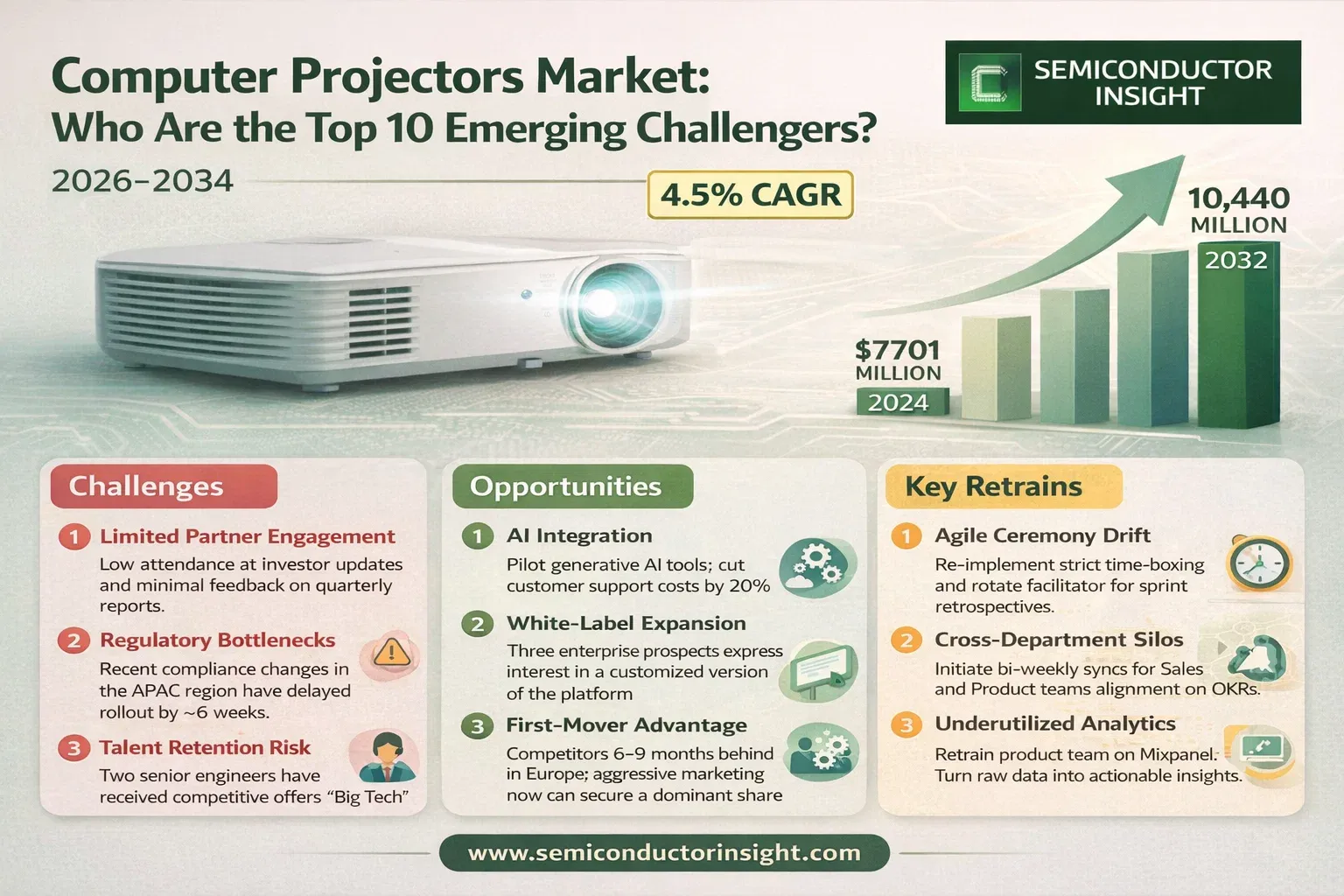
Global Computer Projectors Market was valued at 7701 million in 2024 and is projected to reach USD 10440 million by 2032, at a CAGR of 4.5% during the forecast period.
A computer projector is an optical device that projects images or moving pictures onto a surface, typically a projection screen. These devices are integral to modern presentation and entertainment systems, utilizing technologies such as Digital Light Processing (DLP), Liquid Crystal Display (LCD), and others to deliver high-quality visual output for various professional and personal applications.
The market is experiencing steady growth driven by increasing demand in corporate, educational, and home entertainment sectors. The shift towards hybrid work models and digital classrooms has significantly boosted the adoption of projectors for presentations and interactive learning. Furthermore, technological advancements, including higher resolution capabilities like 4K and 8K, laser light sources for longer lifespan, and smart features with connectivity options, are key factors propelling market expansion. Epson leads the competitive landscape with a 13% market share, followed by Qisda (BenQ) at 12% and Acer at 8%, highlighting a concentrated yet competitive vendor environment focused on innovation and global reach.
Computer Projectors Market MARKET DYNAMICS
Computer Projectors Market MARKET DRIVERS
Rising Demand for Hybrid Work Models and Remote Collaboration Solutions
Global shift toward hybrid work environments continues to fuel demand for computer projectors as organizations invest in advanced collaboration tools. With over 60% of businesses adopting permanent hybrid work policies, there has been a significant increase in procurement of high-quality projection systems for both office and remote settings. These systems enable seamless video conferencing, content sharing, and interactive presentations across distributed teams. The education sector has similarly accelerated adoption, with institutions worldwide implementing digital learning infrastructure that relies heavily on projection technology for both physical classrooms and remote instruction scenarios.
Technological Advancements in Display Resolution and Connectivity
Continuous innovation in projection technology is driving market expansion through improved image quality, enhanced connectivity, and greater energy efficiency. The transition from standard HD to 4K and even 8K resolution projectors has created substantial upgrade demand across commercial and consumer segments. Additionally, integration of smart features such as wireless connectivity, built-in streaming capabilities, and compatibility with IoT ecosystems has expanded projector functionality beyond traditional applications. Manufacturers are increasingly incorporating laser and LED light sources, which offer longer lifespans exceeding 20,000 hours and reduced maintenance requirements compared to traditional lamp-based systems.
Growing Home Entertainment and Gaming Applications
The home entertainment segment has emerged as a significant growth driver, particularly with the rising popularity of home theaters and large-screen gaming experiences. Consumer spending on home entertainment systems has increased substantially, with projection systems offering larger screen sizes at more affordable price points compared to flat-panel displays. The gaming sector specifically has driven demand for high-refresh-rate projectors with low input lag, catering to the needs of serious gamers seeking immersive experiences. This trend aligns with the overall growth in gaming hardware market, which has seen consistent expansion across global markets.
Furthermore, the increasing integration of voice control and smart home compatibility has made modern projectors more accessible to mainstream consumers, expanding the addressable market beyond traditional commercial applications.
Computer Projectors Market MARKET RESTRAINTS
Competition from Large Format Display Technologies
Computer Projectors Market faces significant pressure from alternative display technologies, particularly large-format LCD and OLED panels that continue to decline in price while improving in quality. The average selling price of large-screen televisions has decreased substantially over recent years, making them increasingly competitive with projection systems for both commercial and residential applications. Additionally, the emergence of direct-view LED walls and interactive flat panels in corporate and educational environments has created alternative solutions that offer superior brightness and ease of installation in well-lit environments where projectors traditionally struggle.
Economic Uncertainty and Reduced Corporate Spending
Global economic fluctuations and tightening corporate budgets have created headwinds for the projector market, particularly in the commercial segment where capital expenditure decisions are being scrutinized more carefully. Many organizations are extending refresh cycles for AV equipment or opting for lower-cost solutions, impacting premium projector sales. The education sector, another key market segment, faces budget constraints in numerous regions, leading to delayed or reduced technology investments. This economic pressure is particularly evident in price-sensitive emerging markets where cost considerations often override feature advantages.
Technical Limitations in Bright Environments
Despite technological improvements, projectors continue to face fundamental limitations in high-ambient-light environments that restrict their applicability in certain settings. The need for controlled lighting conditions or specialized screens remains a barrier to adoption in many commercial and educational scenarios where natural light is prevalent or desired. This limitation becomes particularly relevant in modern office designs that emphasize open spaces with abundant natural lighting, creating environments where projection systems cannot compete with direct-view displays in terms of visibility and image quality without significant additional investment in lighting control systems.
Computer Projectors Market MARKET CHALLENGES
Rapid Technological Obsolescence and Short Product Lifecycles
The projector industry faces the constant challenge of rapid technological evolution that accelerates product obsolescence and compresses development cycles. Manufacturers must continuously invest in research and development to keep pace with display technology advancements, connectivity standards, and user interface expectations. This creates significant pressure on profit margins as newer technologies often command premium pricing for limited periods before becoming standardized. The short product lifecycle also complicates inventory management and creates challenges in maintaining adequate after-sales support for older product lines.
Supply Chain Vulnerabilities and Component Shortages
Global supply chain disruptions have exposed vulnerabilities in the projector manufacturing ecosystem, particularly regarding specialized optical components, chipsets, and light sources. The industry’s reliance on specialized suppliers for key components creates production bottlenecks and cost pressures that impact both availability and pricing. These challenges are compounded by fluctuating demand patterns that make accurate forecasting difficult, leading to either inventory shortages or excess stock situations that affect overall market stability.
Environmental Regulations and Sustainability Requirements
Increasing environmental regulations regarding energy efficiency, hazardous materials, and end-of-life disposal present growing compliance challenges for projector manufacturers. New efficiency standards require redesign of power systems and thermal management, while restrictions on certain materials impact manufacturing processes and component selection. The industry must also address growing consumer and corporate demand for environmentally sustainable products, requiring investments in recyclable materials, energy-efficient designs, and reduced packaging waste.
Computer Projectors Market MARKET OPPORTUNITIES
Expansion in Emerging Markets and Digital Infrastructure Development
Significant growth opportunities exist in emerging economies where digital infrastructure development and educational modernization programs are driving increased projector adoption. Government initiatives aimed at digitizing classrooms and improving corporate training facilities create substantial market potential. These regions often present less saturation than developed markets and demonstrate higher growth rates in technology adoption as economic development accelerates educational and commercial investment in visual display solutions.
Integration with Augmented Reality and Interactive Technologies
The convergence of projection technology with augmented reality and interactive systems opens new application areas across multiple sectors. Advanced projection mapping, gesture control interfaces, and interactive projection systems are creating opportunities in retail, entertainment, and specialized industrial applications. These technologies enable immersive experiences that cannot be replicated by conventional displays, positioning projectors as enabling technology for next-generation visual applications rather than merely as display devices.
Development of Ultra-Short-Throw and Portable Solutions
Innovation in ultra-short-throw technology and compact portable projectors addresses previous limitations and expands market opportunities. Ultra-short-throw projectors minimize installation constraints and reduce shadows and glare, making them suitable for environments where traditional projectors were previously impractical. Meanwhile, advancements in portable and pico-projectors create new use cases for business travelers, outdoor entertainment, and mobile presentations. These product categories benefit from improvements in battery technology, wireless connectivity, and miniaturization of optical components.
Furthermore, the integration of artificial intelligence for automatic calibration, content optimization, and user behavior adaptation represents a frontier for product differentiation and value creation within the competitive projector landscape.
COMPUTER PROJECTORS MARKET TRENDS
Advancements in 4K and Laser Illumination Technologies to Emerge as a Trend in the Market
Global Computer Projectors Market is experiencing a significant transformation driven by technological advancements, particularly in 4K resolution and laser illumination. The demand for higher image quality and more reliable light sources has accelerated the shift away from traditional lamp-based projectors. Laser projectors, which offer a lifespan exceeding 20,000 hours and consistent brightness over time, now constitute a growing portion of the market. This is especially critical in high-utilization environments like education and corporate settings, where reduced maintenance and total cost of ownership are paramount. Furthermore, the integration of smart features, including wireless connectivity and built-in streaming apps, is blurring the lines between projectors and large-format displays, creating a new category of connected projection devices for both professional and home entertainment use.
Other Trends
Hybrid Work and Learning Environments
The permanent shift towards hybrid work and learning models is fundamentally reshaping demand patterns within the Computer Projectors Market. Organizations and educational institutions are investing in collaboration technologies to bridge the gap between in-person and remote participants. This has led to increased adoption of projectors equipped with advanced features like interactive capabilities, ultra-short-throw designs to minimize shadows and glare, and integrated video conferencing systems. The education sector, a traditional stronghold for projectors, is modernizing its classrooms with these interactive and connected solutions to facilitate a more engaging and flexible learning experience, ensuring the technology remains relevant in a digitally transformed environment.
Rising Demand for Large-Screen Home Entertainment
While the business and education segments are evolving, the home entertainment segment is witnessing a notable resurgence, fueled by the consumer desire for immersive, large-screen experiences. The proliferation of high-quality streaming content and next-generation gaming consoles has created a robust demand for projectors that can deliver cinematic experiences at a fraction of the cost of large-screen televisions, particularly at screen sizes above 100 inches. This trend is supported by the development of more consumer-friendly projectors featuring user-friendly setup, improved ambient light rejection (ALR) screens, and high dynamic range (HDR) compatibility. The home cinema segment is no longer niche but is becoming a mainstream consideration for consumers looking to upgrade their viewing experience.
COMPETITIVE LANDSCAPE
Key Industry Players
Market Leaders Leverage Technological Innovation and Strategic Positioning
Global Computer Projectors Market exhibits a semi-consolidated competitive structure, characterized by the presence of several established multinational corporations alongside numerous specialized and regional players. Intense competition is driven by continuous technological advancements, pricing strategies, and the expansion of application areas from traditional business and education settings into home entertainment and large-venue installations.
Epson stands as the unequivocal market leader, commanding a 13% global sales share in 2024. This dominance is largely attributable to its extensive and reliable portfolio of 3LCD projectors, which are renowned for their superior color accuracy and brightness, making them a preferred choice in education and corporate environments. The company’s robust global distribution network and strong brand reputation further cement its top position.
Following closely, Qisda Corporation (marketing under the BenQ brand) and Acer Inc. have secured significant market footholds with respective shares of approximately 12% and 8%. BenQ’s growth is powered by its strong focus on the high-growth home cinema and gaming projector segments, offering feature-rich DLP models with low input lag and high contrast ratios. Acer’s competitive strategy hinges on providing cost-effective and versatile projection solutions, effectively capturing price-sensitive segments across education and small businesses.
Other major players, including NEC Corporation, Optoma Technology, and Canon Inc., are aggressively strengthening their market positions. These companies are heavily investing in R&D to pioneer developments in laser and LED light source technology, 4K and 8K resolution, and interactive projection capabilities. Their growth initiatives are not limited to product innovation; they also encompass strategic geographical expansions, particularly in the high-growth markets of Asia-Pacific, and forging partnerships with software and content providers to create integrated AV solutions.
Meanwhile, specialized high-end manufacturers like BARCO, Christie Digital, and Sony are reinforcing their presence in the lucrative cinema and large venue projection market. These companies compete on performance and reliability rather than price, focusing on cutting-edge technology such as RGB laser projection and high-brightness solutions for simulation and large-scale events. Their strategy involves significant investments in R&D and cultivating long-term relationships with professional AV integrators and cinema chains.
List of Key Computer Projector Companies Profiled
- Epson (Japan)
- Qisda(BenQ) (Taiwan)
- Acer Inc. (Taiwan)
- NEC Corporation (Japan)
- Optoma Technology (Taiwan)
- Canon Inc. (Japan)
- Sharp Corporation (Japan)
- Panasonic Corporation (Japan)
- Vivitek (Taiwan)
- Sony Corporation (Japan)
- ViewSonic Corporation (U.S.)
- LG Electronics (South Korea)
- Dell Technologies (U.S.)
- BARCO (Belgium)
- Infocus (U.S.)
- Christie Digital Systems (Canada)
- Digital Projection (U.K.)
- Costar Video Systems (China)
Segment Analysis:
By Technology
DLP Technology Segment Holds Significant Market Share Due to Superior Image Quality and Reliability
The market is segmented based on technology into:
- DLP (Digital Light Processing)
- Subtypes: 1-Chip DLP, 3-Chip DLP
- LCD (Liquid Crystal Display)
- Subtypes: 3LCD, Polysilicon LCD
- LCoS (Liquid Crystal on Silicon)
- Laser
- Others
By Brightness
High-Brightness Projectors Lead in Professional and Large Venue Applications
The market is segmented based on brightness into:
- Below 3000 Lumens
- 3000 to 5000 Lumens
- 5000 to 10000 Lumens
- Above 10000 Lumens
By Resolution
Full HD and 4K Resolution Segments Drive Market Growth with Increasing Demand for High-Definition Content
The market is segmented based on resolution into:
- XGA (1024 x 768)
- WXGA (1280 x 800)
- Full HD (1920 x 1080)
- 4K UHD (3840 x 2160)
- 8K UHD (7680 x 4320)
- Others
By Application
Business and Education Applications Dominate the Market Owing to Widespread Adoption in Corporate and Academic Environments
The market is segmented based on application into:
- Business
- Education
- Home Entertainment
- Cinema
- Large Venue and Events
- Others
Regional Analysis: Computer Projectors Market
Asia-Pacific
The Asia-Pacific region dominates the global Computer Projectors Market, accounting for the largest revenue share due to extensive manufacturing capabilities and massive consumer demand. China serves as both a production hub and a leading consumer market, driven by its vast education sector and growing corporate infrastructure. India’s market is expanding rapidly, supported by government initiatives like the Digital India campaign, which promotes technology adoption in classrooms and businesses. Japan and South Korea are mature markets characterized by high demand for advanced, high-resolution projectors in both professional and home entertainment applications. While cost sensitivity remains a factor in some segments, there is a clear trend toward premium, feature-rich models, particularly laser and 4K projectors, as disposable incomes rise and urbanization accelerates.
North America
North America represents a highly developed and technologically advanced market for computer projectors, with a strong emphasis on innovation and quality. The United States is the largest contributor, driven by significant investments in enterprise digital transformation, a robust education technology sector, and a thriving home cinema culture. High adoption rates of ultra-short-throw and laser projectors are notable, particularly in the home entertainment segment, where consumers seek immersive viewing experiences. Corporate upgrades to hybrid meeting rooms and digital signage solutions further fuel demand. While the market is saturated in some areas, replacement cycles and technological advancements, such as brighter lumens and enhanced connectivity, continue to drive steady growth.
Europe
Europe is a significant and stable market for computer projectors, characterized by stringent quality standards and a strong focus on sustainability and energy efficiency. Germany, the UK, and France lead in adoption, supported by well-funded education systems and corporate sectors that prioritize modern presentation tools. The market shows a pronounced shift toward eco-friendly projectors with lower power consumption and longer lamp life, aligning with the EU’s environmental directives. Additionally, the region’s strong cinema industry demands high-performance digital projectors for both large venues and independent theaters. However, market growth faces moderation due to economic uncertainties and the maturity of several national markets, pushing vendors to compete on innovation rather than volume.
South America
The Computer Projectors Market in South America is emerging, with growth potential tied to economic development and digital infrastructure expansion. Brazil and Argentina are the key markets, where increasing investments in education technology and small to medium-sized businesses are driving demand. However, the market is price-sensitive, with a higher prevalence of entry-level and mid-range LCD projectors. Economic volatility and currency fluctuations often hinder the adoption of premium models and slow down large-scale procurement projects. Nonetheless, as internet penetration improves and remote work culture gains traction, demand for reliable projection solutions is expected to rise gradually over the coming years.
Middle East & Africa
The Middle East & Africa region presents a mixed landscape for computer projectors, with growth concentrated in more economically stable nations. The UAE and Saudi Arabia lead demand, driven by luxury home cinema setups, high-end corporate boardrooms, and large-scale installations in hotels and entertainment venues. Government initiatives aimed at modernizing education and public sector infrastructure also contribute to market growth. In contrast, other parts of the region face challenges such as limited purchasing power, inadequate infrastructure, and political instability, which restrain widespread adoption. Nonetheless, the long-term outlook remains positive as digitalization efforts gain momentum and economic conditions improve in key markets.
Report Scope
This market research report provides a comprehensive analysis of the global Computer Projectors market, covering the forecast period 2025–2032. It offers detailed insights into market dynamics, technological advancements, competitive landscape, and key trends shaping the industry.
Key focus areas of the report include:
- Market Size & Forecast: Historical data and future projections for revenue, unit shipments, and market value across major regions and segments.
- Segmentation Analysis: Detailed breakdown by product type, technology, application, and end-user industry to identify high-growth segments and investment opportunities.
- Regional Outlook: Insights into market performance across North America, Europe, Asia-Pacific, Latin America, and the Middle East & Africa, including country-level analysis where relevant.
- Competitive Landscape: Profiles of leading market participants, including their product offerings, R&D focus, manufacturing capacity, pricing strategies, and recent developments such as mergers, acquisitions, and partnerships.
- Technology Trends & Innovation: Assessment of emerging technologies, integration of AI/IoT, semiconductor design trends, fabrication techniques, and evolving industry standards.
- Market Drivers & Restraints: Evaluation of factors driving market growth along with challenges, supply chain constraints, regulatory issues, and market-entry barriers.
- Stakeholder Analysis: Insights for component suppliers, OEMs, system integrators, investors, and policymakers regarding the evolving ecosystem and strategic opportunities.
Primary and secondary research methods are employed, including interviews with industry experts, data from verified sources, and real-time market intelligence to ensure the accuracy and reliability of the insights presented.
FREQUENTLY ASKED QUESTIONS:
What is the current market size of Global Computer Projectors Market?
-> Computer Projectors Market was valued at 7701 million in 2024 and is projected to reach USD 10440 million by 2032, at a CAGR of 4.5% during the forecast period.
Which key companies operate in Global Computer Projectors Market?
-> Key players include Epson, Qisda(BenQ), Acer, NEC, Optoma, Canon, Sharp, Panasonic, Vivitek, Sony, ViewSonic, LG, Dell, BARCO, Infocus, Christie, Digital Projection, and Costar, among others.
What are the key growth drivers?
-> Key growth drivers include increased demand for home entertainment systems, expansion of digital education infrastructure, corporate adoption of advanced presentation technologies, and growth in cinema digitization.
Which region dominates the market?
-> Asia-Pacific is the fastest-growing region, while North America remains a dominant market due to technological adoption and high corporate spending.
What are the emerging trends?
-> Emerging trends include 4K and 8K ultra-high-definition projectors, laser projection technology, smart projectors with IoT connectivity, and portable mini-projectors for mobile use.
Get Sample Report PDF for Exclusive Insights
Report Sample Includes
- Table of Contents
- List of Tables & Figures
- Charts, Research Methodology, and more...
 Download Sample Report PDF