Market Insights
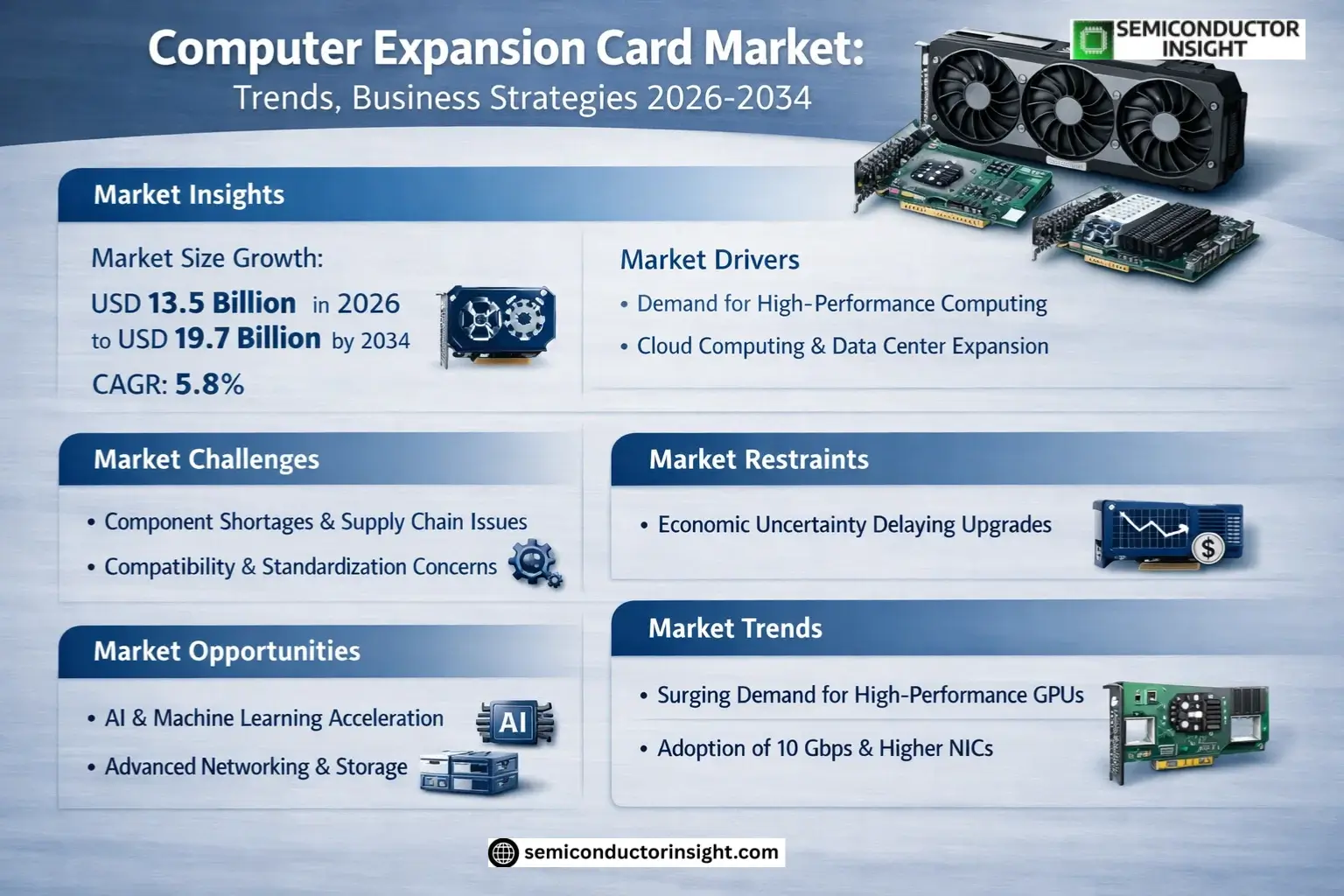
Global Computer Expansion Card Market size was valued at USD 12.8 billion in 2025. The market is projected to grow from USD 13.5 billion in 2026 to USD 19.7 billion by 2034, exhibiting a CAGR of 5.8% during the forecast period.
Computer expansion cards are printed circuit boards that enhance a computer’s functionality by adding specialized hardware capabilities such as graphics processing, networking, or storage control. These cards connect to the motherboard via expansion slots like PCIe (Peripheral Component Interconnect Express) and are essential for upgrading system performance without replacing the entire machine. Common types include graphics cards (GPUs), network interface cards (NICs), sound cards, and storage controllers.
The market is driven by increasing demand for high-performance computing in gaming, AI applications, and data centers, alongside rapid advancements in PCIe standards and GPU technologies. However, supply chain constraints and rising component costs pose challenges. Key players like NVIDIA, AMD, and Intel continue to innovate with products such as ray-tracing GPUs and AI accelerators, further fueling market expansion.
MARKET DRIVERS
Growing Demand for High-Performance Computing
Computer Expansion Card Market is experiencing significant growth due to increasing demand for high-performance computing solutions. Businesses and gamers alike are investing in advanced GPUs, network interface cards, and storage expansion cards to enhance system capabilities. Global shift toward data-intensive applications is accelerating adoption rates by over 12% annually.
Cloud Computing and Data Center Expansion
Rapid expansion of cloud services and data centers has created substantial demand for specialized Computer Expansion Cards. Enterprise-grade solutions for networking, RAID controllers, and FPGA accelerators are witnessing 18% year-over-year growth as hyperscale providers modernize infrastructure.
Emerging technologies like AI acceleration and edge computing are creating new use cases for specialized expansion hardware, particularly in professional workstation segments.
MARKET CHALLENGES
Component Shortages and Supply Chain Disruptions
Computer Expansion Card Market faces persistent challenges from global semiconductor shortages, particularly for high-end GPUs and specialized controllers. Lead times for certain components have extended to 6-9 months, impacting product availability across all major regions.
Other Challenges
Compatibility and Standardization Issues
Ongoing transitions between PCIe generations and form factor standards create compatibility concerns for both consumers and OEMs, requiring careful product selection and system planning.
MARKET RESTRAINTS
Economic Uncertainty Impacting Upgrade Cycles
Global economic conditions are causing some enterprises and consumers to delay PC upgrades and expansion card purchases. Recent market data shows a 7% reduction in discretionary spending on computer hardware upgrades compared to previous years, particularly in price-sensitive segments.
MARKET OPPORTUNITIES
Artificial Intelligence and Machine Learning Acceleration
Specialized AI expansion cards and Tensor Core accelerators represent the fastest-growing segment of the Computer Expansion Card Market, projected to grow at 28% CAGR through 2026. Demand is particularly strong from research institutions and data science applications requiring dedicated processing power.
Computer Expansion Card Market Trends
Accelerated Demand for High-Performance Expansion Cards
Computer Expansion Card Market is experiencing robust growth driven by increasing demand for high-speed data processing across industries. Network interface cards capable of 10 Gbps and higher throughput are becoming standard in enterprise environments, while gaming and creative professionals continue pushing the adoption of advanced graphics cards with real-time ray tracing capabilities.
Other Trends
Vertical-Specific Product Customization
Manufacturers are developing application-specific expansion cards, with financial institutions adopting low-latency network cards for high-frequency trading and healthcare providers implementing specialized storage controller cards for medical imaging systems. This trend reflects the broader customization needs across different industry segments.
Technology Transition in Interface Standards
Computer Expansion Card Market is undergoing a significant shift from legacy PCI standards to PCIe 4.0 and emerging PCIe 5.0 interfaces. This transition enables higher bandwidth for data-intensive applications, with graphics cards and NVMe storage controllers being primary beneficiaries. The standardization of USB4 connectivity is also influencing peripheral expansion card designs.
Integration of AI Acceleration Features
Leading manufacturers are incorporating dedicated AI processors in graphics cards and specialized expansion cards to support machine learning workloads at the edge. This trend aligns with growing enterprise adoption of AI applications across various sectors.
Regional Market Developments
Asia-Pacific has emerged as the fastest-growing region for Computer Expansion Card adoption, driven by data center expansions and gaming industry growth. North America maintains strong demand for premium-grade expansion cards, particularly in the financial and media sectors. European markets show increased interest in energy-efficient expansion card solutions.
COMPETITIVE LANDSCAPE
Key Industry Players
Global Computer Expansion Card Market Dominated by Semiconductor and Component Giants
Computer Expansion Card Market is consolidated among established semiconductor manufacturers and specialized component suppliers. NVIDIA and AMD dominate the graphics card segment with their GPU technologies, while Intel maintains strong positions in network interface and storage controller cards through its enterprise solutions. Asia-based manufacturers like ASUS, Gigabyte, and Micro-Star International control significant market share through motherboard-integrated expansion solutions.
Niche players like Creative Technology and TP-Link have carved specialized positions in sound cards and networking expansion cards respectively. Storage-focused companies such as Samsung and Kingston leverage their NAND flash expertise in storage expansion products. Emerging Chinese manufacturers like Lanqi Technology are gaining traction in cost-sensitive markets through competitively priced offerings.
List of Key Computer Expansion Card Companies Profiled
- NVIDIA
- Advanced Micro Devices (AMD)
- Intel
- ASUS
- Gigabyte Technology
- Micro-Star International
- Samsung
- Kingston
- Western Digital (SanDisk)
- Creative Technology
- TP-Link
- Broadcom
- ASRock Industrial
- CONTEC
- Lanqi Technolog
Segment Analysis:
| Segment Category | Sub-Segments | Key Insights |
| By Type |
|
Graphics Cards dominate due to escalating demand in gaming and professional visualization.
|
| By Application |
|
Gaming Industry remains the primary growth driver with evolving requirements.
|
| By End User |
|
Data Centers show fastest adoption rates for expansion cards.
|
| By Technology |
|
PCI Express maintains technology leadership with continuous upgrades.
|
| By Performance Tier |
|
High-End Segment drives premium market growth and innovation.
|
Regional Analysis: Computer Expansion Card Market
North America
U.S. corporations lead in upgrading server farms with the latest PCIe expansion cards, particularly for virtualization and cloud computing applications. Financial institutions and tech firms drive demand for high-throughput network cards and storage accelerators.
The enthusiast PC market in North America sustains premium GPU demand, with hardware upgrades tracking game development cycles. Streaming professionals and 3D animators utilize high-end expansion cards for real-time rendering workloads.
Research institutions and tech companies deploy specialized expansion cards for machine learning applications. Universities with computing programs maintain consistent procurement channels for FPGA and accelerator card suppliers.
Proximity to major chip designers and assembly facilities ensures faster adoption of new expansion card technologies. Distribution networks efficiently serve both B2B and consumer markets across the continent.
Europe
Western European nations show strong demand for industrial-grade expansion cards in manufacturing automation systems. Germany leads in industrial PC expansions while UK data centers upgrade networking infrastructure. Eastern Europe emerges as cost-effective development hub for specialized expansion card firmware. EU regulations drive adoption of energy-efficient designs while maintaining performance standards across graphics and storage card segments.
Asia-Pacific
China dominates regional production of budget and mid-range expansion cards supplemented by Taiwan’s high-end offerings. India shows growing enterprise adoption while South Korea leads in memory card innovations. Japanese manufacturers focus on reliability-centered expansion solutions for industrial applications. Southeast Asian gaming cafes stimulate volume GPU purchases.
South America
Brazil accounts for majority regional demand focused on cost-effective expansion solutions. Currency fluctuations impact premium card adoption while local assembly operations gain traction. Mining operations drive specialized industrial expansion card requirements across the Andean region.
Middle East & Africa
GCC countries prioritize high-end expansion cards for oil/gas data analysis and smart city projects. South Africa serves as regional hub for enterprise IT expansions. North African nations show growing demand for telecom infrastructure-related expansion solutions with increasing data center investments.
Report Scope
This market research report provides a comprehensive analysis of the Computer Expansion Card Market , covering the forecast period 2025–2034. It offers detailed insights into market dynamics, technological advancements, competitive landscape, and key trends shaping the industry.
Key focus areas of the report include:
- Market Overview: The report begins with an overview outlining its current market scenario, key growth indicators, and industry transformation drivers. It discusses macroeconomic factors, demand–supply balance, regulatory landscape, and the strategic role of expansion cards in powering advancements across industries such as gaming, graphics design, finance, telecommunications, and medical care.
- Market Size & Forecast: Historical data and future projections for revenue, unit shipments, and market value across major regions and segments.
- Segmentation Analysis: Detailed breakdown by product type, including Network Interface Cards, Graphics Cards, Sound Cards, Storage Controller Cards, and Other types to identify high-growth segments and investment opportunities.
- Regional Insights: Insights into market performance across North America, Europe, Asia-Pacific, Latin America, and the Middle East & Africa, including country-level analysis where relevant.
- Competitive Landscape: Profiles of leading market participants, including their product offerings, R&D focus, manufacturing capacity, pricing strategies, and recent developments such as mergers, acquisitions, and partnerships.
- Technology Trends & Innovation: Assessment of emerging technologies, integration of AI/IoT, product upgrades, and evolving industry standards for expansion cards.
- Market Drivers & Restraints: Evaluation of factors driving market growth along with challenges, supply chain constraints, regulatory issues, and market-entry barriers.
- Stakeholder Insights: Insights for component suppliers, OEMs, system integrators, investors, and policymakers regarding the evolving ecosystem and strategic opportunities.
Primary and secondary research methods are employed, including interviews with industry experts, data from verified sources, and real-time market intelligence to ensure the accuracy and reliability of the insights presented.
FREQUENTLY ASKED QUESTIONS:
What is the current market size of Computer Expansion Card Market?
-> Computer Expansion Card Market size was valued at USD 12.8 billion in 2025. The market is projected to grow from USD 13.5 billion in 2026 to USD 19.7 billion by 2034, exhibiting a CAGR of 5.8% during the forecast period.
Which key companies operate in Computer Expansion Card Market?
-> Key players include SANDISK, Samsung, Kingston, ASRock Industrial, ASUS, NVIDIA, AMD, Intel, Creative Technology, TP-Link, Broadcom, and Micro-Star International, among others.
What are the key growth drivers?
-> Key growth drivers include growth of the digital economy, increasing demand from gaming and graphic design industries, advances in IoT and cloud computing technologies, and continuous product upgrades.
Which region dominates the market?
-> Asia is currently a dominant market, with China, Japan, and South Korea leading in adoption.
What are the emerging trends?
-> Emerging trends include higher speed network cards (10 Gbps+), advanced gaming graphics cards, integration with AI technologies, and next-gen memory solutions like NAND flash cards.
Get Sample Report PDF for Exclusive Insights
Report Sample Includes
- Table of Contents
- List of Tables & Figures
- Charts, Research Methodology, and more...
 Download Sample Report PDF