Market Insights
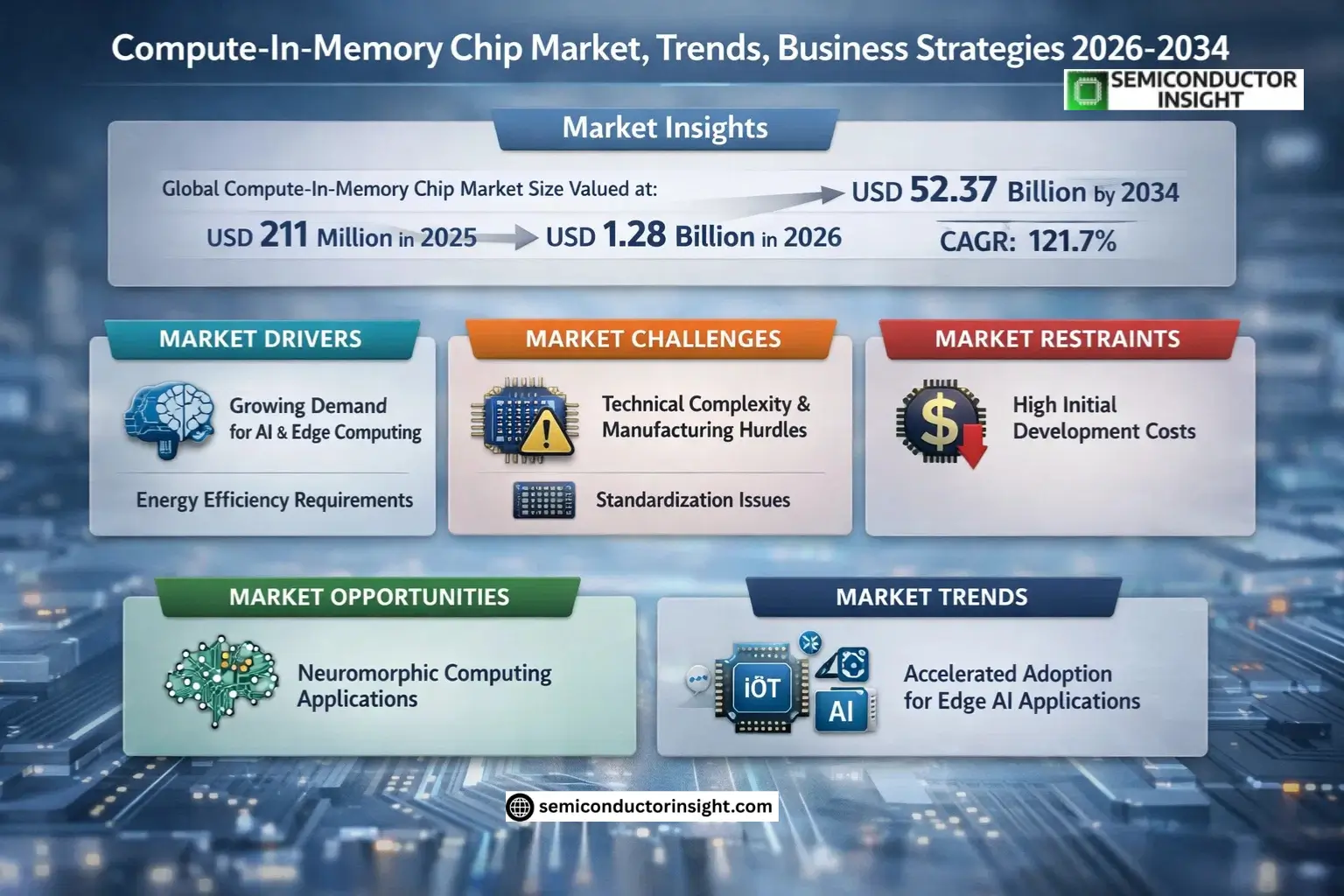
Global Compute-In-Memory Chip Market size was valued at USD 211 million in 2025. The market is projected to grow from USD 1.28 billion in 2026 to USD 52.37 billion by 2034, exhibiting a CAGR of 121.7% during the forecast period.
Compute-In-Memory (CIM) chips are advanced integrated circuits designed to perform computations directly within or adjacent to memory arrays, eliminating the need for data transfer between separate processing and storage units. These chips optimize energy efficiency and reduce latency by executing operations such as multiply-accumulate where data resides, making them ideal for AI inference, neural networks, and edge computing applications.
The market is experiencing exponential growth due to increasing demand for energy-efficient AI hardware solutions and advancements in edge computing technologies. Key players like Samsung, SK Hynix, and Syntiant are driving innovation through collaborations with foundries and research institutions, accelerating commercialization efforts despite challenges related to precision control and software ecosystem maturity.
MARKET DRIVERS
Growing Demand for AI and Edge Computing
Compute-In-Memory Chip Market is experiencing rapid growth due to increasing adoption of AI applications and edge computing solutions. These chips significantly reduce latency and power consumption by processing data directly in memory, making them ideal for real-time AI inference. Global AI chip market is projected to exceed USD 80 billion by 2025, with compute-in-memory solutions capturing a growing share.
Energy Efficiency Requirements
Traditional computing architectures face limitations in power efficiency for data-intensive workloads. Compute-in-memory chips can reduce energy consumption by up to 90% compared to conventional systems, driving adoption in power-sensitive applications like mobile devices and IoT endpoints. This efficiency is particularly valuable as global data traffic continues to grow exponentially.
The technology’s ability to process large datasets without transferring them between memory and processing units makes it particularly valuable for machine learning workloads, where data movement is typically the primary energy consumer.
MARKET CHALLENGES
Technical Complexity and Manufacturing Hurdles
Developing compute-in-memory chips requires advanced 3D stacking technologies and novel materials, presenting significant engineering challenges. Yield rates for these advanced chips remain below 60% at leading foundries, impacting production costs. The integration of memory and logic components also increases design complexity and verification time.
Other Challenges
Standardization and Ecosystem Development
The absence of industry-wide standards for compute-in-memory architectures creates interoperability issues between different vendors’ solutions. Software frameworks and toolchains for these chips are still in early development stages, requiring substantial investment.
MARKET RESTRAINTS
High Initial Development Costs
Compute-In-Memory Chip Market faces constraints from prohibitive R&D expenses, with new chip designs requiring investments exceeding USD 50 million per project. These costs limit market participation to large semiconductor firms and well-funded startups, slowing widespread adoption in cost-sensitive applications.
MARKET OPPORTUNITIES
Neuromorphic Computing Applications
Compute-In-Memory Chip Market is poised for expansion in neuromorphic computing systems that mimic biological neural networks. These applications require the massive parallelism and energy efficiency offered by compute-in-memory architectures, with potential use cases ranging from advanced robotics to brain-computer interfaces.
Compute-In-Memory Chip Market Trends
Accelerated Adoption for Edge AI Applications
Compute-In-Memory Chip Market is experiencing rapid growth due to increasing demand for energy-efficient edge AI solutions. By performing computations directly within memory arrays, CIM chips reduce data movement and power consumption significantly compared to traditional architectures. This makes them ideal for real-time inference tasks in IoT devices, smartphones, and wearable technologies where low latency and power efficiency are critical.
Other Trends
Emerging Architectures Addressing Precision Challenges
Leading manufacturers are developing hybrid CIM approaches combining DRAM and SRAM technologies to balance performance with precision requirements. Advanced memory technologies like ReRAM and MRAM are being tested to overcome process variability issues, with research institutions and fabless semiconductor companies collaborating on novel cell designs.
Vertical-Specific Solutions Gaining Traction
The market is seeing increasing specialization, with tailored CIM solutions emerging for automotive ADAS, industrial automation, and medical imaging. These domain-specific implementations focus on optimizing for particular neural network models and data patterns while addressing sector-specific reliability and safety requirements.
Foundry Partnerships Driving Commercialization
Major memory manufacturers are forming strategic alliances with CIM startups to accelerate production scaling. These collaborations aim to solve challenges in volume manufacturing, including thermal management issues and yield optimization for novel memory-compute architectures.
Software Ecosystem Development
While hardware innovation progresses, the industry recognizes the need for mature compiler tools and software frameworks. Several open-source initiatives are underway to create standardized programming models that can abstract the underlying CIM architecture complexities for AI developers.
COMPETITIVE LANDSCAPE
Key Industry Players
Emerging Leaders and Innovators in Compute-In-Memory Chip Technology
Compute-In-Memory Chip Market is currently dominated by specialized startups and semiconductor innovators, with Syntiant leading the pack through its ultra-low-power neural processing units for edge AI applications. Myhtic has gained significant traction with its analog AI processors, while Graphcore stands out for its IPU architecture tailored for machine learning workloads. The market exhibits a strong presence of Asia-Pacific players like Hangzhou Zhicun (Witmem) Technology and Shenzhen Reexen Technology, reflecting the region’s focus on AI hardware acceleration.
Memory giants Samsung and SK Hynix are making strategic investments in CIM designs to integrate processing capabilities directly into their DRAM products. Emerging European players like Axelera AI and D-Matrix are developing novel architectures for datacenter applications, while Beijing-based firms such as Beijing Pingxin Technology and Beijing Houmo Technology are advancing China’s domestic CIM capabilities. The competitive landscape remains fluid with ongoing R&D collaborations between fabless chip designers, foundries, and memory manufacturers to overcome technical challenges in precision control and manufacturing variability.
List of Key Compute-In-Memory Chip Companies Profiled
- Syntiant
- Hangzhou Zhicun (Witmem) Technology
- Myhtic
- Shenzhen Reexen Technology
- Beijing Pingxin Technology
- Graphcore
- Axelera AI
- AistarTek
- Suzhou Yizhu Intelligent Technology
- Beijing Houmo Technology
- Samsung
- SK Hynix
- D-Matrix
- EnCharge AI
Segment Analysis:
| Segment Category | Sub-Segments | Key Insights |
| By Type |
|
SRAM-based CIM chips are emerging as preferred solutions due to:
|
| By Application |
|
Edge AI Devices represent the most promising near-term opportunity:
|
| By End User |
|
Consumer Electronics are driving early adoption:
|
| By Architecture |
|
True Compute-in-Memory architecture shows strongest potential:
|
| By Technology Readiness |
|
Pilot Deployments are accelerating market validation:
|
Regional Analysis: Compute-In-Memory Chip Market
The U.S. leads in Compute-In-Memory Chip research with DARPA-funded projects and university research centers pioneering novel architectures. MIT and Stanford are developing energy-efficient designs that combine processing and memory functions.
Major cloud service providers and tech giants in North America are early adopters of Compute-In-Memory technologies to enhance AI workloads. Companies are integrating these chips into server farms and IoT devices for faster processing.
Silicon Valley hosts numerous startups specializing in Compute-In-Memory architectures, attracting substantial venture capital. These startups focus on niche applications from autonomous vehicles to biomedical computing.
Federal programs support Compute-In-Memory Chip development through grants and public-private partnerships. The U.S. CHIPS Act includes provisions for next-generation semiconductor technologies that could benefit this market.
Europe
Europe is emerging as a significant player in the Compute-In-Memory Chip Market with its strong semiconductor industry and focus on energy-efficient computing. Countries like Germany, France, and the UK are investing heavily in neuromorphic computing research through Horizon Europe programs. The region’s automotive and industrial sectors are driving demand for specialized Compute-In-Memory solutions for embedded systems. European research institutes are collaborating with Asian chip manufacturers to develop innovative architectures that reduce power consumption while maintaining performance.
Asia-Pacific
The Asia-Pacific region witnesses rapid growth in Compute-In-Memory Chip adoption, led by semiconductor powerhouses like South Korea, Taiwan, and Japan. These countries leverage their established chip fabrication ecosystems to develop advanced Compute-In-Memory solutions. China’s substantial investments in domestic semiconductor capabilities include specific focus on memory-centric computing architectures. The region benefits from increasing demand for AI accelerators and data center solutions, with local manufacturers responding with customized Compute-In-Memory Chip designs.
Middle East & Africa
While still in early stages, the Middle East is showing growing interest in Compute-In-Memory technologies through smart city initiatives and digital transformation programs. Gulf nations are investing in high-performance computing infrastructure that could incorporate these advanced chips. African tech hubs like South Africa and Kenya are beginning to explore applications in fintech and telecommunications, though adoption remains limited compared to other regions.
South America
South America presents emerging opportunities in the Compute-In-Memory Chip Market, primarily in Brazil and Argentina where data center expansion is driving demand. While local semiconductor manufacturing is limited, regional tech companies are collaborating with global partners to implement these solutions. Research institutions are exploring applications in agricultural technology and environmental monitoring systems that could benefit from Compute-In-Memory architectures.
Report Scope
This market research report provides a comprehensive analysis of the Compute-In-Memory Chip Market, covering the forecast period 2025–2032. It offers detailed insights into market dynamics, technological advancements, competitive landscape, and key trends shaping the industry.
Key focus areas of the report include:
- Market Overview: The report begins with an overview outlining its current market scenario, key growth indicators, and industry transformation drivers. It discusses macroeconomic factors, demand–supply balance, regulatory landscape, and the strategic role of semiconductors in powering advancements across industries such as automotive, telecommunications, consumer electronics, and industrial automation.
- Market Size & Forecast: Historical data and future projections for revenue, unit shipments, and market value across major regions and segments.
- Segmentation Analysis: Detailed breakdown by product type, technology, application, and end-user industry to identify high-growth segments and investment opportunities.
- Regional Insights: Insights into market performance across North America, Europe, Asia-Pacific, Latin America, and the Middle East & Africa, including country-level analysis where relevant.
- Competitive Landscape: Profiles of leading market participants, including their product offerings, R&D focus, manufacturing capacity, pricing strategies, and recent developments such as mergers, acquisitions, and partnerships.
- Technology Trends & Innovation: Assessment of emerging technologies, integration of AI/IoT, semiconductor design trends, fabrication techniques, and evolving industry standards.
- Market Drivers & Restraints: Evaluation of factors driving market growth along with challenges, supply chain constraints, regulatory issues, and market-entry barriers.
- Stakeholder Insights: Insights for component suppliers, OEMs, system integrators, investors, and policymakers regarding the evolving ecosystem and strategic opportunities.
Primary and secondary research methods are employed, including interviews with industry experts, data from verified sources, and real-time market intelligence to ensure the accuracy and reliability of the insights presented.
FREQUENTLY ASKED QUESTIONS:
What is the current market size of Compute-In-Memory Chip Market?
-> Compute-In-Memory Chip Market size was valued at USD 211 million in 2025. The market is projected to grow from USD 1.28 billion in 2026 to USD 52.37 billion by 2034, exhibiting a CAGR of 121.7% during the forecast period.
Which key companies operate in Compute-In-Memory Chip Market?
-> Key players include Syntiant, Hangzhou Zhicun (Witmem) Technology, Myhtic, Shenzhen Reexen Technology, Beijing Pingxin Technology, Graphcore, Axelera AI, AistarTek, Suzhou Yizhu Intelligent Technology, Beijing Houmo Technology, Samsung, SK Hynix, D-Matrix, and EnCharge AI, among others.
What are the key growth drivers?
-> Key growth drivers include rising adoption of edge AI, demand for low-power inference solutions, and the need to address memory-bandwidth-constrained workloads in AI and neural network acceleration.
Which region dominates the market?
-> Asia-Pacific is expected to be the fastest-growing region, driven by increasing investments in AI technologies and semiconductor manufacturing.
What are the emerging trends?
-> Emerging trends include advancements in memory technologies (DRAM, SRAM), development of application-specific CIM solutions, and growing collaborations between startups and semiconductor foundries.
Get Sample Report PDF for Exclusive Insights
Report Sample Includes
- Table of Contents
- List of Tables & Figures
- Charts, Research Methodology, and more...
 Download Sample Report PDF