
Compressor Duty Motors Market Insights
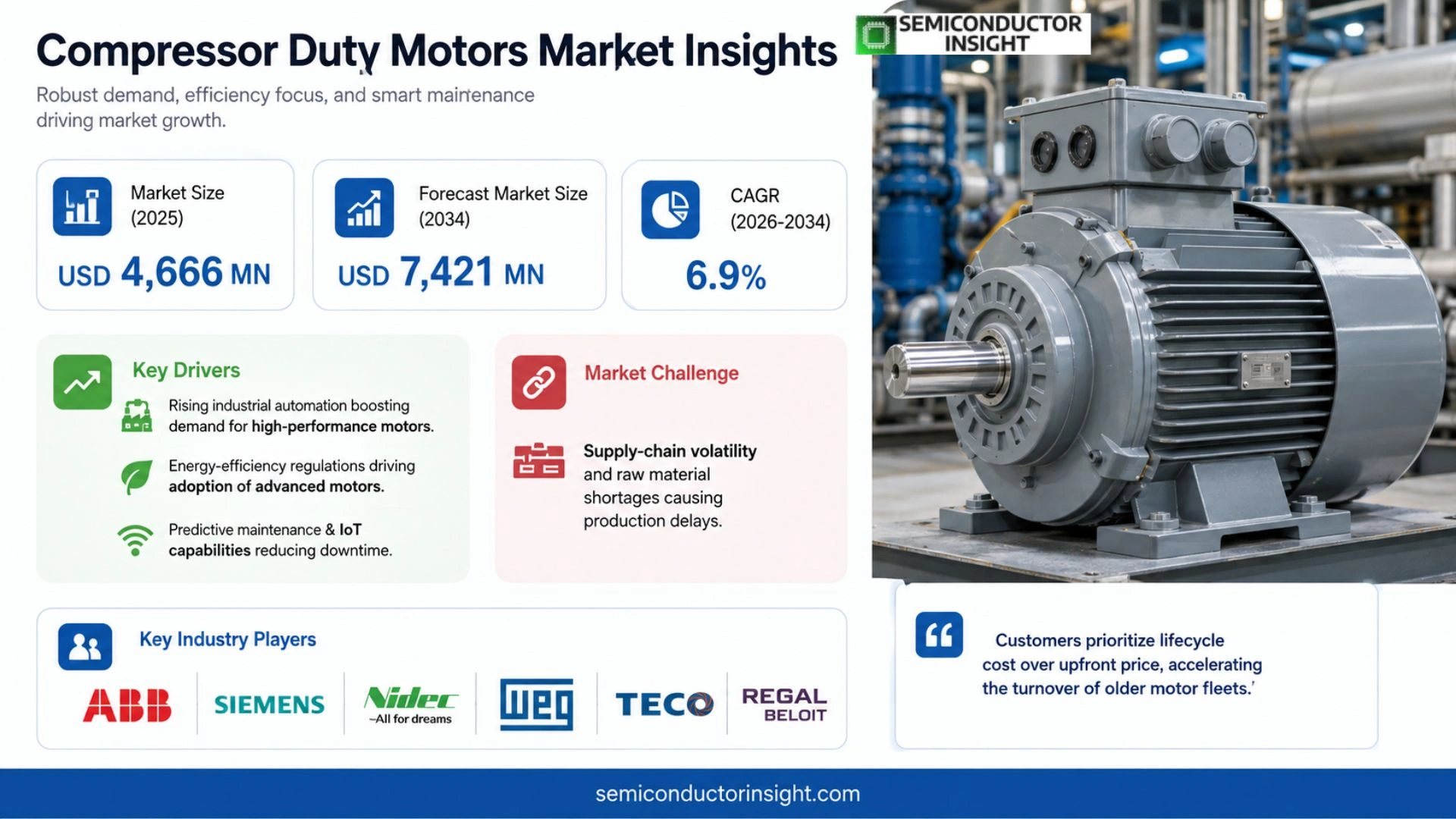
Compressor Duty Motors market size was valued at USD 4666 million in 2025 and will reach USD 7421 million by 2034, exhibiting a CAGR of 6.9% during the forecast period.
Compressor Duty Motors are purpose‑built AC induction units designed for air‑compressor loads that demand high starting torque and repeatable start‑stop cycles. They are typically offered as single‑phase or three‑phase models featuring a stator core, squirrel‑cage rotor, ball bearings, housing, end brackets, cooling fan and terminal box; single‑phase versions often incorporate start/run capacitors and centrifugal switches. The motors are mounted horizontally on foot frames using standardized NEMA dimensions, shaft extensions and keyways that allow direct coupling or belt drive to compressors. Compared with general‑purpose motors, these machines deliver superior hard‑starting capability, constant‑torque performance, thermal endurance and vibration resistance, making them suitable for reciprocating compressors, small rotary screw units, industrial compressed‑air stations, automotive repair shops, paint‑spraying operations and other maintenance‑driven applications.
MARKET DRIVERS
Industrial Automation Demand
The surge in automated production lines across chemicals, petrochemicals, and food processing has elevated the need for high‑performance motor assemblies. Compressor Duty Motors are prized for their torque stability, making them indispensable for continuous‑run compressors that power these plants. Operators are swapping legacy units for motors that can sustain higher duty cycles without overheating, a shift that directly fuels market expansion.
Energy‑Efficiency Regulations
Stringent global standards on power consumption are compelling manufacturers to adopt motors with superior efficiency ratings. Modern duty motors incorporate premium copper windings and optimized magnetic designs that shave several percent off electricity bills,an amount that scales dramatically in large‑capacity compressors. This regulatory pressure translates into incremental order volumes for Compressor Duty Motors Market.
➤ “Customers prioritize lifecycle cost over upfront price, accelerating the turnover of older motor fleets.”
Another catalyst is the strategic emphasis on predictive maintenance. IoT‑enabled sensors embedded in new motor designs generate real‑time performance data, allowing plants to anticipate wear and schedule interventions before failures occur. The resulting reduction in unplanned downtime reinforces the business case for upgrading to next‑generation duty motors.
MARKET CHALLENGES
Supply‑Chain Volatility
Global shortages of high‑grade steel and specialty insulation materials have introduced lead‑time variability for motor manufacturers. While demand remains robust, the inability to secure consistent raw‑material flows forces some suppliers to defer production, creating a mismatch between order intake and delivery capability.
Other Challenges
Cost Sensitivity in Emerging Economies
Enterprises in rapidly industrializing regions often operate under tight capital constraints. Even when the efficiency benefits are clear, the higher initial price of premium duty motors can stall adoption, especially where financing options are limited.
MARKET RESTRAINTS
Technical Integration Barriers
Retrofitting existing compressor installations with new duty motors frequently demands extensive mechanical redesigns and control‑system re‑programming. The engineering effort required can deter plant managers from pursuing upgrades, particularly when equipment is nearing the end of its scheduled replacement horizon.
Moreover, the proprietary nature of certain compressor manufacturers’ motor interfaces limits the pool of compatible third‑party duty motors, constraining market fluidity and reinforcing vendor lock‑in.
MARKET OPPORTUNITIES
Digital Retrofit Services
Service firms that specialize in integrating smart drives and condition‑monitoring packages with legacy duty motors are poised to capture a growing share of the upgrade market. By bundling hardware with analytics platforms, they offer a compelling value proposition that addresses both performance and maintenance concerns.
In parallel, the emergence of additive manufacturing for motor housings opens pathways to lighter, more thermally efficient designs. Early adopters can leverage these innovations to differentiate their product portfolios and command premium pricing within niche applications such as offshore gas compression.
Finally, strategic collaborations between motor OEMs and compressor system integrators are expected to yield co‑engineered solutions that streamline installation processes. These alliances reduce engineering overhead for end users and accelerate time‑to‑value, presenting a fertile ground for revenue growth in Compressor Duty Motors Market.
Compressor Duty Motors Market Trends
Market Value Expansion
The latest forecasts indicate Compressor Duty Motors Market reached roughly $4.7 billion in 2025 and is slated to climb to about $7.4 billion by 2034. This upward move reflects a combination of expanding air‑compressor installations in manufacturing, heightened attention to plant‑level energy efficiency, and the growing prevalence of variable‑speed compressor architectures. Operators now view the motor not merely as a mechanical driver but as a lever for reducing start‑up currents, stabilising system pressure, and extending equipment life. Consequently, OEMs are embedding higher starting torque designs and more robust thermal management into new motor families, while aftermarket distributors are fielding inventory that aligns with standard frame dimensions to satisfy rapid‑swap replacement cycles. The net effect is a steady rise in unit shipments that mirrors the broader push for lower‑cost operation of compressed‑air networks.
Other Trends
Reliability and Compliance Pressures
Reliability remains the decisive purchase criterion because a single motor failure can halt an entire production line. Recent updates to energy‑conservation standards across major regions have introduced tighter efficiency thresholds, forcing manufacturers to certify motors that meet both torque and loss‑reduction targets. Buyers therefore reward suppliers that can demonstrate long‑term vibration resistance, proven thermal endurance, and compliance with NEMA and IEC guidelines. Service organisations are also favoring partners who provide diagnostic tooling and remote monitoring, enabling predictive maintenance rather than reactive fixes. This environment creates a competitive moat for firms that blend mature electromagnetic design with a responsive field‑service network.
Strategic Outlook for Stakeholders
For investors, the segmentation of demand into legacy replacement versus next‑generation system integration suggests a differentiated return profile. Companies that rely solely on catalog sales of generic units may face margin compression as distributors negotiate bulk pricing. In contrast, firms that collaborate with compressor OEMs to co‑develop motors tuned for variable‑frequency drives, digital analytics, and oil‑free operation are positioned to capture premium pricing and recurring service contracts. New entrants should prioritize establishing credibility in high‑frequency, high‑torque niches,such as automotive‑shop compressors and construction‑site equipment,before expanding into more complex, integrated solutions. Policymakers can view this component category as a lever for broader industrial energy‑saving programs, given its influence on start‑up power draw and overall system efficiency.
COMPETITIVE LANDSCAPE
Key Industry Players
Compressor Duty Motors Competitive Overview – 2025‑2034
The market is dominated by a handful of multinational engineering groups whose breadth of motor portfolios allows them to lock in OEM contracts and sustain aftermarket volume. ABB leverages its extensive NEMA‑compatible catalog and has intensified its focus on energy‑efficiency certification, which makes it the preferred supplier for many North‑American compressor assemblers. Siemens complements its high‑performance offering with a strong digital services layer, enabling predictive maintenance integration that resonates with customers pursuing system‑level optimization. Nidec Motor’s aggressive acquisition strategy over the past five years broadened its footprint in Asia‑Pacific, while Regal Rexnord remains a specialist in rugged, high‑torque designs favored by heavy‑industry users. The competitive structure therefore resembles a tiered ecosystem: global powerhouses secure the bulk of OEM spend, while a second tier of regionally strong manufacturers competes on price, lead‑time, and compliance agility.
Beyond the tier‑one giants, a diverse set of niche players enriches the value chain with differentiated engineering or localized service. Toshiba and WEG have cultivated strong positions in the open‑drip‑proof segment, appealing to customers in harsh environments. Wolong Group and TECO‑Westinghouse focus on low‑speed, high‑efficiency motors for rotary‑screw applications, often coupling their products with variable‑speed drives. TMEIC and Hyosung Heavy Industries provide a mix of three‑phase and brushless solutions that are increasingly compatible with emerging digital monitoring platforms. Smaller Chinese firms such as Xiangtan Electric and SEC Electric compete on rapid inventory turnover and customized shaft extensions, whereas European specialists like Lafert Group and Hoyer supply bespoke enclosures for oil‑free or washdown‑duty compressors. OME Motors rounds out the competitive set with a portfolio tailored to automotive‑repair and construction‑site outfits, where cost‑sensitivity and ease‑of‑installation dominate purchasing decisions.
List of Key Compressor Duty Motors Companies Profiled
- ABB
- Siemens
- Nidec Motor
- Regal Rexnord
- Toshiba
- WEG
- Wolong Group
- TECO‑Westinghouse
- TMEIC
- Hyosung Heavy Industries
- XIANGTAN ELECTRIC
- Lafert Group
- Hoyer
- OME Motors
- SEC Electric
Segment Analysis:
| Segment Category | Sub-Segments | Key Insights |
| By Type |
|
High‑Torque Induction
|
| By Application |
|
Core Industrial Usage
|
| By End User |
|
Reliability‑Centric Users
|
| By Enclosure |
|
Protection‑Driven Choices
|
| By Cooling Method |
|
Thermal Management Focus
|
Regional Analysis: Compressor Duty Motors Market
Europe
The European Union’s EcoDesign directive compels manufacturers to cut energy consumption by a measurable margin. This pressure translates into a preference for premium‑efficiency motor designs that can deliver the same output with reduced losses, encouraging OEMs to invest in advanced magnetic materials and refined winding techniques.
Geopolitical tensions have accelerated the reshoring of critical components such as copper windings and silicon steel. European firms are establishing micro‑factories in Eastern Europe to shorten lead times and mitigate exposure to external shocks, a move that reshapes cost structures across the market.
Smart‑motor initiatives in Germany’s “Industrie 4.0” hubs create demand for motors equipped with embedded sensors and edge‑computing capabilities. This integration enables real‑time condition monitoring, allowing plant operators to fine‑tune compressor performance and extend service intervals.
End‑users in the oil‑and‑gas and chemical sectors are requesting motors that combine high torque density with modular housings. The flexibility to adapt motor dimensions without sacrificing power output is becoming a decisive factor in procurement decisions.
North America
In North America, Compressor Duty Motors Market is being driven by a surge in natural‑gas processing capacity and a growing demand for reliable power in emerging renewable‑hydrogen projects. U.S. manufacturers are leveraging extensive automation expertise to offer turnkey motor‑compressor packages that promise lower total‑ownership cost. Canadian firms, meanwhile, are capitalising on their proximity to offshore wind farms, supplying motors that can endure harsh marine environments while maintaining efficiency thresholds set by local utilities. The competitive landscape rewards vendors that can demonstrate rapid field service and supply‑chain agility, especially as customers shift toward just‑in‑time inventory models.
Asia‑Pacific
Asia‑Pacific’s rapid industrialisation fuels the need for robust motor solutions across petrochemical complexes in China and expanding LNG terminals in Indonesia. Regional players are focusing on cost‑effective manufacturing techniques, such as automated brazing and high‑volume casting, to keep price points attractive for price‑sensitive buyers. Simultaneously, the region’s growing emphasis on sustainability encourages the adoption of motors with higher efficiency classes, prompting Chinese OEMs to invest heavily in research on rare‑earth‑free magnetic alloys. The market’s trajectory is further shaped by governmental incentives for energy‑saving equipment, which lower the barrier for end‑users to upgrade older compressor fleets.
South America
South American markets, particularly Brazil and Argentina, are experiencing a modest but steady demand for compressor duty motors as oil‑refining capacities modernise. Local energy policies that reward low‑emission equipment are nudging plant operators toward premium‑efficiency motors despite higher upfront costs. Supply constraints for high‑grade steel have prompted regional distributors to forge strategic alliances with European suppliers, ensuring a steady flow of critical components. The prevailing business mindset values long‑term service agreements, making after‑sale support a decisive differentiator for market participants.
Middle East & Africa
The Middle East & Africa region leverages its abundant hydrocarbon resources to sustain a sizeable Compressor Duty Motors Market, especially in Saudi Arabia and the United Arab Emirates where mega‑refinery projects are underway. Operators seek motors that can operate at elevated ambient temperatures without derating, prompting manufacturers to adopt advanced insulation materials and robust cooling schemes. In South Africa, the growing emphasis on renewable‑energy storage introduces a new segment where motors must be both high‑performance and adaptable to variable load profiles. The overall market is defined by a blend of legacy demand from oil‑centric operations and nascent opportunities in green‑energy infrastructure.
Report Scope
This market research report provides a comprehensive analysis of the Compressor Duty Motors Market , covering the forecast period 2026–2034. It offers detailed insights into market dynamics, technological advancements, competitive landscape, and key trends shaping the industry.
Key focus areas of the report include:
- Market Overview: The report begins with an overview outlining its current market scenario, key growth indicators, and industry transformation drivers. It discusses macroeconomic factors, demand–supply balance, regulatory landscape, and the strategic role of semiconductors in powering advancements across industries such as automotive, telecommunications, consumer electronics, and industrial automation.
- Market Size & Forecast: Historical data and future projections for revenue, unit shipments, and market value across major regions and segments.
- Segmentation Analysis: Detailed breakdown by product type, technology, application, and end-user industry to identify high-growth segments and investment opportunities.
- Regional Insights: Insights into market performance across North America, Europe, Asia-Pacific, Latin America, and the Middle East & Africa, including country-level analysis where relevant.
- Competitive Landscape: Profiles of leading market participants, including their product offerings, R&D focus, manufacturing capacity, pricing strategies, and recent developments such as mergers, acquisitions, and partnerships.
- Technology Trends & Innovation: Assessment of emerging technologies, integration of AI/IoT, semiconductor design trends, fabrication techniques, and evolving industry standards.
- Market Drivers & Restraints: Evaluation of factors driving market growth along with challenges, supply chain constraints, regulatory issues, and market-entry barriers.
- Stakeholder Insights: Insights for component suppliers, OEMs, system integrators, investors, and policymakers regarding the evolving ecosystem and strategic opportunities.
Primary and secondary research methods are employed, including interviews with industry experts, data from verified sources, and real-time market intelligence to ensure the accuracy and reliability of the insights presented.
FREQUENTLY ASKED QUESTIONS:
What is the current market size of Compressor Duty Motors Market?
-> Compressor Duty Motors market will reach USD 7421 million by 2034, exhibiting a CAGR of 6.9% during the forecast period.
Which key companies operate in Compressor Duty Motors Market?
-> Key players include ABB, Siemens, Nidec Motor, Regal Rexnord, Toshiba, WEG, Wolong Group, TECO-Westinghouse, TMEIC, Hyosung Heavy Industries, XIANGTAN ELECTRIC, Lafert Group, Hoyer, OME Motors, SEC Electric, among others.
What are the key growth drivers?
-> Key growth drivers include industrial energy upgrading, equipment reliability improvement, redesign of compressed‑air systems, demand for higher efficiency and variable‑speed control, and increasing adoption of digital monitoring and IoT‑enabled motor solutions.
Which region dominates the market?
-> North America currently holds the largest market share due to mature industrial base and stringent energy‑efficiency standards, while Asia‑Pacific is emerging as the fastest‑growing region driven by expanding manufacturing and automation activities.
What are the emerging trends?
-> Emerging trends include integration with variable‑speed drives, advanced digital diagnostics, oil‑free motor designs, enhanced energy‑efficiency classifications, and greater focus on IoT‑based condition monitoring for predictive maintenance.

Get Sample Report PDF for Exclusive Insights
Report Sample Includes
- Table of Contents
- List of Tables & Figures
- Charts, Research Methodology, and more...
 Download Sample Report PDF