
Cold Chain Environment Monitoring Sensors Market Insights
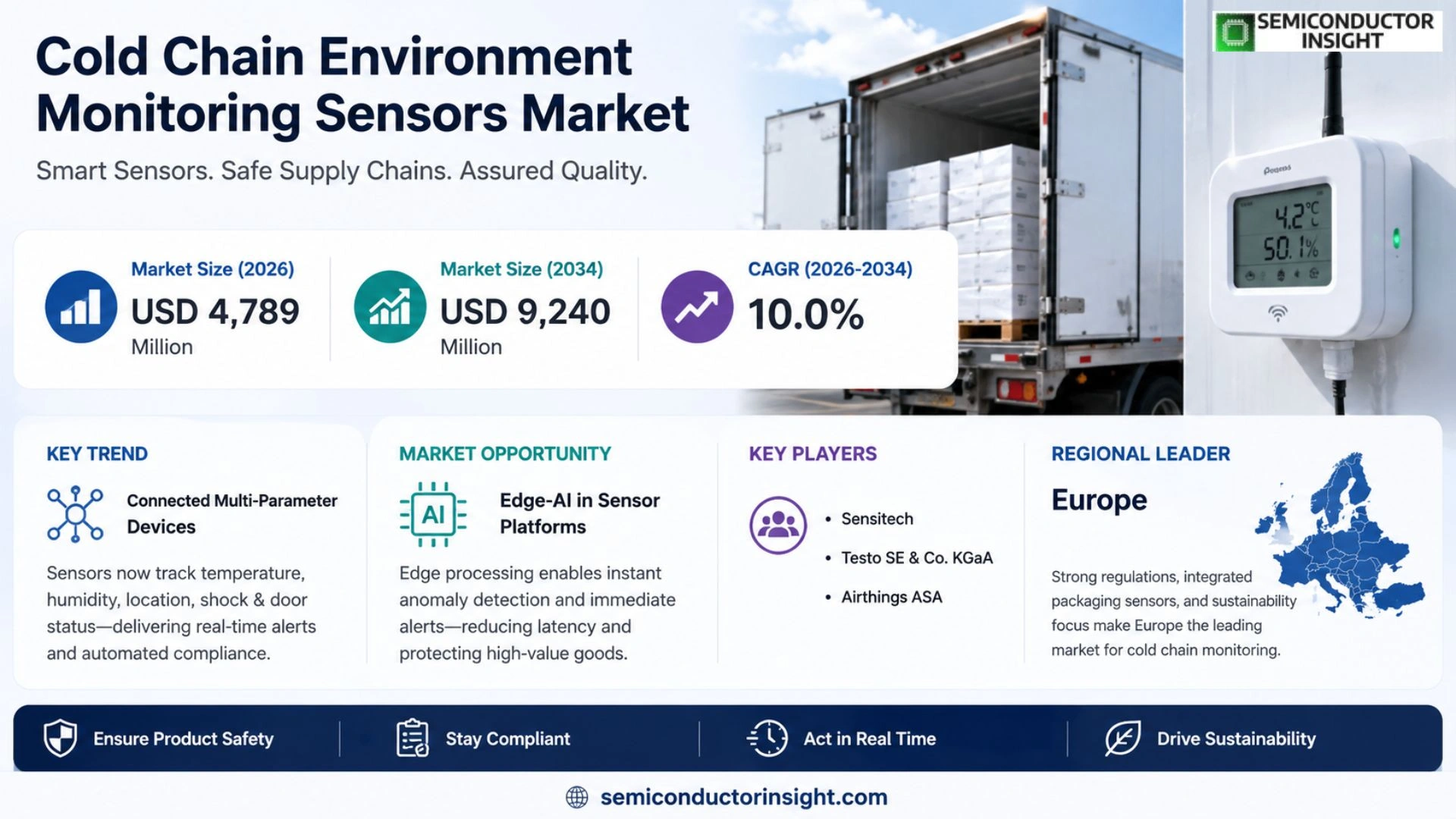
Global Cold Chain Environment Monitoring Sensors market is expected to increase from USD 4,789 million in 2026 to USD 9,240 million by 2034, exhibiting a CAGR of 10.0% during the forecast period.
Cold chain environment monitoring sensors are data‑logging devices that continuously detect, record and sometimes transmit temperature together with humidity, light exposure, door‑open events, shock, tilt and location throughout refrigerated storage and temperature‑controlled transportation.
The expansion results from tighter compliance mandates across pharmaceuticals and food sectors as well as heightened demand for real‑time visibility; manufacturers are adding wireless connectivity while end users require calibrated solutions that enable automated reporting and audit‑ready records.
MARKET DRIVERS
Regulatory Momentum Accelerates Adoption
Stringent food safety regulations across North America and Europe compel shippers to equip refrigerated containers with real‑time monitoring devices. Compliance audits now flag any lapse in temperature control, prompting logistics firms to replace manual logbooks with networked sensors. This shift translates into higher spend on telemetry platforms and firmware upgrades, directly fueling market expansion.
Supply‑Chain Visibility Becomes a Competitive Imperative
Retail giants are integrating sensor data into enterprise resource planning (ERP) systems to anticipate spoilage before it occurs. Predictive analytics backed by continuous temperature streams can reduce waste by up to 15 %, creating a clear ROI argument for new deployments. As margins tighten, end‑users prioritize technologies that deliver actionable insights, thereby reinforcing demand for advanced monitoring units.
➤ “Investors are now questioning the cost of downtime more than the cost of sensor hardware.”
Industrial players are also expanding portfolios to include humidity and shock detection, responding to pharmaceutical requirements for multi‑parameter oversight. This broader functionality encourages cross‑selling opportunities and enlarges the addressable market for sensor manufacturers.
MARKET CHALLENGES
High Initial Capital Outlay Hinders Small‑Scale Operators
While large carriers can amortize sensor investments across hundreds of assets, independent distributors often lack the cash flow to purchase integrated solutions. Up‑front expenditures for calibrated devices, gateway infrastructure, and subscription services can exceed $10,000 per vehicle, creating a barrier to entry that slows overall market penetration.
Other Challenges
Interoperability Constraints
A fragmented ecosystem of proprietary communication protocols forces some users to deploy multiple gateways, inflating operational complexity. This lack of standardization discourages adoption among firms seeking a single, scalable architecture.
MARKET RESTRAINTS
Data Security Concerns Limit Cloud Migration
Cold‑chain stakeholders are wary of transmitting temperature logs over public networks, fearing interception that could jeopardize compliance records. Encryption mandates and stringent data‑hosting regulations add layers of cost and delay, prompting many to retain on‑premise storage solutions that lack the flexibility of cloud analytics.
MARKET OPPORTUNITIES
Growth of Edge‑AI in Sensor Platforms
Emerging edge‑processing chips enable real‑time anomaly detection without relying on continuous connectivity. Embedding lightweight AI models within the sensor itself can trigger instant alerts, reducing latency to seconds rather than minutes. Companies that master this capability are positioned to capture premium contracts with vaccine distributors and high‑value perishables.
Cold Chain Environment Monitoring Sensors Market Trends
Transition to Connected Multi‑Parameter Devices
The sensor ecosystem is moving away from single‑point temperature loggers toward platforms that capture humidity, door status, shock, and location while streaming data to cloud dashboards. This evolution reflects customers’ demand for instantaneous alerts rather than post‑event reports. In practice, a pharmaceutical shipper can now receive a push notification the moment a temperature excursion occurs, enabling corrective action within minutes and preventing product loss. The shift also unlocks value‑added services such as automated compliance reporting, which reduces manual audit effort for regulated firms.
Other Trends
Compliance‑Centric Monitoring in Life‑Sciences and Food
Regulatory agencies have tightened tolerances for temperature excursions across vaccine distribution and perishable food chains. As a result, manufacturers are increasingly specifying validated sensors with built‑in calibration certificates and audit‑ready logs. The cost premium for such devices is justified by the avoidance of costly recalls and the ability to demonstrate traceability to end‑users. Companies that embed compliance modules directly into the hardware gain a competitive edge, especially in regions where enforcement is rigorous.
Segmentation by Use‑Case and Asset Lifecycle
Short‑haul food deliveries favor disposable or semi‑disposable units that keep unit cost low while delivering sufficient accuracy for brief trips. Conversely, long‑duration pharmaceutical storage and ultra‑low‑temperature shipments require reusable, calibrated devices with extended battery life and robust wireless reliability. Vendors are therefore differentiating portfolios to address the distinct economics of each segment, offering tiered pricing and service contracts that align with asset turnover rates.
Real‑Time Wireless Sensing as a Competitive Lever
Wireless connectivity eliminates the need for manual data retrieval, reducing labor costs and minimizing the risk of data tampering. Fleet managers can now monitor an entire portfolio of refrigerated trucks from a single interface, spotting patterns such as recurring door‑open events that indicate procedural gaps. This visibility drives operational efficiencies and supplies the analytics foundation for predictive maintenance of cooling equipment. Early adopters report margin improvements of up to 15 % by cutting spoilage and streamlining compliance workflows.
COMPETITIVE LANDSCAPE
Key Industry Players
Competitive Assessment of Leading Sensor Providers
The market is anchored by a handful of multinational firms that combine semiconductor expertise with specialized calibration services. Sensitech, for example, leverages a robust R&D pipeline to integrate cloud analytics with its temperature‑only loggers, thereby capturing a sizable share of pharmaceutical shipments in North America and Europe. Its vertical ownership of firmware development and field service networks creates high entry barriers for newcomers, reinforcing an oligopolistic structure where the top three players command roughly 55 % of global shipments. This concentration is tempered by regional specialists that tailor device form‑factors to specific logistics chains, but the overall architecture remains dominated by firms that can sustain long‑term compliance programs and deliver end‑to‑end data validation.
Beyond the dominant trio, a diverse cohort of niche innovators fuels product differentiation. Companies such as Berlinger and ELPRO focus on ultra‑low‑temperature modules for vaccine transport, while Controlant and DeltaTrak specialize in real‑time wireless alerts for perishable foods. European outfit Testo emphasizes multi‑parameter sensors with advanced humidity compensation, and Japan’s JLY Technology supplies low‑cost disposable tags for short‑haul food distribution. Smaller players like Kaye, Elitech, Dickson, and LogTag Recorders occupy the mid‑range segment, offering calibrated, reusable units for laboratory and hospital use. Their agility in adopting emerging communication standards,Bluetooth Low Energy, LoRaWAN,adds competitive pressure on the incumbents to broaden connectivity options.
List of Key Cold Chain Environment Monitoring Sensors Companies Profiled
- Sensitech
- Berlinger
- Controlant
- DeltaTrak
- ELPRO
- LogTag Recorders
- Dickson
- Testo
- Copeland
- Kaye
- Elitech
- JLY Technology
Segment Analysis:
| Segment Category | Sub-Segments | Key Insights |
| By Type |
|
Wireless Sensor is emerging as the dominant preference because it enables real‑time alerts, cloud connectivity and remote diagnostics.
|
| By Application |
|
Pharmaceuticals & Vaccines command the most rigorous monitoring due to stringent regulatory demands.
|
| By End User |
|
Pharma manufacturers drive sensor adoption through compliance imperatives and high‑value product protection.
|
| By Monitoring Parameter |
|
Multi‑Parameter Monitoring is gaining traction as customers pursue holistic cold‑chain visibility.
|
| By Temperature Range |
|
Ultra‑Low Temperature Monitoring addresses the growing need for vaccine and biologics transport at -70°C or lower.
|
Regional Analysis: Cold Chain Environment Monitoring Sensors Market
Europe
The EU’s stringent temperature‑logging mandates have elevated sensor deployment from optional to mandatory in many temperature‑sensitive supply chains. Auditors now request digital audit trails, prompting vendors to certify sensors against harmonized standards, which in turn accelerates market acceptance across member states.
Logistics firms across Germany, France and the Benelux region embed sensors into handling equipment, enabling real‑time alerts that prevent deviations before they reach distribution centers. This integration reduces loss and supports just‑in‑time inventory models that dominate European retail.
Bluetooth Low Energy and LoRaWAN networks have become the de‑facto connectivity choices for European operators, balancing range and power consumption. Sensor manufacturers tailor firmware to these protocols, creating a plug‑and‑play environment that shortens deployment cycles.
A handful of established OEMs dominate the market, yet niche startups gain foothold by offering ultra‑compact, recyclable units. Incumbents are therefore acquiring promising innovators to broaden their portfolio and meet ESG expectations.
North America
In the United States and Canada, the cold chain sensor market is shaped by a blend of consumer expectation for freshness and a fragmented logistics landscape. Retail giants demand granular temperature data to justify premium pricing, while smaller distributors rely on low‑cost sensors that can be retrofitted onto existing pallets. The prevalence of e‑commerce has opened opportunities for last‑mile monitoring, where real‑time alerts can trigger dynamic rerouting. Companies that pair sensor data with predictive analytics are differentiating themselves, turning raw temperature logs into actionable insights that reduce waste and improve service levels.
Asia‑Pacific
Asia‑Pacific presents a paradox of rapid urbanization and uneven infrastructure. While major economies such as Japan, South Korea and Australia exhibit sophisticated cold‑chain practices, emerging markets like India and Vietnam still grapple with unreliable power supplies. This disparity drives a dual‑track strategy: high‑performance sensors for mature corridors and rugged, battery‑optimized devices for less developed routes. Governments are gradually introducing food‑safety guidelines that reference digital monitoring, encouraging multinational players to standardize offerings across the region.
South America
Brazil and Argentina lead South American activity, where agricultural exports dominate the temperature‑sensitive cargo mix. Port authorities have begun requiring sensor‑based verification for shipments bound for Europe, turning compliance into a market entry condition. However, logistics costs remain high, prompting operators to seek sensors that balance accuracy with minimal maintenance. Partnerships between local distributors and European sensor firms are emerging, aiming to localize support while leveraging advanced technology.
Middle East & Africa
The Middle East’s focus on high‑value pharmaceuticals and luxury foods fuels demand for reliable monitoring in desert climates, where temperature excursions are a constant risk. Meanwhile, African markets are still nascent; pilot projects in Kenya and Nigeria illustrate how off‑grid sensors powered by solar cells can overcome electricity challenges. International investors watch these trials closely, as successful deployments could unlock a sizable market segment that currently relies on manual checks.
Report Scope
This market research report provides a comprehensive analysis of the Cold Chain Environment Monitoring Sensors Market , covering the forecast period 2026–2034. It offers detailed insights into market dynamics, technological advancements, competitive landscape, and key trends shaping the industry.
Key focus areas of the report include:
- Market Overview: The report begins with an overview outlining its current market scenario, key growth indicators, and industry transformation drivers. It discusses macroeconomic factors, demand–supply balance, regulatory landscape, and the strategic role of semiconductors in powering advancements across industries such as automotive, telecommunications, consumer electronics, and industrial automation.
- Market Size & Forecast: Historical data and future projections for revenue, unit shipments, and market value across major regions and segments.
- Segmentation Analysis: Detailed breakdown by product type, technology, application, and end-user industry to identify high-growth segments and investment opportunities.
- Regional Insights: Insights into market performance across North America, Europe, Asia-Pacific, Latin America, and the Middle East & Africa, including country-level analysis where relevant.
- Competitive Landscape: Profiles of leading market participants, including their product offerings, R&D focus, manufacturing capacity, pricing strategies, and recent developments such as mergers, acquisitions, and partnerships.
- Technology Trends & Innovation: Assessment of emerging technologies, integration of AI/IoT, semiconductor design trends, fabrication techniques, and evolving industry standards.
- Market Drivers & Restraints: Evaluation of factors driving market growth along with challenges, supply chain constraints, regulatory issues, and market-entry barriers.
- Stakeholder Insights: Insights for component suppliers, OEMs, system integrators, investors, and policymakers regarding the evolving ecosystem and strategic opportunities.
Primary and secondary research methods are employed, including interviews with industry experts, data from verified sources, and real-time market intelligence to ensure the accuracy and reliability of the insights presented.
FREQUENTLY ASKED QUESTIONS:
What is the current market size of Cold Chain Environment Monitoring Sensors Market?
-> Cold Chain Environment Monitoring Sensors market is expected to increase from USD 4,789 million in 2026 to USD 9,240 million by 2034, exhibiting a CAGR of 10.0%
Which key companies operate in Cold Chain Environment Monitoring Sensors Market?
-> Key players include Sensitech, Berlinger, Controlant, ELPRO, DeltaTrak, LogTag Recorders, Dickson, Testo, Copeland, Kaye, Elitech, JLY Technology.
What are the key growth drivers?
-> Key growth drivers include increasing compliance‑driven monitoring requirements in pharma and food sectors, rising demand for real‑time wireless sensing, growth of vaccine and biologics logistics, and the shift toward multi‑parameter, cloud‑connected devices.
Which region dominates the market?
-> North America holds a leading position due to its mature pharmaceutical supply chain, extensive cold‑chain logistics infrastructure, and early adoption of advanced monitoring technologies.
What are the emerging trends?
-> Emerging trends include multi‑parameter connected sensors delivering real‑time alerts, cloud‑based analytics, tighter audit‑ready compliance features, and expanded use of wireless battery‑efficient modules for ultra‑low‑temperature shipments.

Get Sample Report PDF for Exclusive Insights
Report Sample Includes
- Table of Contents
- List of Tables & Figures
- Charts, Research Methodology, and more...
 Download Sample Report PDF


