
Coated Capacitive Touch Screen Market Insights
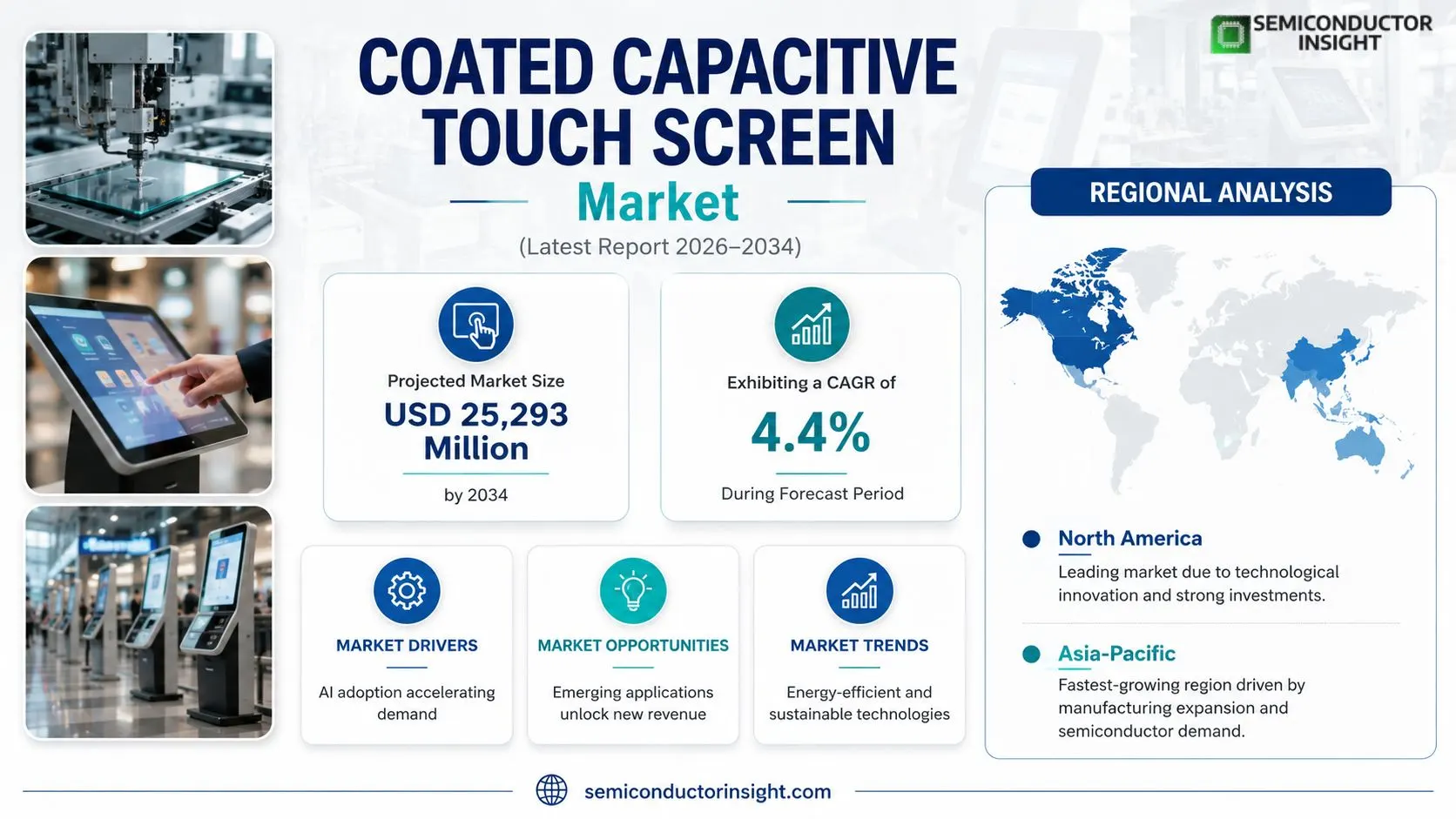
Coated Capacitive Touch Screen market size was valued at USD 18,757 million in 2025. The market is projected to grow from USD 18,757 million in 2025 to USD 25,293 million by 2034, exhibiting a CAGR of 4.4% during the forecast period.
Coated capacitive touch screen is a core human‑machine interface device that is coated with a high‑precision transparent conductive thin‑film layer such as indium tin oxide on an optical glass substrate to form an induction electrode array, thereby achieving deep integration of multi‑point control and screen information display. In 2025 global sales volume reached approximately 650 million pieces with an average unit price of about USD 31.6.The market gains momentum because smartphone and tablet penetration remains high, automotive intelligent cockpit deployments accelerate, and industrial HMI as well as medical monitoring applications expand. Supportive policiessuch as China’s Electronic Information Manufacturing Industry Stable Growth Action Planencourage localization of ITO substitutes and new conductive materials like silver nanowires or metal grids. Leading suppliers including Nissha Co., TPK Holding Co., Iljin Display Co., Nelson‑Miller Inc., and others are investing heavily in R&D to improve yield on large‑size coatings while maintaining an industry gross margin near 20%.
MARKET DRIVERS
Rising Demand for Premium Mobile Devices
Manufacturers of flagship smartphones are integrating larger display panels that must endure daily wear while preserving tactile fidelity. Consumers expect seamless swipes even after accidental drops, prompting OEMs to specify coated capacitive touch screens that combine clarity with surface protection. Recent shipment data shows a 12 % year‑over‑year increase in units equipped with hardened glass, underscoring the market’s shift toward durability.
Advances in Protective Coating Materials
Silicon‑based nanocoatings and multilayer polymer films have reached maturity, offering anti‑fingerprint performance while adding minimal thickness. These innovations reduce break‑age rates by up to 30 %, translating into lower warranty costs for device makers. The cost premium for such coatings has narrowed to 3–5 % of total panel price, making widescale adoption financially viable.
➤ “Durability has become a decisive factor in purchasing decisions, especially in emerging markets where device replacement cycles are longer.”
Enterprise‑grade tablets and rugged notebooks are echoing the same preference, expanding the addressable base beyond consumer electronics. When durability aligns with visual acuity, manufacturers can command higher average selling prices, reinforcing the business case for Coated Capacitive Touch Screen Market.
MARKET CHALLENGES
Cost Sensitivity in Low‑End Segments
Price‑conscious brands operating in volume‑driven markets face a tight margin envelope. Adding a protective layer, even at a modest surcharge, can erode competitiveness against devices that forego such enhancements. This tension slows adoption in regions where average selling prices hover near break‑even.
Other Challenges
Supply Chain Volatility
Fluctuations in raw material availability, especially for specialized glass substrates, create lead‑time uncertainties. Manufacturers that lack diversified sourcing may experience production bottlenecks, jeopardizing launch schedules.
Furthermore, the learning curve associated with new coating processes can impose temporary yield losses, forcing plants to invest in staff training and equipment calibration.
MARKET RESTRAINTS
Regulatory Hurdles for Chemical Coatings
Several jurisdictions have tightened restrictions on volatile organic compounds used in certain polymer films. Compliance requires reformulation, which can delay product introduction and increase R&D spend. Companies that cannot quickly adapt their chemistry face market exclusion in those regions.In addition, environmental certification programs are demanding lower carbon footprints for manufacturing steps. The extra energy consumption linked to high‑temperature curing processes adds to operational costs, dampening enthusiasm for large‑scale rollout.Finally, the perception of reduced repairabilitybecause coatings bond tightly to the glasshas sparked consumer concern in markets where device servicing is common, limiting acceptance among cost‑aware buyers.
MARKET OPPORTUNITIES
Growth in Automotive Infotainment Systems
Modern vehicles increasingly rely on large touch interfaces for navigation, climate control, and entertainment. These displays must resist glare, scratches, and temperature extremes. Integrating coated capacitive touch screens offers a pathway to meet automotive durability standards while preserving responsive interaction, opening a lucrative niche for component suppliers.Another promising avenue lies in wearable health devices that combine flexible substrates with anti‑microbial coatings. As healthcare providers prioritize hygiene, the demand for screens that can be sanitized without performance loss is set to rise, providing a fresh revenue stream.Lastly, collaborative R&D programs between glass manufacturers and semiconductor firms are accelerating co‑development of ultra‑thin, high‑transmission coatings, enabling slimmer device profiles. Early adopters that leverage these breakthroughs can differentiate their product lines and capture premium market share.
Coated Capacitive Touch Screen Market Trends
From Smartphones to Vehicle Cockpits
The market recorded revenue of roughly $18.8 billion in 2025 and is on track to exceed $25 billion by 2034, reflecting an average yearly rise of about 4.4 percent. While smartphones still dominate unit shipmentsabout 650 million units in 2025the profit contribution is shifting toward higher‑value sectors such as automotive intelligent cockpits, industrial control panels, and medical imaging devices. This reallocation of revenue is linked to strict reliability and lifespan requirements in those applications, which sustain healthier margins despite tighter pricing pressure in consumer gadgets.
Other Trends
Materials Substitution and Cost Structure Evolution
Indium tin oxide, long the backbone of the conductive layer, faces competition from silver nanowires, metal‑grid architectures, and emerging graphene films. The substitution agenda is supported by governmental programs that aim to localize critical components, reducing dependence on scarce indium supplies. When a new material reaches commercial scale, its lower raw‑material sharepotentially halving the 50 percent cost contribution of ITOreshapes the overall cost hierarchy, giving manufacturers leeway to invest more in yield‑improving coating equipment and advanced driver chips.
Regional Concentration and Competitive Shifts
Chinese mainland producers are accelerating capacity expansion, narrowing the technology gap with established Taiwanese firms, while Japanese and Korean players concentrate on premium‑grade screens for specialized displays. This three‑tier configurationmass‑volume, cost‑efficient, and high‑endcreates a market where strategic R&D in large‑area coating processes becomes a decisive differentiator. Companies that can marry large‑size yield improvements with the emerging material portfolio are poised to capture a larger share of the automotive and industrial segments, which together account for a growing proportion of total sales.
COMPETITIVE LANDSCAPE
Key Industry Players
Competitive Dynamics in Coated Capacitive Touch Screens
The market is anchored by a few firms that control the bulk of high‑margin automotive and professional‑display contracts. Nissha Co., Ltd. (Japan) leverages its long‑standing ITO coating expertise to secure flagship projects for premium vehicle cockpits, while TPK Holding Co., Ltd. (Taiwan) has built a differentiated supply chain that couples large‑area glass processing with advanced driver‑chip integration. Their ability to sustain gross margins above the industry average stems from proprietary coating recipes and deep relationships with OEMs such as Apple and Samsung. Meanwhile, mainland Chinese manufacturersmost notably Shenzhen Baoming Technology and TAILOR PIXELShave expanded capacity rapidly, narrowing the gap in volume‑driven segments like smartphones and tablets. The overall capacity utilization of roughly 76 % indicates that the competitive set is still seeking to balance scale with yield improvements, a dynamic that shapes pricing pressure and profit distribution across the value chain.Beyond the dominant players, a cohort of specialised firms fuels innovation in niche applications. Iljin Display (South Korea) is pioneering metal‑grid conductors to alleviate indium scarcity, positioning itself for automotive‑grade reliability contracts. GTK (UK) focuses on medical‑grade screens, where anti‑pollution coatings command premium pricing. Young Fast Optoelectronics (Taiwan) and Ampire Co., Ltd. (Taiwan) concentrate on industrial HMIs, exploiting the Industry 4.0 surge to secure long‑term supply agreements with Siemens and Rockwell Automation. Large panel makers such as AUO Corporation, Innolux Corporation, BOE Technology Group, Samsung Display, and LG Display diversify their portfolios by adding coated capacitive layers to existing LCD and OLED lines, thereby defending their market share against emerging entrants. These firms differentiate through material substitution research (silver nanowires, graphene) and by targeting high‑end segmentsintelligent cockpits, medical imaging tablets, and interactive whiteboardswhere reliability and longevity outweigh pure cost considerations.
List of Key Coated Capacitive Touch Screen Companies Profiled
- Nissha Co., Ltd.
- TPK Holding Co., Ltd.
- Ampire Co., Ltd.
- Iljin Display Co., Ltd.
- Nelson-Miller, Inc.
- Elcom Design Inc.
- GTK (UK)
- TAILOR PIXELS TECHNOLOGY CO., LTD.
- Shenzhen Baoming Technology Co., Ltd.
- CN Innovations Holdings Limited
- Young Fast Optoelectronics Co., Ltd.
- AUO Corporation
- Innolux Corporation
- Samsung Display
- BOE Technology Group
Segment Analysis:
| Segment Category | Sub-Segments | Key Insights |
| By Type |
|
Leading Segment
|
| By Application |
|
Leading Segment
|
| By End User |
|
Leading Segment
|
| By Vehicle Integration |
|
Leading Segment
|
| By Industry Vertical |
|
Leading Segment
|
Regional Analysis: Coated Capacitive Touch Screen Market
Asia-Pacific
High‑density fabs in Shenzhen and Suwon enable rapid prototyping, while economies of scale keep coating material costs low. This concentration attracts tier‑1 device makers seeking synchronized delivery schedules and tighter quality control.
Regional logistics hubs and cross‑border free trade zones allow swift re‑routing of glass substrates, cushioning the impact of localized disruptions and preserving production continuity.
Collaborative labs linking coating chemists with UI engineers produce tactile patterns that adapt to gesture intensity, giving manufacturers a pathway to differentiate next‑generation handhelds and in‑car consoles.
Stricter emissions standards for volatile organic compounds are prompting a shift toward water‑based coating chemistries, a transition that also satisfies growing corporate sustainability mandates.
North America
In North America, Coated Capacitive Touch Screen Market is shaped by a premium‑oriented consumer base that values high‑resolution visuals and robust touch performance. Domestic manufacturers focus on advanced coating formulations that enhance anti‑fingerprint characteristics, catering to professional devices used in healthcare and field services. Partnerships between display fabricators and software firms enable firmware‑level optimization of touch latency, a differentiator for gaming and augmented reality applications. Regulatory scrutiny around chemical safety drives gradual adoption of greener processes, though conversion timelines remain longer than in Asia due to entrenched legacy equipment.
Europe
European players emphasize design excellence and compliance with stringent environmental directives. The market here leans toward thin‑film coatings that support ultra‑light devices, aligning with the continent’s strong automotive electrification agenda. OEMs collaborate closely with coating specialists to embed tactile feedback that meets ergonomic standards mandated by EU safety guidelines. While cost pressures are present, many firms justify higher expenditures by leveraging the region’s reputation for durable, high‑quality displays, especially in luxury consumer electronics and medical imaging.
South America
South America presents a growing, albeit fragmented, landscape where emerging mobile manufacturers seek cost‑effective coating solutions without sacrificing durability in tropical environments. Local assemblers often rely on imported glass substrates, making logistics a pivotal factor in market dynamics. Companies that can offer moisture‑resistant coatings gain an edge, as device reliability in humid climates directly influences brand perception. Market activity is also fueled by government incentives aimed at expanding domestic electronics production, encouraging modest investments in coating line upgrades.
Middle East & Africa
The Middle East & Africa region is witnessing a gradual shift from price‑driven imports to localized assembly hubs, spurred by rising demand for touch‑enabled kiosks and automotive infotainment systems. Stakeholders prioritize coatings that withstand high ambient temperatures and sand abrasion, a functional requirement unique to the climate. Strategic joint ventures with Asian coating firms are emerging, providing technology transfer that shortens the learning curve for regional manufacturers. Although the market remains nascent, the focus on durability and climate resilience is carving out a distinctive niche within ecosystem.
Report Scope
This market research report provides a comprehensive analysis of the Coated Capacitive Touch Screen Market , covering the forecast period 2026–2034. It offers detailed insights into market dynamics, technological advancements, competitive landscape, and key trends shaping the industry.
Key focus areas of the report include:
- Market Overview: The report begins with an overview outlining its current market scenario, key growth indicators, and industry transformation drivers. It discusses macroeconomic factors, demand–supply balance, regulatory landscape, and the strategic role of semiconductors in powering advancements across industries such as automotive, telecommunications, consumer electronics, and industrial automation.
- Market Size & Forecast: Historical data and future projections for revenue, unit shipments, and market value across major regions and segments.
- Segmentation Analysis: Detailed breakdown by product type, technology, application, and end-user industry to identify high-growth segments and investment opportunities.
- Regional Insights: Insights into market performance across North America, Europe, Asia-Pacific, Latin America, and the Middle East & Africa, including country-level analysis where relevant.
- Competitive Landscape: Profiles of leading market participants, including their product offerings, R&D focus, manufacturing capacity, pricing strategies, and recent developments such as mergers, acquisitions, and partnerships.
- Technology Trends & Innovation: Assessment of emerging technologies, integration of AI/IoT, semiconductor design trends, fabrication techniques, and evolving industry standards.
- Market Drivers & Restraints: Evaluation of factors driving market growth along with challenges, supply chain constraints, regulatory issues, and market-entry barriers.
- Stakeholder Insights: Insights for component suppliers, OEMs, system integrators, investors, and policymakers regarding the evolving ecosystem and strategic opportunities.
Primary and secondary research methods are employed, including interviews with industry experts, data from verified sources, and real-time market intelligence to ensure the accuracy and reliability of the insights presented.
FREQUENTLY ASKED QUESTIONS:
What is the current market size of Coated Capacitive Touch Screen Market?
-> Coated Capacitive Touch Screen Market was valued at USD 18,757 million in 2025 and is expected to reach USD 25,293 million by 2034, at a CAGR of 4.4% during the forecast period.
Which key companies operate in Coated Capacitive Touch Screen Market?
-> Key players include Nissha Co., Ltd. (JP), TPK Holding Co., Ltd. (TW), Ampire Co., Ltd. (TW), Iljin Display Co., Ltd. (KR), Nelson-Miller, Inc. (US), Elcom Design Inc. (TW), GTK (UK), TAILOR PIXELS TECHNOLOGY CO., LTD. (CN), Shenzhen Baoming Technology Co., Ltd. (CN), CN Innovations Holdings Limited (HK), Young Fast Optoelectronics Co., Ltd. (TW), AUO Corporation (TW), Innolux Corporation (TW).
What are the key growth drivers?
-> Key growth drivers include strong policy support from the Chinese Ministry of Industry and Information Technology, rapid adoption of intelligent cockpit and large‑screen solutions in new‑energy vehicles, development of indium‑tin‑oxide substitutes and new conductive materials (silver nanowires, metal grids, graphene), and the expanding demand from automotive, industrial digitization, and medical sectors driven by Industry 4.0 and contactless operation trends.
Which region dominates the market?
-> Asia‑Pacific remains the dominant region, fueled by high smartphone and tablet penetration, robust automotive manufacturing, and aggressive rollout of intelligent cockpit systems in China, Japan, and South Korea.
What are the emerging trends?
-> Emerging trends include the commercial mass production of alternative conductive materials such as silver nanowires and metal‑grid technologies, increasing integration of coated capacitive touch screens in multi‑screen intelligent cockpits, larger‑format displays for new‑energy vehicles, and heightened adoption of touch‑sensitive human‑machine interfaces in Industry 4.0 factories and contact‑free medical equipment.
Get Sample Report PDF for Exclusive Insights
Report Sample Includes
- Table of Contents
- List of Tables & Figures
- Charts, Research Methodology, and more...
 Download Sample Report PDF