CMOS ring oscillator PUF for hardware security Market Insights
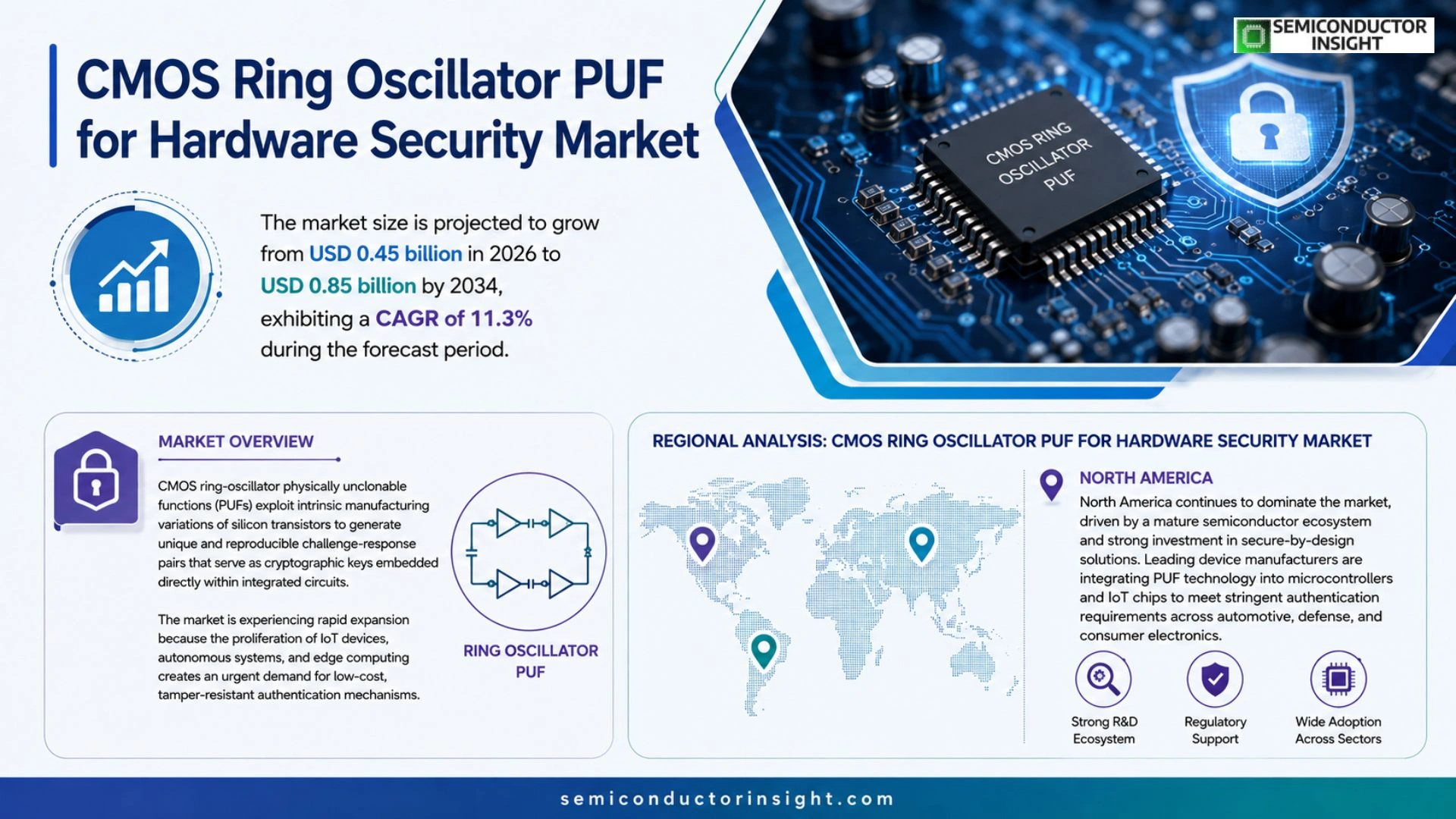
Global CMOS ring oscillator PUF for hardware security market size is projected to grow from USD 0.33 billion in 2025 to USD 0.85 billion by 2034, exhibiting a CAGR of 11.3% during the forecast period.
CMOS ring‑oscillator physically unclonable functions (PUFs) exploit intrinsic manufacturing variations of silicon transistors to generate unique and reproducible challenge‑response pairs that serve as cryptographic keys embedded directly within integrated circuits.
The market is experiencing rapid expansion because the proliferation of IoT devices, autonomous systems, and edge computing creates an urgent demand for low‑cost, tamper‑resistant authentication mechanisms.
Furthermore, heightened regulatory focus on supply‑chain integrity and rising cyber‑threat sophistication encourage semiconductor vendors such as Intel, NXP Semiconductors, and Microchip Technology to embed ring‑oscillator PUFs into their product portfolios.
MARKET DRIVERS
Growing Adoption of Secure IoT Devices
The rapid expansion of Internet‑of‑Things ecosystems is creating a pressing need for robust, low‑cost authentication mechanisms. CMOS ring oscillator PUF technology offers a silicon‑based fingerprint that can be generated without additional hardware, making it ideal for cost‑sensitive IoT deployments. Analysts estimate that secure IoT deployments will account for more than 45% of new device shipments by 2028.
Demand for Low‑Power, On‑Chip Security
Edge computing devices require security solutions that consume minimal power. The intrinsic low‑power nature of ring‑oscillator‑based PUFs aligns perfectly with battery‑operated sensors and wearable electronics, driving design choices toward this approach. Industry surveys indicate that over 60% of new ASIC projects now prioritize on‑chip PUF integration.
➤ CMOS ring oscillator PUF for hardware security Market is projected to exceed $3.2 billion by 2030, registering a CAGR of 12.5%.
These dynamics are further reinforced by increasing cyber‑threat awareness among manufacturers, who view on‑chip PUFs as a proactive defense layer against counterfeiting and cloning attacks.
MARKET CHALLENGES
Technical Integration Complexity
Integrating ring‑oscillator PUFs into existing design flows can be challenging due to variability control and calibration requirements. Many design houses lack in‑house expertise, leading to longer development cycles and higher NRE costs.
Other Challenges
Supply Chain Constraints
The specialized silicon processes required for consistent PUF performance are limited to a few foundries, which can create bottlenecks and affect volume pricing. This supply concentration may slow market adoption in price‑sensitive segments.
MARKET RESTRAINTS
Regulatory and Standardization Barriers
Global security standards for PUF implementation are still evolving, and the lack of unified certification criteria hampers cross‑border product releases. Companies often postpone PUF‑enabled designs until regulatory frameworks become clearer, which restrains market momentum.
MARKET OPPORTUNITIES
Emerging Automotive Security Applications
Automotive manufacturers are increasingly targeting secure keyless entry and in‑vehicle communication authentication. CMOS ring oscillator PUF for hardware security Market stands to benefit from this trend, as the technology satisfies automotive safety integrity level (ASIL) requirements while maintaining low latency. Forecasts suggest that automotive PUF adoption could contribute an additional $800 million in revenue by 2029.
CMOS ring oscillator PUF for hardware security Market Trends
Rapid IoT‑Driven Adoption
The proliferation of connected devices across consumer, industrial, and automotive sectors is creating a pronounced need for low‑cost, tamper‑resistant authentication. Ring‑oscillator physically unclonable functions (PUFs) satisfy this need by leveraging intrinsic transistor variations to generate cryptographic keys directly within silicon. As edge computing workloads expand, designers favor solutions that add minimal area and power overhead, making CMOS‑based PUFs an attractive choice. Concurrently, heightened regulatory scrutiny of supply‑chain security is compelling manufacturers to embed hardware‑rooted trust mechanisms early in the design flow. These forces combine to accelerate adoption rates, positioning the technology as a foundational element of next‑generation secure hardware architectures.
Other Trends
Regulatory Influence on Supply‑Chain Integrity
Governments worldwide are introducing stricter standards for device authentication and provenance tracking. Compliance frameworks now require traceable, immutable identities for critical components, prompting semiconductor vendors to integrate ring‑oscillator PUFs as a built‑in security primitive. This regulatory pressure not only drives product differentiation but also reduces the risk profile for downstream integrators, who can rely on hardware‑based keys rather than software‑only solutions. As a result, design teams are allocating greater silicon budget to PUF implementation, and verification processes are being updated to validate the uniqueness and reliability of generated challenge‑response pairs throughout the product lifecycle.
Integration by Leading Semiconductor Vendors
Major players such as Intel, NXP Semiconductors, and Microchip Technology have begun embedding ring‑oscillator PUF blocks into their standard microcontroller and SoC portfolios. This strategic move reflects confidence in the technology’s scalability and its compatibility with existing design flows. By offering pre‑qualified PUF IP, these vendors enable faster time‑to‑market for secure IoT modules and autonomous system components. The industry trend toward modular security solutions further amplifies the relevance of CMOS‑based PUFs, as system architects can selectively enable hardware authentication without extensive redesign. Consequently, the overall ecosystem is witnessing a shift toward tighter integration of physical unclonable functions as a default security layer.
COMPETITIVE LANDSCAPE
Key Industry Players
Competitive dynamics of the CMOS ring‑oscillator PUF market
The market is anchored by semiconductor giants that have integrated CMOS ring‑oscillator physically unclonable functions into their microcontroller and system‑on‑chip portfolios to address escalating IoT and edge‑compute security requirements. Intel leads the space by embedding ring‑oscillator PUFs in its Xeon and Atom families, leveraging its advanced process nodes to maximize entropy and low‑power operation. NXP Semiconductors follows closely, offering PUF‑enabled secure elements for automotive and industrial applications. Microchip Technology has differentiated its product line with dedicated PUF blocks in its PIC and AVR families, positioning itself as a cost‑effective solution for mass‑market devices. The overall market structure reflects a blend of large‑scale integrated device manufacturers and specialized security‑chip providers, all benefitting from an 11.3% projected CAGR through 2034.
Beyond the dominant tier, a suite of niche players contributes critical innovations and regional diversification. STMicroelectronics provides PUF‑enhanced microcontrollers for European automotive markets, while Texas Instruments integrates ring‑oscillator PUFs into its low‑power MSP430 series. Renesas Electronics focuses on secure IoT gateways, and Infineon Technologies supplies PUF‑rich secure MCUs for industrial control. Emerging contributors such as Samsung Electronics, AMD, Qualcomm, and Analog Devices are expanding their silicon‑security roadmaps, often collaborating with foundries to fine‑tune process variations for optimal PUF performance. These companies collectively broaden the ecosystem, fostering competitive pricing and accelerated adoption across diverse verticals.
List of Key CMOS Ring‑Oscillator PUF Companies Profiled
- Intel
- NXP Semiconductors
- Microchip Technology
- STMicroelectronics
- Texas Instruments
- Renesas Electronics
- Infineon Technologies
- Samsung Electronics
- AMD
- Qualcomm
- Analog Devices
- Broadcom
- ON Semiconductor
- GlobalFoundries
Segment Analysis:
| Segment Category | Sub-Segments | Key Insights |
| By Type |
|
Ring‑Oscillator PUF stands out as the leading type for hardware security because:
|
| By Application |
|
IoT Authentication emerges as the dominant application because:
|
| By End User |
|
Device Manufacturers drive adoption because:
|
| By Security Level |
|
High‑Assurance Security is the most valued tier because:
|
| By Integration Mode |
|
Embedded Silicon Integration dominates because:
|
Regional Analysis: CMOS ring oscillator PUF for hardware security Market
The region hosts multiple fabless innovators focused on reducing oscillator phase noise and enhancing temperature resilience, which are critical for reliable PUF operation in harsh environments.
Recent cybersecurity standards encourage embedding PUFs directly into silicon, prompting manufacturers to adopt design‑for‑security practices early in product development cycles.
Automotive OEMs, defense contractors, and IoT platform providers are the primary buyers, seeking tamper‑evident keys and low‑cost authentication for mass‑produced devices.
A well‑established fab network ensures steady silicon supply, while specialized IP vendors offer turnkey PUF blocks that integrate seamlessly with standard design flows.
Europe
European manufacturers are leveraging strong data‑privacy regulations to differentiate their hardware offerings. The focus is on creating PUF‑enabled devices that comply with GDPR‑related security expectations, especially for smart‑city infrastructure and medical devices. Collaborative research projects funded by the EU aim to standardize measurement techniques, improving cross‑vendor compatibility. Market participants emphasize low‑power designs to suit the continent’s growing emphasis on energy‑efficient IoT deployments. While adoption rates are modest compared with North America, Europe’s strategic emphasis on trustworthy hardware fuels a steady pipeline of innovative solutions.
Asia‑Pacific
Asia‑Pacific displays rapid growth potential, fueled by expansive manufacturing capacity and emerging demand for secure IoT platforms in China, India, and Southeast Asia. Original equipment manufacturers are embedding PUFs into consumer electronics to combat counterfeiting and to meet local security certifications. The region’s cost‑sensitive market drives a focus on minimalist oscillator architectures that preserve performance while minimizing silicon area. Government initiatives in several countries encourage domestic development of hardware security primitives, creating a fertile environment for both established semiconductor firms and agile start‑ups.
South America
In South America, market activity is centered around niche applications such as secure payment terminals and agricultural IoT sensors. Regional players are beginning to partner with North American IP vendors to integrate proven PUF designs into locally manufactured chips. The emphasis is on ruggedness and low‑cost production, balancing security requirements with price sensitivity. Although the overall market share remains modest, growing awareness of supply‑chain integrity is prompting increased interest from both public and private sectors.
Middle East & Africa
The Middle East & Africa region is in an early adoption phase, with interest primarily driven by defense and critical‑infrastructure projects. Countries investing in sovereign chip development are exploring PUF technology to secure communications and protect sensitive data. Limited local fabs mean most designs are imported, but regional partnerships are forming to adapt global IP to specific climate and operational constraints. As digital transformation initiatives accelerate, the demand for hardware‑based security primitives is expected to rise, setting the stage for gradual market expansion.
Report Scope
This market research report provides a comprehensive analysis of the CMOS ring oscillator PUF for hardware security Market , covering the forecast period 2026–2034. It offers detailed insights into market dynamics, technological advancements, competitive landscape, and key trends shaping the industry.
Key focus areas of the report include:
- Market Overview: The report begins with an overview outlining its current market scenario, key growth indicators, and industry transformation drivers. It discusses macroeconomic factors, demand–supply balance, regulatory landscape, and the strategic role of semiconductors in powering advancements across industries such as automotive, telecommunications, consumer electronics, and industrial automation.
- Market Size & Forecast: Historical data and future projections for revenue, unit shipments, and market value across major regions and segments.
- Segmentation Analysis: Detailed breakdown by product type, technology, application, and end-user industry to identify high-growth segments and investment opportunities.
- Regional Insights: Insights into market performance across North America, Europe, Asia-Pacific, Latin America, and the Middle East & Africa, including country-level analysis where relevant.
- Competitive Landscape: Profiles of leading market participants, including their product offerings, R&D focus, manufacturing capacity, pricing strategies, and recent developments such as mergers, acquisitions, and partnerships.
- Technology Trends & Innovation: Assessment of emerging technologies, integration of AI/IoT, semiconductor design trends, fabrication techniques, and evolving industry standards.
- Market Drivers & Restraints: Evaluation of factors driving market growth along with challenges, supply chain constraints, regulatory issues, and market-entry barriers.
- Stakeholder Insights: Insights for component suppliers, OEMs, system integrators, investors, and policymakers regarding the evolving ecosystem and strategic opportunities.
Primary and secondary research methods are employed, including interviews with industry experts, data from verified sources, and real-time market intelligence to ensure the accuracy and reliability of the insights presented.
FREQUENTLY ASKED QUESTIONS:
What is the current market size of CMOS ring oscillator PUF for hardware security Market?
-> CMOS ring oscillator PUF for hardware security market size is projected to grow from USD 0.33 billion in 2025 to USD 0.85 billion by 2034.
Which key companies operate in CMOS ring oscillator PUF for hardware security Market?
-> Key players include Intel, NXP Semiconductors, and Microchip Technology, among others.
What are the key growth drivers?
-> Key growth drivers include the rapid proliferation of IoT devices, autonomous systems, edge computing, heightened regulatory focus on supply‑chain integrity, and increasing cyber‑threat sophistication.
Which region dominates the market?
-> The reference does not specify a dominant region.
What are the emerging trends?
-> Emerging trends include integration of ring‑oscillator PUFs into IoT and edge devices, increased adoption for secure authentication in autonomous systems, and the development of standards for PUF‑based cryptographic keys.

Get Sample Report PDF for Exclusive Insights
Report Sample Includes
- Table of Contents
- List of Tables & Figures
- Charts, Research Methodology, and more...