
Cloud Radio Access Network Semiconductor Market Insights
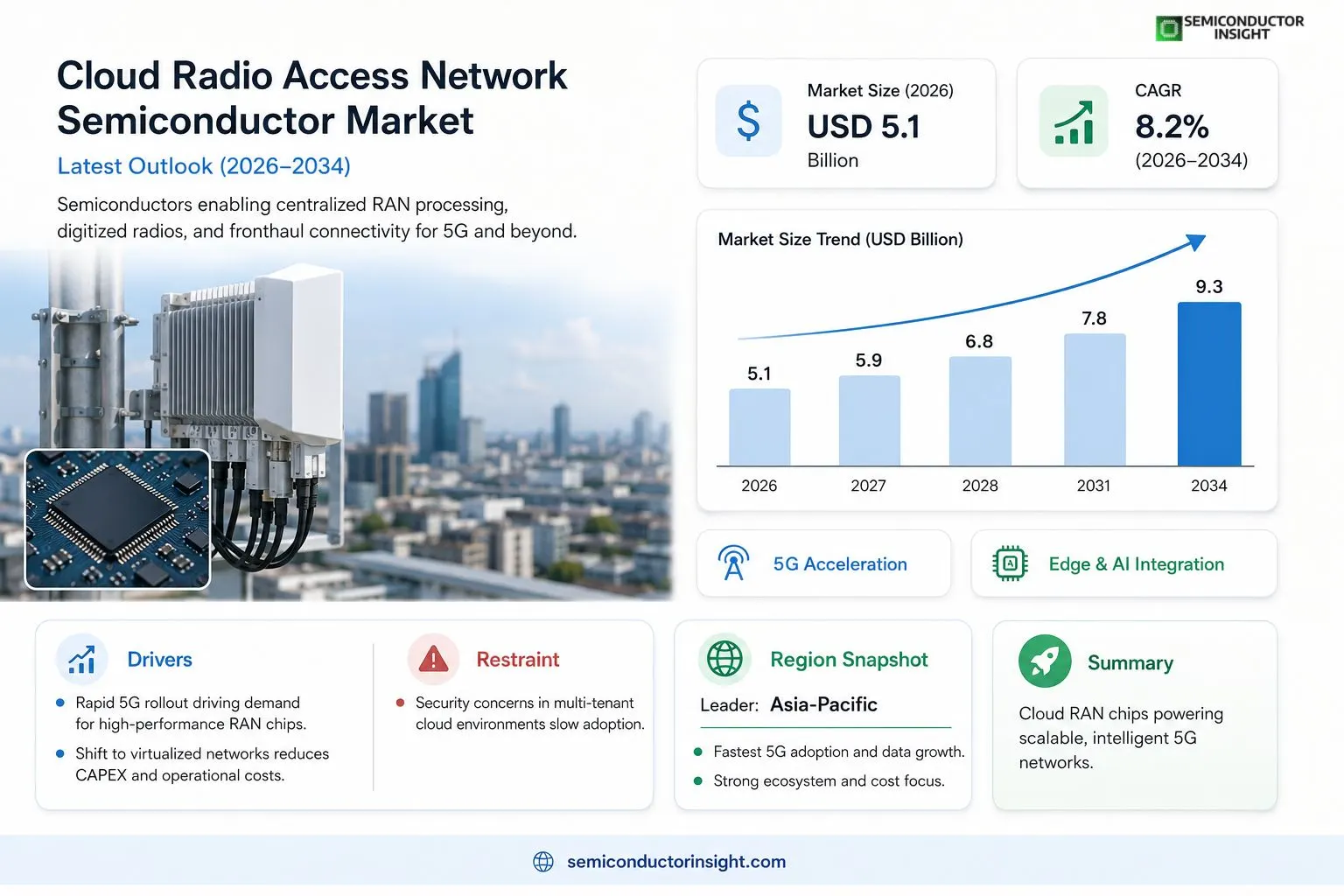
Global Cloud Radio Access Network Semiconductor Market is projected to grow from USD 5.1 billion in 2026 to USD 9.3 billion by 2034, exhibiting a CAGR of 8.2% during the forecast period.
Cloud Radio Access Network (C‑RAN) semiconductors are integrated circuit solutions that enable centralized baseband processing, radio unit digitization, and fronthaul connectivity for next‑generation mobile networks. These chips typically incorporate high‑performance baseband processors, RF transceivers, and advanced power‑management units, facilitating low‑latency, scalable deployment of 5G and future 6G infrastructures.The market is experiencing rapid growth because telecom operators are accelerating network densification and virtualized architecture adoption. However, challenges such as spectrum scarcity and high upfront CapEx persist. Furthermore, rising demand for edge computing and AI‑driven network optimization further fuels investment in C‑RAN semiconductor platforms. Key players—including Qualcomm Technologies, Intel Corporation, MediaTek Inc., and Samsung Electronics—are expanding their portfolios through strategic partnerships and technology roadmaps announced throughout 2023‑2024.
MARKET DRIVERS
Increasing 5G Adoption Fuels Demand
The rapid rollout of 5G networks worldwide is a primary catalyst for Cloud Radio Access Network Semiconductor Market. Mobile operators are transitioning from traditional RAN architectures to cloud‑native solutions to achieve higher throughput, lower latency, and flexible scaling. This shift is driving semiconductor manufacturers to develop high‑performance baseband processors and fronthaul chips that can support massive MIMO and beamforming.
Shift Toward Virtualized Network Infrastructure
Enterprises are embracing network function virtualization (NFV) and software‑defined networking (SDN) to reduce CAPEX and OPEX. Cloud‑based RAN reduces the need for costly on‑site hardware, prompting operators to invest in specialized semiconductor solutions that enable seamless integration of virtualized base stations and edge computing resources.
➤ Analysts estimate that the Cloud RAN semiconductor segment will grow at a CAGR of roughly 12% through 2030, reflecting the accelerating migration to cloud‑centric wireless architectures.
Another important driver is the growing emphasis on energy efficiency. Modern semiconductor designs incorporate advanced power‑saving techniques, which align with the sustainability goals of telecom providers and help lower the total cost of ownership for cloud‑based radio access networks.
MARKET CHALLENGES
High Capital Expenditure for Initial Deployment
While cloud RAN promises long‑term cost savings, the upfront investment required for data center upgrades, high‑speed fiber deployment, and specialized semiconductor hardware remains a significant hurdle for many operators, especially in emerging markets.
Other Challenges
Interoperability and Standardization
The lack of universally accepted standards for cloud‑native interfaces can lead to integration complexities, forcing vendors to support multiple protocols and increasing engineering effort.
MARKET RESTRAINTS
Security Concerns in Multi‑Tenant Environments
Deploying RAN functions in shared cloud infrastructures raises issues related to data privacy, cyber‑attack surface, and regulatory compliance. Operators are cautious about exposing critical radio functions to potential vulnerabilities, which can slow the adoption of cloud‑based semiconductor solutions.
MARKET OPPORTUNITIES
Edge‑Centric Applications and Private 5G Networks
Growth in industrial IoT, autonomous vehicles, and smart‑city initiatives is driving demand for low‑latency, edge‑distributed compute. Semiconductor vendors that can deliver compact, high‑performance chips optimized for edge‑deployed cloud RAN stand to capture a sizable share of this emerging market segment.
Cloud Radio Access Network Semiconductor Market Trends
Centralized Baseband Processing Fuels Market Momentum
Cloud Radio Access Network Semiconductor Market is being reshaped by the rapid rollout of centralized baseband architectures. Semiconductor designers are delivering integrated circuit solutions that combine high‑performance baseband processors, RF transceivers, and advanced power‑management units on a single die. This integration reduces latency and enables scalable deployment of 5G services while preparing the substrate for future 6G requirements. Telecom operators, seeking to densify network footprints and adopt virtualized RAN, prefer these chips because they support flexible fronthaul connectivity and simplify hardware provisioning in edge sites. The resulting efficiency gains are prompting operators to migrate legacy Distributed RAN nodes to cloud‑native platforms, creating a sustained demand pipeline for next‑generation semiconductor offerings.
Other Trends
Spectrum Scarcity and Capital Expenditure Constraints
Despite strong technical incentives, the market encounters notable hurdles. Limited spectrum availability in many regions forces operators to optimize existing bands, placing additional performance pressure on semiconductor components to deliver higher throughput per Hertz. Simultaneously, the upfront capital expenditure required for large‑scale C‑RAN deployment remains substantial. Operators balance the long‑term operational savings against short‑term financial outlays, often staging investments over multiple fiscal periods. Vendors respond by offering modular chip families that can be incrementally upgraded, allowing network owners to spread costs while still benefiting from the advantages of centralized processing.
Edge Computing and AI Integration Accelerate Adoption
Edge computing workloads and AI‑driven network optimization are emerging as powerful catalysts for further market expansion. Modern C‑RAN semiconductors embed AI inference engines that enable real‑time traffic steering, interference mitigation, and predictive maintenance at the radio unit level. By processing data closer to the user, these chips reduce backhaul demand and improve quality of experience for latency‑sensitive applications such as augmented reality and autonomous vehicles. Leading vendors—including Qualcomm Technologies, Intel Corporation, MediaTek Inc., and Samsung Electronics—have announced strategic partnerships and roadmaps that prioritize AI acceleration and edge‑centric features, reinforcing the market’s trajectory toward more intelligent and distributed radio access solutions.
COMPETITIVE LANDSCAPEKey Industry Players
Competitive Overview of the Cloud RAN Semiconductor Industry
The Cloud Radio Access Network (C‑RAN) semiconductor market is dominated by a handful of globally recognized silicon innovators that command the majority of design wins for 5G and emerging 6G deployments. Qualcomm Technologies leads with its integrated baseband and RF solutions that enable high‑throughput fronthaul while offering power‑efficient processing for massive MIMO arrays. Intel Corporation follows, leveraging its x86‑based portfolio and recent acquisition of Altera (now Intel Programmable Solutions) to provide flexible, data‑center‑grade chips for edge‑compute‑enabled RANs. MediaTek Inc. has accelerated its C‑RAN cadence through aggressive roadmap announcements, targeting cost‑sensitive operators in emerging markets. Samsung Electronics complements the ecosystem with advanced System‑on‑Chip (SoC) designs that integrate AI‑driven radio scheduling, positioning the company as a critical supplier for both network equipment manufacturers (NEMs) and mobile operators.Beyond the primary tier, a diverse set of niche players contributes specialized capabilities that enrich the overall market fabric. Nvidia’s AI‑optimized GPUs are increasingly embedded in virtualized RAN platforms to enable real‑time inference for network optimization. Broadcom supplies high‑frequency RF transceivers that meet stringent linearity requirements for dense urban deployments. AMD (through its Xilinx acquisition) delivers reconfigurable logic that accelerates prototyping of custom C‑RAN functions. Marvell, Huawei, ZTE, Nokia, Ericsson, Qorvo, NXP Semiconductors, Renesas Electronics, and Skyworks Solutions round out the competitive set, each offering differentiated IP blocks, power‑management solutions, or region‑specific compliance that support operators’ varied rollout strategies.
List of Key Cloud Radio Access Network Semiconductor Companies Profiled
- Qualcomm Technologies
- Intel Corporation
- MediaTek Inc.
- Samsung Electronics
- Nvidia Corporation
- Broadcom Inc.
- Advanced Micro Devices (AMD) – Xilinx
- Marvell Technology Group Ltd.
- Huawei Technologies Co., Ltd.
- ZTE Corporation
- Nokia Corporation
- Ericsson AB
- Qorvo, Inc.
- NXP Semiconductors N.V.
- Renesas Electronics Corporation
- Skyworks Solutions, Inc.
Segment Analysis:
| Segment Category | Sub-Segments | Key Insights |
| By Type |
|
Baseband Processors
|
| By Application |
|
Edge Computing Nodes
|
| By End User |
|
Telecom Operators
|
| By [Segment Category 3]] |
|
Leading Segment description with qualitative insights only [Pointers preferred in bullets atleast 2-3]. |
| By [Segment Category 4]] |
|
Leading Segment description with qualitative insights only [Pointers preferred in bullets atleast 2-3]. |
Regional Analysis: North America
North America
Ongoing investments in 5G infrastructure across North America are fueling demand for advanced semiconductors. This includes equipment for base stations, core networks, and edge computing facilities. The need for high-bandwidth, low-latency connectivity is a primary driver.
The growth of edge computing is creating new opportunities for semiconductor manufacturers. Cloud RAN deployments often involve processing data closer to the source, requiring powerful and energy-efficient chips.
Security remains a critical concern in the Cloud Radio Access Network. Semiconductors with built-in security features and robust encryption capabilities are in high demand to protect against evolving cyber threats.
There is a growing emphasis on energy efficiency in Cloud RAN deployments to reduce operational costs and environmental impact. Semiconductor vendors are focusing on developing power-optimized solutions.
North America
Cloud Radio Access Network Semiconductor Market in North America is experiencing significant transformation driven by the expanding 5G landscape. The architecture of Cloud Radio Access Network impacts the semiconductor market significantly, requiring specialized chips for distributed units and cloud-based processing. This shift has created a substantial demand for semiconductors capable of handling high data throughputs with low latency. The mature telecommunications infrastructure and a robust ecosystem of technology providers further support market growth. The focus within the market is on optimizing network performance, lowering operational expenses, and ensuring security. As the deployment of Cloud RAN continues to accelerate, the demand for sophisticated semiconductor solutions will increase, leading to innovation and competitiveness among market participants.
Europe
Europe’s Cloud Radio Access Network Semiconductor Market is characterized by a strong emphasis on regulatory compliance and data privacy. The region has a well-established telecommunications infrastructure and is actively pursuing 5G deployments. Key trends include the adoption of open RAN architectures and a growing focus on energy efficiency. The market is influenced by stringent data protection regulations, which impact the design and functionality of semiconductors used in Cloud RAN systems. The competitive landscape is marked by a mix of established semiconductor vendors and emerging players.
Asia-Pacific
Asia-Pacific represents the largest and fastest-growing market for Cloud Radio Access Network Semiconductor Market. This growth is driven by rapid 5G adoption, increasing mobile data consumption, and government initiatives to promote digital transformation. The region has a diverse range of telecommunications operators and a rapidly expanding ecosystem of technology vendors. Semiconductor demand is particularly strong in countries like China, India, and Japan. The focus is on cost-effective solutions, energy efficiency, and supporting the deployment of high-capacity networks.
South America
Cloud Radio Access Network Semiconductor Market in South America is in an early stage of development but has significant growth potential. The region is witnessing increasing investments in 5G infrastructure and a growing demand for high-speed mobile connectivity. The market is influenced by factors such as economic growth, government policies, and the availability of funding for network upgrades. The focus is on providing affordable and reliable connectivity to address the digital divide.
Middle East & Africa
Cloud Radio Access Network Semiconductor Market in the Middle East & Africa is characterized by a growing demand for mobile data and a focus on expanding network coverage. The region is witnessing increasing investments in 5G infrastructure and a growing adoption of cloud-based services. The market is influenced by factors such as economic development, government initiatives, and the increasing use of mobile devices. The focus is on providing cost-effective and reliable connectivity to support the region’s digital transformation.
Report Scope
This market research report provides a comprehensive analysis of the Cloud Radio Access Network Semiconductor Market , covering the forecast period 2026–2034. It offers detailed insights into market dynamics, technological advancements, competitive landscape, and key trends shaping the industry.
Key focus areas of the report include:
- Market Overview: ✅ The report begins with an overview outlining its current market scenario, key growth indicators, and industry transformation drivers. It discusses macroeconomic factors, demand–supply balance, regulatory landscape, and the strategic role of semiconductors in powering advancements across industries such as automotive, telecommunications, consumer electronics, and industrial automation.
- ✅ Market Size & Forecast: Historical data and future projections for revenue, unit shipments, and market value across major regions and segments.
- ✅ Segmentation Analysis: Detailed breakdown by product type, technology, application, and end-user industry to identify high-growth segments and investment opportunities.
- ✅ Regional Insights: Insights into market performance across North America, Europe, Asia-Pacific, Latin America, and the Middle East & Africa, including country-level analysis where relevant.
- ✅ Competitive Landscape: Profiles of leading market participants, including their product offerings, R&D focus, manufacturing capacity, pricing strategies, and recent developments such as mergers, acquisitions, and partnerships.
- ✅ Technology Trends & Innovation: Assessment of emerging technologies, integration of AI/IoT, semiconductor design trends, fabrication techniques, and evolving industry standards.
- ✅ Market Drivers & Restraints: Evaluation of factors driving market growth along with challenges, supply chain constraints, regulatory issues, and market-entry barriers.
- ✅ Stakeholder Insights: Insights for component suppliers, OEMs, system integrators, investors, and policymakers regarding the evolving ecosystem and strategic opportunities.
Primary and secondary research methods are employed, including interviews with industry experts, data from verified sources, and real-time market intelligence to ensure the accuracy and reliability of the insights presented.
FREQUENTLY ASKED QUESTIONS:
What is the current market size of Cloud Radio Access Network Semiconductor Market?
-> Cloud Radio Access Network Semiconductor Market was valued at USD 4.7 billion in 2025 and is expected to reach USD 9.3 billion by 2034.
Which key companies operate in Cloud Radio Access Network Semiconductor Market?
-> Key players include Qualcomm Technologies, Intel Corporation, MediaTek Inc., and Samsung Electronics.
What are the key growth drivers?
-> Key growth drivers include network densification, virtualized architecture adoption, edge computing demand, and AI‑driven network optimization.
Which region dominates the market?
-> The reference does not specify a dominant region.
What are the emerging trends?
-> Emerging trends include integration of high‑performance baseband processors, RF transceivers, advanced power‑management units, and the convergence of AI/IoT with C‑RAN semiconductor platforms.
Get Sample Report PDF for Exclusive Insights
Report Sample Includes
- Table of Contents
- List of Tables & Figures
- Charts, Research Methodology, and more...
 Download Sample Report PDF


