
Clean Room Chemical Filter Market Insights
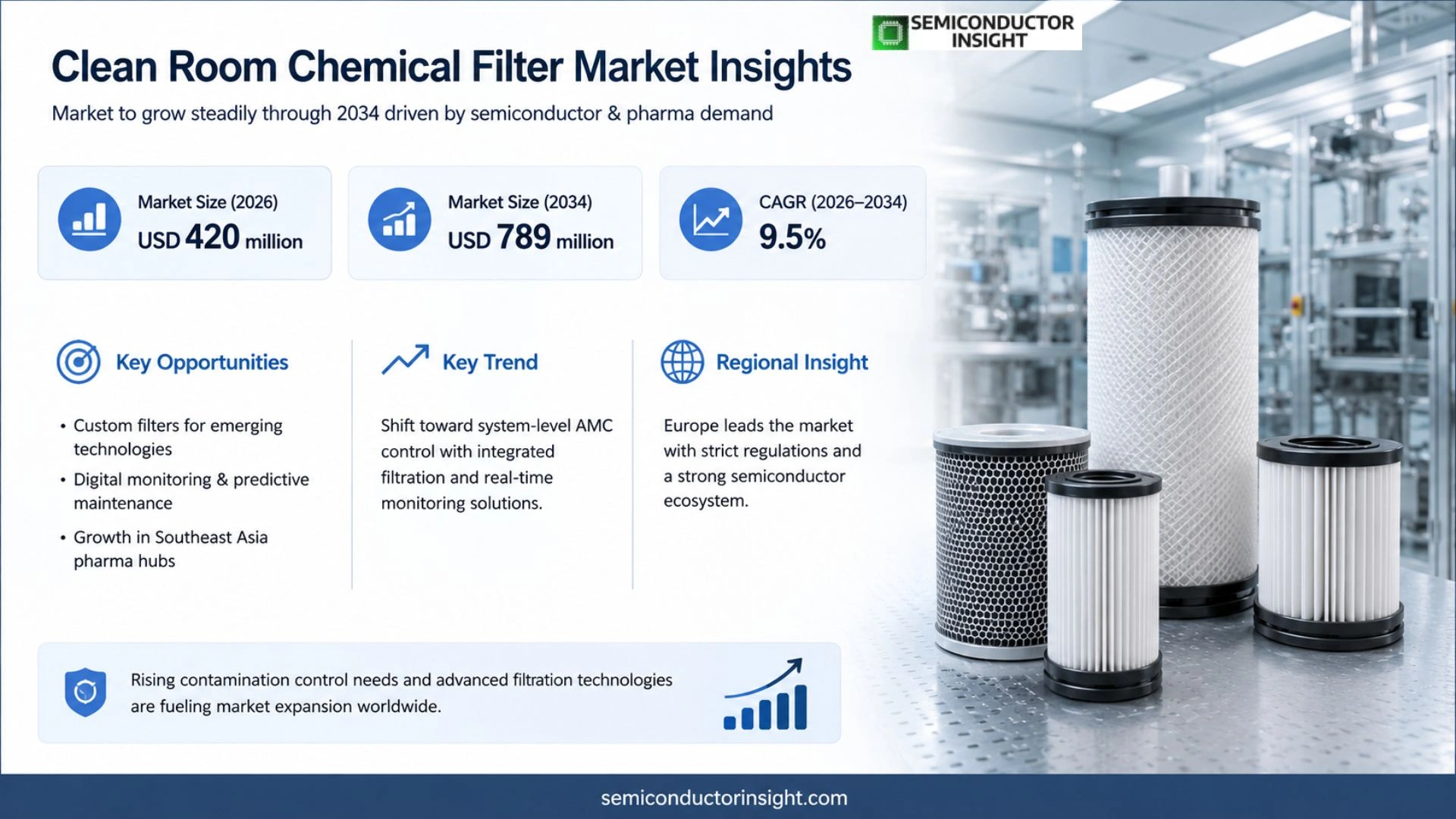
Clean Room Chemical Filter market is projected to grow from USD 420 million in 2026 to USD 789 million by 2034, exhibiting a CAGR of 9.5% during the forecast period.
Clean room chemical filters are airborne molecular contamination (AMC) control products used in semiconductor fabs, display lines, data‑center facilities and other ultra‑clean environments. Their primary function is the selective removal of acidic gases, alkaline gases, organic vapors and dopant‑related molecules rather than particle capture, thereby protecting wafers, lithography tools and metrology equipment while reducing defect rates and improving yield. Typical designs incorporate activated carbon, impregnated carbon or activated alumina media configured as panels, boxes or V‑bank modules that deliver low pressure‑drop and low outgassing performance.
MARKET DRIVERS
Increasing Demand for Contamination Control
Clean Room Chemical Filter Market is being propelled by manufacturers that must meet tighter particulate and chemical emission limits. As product lines become more sensitive, firms invest in higher‑efficiency filtration media to safeguard yield and comply with regulatory expectations. This shift tends to raise the average spend per square metre of clean‑room infrastructure, creating a clear upside for filter suppliers.
Expansion of Advanced Semiconductor Fabrication
Semiconductor fabs are scaling to sub‑10 nm nodes, a process that generates more volatile organic compounds and ultrafine particles. To maintain defect‑free wafers, operators replace legacy filters with chemically resistant cartridges that can handle aggressive etchants. The resulting upgrade cycles inject steady demand into Clean Room Chemical Filter Market.
➤ “Upgrading filtration systems is now a strategic priority for any plant aiming to stay competitive in high‑tech manufacturing.”
Beyond semiconductor, the rise of biologics and sterile drug manufacturing adds a layer of scrutiny around airborne contaminants. Companies in these sectors are adopting filter designs that combine HEPA efficiency with chemical sorption capabilities, a niche that is expanding the addressable market for specialized filter solutions.
MARKET CHALLENGES
Stringent Certification Requirements
Certification bodies such as ISO‑14644 and GMP prescribe precise testing protocols for filter performance. Meeting these standards demands significant engineering effort and can elongate product development cycles. Suppliers that cannot demonstrate compliance risk exclusion from high‑margin contracts within Clean Room Chemical Filter Market.
Other Challenges
Cost Sensitivity in Emerging Regions
Manufacturers in developing economies often operate on thin margins, prompting them to favor lower‑cost filtration options. This price pressure can deter adoption of premium chemically resistant media, limiting market penetration despite the technical advantages of advanced filters.
MARKET RESTRAINTS
Limited Availability of High‑Performance Materials
Materials that simultaneously offer high chemical resistance, low pressure drop, and robust particle capture are produced by a small group of specialty manufacturers. Supply chain bottlenecks in these raw materials can cause lead‑time extensions, discouraging end‑users from placing large orders for new filter installations.
The capital intensity of retrofitting existing clean rooms further restrains growth. Installing upgraded filtration often requires HVAC redesign, a project that can stall if the anticipated return on investment is unclear. This hesitancy slows the overall velocity of Clean Room Chemical Filter Market.
Regulatory fragmentation across regions adds another layer of complexity. Differing test methods and certification timelines force suppliers to maintain multiple product variants, inflating R&D costs and diluting focus on core innovations.
MARKET OPPORTUNITIES
Customization for Emerging Technologies
Industries such as quantum computing and advanced battery manufacturing are beginning to define their own contamination profiles. Tailored filter cartridges that address niche chemicals and particles present a high‑margin avenue for suppliers willing to co‑develop solutions with early adopters in Clean Room Chemical Filter Market.
Digital monitoring platforms that integrate pressure‑drop analytics with filter life‑cycle management are gaining traction. Vendors that bundle sensor‑enabled filters with predictive maintenance software can differentiate themselves and capture a larger share of service‑related revenue.
Geographically, the rollout of new pharma production hubs in Southeast Asia offers a fresh demand base. Local partners that navigate regional certification frameworks can secure contracts that were previously dominated by established Western players, expanding the overall market footprint.
Clean Room Chemical Filter Market Trends
Shift Toward System‑Level AMC Control
Clean Room Chemical Filter Market is moving beyond isolated cartridge replacements toward integrated air‑management solutions that address contamination at multiple points in a fab’s ventilation network. Suppliers now bundle fresh‑air, recirculation, and equipment‑inlet filtration with on‑site monitoring hardware, enabling real‑time adjustments to media selection as process loads change. This approach reduces the latency between contaminant breakthrough and corrective action, directly impacting defect density in sub‑nanometer lithography steps. Companies that can demonstrate a measurable yield uplift from coordinated filter architectures are gaining preference in high‑volume semiconductor plants, where even marginal improvements translate into sizable revenue protection.
Other Trends
Modular and Regenerative Media Platforms
Designs that allow filter elements to be extracted, regenerated, or swapped without full system shutdown are gaining traction, especially in regions where labor costs for rapid turn‑around are high. Modular trays and V‑bank configurations let operators replace spent adsorbent media while maintaining airflow continuity, preserving process uptime. Regeneration cycles based on breakthrough analysis extend service life threefold compared with conventional single‑use cartridges, aligning with green‑manufacturing targets that many large fabs now mandate. This evolution pushes vendors toward service‑oriented business models, blending hardware sales with ongoing maintenance contracts.
Regional Emphasis on Energy‑Efficient Filtration
In East Asian manufacturing clusters, the pressure to reduce operational electricity consumption is reshaping filter design priorities. Low‑pressure‑drop media that maintain removal efficiencies above 90 % are becoming baseline specifications, as utilities price energy more aggressively. Meanwhile, North American and European customers are emphasizing compliance with emerging standards for out‑gassing and waste‑stream minimization, prompting a rise in composite adsorbents that combine activated carbon with ion‑exchange fibers. The convergence of these regional pressures is fostering a competitive landscape where performance, energy use, and lifecycle cost are evaluated holistically rather than in isolation.
COMPETITIVE LANDSCAPE
Key Industry Players
Clean Room Chemical Filter Market – Competitive Overview
Entegris remains the de‑facto benchmark in the sector, largely because its tool‑level AMC portfolio couples high‑removal media blends with a global service network that spans most major fabs. The company’s ability to tailor activated‑carbon and alumina formulations to specific lithography or CMP tools gives it leverage over both pure‑play filter manufacturers and broader clean‑room equipment suppliers. AAF International follows closely, leveraging a diversified format catalog, box, canister, V‑bank and tray, to satisfy MAU, RAU and FFU applications across North America, Europe and Asia. Camfil’s European heritage and strict adherence to ISO 10121 testing standards have positioned it as a preferred partner for display‑panel lines that prioritize low out‑gassing and modular regeneration. Together, these three firms anchor a market structure where multinational OEMs provide end‑to‑end solutions, while a growing cohort of regional specialists competes on niche media chemistries, pressure‑drop optimization, and on‑site service contracts.
Beyond the global leaders, a cluster of Asian companies is reshaping the competitive dynamics by focusing on high‑volume, cost‑effective designs for the rapidly expanding wafer‑fab ecosystems in China, Taiwan, South Korea and Japan. MayAir Technology (China) differentiates its Puro‑F, Puro‑C and Puro‑V lines through documented efficiency gains above 90 % and service‑life extensions that triple typical expectations. GreenFiltec and Yesiang advance the sustainability narrative, offering 3R‑compatible modular cartridges and regenerative media that reduce waste streams. Dan‑Takuma and Nippon Muki, both Japanese, are entrenched in ultra‑clean environments for semiconductor photolithography, emphasizing ultra‑low pressure drop and near‑zero particle generation. EcoPro HN (South Korea) integrates ESG‑focused product roadmaps, while Purafil and Exyte Technology provide complementary system‑level engineering services that bundle filtration with air‑handling and monitoring solutions. This diversification signals a shift from pure filtration performance toward integrated, lifecycle‑managed offerings that address energy consumption, waste reduction and rapid replacement logistics.
List of Key Clean Room Chemical Filter Companies Profiled
- Entegris
- AAF International
- Camfil
- MayAir Technology (China) Co., Ltd.
- GreenFiltec Ltd.
- YESIANG Enterprise
- Dan‑Takuma Co., Ltd.
- Nippon Muki Co., Ltd.
- EcoPro HN Co., Ltd.
- Purafil
- Exyte Technology
- Purafil
- MayAir Technology (China) – Modular Line
- GreenFiltec – 3R Solutions
- YESIANG – Regenerative Media
Segment Analysis:
| Segment Category | Sub-Segments | Key Insights |
| By Type |
|
Chemisorption Filters
|
| By Application |
|
Process Tool Inlet Protection
|
| By End User |
|
Semiconductor Wafer fabs
|
| By Media Technology |
|
Hybrid Composite Media
|
| By Service Model |
|
Regeneration‑As‑a‑Service
|
Regional Analysis: Clean Room Chemical Filter Market
Europe
European directives such as EU‑97/68 set low permissible limits for volatile organic compounds, compelling clean‑room operators to specify filters with ≥99.99% removal efficiency. Compliance audits intensify scrutiny on filter integrity, driving investors toward vendors who provide comprehensive validation kits and documented traceability. Consequently, regulatory stringency fuels a premium segment within the market.
Europe’s established polymer extrusion facilities benefit from a skilled labor pool and proximity to raw‑material suppliers, enabling short lead times for custom filter media. Major producers have expanded capacity to accommodate the surge in demand from both semiconductor fabs and emerging biotech clusters, while maintaining stringent quality‑control protocols that satisfy Tier‑1 OEM requirements.
Germany’s Baden‑Wurttemberg region, France’s Île‑de‑France corridor, and the Netherlands’ Eindhoven cluster converge as hotbeds for filter‑media R&D. Collaborative programs between universities and industry accelerate the adoption of nanofiber layers and electrostatic charging techniques, delivering higher contaminant capture without increasing pressure drop. These breakthroughs translate into differentiated product lines that command higher margins.
Recent geopolitical tensions have prompted European firms to diversify logistics, establishing regional depots in Eastern Europe and the Mediterranean to hedge against port disruptions. By coupling digital inventory platforms with just‑in‑time replenishment, manufacturers can sustain uninterrupted filter supply even during raw‑material shortages, preserving operational continuity for downstream clean‑room facilities. This strategic layering reduces reliance on single‑source suppliers and enhances overall market agility.
North America
North America remains a formidable contender in Clean Room Chemical Filter Market, driven largely by the United States’ expansive semiconductor manufacturing footprint. Federal initiatives that fund advanced packaging and heterogeneous integration projects have spurred demand for filters that can handle increased particle fluxes. However, the region’s fragmented supplier landscape, characterized by a mix of legacy filter manufacturers and emerging start‑ups, creates a competitive arena where price sensitivity coexists with a quest for performance. The adoption of lean inventory models, accelerated by the pandemic’s supply shock, forces vendors to prove reliability through rigorous certification programs. As a result, partnerships between filter producers and fab operators are evolving into long‑term service agreements that embed filter performance guarantees into equipment leasing contracts.
Asia-Pacific
Asia‑Pacific is emerging as the fastest‑growing arena for clean‑room filtration, underpinned by the rapid expansion of semiconductor fabs in China, Taiwan, South Korea and increasingly, Vietnam. Government incentives targeting high‑value manufacturing encourage fabs to adopt next‑generation filtration technologies that can sustain sub‑nanometer particle control. Local producers leverage cost‑effective polymer sourcing to offer competitively priced filters, yet they face pressure to meet international quality certifications demanded by multinational equipment OEMs. The region’s intense talent pipeline fuels continuous improvement in filter media engineering, while cross‑border collaborations with European research institutes accelerate technology transfer. Consequently, Asia‑Pacific firms are poised to capture market share by balancing affordability with compliance.
South America
South America’s footprint in Clean Room Chemical Filter Market is modest but gaining traction as the region diversifies beyond traditional extractive industries. Brazil’s emerging medical‑device sector and Argentina’s growing pharmaceutical manufacturing base require controlled environments, prompting local suppliers to adapt filter designs originally intended for electronics. Investment in clean‑room infrastructure, supported by government‑backed industrial parks, is creating a nascent demand curve. Nevertheless, logistical challenges, particularly lengthy customs procedures and limited domestic polymer producers, constrain rapid scale‑up. Companies that can establish regional distribution hubs and offer localized technical support are likely to differentiate themselves and secure contracts with multinational firms expanding into the continent.
Middle East & Africa
The Middle East & Africa (MEA) region presents a niche but strategic opportunity for Clean Room Chemical Filter Market, primarily driven by the United Arab Emirates’ ambition to become a hub for high‑tech manufacturing and biotech research. State‑backed initiatives to attract semiconductor and pharmaceutical investors necessitate compliance with strict clean‑room standards, opening a market for premium filtration solutions. Local distributors are beginning to partner with European filter manufacturers to import validated products, while regional universities initiate joint R&D projects on anti‑microbial filter coatings. Supply‑chain constraints, such as dependence on imports for raw polymers, remain a challenge, yet the willingness of MEA governments to subsidize critical infrastructure could offset these hurdles and stimulate market entry.
Report Scope
This market research report provides a comprehensive analysis of the Clean Room Chemical Filter Market , covering the forecast period 2026–2034. It offers detailed insights into market dynamics, technological advancements, competitive landscape, and key trends shaping the industry.
Key focus areas of the report include:
- Market Overview: The report begins with an overview outlining its current market scenario, key growth indicators, and industry transformation drivers. It discusses macroeconomic factors, demand–supply balance, regulatory landscape, and the strategic role of semiconductors in powering advancements across industries such as automotive, telecommunications, consumer electronics, and industrial automation.
- Market Size & Forecast: Historical data and future projections for revenue, unit shipments, and market value across major regions and segments.
- Segmentation Analysis: Detailed breakdown by product type, technology, application, and end-user industry to identify high-growth segments and investment opportunities.
- Regional Insights: Insights into market performance across North America, Europe, Asia-Pacific, Latin America, and the Middle East & Africa, including country-level analysis where relevant.
- Competitive Landscape: Profiles of leading market participants, including their product offerings, R&D focus, manufacturing capacity, pricing strategies, and recent developments such as mergers, acquisitions, and partnerships.
- Technology Trends & Innovation: Assessment of emerging technologies, integration of AI/IoT, semiconductor design trends, fabrication techniques, and evolving industry standards.
- Market Drivers & Restraints: Evaluation of factors driving market growth along with challenges, supply chain constraints, regulatory issues, and market-entry barriers.
- Stakeholder Insights: Insights for component suppliers, OEMs, system integrators, investors, and policymakers regarding the evolving ecosystem and strategic opportunities.
Primary and secondary research methods are employed, including interviews with industry experts, data from verified sources, and real-time market intelligence to ensure the accuracy and reliability of the insights presented.
FREQUENTLY ASKED QUESTIONS:
What is the current market size of Clean Room Chemical Filter Market?
-> Clean Room Chemical Filter market is projected to grow from USD 420 million in 2026 to USD 789 million by 2034, exhibiting a CAGR of 9.5%
Which key companies operate in Clean Room Chemical Filter Market?
-> Key players include Exyte Technology, Entegris, Camfil, Purafil, AAF International, Nippon Muki Co., Ltd., DAN-TAKUMA Co., Ltd., ECOPRO HN Co., Ltd., YESIANG Enterprise, GreenFiltec Ltd., MayAir Technology (China) Co., Ltd., among others.
What are the key growth drivers?
-> Key growth drivers include shrink‑then‑line widths and advanced node requirements, the need for sub‑ppb AMC control to improve yield, energy‑efficient low‑pressure‑drop filter designs, and rising emphasis on green manufacturing and circular‑economy practices.
Which region dominates the market?
-> Asia remains the dominant region, driven by a high concentration of semiconductor fabs, display manufacturers, and clean‑room engineering activities in Mainland China, Taiwan, South Korea, Japan and the United States.
What are the emerging trends?
-> Emerging trends include modular and regenerative filter architectures, integrated AMC monitoring and media‑selection services, and the convergence of filtration with IoT‑enabled performance verification.

Get Sample Report PDF for Exclusive Insights
Report Sample Includes
- Table of Contents
- List of Tables & Figures
- Charts, Research Methodology, and more...
