
MARKET INSIGHTS
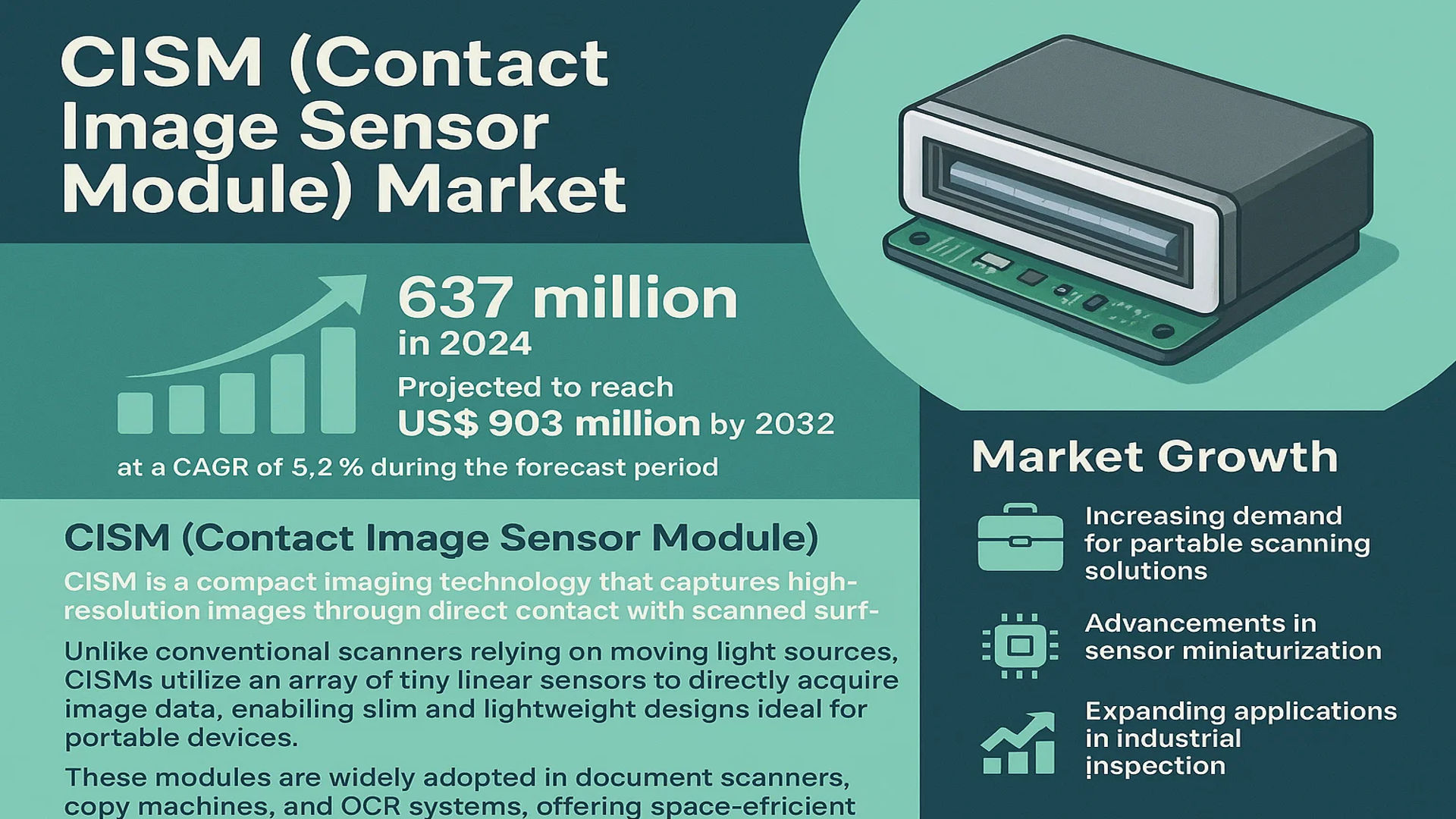
The global CISM (Contact Image Sensor Module) Market was valued at 637 million in 2024 and is projected to reach US$ 903 million by 2032, at a CAGR of 5.2% during the forecast period.
CISM (Contact Image Sensor Module) is a compact imaging technology that captures high-resolution images through direct contact with the scanned surface. Unlike conventional scanners relying on moving light sources, CISMs utilize an array of tiny linear sensors to directly acquire image data, enabling slim and lightweight designs ideal for portable devices. These modules are widely adopted in document scanners, copy machines, and OCR systems, offering space-efficient solutions for applications requiring precise image capture.
The market growth is driven by increasing demand for portable scanning solutions, advancements in sensor miniaturization, and expanding applications in industrial inspection. However, competition from CMOS-based scanning technologies poses a challenge. Key players like Mitsubishi Electric, Canon, and ON Semiconductor dominate the market, collectively holding a significant revenue share. Recent innovations focus on improving resolution and power efficiency to meet evolving industry demands.
MARKET DYNAMICS
MARKET DRIVERS
Growing Demand for Compact and Portable Scanning Solutions Accelerates CISM Adoption
The global shift towards digitization and paperless workflows continues to drive demand for efficient document scanning solutions. Contact Image Sensor Modules have emerged as a preferred technology for compact scanning devices due to their slim form factor and energy-efficient operation. Unlike traditional CCD-based scanners, CISMs eliminate the need for complex optical systems while delivering high-resolution imaging. The technology’s compatibility with mobile devices has fueled innovations in portable scanners, with the handheld scanner segment expected to grow at over 6% CAGR through 2030. This aligns with the increasing mobile workforce, where professionals require on-the-go document capture solutions.
Advancements in OCR Technology Expand Application Scope
Optical Character Recognition has undergone significant technological improvements, with modern systems achieving accuracy rates exceeding 98% for printed text. This evolution has created substantial demand for high-performance imaging modules that can capture text with exceptional clarity. CISMs provide distinct advantages for OCR applications, offering superior edge definition and consistent illumination across the scanning surface. Recent innovations in AI-powered document processing further amplify this demand, as machine learning algorithms require high-fidelity input images for reliable text extraction. The global OCR market, projected to surpass $26 billion by 2027, represents a key growth avenue for CISM technology adoption.
Furthermore, regulatory mandates for digital record-keeping across healthcare, financial services, and government sectors continue to drive investments in scanning infrastructure. Many institutions now require electronic document management systems that depend on reliable scanning solutions.
➤ For instance, recent banking regulations mandate the digitization of customer onboarding documents within 24 hours of receipt, creating a sustained demand for high-throughput scanning solutions.
The trend towards automation in enterprise document processing also contributes to market expansion, with CISMs being increasingly integrated into robotic process automation (RPA) systems.
MARKET RESTRAINTS
High Initial Costs and Complex Integration Pose Adoption Barriers
While CISMs offer significant space and energy advantages, their adoption faces challenges from relatively high production costs compared to traditional scanning technologies. The precision manufacturing required for sensor arrays and illumination systems adds approximately 20-30% to component costs versus conventional CCD modules. For OEMs integrating these modules into end products, the total system cost can be prohibitive for price-sensitive market segments. This economic factor particularly affects adoption in emerging markets where cost remains the primary purchasing consideration.
Additionally, the technical complexity of integrating CISMs into scanning systems creates barriers for smaller manufacturers. The modules require sophisticated control electronics and precise mechanical alignment to achieve optimal performance characteristics. Many enterprises report spending 30-40% more development time on CISM integration compared to alternative solutions, potentially delaying product time-to-market.
Performance Limitations in Certain Applications
Although CISMs excel in document scanning applications, they face limitations in situations requiring three-dimensional object capture or scanning of textured surfaces. The technology’s fixed focus and reliance on direct contact prevent effective imaging of non-flat objects, restricting potential applications in industrial inspection systems. Furthermore, the limited depth of field (typically under 1mm) makes CISMs unsuitable for many quality control applications where variable surface heights are common.
MARKET OPPORTUNITIES
Emerging Applications in Healthcare and Financial Services Present Growth Potential
The healthcare sector presents significant untapped potential for CISM technology, particularly in medical records digitization. With healthcare facilities processing millions of paper documents annually, the demand for compact, high-speed scanning solutions continues to grow. Specific applications include patient record archiving, insurance claim processing, and prescription management systems. Recent regulatory changes requiring faster access to medical histories have accelerated investments in document digitization infrastructure, creating estimated $1.2 billion in potential market opportunity for scanning technologies.
Financial institutions represent another high-growth sector, where CISMs are being increasingly deployed in check processing and document verification systems. The transition toward remote banking services has created demand for distributed scanning solutions that can capture financial documents with bank-level quality standards. Innovative applications include integrated teller systems and mobile banking kiosks where space constraints favor CISM technology.
Technological Innovations in Multi-Spectral Imaging Open New Possibilities
Recent advancements in multi-spectral CISMs capable of capturing images across different light wavelengths have expanded potential applications beyond traditional document scanning. Emerging use cases include security document verification, where the technology can detect watermarks and security features invisible under normal light. Experimental applications in art preservation and forensic document analysis also demonstrate the technology’s versatility. While currently representing a niche segment, these specialized applications command premium pricing and could drive higher-margin growth opportunities for manufacturers.
The integration of AI co-processors directly into CISM modules presents another frontier for innovation. Such developments could enable real-time image processing at the sensor level, reducing system complexity and power consumption for portable applications. Early prototypes have demonstrated 30% faster processing times for OCR applications, suggesting significant potential for performance improvements.
MARKET CHALLENGES
Supply Chain Constraints Impact Manufacturing Consistency
The CISM manufacturing process relies on specialized semiconductor components that have faced recurring supply challenges. During recent market fluctuations, lead times for certain sensor components extended beyond 26 weeks, disrupting production schedules across the industry. This vulnerability in the supply chain creates uncertainty for manufacturers committing to long-term contracts with enterprise customers. The situation is particularly challenging for smaller producers who lack the purchasing power to secure priority allocation during shortages.
Furthermore, the precision assembly required for CISM production limits the number of qualified manufacturing partners globally. This concentration of production expertise creates potential bottlenecks as demand grows, with capacity expansion often requiring significant capital investments. Some manufacturers report having to allocate 18-24 months for establishing new production lines due to the specialized equipment and calibration requirements.
Intense Competition from Alternative Technologies
While CISMs offer distinct advantages in certain applications, they face strong competition from improving CMOS-based imaging solutions. Recent advancements in area-scan CMOS sensors have narrowed the performance gap for document scanning applications, offering greater flexibility in system design. Manufacturers of traditional office scanning equipment have been particularly keen to adopt these alternatives, as they allow reuse of existing optical designs while providing digital connectivity benefits.
The emergence of smartphone-based document scanning applications also poses a disruptive challenge, particularly in consumer and small business segments. Modern computational photography techniques enable mobile devices to achieve surprisingly good results for casual scanning needs, potentially eroding the market for dedicated low-end scanners.
CISM (CONTACT IMAGE SENSOR MODULE) MARKET TRENDS
Growing Adoption of Compact Scanning Solutions to Drive Market Expansion
The global CISM market is experiencing accelerated growth due to its widespread adoption in compact scanner applications, which require high-resolution imaging in limited space. Contact image sensors eliminate the need for bulky optical components by using a linear sensor array to scan documents upon direct contact, making them ideal for portable and handheld devices. This has led to their increased use in mobile document scanners, receipt printers, and banking kiosks. With monochrome CIS modules accounting for over 65% of the market share, demand remains particularly high in cost-sensitive sectors such as industrial inspection and basic document processing. Furthermore, advancements in pixel density and power efficiency have enabled CISMs to achieve higher resolutions while maintaining energy efficiency—a critical factor for battery-operated devices.
Other Trends
Expansion of Color CIS Technology
While monochrome CISMs dominate industrial applications, the demand for color contact image sensors is rising, particularly in medical imaging, digital archiving, and graphic arts. Color CIS modules now support resolutions exceeding 1200 dpi, enabling precise color reproduction for high-end scanning tasks. The ability to capture fine details without distortion makes them suitable for applications in passport scanners and quality control systems. Additionally, the market is witnessing the integration of AI-driven image processing algorithms, which enhance color accuracy and reduce noise, further improving their adoption in professional settings.
Shift Toward High-Speed Document Digitization
The increasing digitization of business processes has heightened the need for high-speed scanning solutions, particularly in financial and legal sectors where large volumes of documents require rapid processing. Modern CISMs now support scan speeds of up to 60 pages per minute, a significant improvement over earlier models. This efficiency is driving their integration into multifunction printers and automated document processing systems. Additionally, the rise of remote work and paperless offices has further accelerated demand, particularly in North America and Europe, where digital transformation initiatives are most advanced. As businesses continue transitioning to cloud-based document management systems, the role of CISMs as critical enablers of digitization will expand.
COMPETITIVE LANDSCAPE
Key Industry Players
Technological Innovation Drives Market Competition for Compact Imaging Solutions
The global CISM (Contact Image Sensor Module) market exhibits a moderately consolidated structure, dominated by established electronics and semiconductor manufacturers with strong technological expertise. Mitsubishi Electric leads the market share, commanding approximately 18% of 2024 revenues, owing to its vertically integrated production capabilities and extensive patent portfolio in image sensor technology. The company’s strategic focus on miniaturization has enabled it to capture significant demand from portable scanner manufacturers.
Canon and ROHM Semiconductor follow closely, collectively accounting for nearly 30% of the market. These players benefit from their dual capabilities in both sensor development and optical systems integration – a critical advantage in developing high-resolution CIS modules. Their recent investments in monochrome sensor variants (projected to grow at 6.1% CAGR through 2030) demonstrate strategic alignment with industrial inspection applications.
Meanwhile, mid-tier competitors like ON Semiconductor and Lite-On Semiconductor are gaining traction through specialized offerings. ON Semiconductor’s recent breakthrough in low-power CIS designs has positioned it strongly in battery-operated devices, while Lite-On’s cost-optimized solutions dominate emerging market segments.
The competitive landscape continues to evolve with new entrants focusing on niche applications. Tichawa Vision has emerged as a key innovator in high-speed CIS modules for manufacturing automation, while CMOS Sensor Inc. expands its footprint through strategic OEM partnerships in the document scanning sector.
List of Key CISM Manufacturers Profiled
- Mitsubishi Electric Corporation (Japan)
- Canon Inc. (Japan)
- ROHM Semiconductor (Japan)
- ON Semiconductor (U.S.)
- Syscan Imaging (China)
- Lite-On Semiconductor Corporation (Taiwan)
- WHEC Electronics (China)
- CMOS Sensor Inc. (Belgium)
- Tichawa Vision GmbH (Germany)
Segment Analysis:
By Type
Monochrome Contact Image Sensor Segment Leads Due to Cost-Effectiveness and High Resolution in Document Scanning
The market is segmented based on type into:
- Monochrome Contact Image Sensor
- Color Contact Image Sensor
By Application
Scanner Applications Segment Dominates Owing to Widespread Adoption in Offices and Commercial Spaces
The market is segmented based on application into:
- Copy Machine Applications
- Scanner Applications
- Inspection
- Others
By Region
Asia Pacific Emerges as a Key Market Due to Strong Electronics Manufacturing Ecosystem
The market is segmented based on region into:
- North America
- Europe
- Asia Pacific
- Latin America
- Middle East & Africa
Regional Analysis: CISM (Contact Image Sensor Module) Market
Asia-Pacific
The Asia-Pacific region dominates the global CISM market, accounting for over 45% of total revenue in 2024. China leads with a 28% market share, driven by its robust electronics manufacturing sector and widespread adoption of document scanning technologies in enterprises and government agencies. Japan follows closely, home to key manufacturers like Canon and ROHM Semiconductor that develop high-precision CISMs for OEM applications. The region benefits from strong supply chain integration, cost-effective production capabilities, and growing demand for automated inspection systems in manufacturing plants. However, competition among local players keeps price pressures high, particularly for monochrome sensors.
North America
North America’s CISM market is characterized by technological innovation and premium product demand. The U.S. holds 22% of global revenue, with major applications in healthcare (medical document digitization) and banking (check scanners). Enterprises prioritize modules with advanced OCR capabilities and high scanning resolution (600 dpi and above). Key suppliers like ON Semiconductor and Syscan focus on ruggedized CISMs for industrial inspection equipment. While growth is steady, the market faces challenges from smartphone-based scanning alternatives in consumer segments. Canada shows niche demand for portable scanners in field services and logistics.
Europe
Europe maintains a 20% market share, led by Germany’s industrial automation sector and the UK’s financial services industry. EU data compliance laws drive document digitization, particularly in sectors like legal and insurance where CISMs enable secure record-keeping. Manufacturers emphasize energy-efficient designs to meet stringent EU eco-design directives. France and Italy show growing adoption in retail POS systems. However, high labor costs limit local CISM production, making the region reliant on imports from Asia. Recent developments include multi-spectral CISMs for specialized applications in art restoration and forensics.
South America
The South American CISM market remains nascent but shows steady growth in Brazil (65% of regional demand) and Argentina. Government digitization initiatives are driving scanner adoption in public administration, though economic constraints limit private sector investments. Most imported modules are mid-range monochrome sensors from Chinese suppliers like WHEC and Lite-On. The lack of local manufacturing and high import duties inflate end-user prices by 15-20% compared to Asian markets. Chile and Colombia demonstrate potential in banking applications, particularly for compact check scanners in branchless banking services.
Middle East & Africa
MEA represents an emerging market with a 5% global share, where demand is concentrated in GCC countries and South Africa. The UAE leads in adopting CISMs for smart government services, while Saudi Arabia focuses on industrial inspection for oil/gas infrastructure. Turkey shows growth in OEM scanner production. Challenges include limited technical expertise in module integration and reliance on European/Asian suppliers. African markets face infrastructural barriers, though mobile money services in Kenya and Nigeria are creating demand for low-cost portable scanners. Long-term potential exists in document digitization for education and healthcare sectors.
Report Scope
This market research report provides a comprehensive analysis of the global CISM (Contact Image Sensor Module) market, covering the forecast period 2024–2032. It offers detailed insights into market dynamics, technological advancements, competitive landscape, and key trends shaping the industry.
Key focus areas of the report include:
- Market Size & Forecast: Historical data and future projections for revenue, unit shipments, and market value across major regions and segments. The global CISM market was valued at USD 637 million in 2024 and is projected to reach USD 903 million by 2032, growing at a CAGR of 5.2%.
- Segmentation Analysis: Detailed breakdown by product type (Monochrome Contact Image Sensor, Color Contact Image Sensor), application (Copy Machine, Scanner, Inspection, Others), and end-user industry to identify high-growth segments.
- Regional Outlook: Insights into market performance across North America, Europe, Asia-Pacific, Latin America, and Middle East & Africa. The U.S. and China are key markets with significant growth potential.
- Competitive Landscape: Profiles of leading market participants including Mitsubishi Electric, Canon, ROHM Semiconductor, ON Semiconductor, and Syscan, covering their product portfolios, market share, and strategic initiatives.
- Technology Trends: Assessment of emerging innovations in contact imaging technology, integration with AI-based OCR systems, and miniaturization trends for portable devices.
- Market Drivers & Restraints: Analysis of factors such as increasing demand for compact scanning solutions, digital transformation trends, along with challenges in component supply chains.
- Stakeholder Analysis: Strategic insights for sensor manufacturers, OEMs, system integrators, and investors regarding market opportunities and competitive positioning.
The report employs both primary and secondary research methodologies, including interviews with industry experts and analysis of verified market data, to ensure accuracy and reliability.
FREQUENTLY ASKED QUESTIONS:
What is the current market size of Global CISM Market?
->CISM (Contact Image Sensor Module) Market was valued at 637 million in 2024 and is projected to reach US$ 903 million by 2032, at a CAGR of 5.2% during the forecast period.
Which key companies operate in Global CISM Market?
-> Key players include Mitsubishi Electric, Canon, ROHM Semiconductor, ON Semiconductor, Syscan, Lite-On Semiconductor, and WHEC, among others.
What are the key growth drivers?
-> Key growth drivers include rising demand for portable scanning devices, increasing digitization across industries, and advancements in contact imaging technology.
Which region dominates the market?
-> Asia-Pacific shows the highest growth potential, while North America currently leads in technological innovation and adoption.
What are the emerging trends?
-> Emerging trends include integration with AI-powered OCR systems, development of ultra-slim CIS modules, and increasing use in industrial inspection applications.

Get Sample Report PDF for Exclusive Insights
Report Sample Includes
- Table of Contents
- List of Tables & Figures
- Charts, Research Methodology, and more...




