
Chromatic Confocal Sensors Market Insights
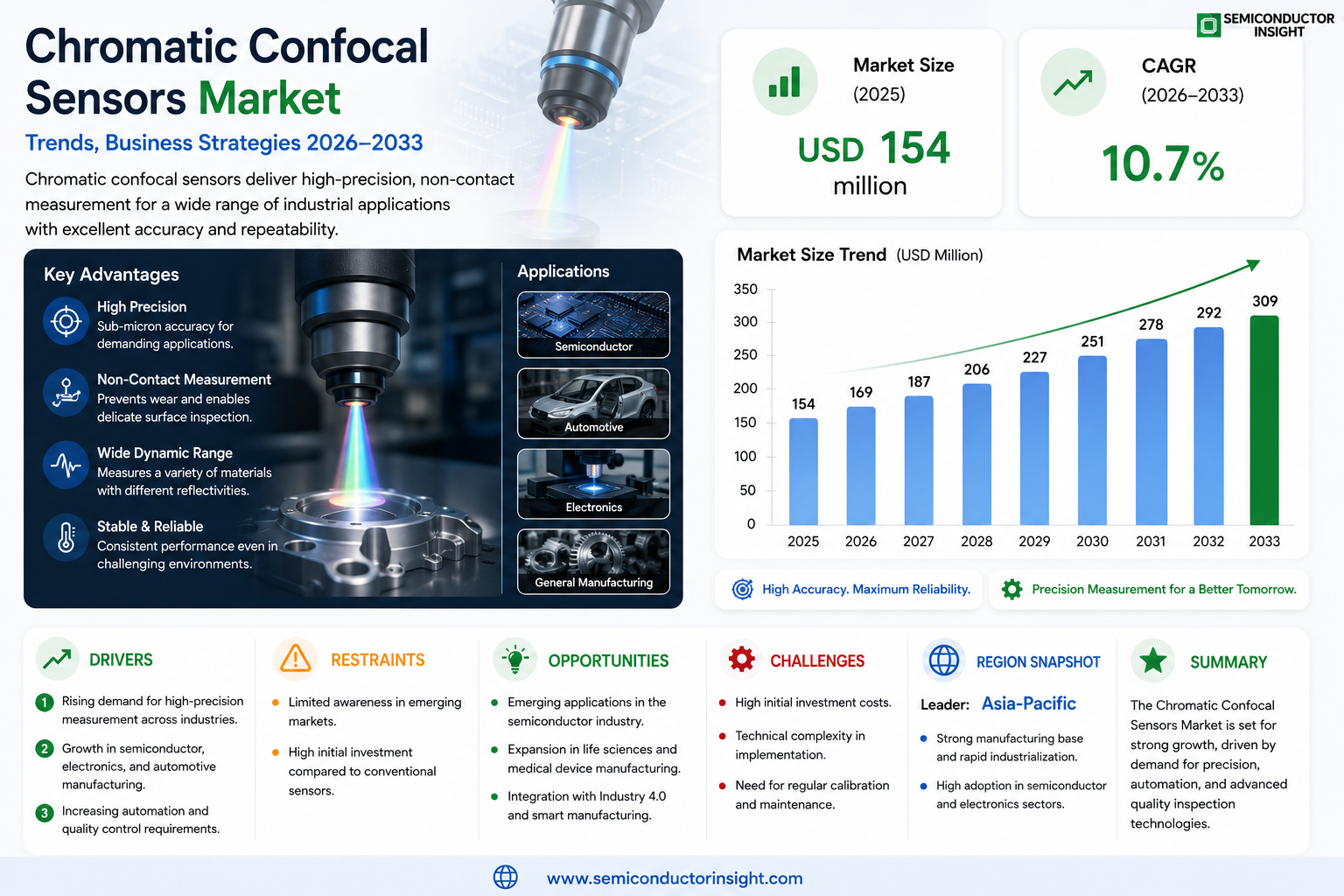
The global chromatic confocal sensors market was valued at USD 154 million in 2024 and is projected to reach USD 309 million by 2032, exhibiting a CAGR of 10.7% during the forecast period.
Chromatic confocal sensors, also known as confocal displacement sensors or confocal distance sensors, are optical devices that utilize chromatic confocal imaging technology to measure distances, thicknesses, or surface profiles with high precision in a non-contact manner. These sensors operate by passing white light through a multi-lens optical system (typically a chromatically aberrated lens), which disperses the light into different wavelengths each focused at varying distances along the optical axis.
The market growth is driven by increasing demand for high-precision measurement solutions across industries such as semiconductors, electronics, and medical devices. Additionally, advancements in automation and Industry 4.0 have accelerated adoption in smart manufacturing environments. Key players like Keyence, Micro-Epsilon, and LMI Technologies dominate the market with innovative product offerings tailored for diverse industrial applications.
 MARKET DRIVERS
Growing Demand for High-Precision Measurement Solutions
The Chromatic Confocal Sensors Market is experiencing significant growth due to increasing demand for non-contact, high-speed, and high-precision measurement systems across industries such as automotive, electronics, and medical devices. These sensors offer micron-level accuracy, making them indispensable for quality control applications.
Advancements in Industrial Automation
With the rapid adoption of Industry 4.0 technologies, chromatic confocal sensors are being increasingly integrated into automated production lines. Their ability to measure transparent, reflective, and curved surfaces with exceptional reliability positions them as critical components in smart manufacturing systems.
➤ The global market for chromatic confocal sensors is projected to grow at a CAGR of 7.2% through 2028, driven by their superior performance compared to traditional measurement techniques.
Miniaturization trends in electronics and medical devices are creating new applications for these sensors, particularly in measuring thin films and micro-components where traditional methods fall short.
MARKET CHALLENGES
High Initial Investment Costs
The sophisticated optical technology behind chromatic confocal sensors results in higher price points compared to conventional sensors, potentially limiting adoption among small and medium-sized enterprises. This cost factor remains a significant barrier to widespread market penetration.
Other Challenges
Technical Complexity in Implementation
Integrating chromatic confocal sensors requires specialized knowledge and calibration, which can increase deployment time and costs. The need for regular maintenance and periodic recalibration adds to operational expenses.
MARKET RESTRAINTS
Limited Awareness in Emerging Markets
While chromatic confocal sensors offer superior performance, many potential users in developing regions remain unaware of their capabilities or continue to rely on traditional measurement methods. This knowledge gap represents a significant restraint on market expansion in these regions.
MARKET OPPORTUNITIES
Emerging Applications in Semiconductor Industry
The semiconductor sector presents a lucrative growth opportunity for chromatic confocal sensor manufacturers. These sensors are increasingly being used for wafer inspection and thin-film measurement applications, driven by the miniaturization of semiconductor components.
Chromatic Confocal Sensors Market Trends
High-Precision Measurement Demand Fuels Market Growth
The global chromatic confocal sensors market is projected to grow from $154 million in 2024 to $309 million by 2032, at a CAGR of 10.7%. This growth is primarily driven by increasing demand for nanometer-level precision in industries such as semiconductors, electronics, and medical devices. These sensors enable non-contact measurement of wafer thickness in chip manufacturing and corneal thickness in ophthalmology applications.
Other Trends
Industry 4.0 Integration
Chromtaic confocal sensors are becoming integral to automated production lines and robotics, particularly in smart factories implementing Industry 4.0 practices. Their ability to provide real-time process monitoring reduces human intervention while ensuring consistent product quality in high-volume manufacturing environments.
Regulatory Compliance and Quality Standards
Stringent regulations in aerospace (FAA, EASA) and healthcare (FDA) sectors are mandating precise measurement tolerances. Chromatic confocal sensors meet these requirements with their high reliability and accuracy, making them essential for compliance in critical applications.
Emerging Applications and Regional Expansion
The market is expanding into new applications including additive manufacturing for 3D printing layer inspection, electric vehicle battery production, and renewable energy applications like solar cell coating measurements. Geographically, Asia-Pacific is witnessing rapid adoption, particularly in China, Japan, and South Korea, due to their growing semiconductor and electronics manufacturing sectors.
Technological Advancements and Miniaturization
Continuous sensor miniaturization addresses the measurement needs of increasingly smaller components in microelectronics and MEMS devices. Manufacturers are developing compact sensors capable of measuring complex geometries while maintaining high precision.
COMPETITIVE LANDSCAPE
Key Industry Players
Structured Competition Drives Innovation in Precision Measurement Solutions
The chromatic confocal sensors market is consolidated with Keyence, Precitec, and Micro-Epsilon collectively holding over 45% revenue share in 2024. Market leader Keyence dominates with its comprehensive product portfolio and strong distribution network across semiconductor and electronics verticals. These established players invest heavily in R&D for sub-nanometer resolution capabilities, with recent advancements in multi-channel line sensors for industrial automation applications.
Niche specialists like STIL (acquired by OPGAL in 2022) focus on high-end microscopy applications, while LMI Technologies targets 3D surface inspection solutions. Emerging Chinese manufacturers including Hypersen and Pomeas are gaining traction in APAC markets through competitively priced alternatives, though with limited capability in ultra-high precision segments below 50nm resolution.
List of Key Chromatic Confocal Sensors Companies Profiled
- Keyence
- Precitec
- Micro-Epsilon
- LMI Technologies
- STIL
- SICK
- OMRON
- Hypersen
- LightE
- Pomeas
- SinceVision
- THINKFOCUS
- Acuity Laser
- Proldv
- Tronsight
Segment Analysis:
| Segment Category | Sub-Segments | Key Insights |
| By Type |
|
Point Sensors dominate due to their versatility in measuring both opaque and transparent surfaces with high precision. Key drivers include:
|
| By Application |
|
Semiconductors represent the most demanding application segment with critical requirements:
|
| By End User |
|
Electronics Manufacturers are the primary adopters due to:
|
| By Measurement Capability |
|
Thickness Measurement remains the most critical capability because:
|
| By Technology |
|
Single-Point technology maintains leadership position due to:
|
Regional Analysis: Global Chromatic Confocal Sensors Market
China’s position as the world’s factory creates enormous demand for chromatic confocal sensors in electronics assembly and automotive component inspection. Government-backed smart manufacturing initiatives prioritize optical measurement technologies.
Japanese firms pioneer high-precision chromatic confocal sensor developments, integrating them into robotics and semiconductor production lines. Keiretsu networks enable seamless technology transfer between manufacturers and research institutions.
Samsung and LG’s massive production facilities drive chromatic confocal sensor adoption for display panel inspections. The country’s concentrated high-tech ecosystem creates ideal conditions for optical metrology solutions.
Thailand, Vietnam and Malaysia are witnessing growing chromatic confocal sensor implementation as multinationals shift precision manufacturing operations to these cost-competitive locations with improving technical capabilities.
North America
The North American chromatic confocal sensors market benefits from strong aerospace, medical device, and defense sector demand. U.S. manufacturers prioritize high-accuracy dimensional inspection, particularly in turbine blade production and microdevice manufacturing. Canada’s growing photonics cluster supports sensor innovations while Mexico’s automotive export industry creates measurement technology demand. Stringent quality standards across industries ensure sustained adoption of advanced optical measurement solutions.
Europe
Europe maintains robust chromatic confocal sensor adoption driven by automotive OEMs and industrial automation sectors. German machine tool manufacturers integrate these sensors into production lines while Swiss watchmakers utilize them for precision component inspection. The EU’s focus on metrology standards and Industry 5.0 initiatives supports technology adoption. Eastern European countries show increasing demand as manufacturing capabilities advance.
Middle East & Africa
The MEA region demonstrates growing chromatic confocal sensor utilization in oil & gas equipment maintenance and infrastructure projects. UAE and Saudi Arabia lead in adopting advanced measurement technologies as they diversify economies. South Africa’s automotive component exports create niche demand. Market growth remains constrained by limited local manufacturing but benefits from technology transfers.
South America
Brazil and Argentina represent South America’s primary chromatic confocal sensor markets, driven by automotive and aerospace manufacturing requirements. Local production remains limited but multinational corporations introduce measurement technologies. Market growth faces challenges from economic volatility but shows potential in precision agriculture and mining equipment applications.
Report Scope
This market research report provides a comprehensive analysis of the Chromatic Confocal Sensors Market, covering the forecast period 2025–2032. It offers detailed insights into market dynamics, technological advancements, competitive landscape, and key trends shaping the industry.
Key focus areas of the report include:
- Market Overview: The report begins with an overview outlining its current market scenario, key growth indicators, and industry transformation drivers. It discusses macroeconomic factors, demand–supply balance, regulatory landscape, and the strategic role of chromatic confocal sensors in powering advancements across industries such as semiconductors, electronics, medical devices, and precision manufacturing.
- Market Size & Forecast: Historical data and future projections for revenue, unit shipments, and market value across major regions and segments.
- Segmentation Analysis: Detailed breakdown by product type (Point Sensors, Line Sensors), technology, application, and end-user industry to identify high-growth segments and investment opportunities.
- Regional Insights: Insights into market performance across North America, Europe, Asia-Pacific, Latin America, and the Middle East & Africa, including country-level analysis where relevant.
- Competitive Landscape: Profiles of leading market participants, including their product offerings, R&D focus, manufacturing capacity, pricing strategies, and recent developments such as mergers, acquisitions, and partnerships.
- Technology Trends & Innovation: Assessment of emerging technologies, integration of automation, semiconductor design trends, and evolving industry standards.
- Market Drivers & Restraints: Evaluation of factors driving market growth along with challenges, supply chain constraints, regulatory issues, and market-entry barriers.
- Stakeholder Insights: Insights for component suppliers, OEMs, system integrators, investors, and policymakers regarding the evolving ecosystem and strategic opportunities.
Primary and secondary research methods are employed, including interviews with industry experts, data from verified sources, and real-time market intelligence to ensure the accuracy and reliability of the insights presented.
FREQUENTLY ASKED QUESTIONS:
What is the current market size of Chromatic Confocal Sensors Market?
-> The Global Chromatic Confocal Sensors Market was valued at USD 154 million in 2024 and is projected to reach USD 309 million by 2032, growing at a CAGR of 10.7% during the forecast period.
Which key companies operate in Chromatic Confocal Sensors Market?
-> Key players include Keyence, Precitec, Micro-Epsilon, LMI Technologies, STIL, SICK, OMRON, Hypersen, LightE, Pomeas, SinceVision, THINKFOCUS, Acuity Laser, Proldv, and Tronsight, among others.
What are the key growth drivers?
-> Key growth drivers include demand for high-precision measurement, growth in automation and Industry 4.0, stringent quality standards, non-contact measurement needs, and expansion into emerging applications like additive manufacturing and electric vehicle battery production.
Which region dominates the market?
-> Asia-Pacific is the fastest-growing region, with countries such as China, Japan, and South Korea being key markets for chromatic confocal sensors.
What are the emerging trends?
-> Emerging trends include miniaturization of components, expansion into emerging markets, integration with smart factories, and applications in renewable energy sectors.

Get Sample Report PDF for Exclusive Insights
Report Sample Includes
- Table of Contents
- List of Tables & Figures
- Charts, Research Methodology, and more...
 Download Sample Report PDF


