MARKET INSIGHTS
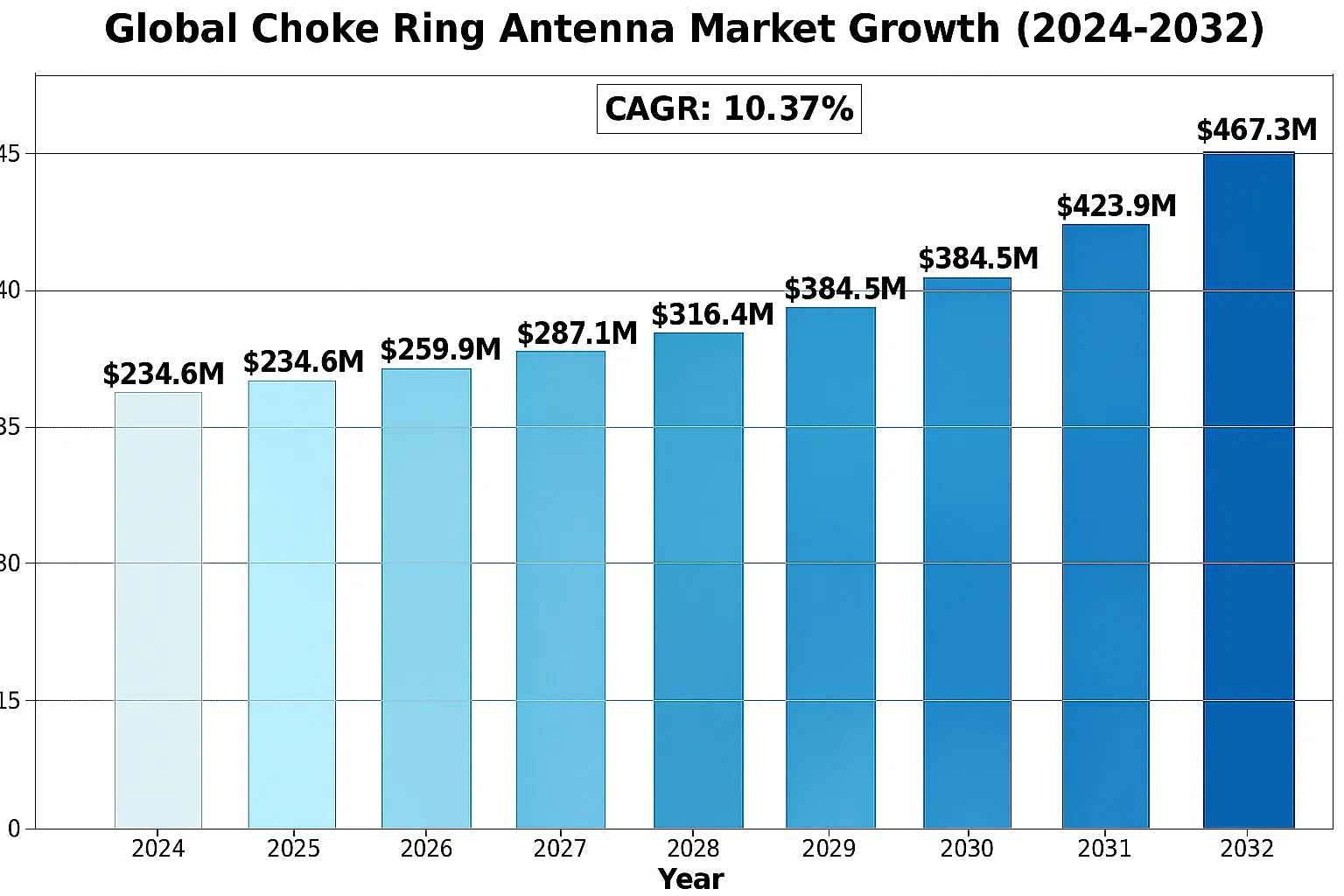
The global Choke Ring Antenna Market size was valued at US$ 234.60 million in 2024 and is projected to reach US$ 467.30 million by 2032, at a CAGR of 10.37% during the forecast period 2025–2032.
Choke ring antennas are specialized GPS antennas designed to mitigate multipath interference by suppressing ground-reflected signals. These antennas feature concentric conductive rings that create high impedance to surface waves, significantly improving positioning accuracy. They are widely used in high-precision applications such as geodetic surveying, aerospace navigation, and military systems where signal integrity is critical.
The market growth is driven by increasing demand for precise positioning in autonomous vehicles and drone navigation systems. Furthermore, expanding 5G infrastructure deployments are creating new opportunities, as choke ring antennas help maintain signal stability in congested RF environments. Key industry players like Trimble and Septentrio are enhancing product capabilities through advanced materials and compact designs, with the 3D choke ring segment projected to grow at 8.2% CAGR through 2032 due to superior performance in urban canyon environments.
MARKET DYNAMICS
MARKET DRIVERS
Growing Adoption of High-Precision GNSS Systems to Fuel Market Expansion
The choke ring antenna market is experiencing significant growth due to the rising adoption of high-precision Global Navigation Satellite Systems (GNSS) across various industries. These specialized antennas are critical components in applications requiring centimeter-level accuracy, such as surveying, precision agriculture, and autonomous vehicle navigation. With the global GNSS market projected to grow substantially, demand for choke ring antennas is increasing because they effectively mitigate multipath interference—a key challenge in urban canyons or environments with signal reflections. Recent advancements in satellite constellations, including Galileo and BeiDou expansions, have further enhanced positioning accuracy requirements, directly benefiting choke ring antenna manufacturers.
Military Modernization Programs Driving Demand for Resilient Positioning Solutions
Defense sector investments in next-generation navigation systems are creating robust demand for choke ring antennas worldwide. Modern military operations increasingly rely on jam-resistant, spoof-proof GNSS receivers that maintain functionality in contested electromagnetic environments. Choke ring antennas play a vital role in these systems by providing superior signal filtering capabilities compared to conventional designs. Several nations have allocated substantial budgets for GNSS modernization, with particular emphasis on secure positioning, navigation, and timing (PNT) solutions. This trend is expected to continue as armed forces prioritize resilient infrastructure against growing electronic warfare threats.
Expansion of Autonomous Vehicle Infrastructure Creating New Application Horizons
The development of autonomous vehicle ecosystems presents substantial growth opportunities for choke ring antenna providers. These antennas enable reliable GNSS reception for self-driving cars, drones, and robotic systems operating in complex urban environments where signal multipath remains a persistent challenge. As automotive manufacturers and technology firms accelerate testing of autonomous fleets, the need for high-integrity positioning solutions has intensified. Many prototype autonomous vehicles now incorporate choke ring antennas as part of redundant sensor suites to meet stringent safety requirements. This application segment is expected to expand rapidly with impending deployments of Level 4 autonomous systems in controlled environments.
MARKET RESTRAINTS
High Production Costs and Complex Manufacturing Processes Limiting Market Penetration
While choke ring antennas offer superior performance, their market adoption faces constraints due to significant manufacturing challenges. These antennas require precise engineering and specialized materials to achieve their characteristic interference-rejection properties, resulting in production costs that can be several times higher than standard GNSS antennas. The precision machining of concentric grounding rings and dielectric materials adds complexity to the manufacturing process. For price-sensitive commercial applications, this cost differential often makes choke ring antennas economically unviable, pushing users toward less expensive alternatives despite performance compromises.
Other Restraints
Size and Weight Limitations
The physical footprint of traditional choke ring designs presents integration challenges for modern compact devices. Many emerging applications, particularly in consumer electronics and miniaturized IoT devices, prioritize form factor over absolute positioning accuracy. This trend has restricted choke ring adoption in sectors where space constraints outweigh performance benefits.
Emerging Alternative Technologies
Advancements in adaptive antenna arrays and AI-based signal processing are providing alternative solutions to multipath mitigation. While these technologies currently lack the proven reliability of choke ring designs, their continued development poses a long-term challenge to market growth.
MARKET CHALLENGES
Standardization and Certification Hurdles in Critical Applications
The choke ring antenna market faces significant certification challenges across regulated industries. Aviation, marine navigation, and defense applications require extensive qualification processes that can delay product commercialization. Meeting diverse international standards—RTCA DO-228 for aviation or MIL-STD-810 for military use—demands substantial testing resources and documentation. These requirements create barriers for smaller manufacturers while increasing time-to-market for all participants. Additionally, the lack of universal performance metrics for multipath rejection complicates product comparisons and procurement decisions.
Supply Chain Vulnerabilities for Specialized Components
Manufacturers confront ongoing challenges in securing critical materials for choke ring antenna production. Certain proprietary dielectric compounds and high-precision metal components come from limited supplier networks vulnerable to geopolitical and logistical disruptions. The specialized nature of these materials makes substitution difficult without compromising performance characteristics. Recent global supply chain instability has exacerbated lead times for key inputs, forcing some manufacturers to maintain larger inventories than historically required.
MARKET OPPORTUNITIES
Integration with 5G Infrastructure Creates New Deployment Scenarios
The rollout of 5G networks presents compelling opportunities for choke ring antenna innovation. Telecommunications providers are increasingly incorporating precise timing synchronization into their networks, creating demand for robust GNSS reception solutions at cell tower installations. Choke ring antennas can play a pivotal role in ensuring network timing stability, particularly in dense urban areas where conventional antennas struggle with signal reflections. Several trials have demonstrated significant improvements in timing accuracy when using choke ring designs for 5G base station synchronization.
Emerging Space Applications Drive Demand for Radiation-Hardened Variants
Growing satellite constellations and space exploration initiatives are generating demand for specialized choke ring antennas capable of operating in harsh orbital environments. These space-qualified variants must maintain performance despite extreme temperature fluctuations, vacuum conditions, and radiation exposure. Recent developments in material science have enabled new antenna designs that meet these requirements while retaining the multipath rejection capabilities of terrestrial models. The expanding small satellite market represents a particularly promising segment for radiation-hardened choke ring solutions.
CHOKE RING ANTENNA MARKET TRENDS
Precision Navigation Demand Fuels Choke Ring Antenna Adoption
The growing demand for high-precision navigation across industries such as aerospace, defense, and surveying is accelerating the adoption of choke ring antennas. These specialized antennas are designed to mitigate multipath interference—a critical challenge in GNSS (Global Navigation Satellite System) applications. Market analysis indicates that choke ring antennas account for nearly 30% of the high-precision GNSS antenna segment, with particular dominance in geodetic and military applications. Recent advancements in multi-frequency support and ruggedized designs have further expanded their deployment in harsh environments, including marine and Arctic surveying operations.
Key Market Drivers
Military Modernization Programs
Global military modernization initiatives are significantly boosting demand for choke ring antennas, especially in guidance and targeting systems. The U.S. Department of Defense’s increased spending on GNSS-dependent systems—which grew by approximately 12% in 2023—has created substantial opportunities for manufacturers. Meanwhile, China’s BeiDou navigation system deployment has driven regional demand, with domestic manufacturers capturing over 40% of the Asia-Pacific choke ring antenna market. These antennas’ ability to maintain signal integrity in electronic warfare scenarios makes them indispensable for modern defense applications.
Emergence of Autonomous Systems
The rapid development of autonomous vehicles and drones is reshaping choke ring antenna requirements. While traditional 2D choke rings dominate current market share (approximately 65%), there’s increasing demand for 3D designs that offer omnidirectional multipath rejection—critical for UAVs and self-driving cars operating in urban canyons. Industry collaborations between antenna specialists like Trimble and autonomous vehicle manufacturers are yielding hybrid designs that combine choke ring technology with phased array elements, potentially opening a $120 million niche market by 2027.
Technological Convergence in GNSS Infrastructure
Integration with emerging technologies is transforming choke ring antenna capabilities. The implementation of AI-driven signal processing algorithms has improved real-time multipath detection by 50% in recent field tests conducted by leading manufacturers. Simultaneously, the shift toward multi-constellation support (GPS, Galileo, GLONASS, BeiDou) necessitates antennas with wider bandwidths—a challenge that’s being addressed through innovative concentric ring designs. Surveying equipment manufacturers report that next-generation choke rings now deliver sub-centimeter accuracy in 90% of fieldwork scenarios, compared to 75% five years ago.
COMPETITIVE LANDSCAPE
Key Industry Players
Innovation and Global Expansion Define the Competitive Edge in Choke Ring Antenna Market
The choke ring antenna market features a mix of established players and emerging competitors, creating a dynamic competitive environment. Trimble and Septentrio currently lead the market due to their extensive product portfolios and strong penetration in high-precision GNSS applications. These companies have maintained their dominance through continuous R&D investments and strategic acquisitions, securing approximately 30% combined market share as of 2024.
Leica Geosystems and TOPCON have emerged as significant contenders, particularly in surveying and construction applications. Their growth stems from integrating choke ring technology with advanced positioning systems, offering superior multipath mitigation crucial for centimeter-level accuracy requirements. Both companies have expanded their manufacturing capabilities in Asia to capitalize on the region’s infrastructure boom.
The market also sees aggressive competition from Chinese manufacturers like ComNav Technology and CHCNAV, who are gaining traction through cost-competitive offerings while improving technological sophistication. These companies have successfully captured over 15% of the Asian market by focusing on localized solutions and faster delivery times.
Meanwhile, specialized players such as Tallysman and Harxon are carving niches in aerospace and defense applications, where custom choke ring configurations are essential. Their success lies in developing ruggedized antennas capable of operating in extreme conditions, a segment that commands premium pricing. Recent collaborations with satellite navigation providers have further strengthened their market positions.
List of Key Choke Ring Antenna Manufacturers
- Trimble Inc. (U.S.)
- Septentrio N.V. (Belgium)
- Leica Geosystems AG (Switzerland)
- TOPCON Corporation (Japan)
- ComNav Technology Ltd. (China)
- CHC Navigation (China)
- Sunnav Technologies (China)
- Tallysman Wireless (Canada)
- Harxon Corporation (China)
- South GNSS Navigation (China)
- Airplux Technologies (South Korea)
- eSurvey GNSS (India)
Segment Analysis:
By Type
2D Choke Ring Antenna Segment Leads Due to Cost-Effectiveness and Widespread GNSS Applications
The market is segmented based on type into:
- 2D Choke Ring Antenna
- 3D Choke Ring Antenna
By Application
GPS Segment Dominates with Increasing Demand for High-Precision Navigation Systems
The market is segmented based on application into:
- GPS
- Radar
- Others
By End User
Surveying & Mapping Sector Shows Significant Adoption for Geodetic Applications
The market is segmented based on end user into:
- Surveying & Mapping
- Military & Defense
- Aviation
- Marine
- Others
Regional Analysis: Choke Ring Antenna Market
North America
The North American choke ring antenna market is characterized by robust demand driven by the region’s advanced GPS and radar infrastructure. The U.S. dominates the regional market, accounting for over 65% of revenue share in 2024, largely due to significant defense spending and precision agriculture applications. Canada follows with steady growth in mining and surveying sectors. Regulatory emphasis on high-precision positioning systems in aviation and automotive industries is accelerating adoption. Key players like Trimble and Tallysman maintain strong footholds through continuous R&D investments in 3D choke ring technology. While military applications lead demand, commercial sectors are showing increased uptake due to rising accuracy requirements for autonomous vehicles and IoT ecosystems.
Europe
Europe’s market growth is propelled by stringent GNSS accuracy standards in aerospace and maritime navigation. Germany and France collectively hold 40% of regional market share, with companies like Septentrio and Leica Geosystems pioneering multi-frequency antenna solutions. The EU’s Galileo satellite system rollout has created sustained demand for compatible choke ring antennas across transportation and geospatial sectors. However, price sensitivity among small-scale survey firms and lengthy certification processes for aviation-grade products pose adoption challenges. Recent developments include partnerships between antenna manufacturers and precision farming equipment providers to enhance agricultural automation capabilities across Nordic countries.
Asia-Pacific
APAC represents the fastest-growing choke ring antenna market, projected to expand at a CAGR exceeding 8% through 2032. China’s BeiDou navigation system deployment and India’s infrastructure modernization programs are key growth drivers. While 2D choke rings dominate cost-sensitive applications, rising demand for centimeter-level accuracy in surveying is boosting 3D antenna adoption. Japan and South Korea contribute significantly to technological advancements, particularly in automotive testing and robotics. Regional manufacturers like CHCNAV and South GNSS Navigation are gaining market share through competitive pricing, though quality variations remain a concern. The lack of standardized testing protocols across emerging economies continues to challenge market consolidation.
South America
This region shows moderate but consistent growth, primarily supported by mining and oil exploration activities in Brazil and Argentina. Market penetration remains limited by infrastructure gaps and reliance on imported components. Local players focus on refurbished and entry-level choke ring antennas to cater to budget-conscious buyers. While GPS applications account for 70% of regional demand, increasing maritime trade is creating opportunities for specialized marine antennas. Political instability in several countries and currency fluctuations continue to deter large-scale investments from global manufacturers, resulting in fragmented supply chains.
Middle East & Africa
The MEA market is emerging with growth concentrated in GCC countries and South Africa. UAE and Saudi Arabia lead adoption through smart city initiatives and port modernization projects requiring high-precision positioning systems. Defense sectors account for over 50% of regional demand, with increasing investments in border security systems. African markets remain underpenetrated due to limited GNSS infrastructure, though agricultural development programs in Kenya and Nigeria show promising uptake of basic 2D antennas. The lack of local manufacturing facilities results in dependence on European and Chinese imports, creating pricing volatility. Long-term growth potential exists as regional governments prioritize digital transformation and satellite navigation infrastructure.
Report Scope
This market research report provides a comprehensive analysis of the global and regional Choke Ring Antenna markets, covering the forecast period 2024–2032. It offers detailed insights into market dynamics, technological advancements, competitive landscape, and key trends shaping the industry.
Key focus areas of the report include:
- Market Size & Forecast: Historical data and future projections for revenue, unit shipments, and market value across major regions and segments. The global Choke Ring Antenna market was valued at US$ 234.60 million in 2024 and is projected to reach US$ 467.30 million by 2032, growing at a CAGR of 10.37%.
- Segmentation Analysis: Detailed breakdown by product type (2D and 3D Choke Ring Antennas), application (GPS, Radar, Others), and end-user industries to identify high-growth segments.
- Regional Outlook: Insights into market performance across North America, Europe, Asia-Pacific, Latin America, and the Middle East & Africa, including country-level analysis. The U.S. market is estimated at USD 78.4 million in 2024, while China is projected to reach USD 92.7 million by 2032.
- Competitive Landscape: Profiles of leading market participants including SunNav, Trimble, ComNav Technology, Septentrio, and CHCNAV, covering their product portfolios, market shares (top five players held approximately 42% share in 2024), and strategic developments.
- Technology Trends & Innovation: Assessment of emerging antenna designs, multi-frequency capabilities, and integration with GNSS systems.
- Market Drivers & Restraints: Evaluation of factors including increasing GNSS applications, defense modernization programs, and challenges like high manufacturing costs.
- Stakeholder Analysis: Insights for antenna manufacturers, system integrators, defense contractors, and investors regarding market opportunities.
The research methodology combines primary interviews with industry experts and analysis of verified market data to ensure accuracy and reliability.
FREQUENTLY ASKED QUESTIONS:
What is the current market size of Global Choke Ring Antenna Market?
-> Choke Ring Antenna Market size was valued at US$ 234.60 million in 2024 and is projected to reach US$ 467.30 million by 2032, at a CAGR of 10.37% during the forecast period 2025–2032.
Which key companies operate in Global Choke Ring Antenna Market?
-> Key players include SunNav, Trimble, ComNav Technology, Septentrio, CHCNAV, eSurvey, and Tallysman, among others.
What are the key growth drivers?
-> Key growth drivers include increasing GNSS applications, defense modernization programs, and demand for high-precision positioning systems.
Which region dominates the market?
-> North America currently leads the market, while Asia-Pacific is projected to be the fastest-growing region.
What are the emerging trends?
-> Emerging trends include multi-frequency choke ring designs, integration with autonomous systems, and lightweight materials.

Get Sample Report PDF for Exclusive Insights
Report Sample Includes
- Table of Contents
- List of Tables & Figures
- Charts, Research Methodology, and more...