MARKET INSIGHTS
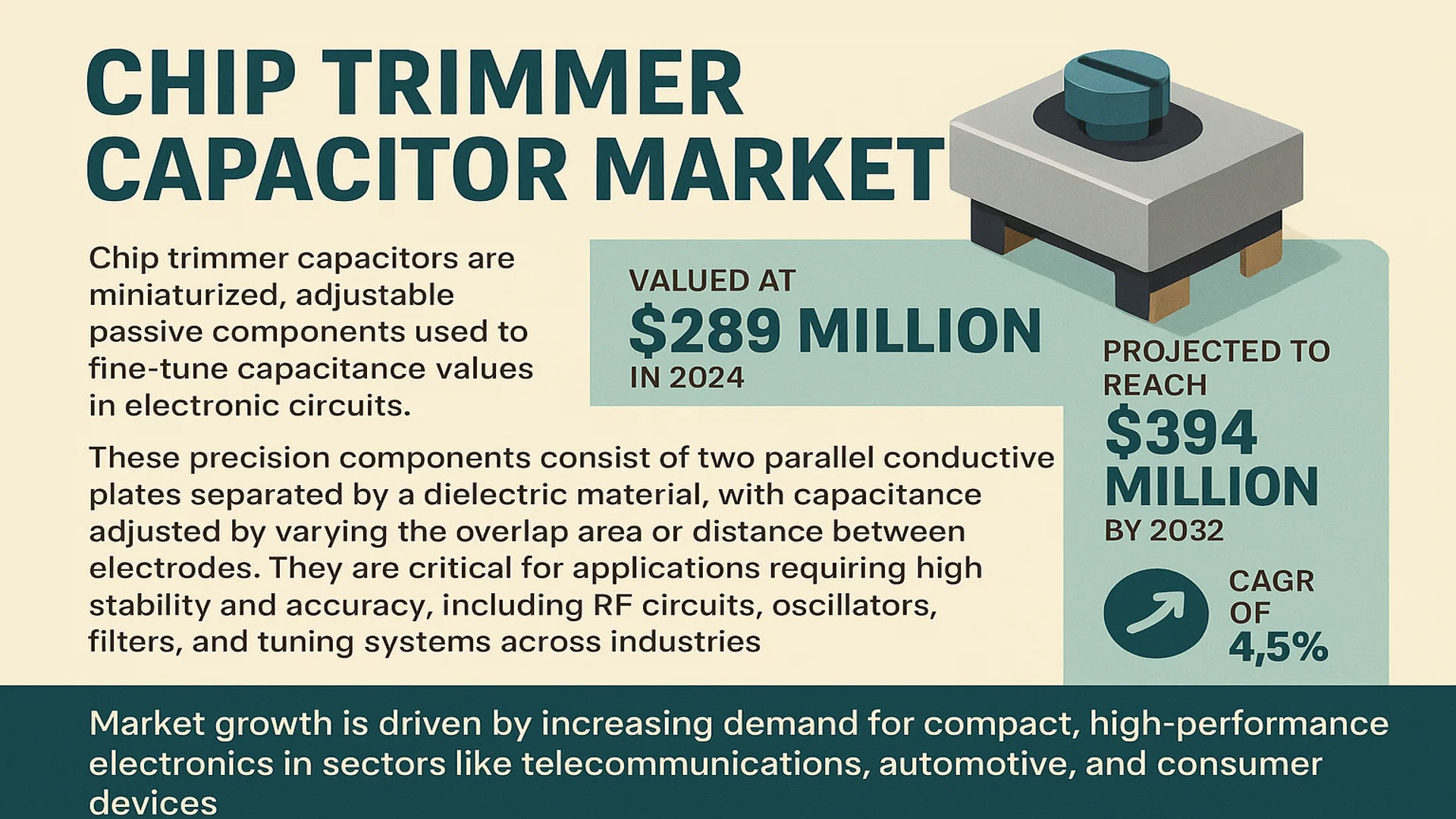
The global Chip Trimmer Capacitor Market was valued at 289 million in 2024 and is projected to reach US$ 394 million by 2032, at a CAGR of 4.5% during the forecast period.
Chip trimmer capacitors are miniaturized, adjustable passive components used to fine-tune capacitance values in electronic circuits. These precision components consist of two parallel conductive plates separated by a dielectric material (such as PET or PP film), with capacitance adjusted by varying the overlap area or distance between electrodes. They are critical for applications requiring high stability and accuracy, including RF circuits, oscillators, filters, and tuning systems across industries.
Market growth is driven by increasing demand for compact, high-performance electronics in sectors like telecommunications, automotive, and consumer devices. The rise of 5G networks and IoT devices has particularly boosted adoption, as these applications require precise impedance matching and frequency tuning. While North America currently dominates the market with advanced manufacturing capabilities, Asia-Pacific is witnessing rapid growth due to expanding electronics production in China, Japan, and South Korea. Key players like Murata Manufacturing, Knowles Precision Devices, and Samsung continue to innovate with smaller form factors and improved temperature stability to meet evolving industry needs.
MARKET DYNAMICS
MARKET DRIVERS
Expanding Demand for Miniaturized Electronics to Accelerate Market Growth
The global shift toward compact and high-performance electronic devices is significantly propelling the chip trimmer capacitor market. With the consumer electronics sector projected to exceed $1.5 trillion by 2027, there is an escalating need for components that offer precision in minimal space. Chip trimmer capacitors, known for their small footprint and adjustable capacitance, are becoming indispensable in smartphones, wearables, IoT devices, and 5G infrastructure. Manufacturers are increasingly integrating these components to optimize signal tuning and filtering in densely packed circuit boards, driving steady market expansion.
Advancements in Automotive Electronics to Fuel Adoption
Modern vehicles now incorporate over 3,000 microelectronic components, creating robust demand for reliable trimmer capacitors in applications like infotainment systems, ADAS, and engine control units. The transition to electric and autonomous vehicles further amplifies this trend, with chip trimmers playing a critical role in RF communication modules and sensor calibration. As automotive electronics evolve toward higher frequency operations, the precision and thermal stability of these components make them vital for ensuring signal integrity and reducing electromagnetic interference.
Strategic Collaborations Enhancing Market Prospects
Leading manufacturers are actively collaborating with automotive and telecom giants to develop application-specific solutions. For example, recent partnerships aimed at enhancing capacitor performance for millimeter-wave applications in 5G base stations and radar systems underscore the component’s growing relevance. These alliances are accelerating product innovation while expanding addressable markets.
MARKET RESTRAINTS
High Manufacturing Costs and Supply Chain Volatility Limit Market Penetration
The production of chip trimmer capacitors requires specialized materials like PET and PP films, along with precision machining tools, contributing to elevated manufacturing expenses. Fluctuations in raw material costs—particularly for rare-earth metals used in electrodes—add further unpredictability. These economic pressures disproportionately affect small and medium-sized manufacturers, restricting their ability to compete with established players who benefit from economies of scale.
Technical Limitations in High-Frequency Applications Pose Challenges
While chip trimmers excel in conventional electronics, their performance in ultra-high-frequency ranges above 10 GHz remains constrained by parasitic effects and Q-factor degradation. This limitation hinders adoption in next-gen radar and satellite communication systems where alternative technologies like MEMS tunable capacitors are gaining traction. Overcoming these performance barriers requires substantial R&D investment—a hurdle for many market participants.
MARKET CHALLENGES
Intense Competition from Alternative Technologies Threatens Market Share
The emergence of semiconductor-based variable capacitors and digitally tunable components presents formidable competition. These alternatives offer superior integration capabilities with ICs, appealing to designers prioritizing board space optimization. While traditional trimmer capacitors maintain advantages in cost and reliability for certain applications, their long-term position in the component ecosystem depends on continuous innovation to match the versatility of newer solutions.
Other Key Challenges
Standardization Issues: Lack of uniform performance specifications across manufacturers complicates component selection and interoperability in global supply chains.
Environmental Regulations: Stricter RoHS and REACH compliance requirements necessitate expensive material reformulations, particularly for lead-based dielectric formulations still used in niche applications.
MARKET OPPORTUNITIES
Growth in Defense and Aerospace Sector Opens New Avenues
With global defense electronics expenditures surpassing $200 billion annually, there is surging demand for ruggedized trimmer capacitors in avionics, missile guidance systems, and secure communications equipment. These applications require components that withstand extreme conditions while maintaining precise tuning capabilities—a combination that positions chip trimmers as ideal solutions. Military modernization programs worldwide will likely sustain this demand through the decade.
Emerging 6G Research Creates Future Potential
Early-stage development of terahertz-range communication systems for 6G networks presents a forward-looking opportunity. While current capacitor technologies face frequency limitations, proactive investments in novel dielectric materials and structural designs could enable participation in this nascent market. Several industry leaders have already initiated research collaborations with academic institutions to explore these frontiers.
CHIP TRIMMER CAPACITOR MARKET TRENDS
Increasing Demand for Miniaturized Electronics Driving Market Expansion
The global chip trimmer capacitor market is experiencing robust growth due to the escalating demand for miniaturized electronic components. The rise in high-frequency applications across industries, particularly in telecommunications and consumer electronics, has necessitated the use of compact, high-precision capacitors. The transition to 5G networks has further amplified this demand, as these networks require highly stable and adjustable capacitors for signal processing. The chip trimmer capacitor market is projected to grow at a steady 4.5% CAGR, reaching $394 million by 2032, indicating strong industry momentum.
Other Trends
Automotive Industry Adoption
The automotive sector is increasingly incorporating chip trimmer capacitors to enhance vehicle electronics, particularly in advanced driver-assistance systems (ADAS) and infotainment solutions. With the rise of electric vehicles (EVs), there is greater emphasis on reliable electronic components that ensure precise capacitance adjustments in power management systems. Furthermore, the increasing adoption of IoT-based automotive solutions is accelerating the need for these capacitors in sensor calibration and RF signal optimization.
Technological Innovations and Material Advancements
Manufacturers are focusing on material improvements, such as the use of PET films and PP films, to enhance the performance and durability of chip trimmer capacitors. Innovations in dielectric materials have led to increased capacitance stability and reduced power loss, making them ideal for high-frequency applications. Additionally, key market players like Murata Manufacturing and Knowles Precision Devices are investing in R&D to develop capacitors with tighter tolerances, catering to industries that demand ultra-precise tuning, such as aerospace and defense.
COMPETITIVE LANDSCAPE
Key Industry Players
Global Leaders Push Innovation to Meet Rising Demand in RF and Precision Applications
The global chip trimmer capacitor market features a mix of established electronics component manufacturers and specialized capacitor producers competing on precision, miniaturization, and application-specific solutions. Murata Manufacturing currently leads the sector, leveraging its extensive portfolio of ceramic-based trimming capacitors and dominance in consumer electronics supply chains across Asia and North America. The company holds approximately 22% of the global market share as of 2024, according to industry reports.
Close competitors include Knowles Precision Devices and Vishay Intertechnology, which have strengthened their positions through patented dielectric technologies. Knowles’ recent development of ultra-stable PET film capacitors for 5G infrastructure and Vishay’s expansion of military-grade trimmers demonstrate the industry’s focus on high-reliability applications. These players collectively account for about 35% of total market revenue.
Mid-sized competitors like Kingtronics and Suntan Technology are gaining traction through cost-competitive offerings for automotive and industrial applications. The growing adoption of chip trimmers in electric vehicle charging systems and IoT devices has prompted these companies to expand their production capacities, particularly in Southeast Asia where labor and material costs remain favorable.
Meanwhile, Samsung Electro-Mechanics and SEHWA Electronics are emphasizing R&D collaborations with chipset manufacturers to develop integrated trimming solutions for next-generation semiconductor packages. This vertical integration strategy is expected to drive product differentiation as the market approaches its projected $394 million valuation by 2032.
List of Key Chip Trimmer Capacitor Manufacturers
- Murata Manufacturing (Japan)
- Knowles Precision Devices (U.S.)
- Vishay Intertechnology (U.S.)
- Kingtronics International (Hong Kong)
- Suntan Technology (Taiwan)
- JB Capacitors (China)
- Cal-Chip Electronics (U.S.)
- Passive Plus (U.S.)
- Samsung Electro-Mechanics (South Korea)
- SEHWA Electronics (South Korea)
Segment Analysis:
By Type
PET Film Segment Dominates the Market Due to Superior Dielectric Properties and Stability
The market is segmented based on type into:
- PET Film
- PP Film
- Ceramic
- Others
By Application
Consumer Electronics Segment Leads Due to High Demand for Miniaturized Components
The market is segmented based on application into:
- Consumer Electronics
- Automobile Industry
- Industrial Application
- National Defense and Military
- Others
By Adjustment Method
Mechanical Adjustment Segment Holds Significant Market Share
The market is segmented based on adjustment method into:
- Mechanical Adjustment
- Electrical Adjustment
By End-User
Electronics Manufacturers Drive Bulk of Market Demand
The market is segmented based on end-user into:
- OEMs (Original Equipment Manufacturers)
- Aftermarket
- Research Institutions
Regional Analysis: Chip Trimmer Capacitor Market
Asia-Pacific
The Asia-Pacific region dominates the global chip trimmer capacitor market, with China accounting for the largest share due to its thriving electronics manufacturing sector. As the world’s leading producer of consumer electronics, China’s demand for precision capacitors in RF circuits, telecommunications, and IoT devices drives significant market growth. Japan and South Korea follow closely, backed by their advanced semiconductor industries and investments in 5G infrastructure. India’s rapidly expanding electronics sector, supported by government initiatives like ‘Make in India’, presents new opportunities for trimmer capacitor manufacturers. While cost-sensitive segments still favor conventional capacitors, there is steady demand for miniaturized, high-precision components in military and aerospace applications across the region.
North America
North America maintains a strong position in the chip trimmer capacitor market, particularly in high-end applications. The United States leads with substantial demand from the defense, aerospace, and medical equipment sectors, where precision and reliability are paramount. Technological advancements in IoT devices and smart infrastructure are creating additional growth opportunities. Major manufacturers are focusing on R&D to develop capacitors with enhanced thermal stability and lower ESR (Equivalent Series Resistance) to meet stringent industry requirements. The region benefits from strong IP protection and well-established supply chains, though increasing competition from Asian manufacturers presents pricing challenges for domestic producers.
Europe
Europe’s chip trimmer capacitor market is characterized by steady demand from automotive and industrial automation sectors. Germany remains the largest market, driven by its robust automotive electronics industry and the region’s transition to electric vehicles. The EU’s focus on sustainable electronics manufacturing has prompted capacitor suppliers to develop environmentally friendly materials and production processes. While growth remains stable, the market faces challenges from declining consumer electronics manufacturing in the region. However, emerging applications in renewable energy systems and industrial IoT present new opportunities for market expansion.
South America
The South American chip trimmer capacitor market shows moderate growth, primarily serving consumer electronics and automotive aftermarket segments. Brazil accounts for the largest share, though economic instability and currency fluctuations have constrained market development. Local manufacturing remains limited, with most capacitors being imported from Asia. However, increasing foreign investment in Brazil’s electronics sector and gradual recovery of industrial activity suggest potential for future market expansion. The region’s challenging business environment and lack of local component suppliers continue to hinder faster adoption of advanced trimming capacitor technologies.
Middle East & Africa
This emerging market shows gradual growth, primarily driven by telecommunications infrastructure development and increasing electronics imports. While local manufacturing remains negligible, countries like Israel and Turkey demonstrate growing demand for precision components in military and aerospace applications. The UAE serves as a regional distribution hub, with most capacitors being re-exported to neighboring countries. Market growth faces obstacles from limited technical expertise and lack of local production facilities, though increasing foreign investment in technology sectors may gradually improve market conditions.
Key Market Observations: The chip trimmer capacitor market reflects broader electronics industry trends, with Asia-Pacific maintaining dominance through manufacturing scale while Western markets focus on high-value applications. Miniaturization and precision requirements continue to drive product innovation, particularly in RF and filtering applications across all regions.
Report Scope
This market research report provides a comprehensive analysis of the global Chip Trimmer Capacitor market, covering the forecast period 2025–2032. It offers detailed insights into market dynamics, technological advancements, competitive landscape, and key trends shaping the industry.
Key focus areas of the report include:
- Market Size & Forecast: Historical data and future projections for revenue, unit shipments, and market value across major regions and segments. The global Chip Trimmer Capacitor market was valued at USD 289 million in 2024 and is projected to reach USD 394 million by 2032, growing at a CAGR of 4.5%.
- Segmentation Analysis: Detailed breakdown by product type (PET Film, PP Film), application (Consumer Electronics, Automobile Industry, Industrial Application, National defense and Military, Others), and end-user industry to identify high-growth segments.
- Regional Outlook: Insights into market performance across North America, Europe, Asia-Pacific, Latin America, and the Middle East & Africa, including country-level analysis. The U.S. market size is estimated at USD million in 2024, while China is projected to reach USD million by 2032.
- Competitive Landscape: Profiles of leading market participants including Knowles Precision Devices, Murata Manufacturing, Samsung, Vishay, and Kingtronics, covering their product portfolios, R&D investments, and strategic developments.
- Technology Trends & Innovation: Assessment of emerging technologies in capacitor design, miniaturization trends, and advanced dielectric materials for improved performance.
- Market Drivers & Restraints: Evaluation of factors such as growing demand for consumer electronics, 5G deployment, and automotive electronics versus challenges like raw material price volatility.
- Stakeholder Analysis: Strategic insights for component manufacturers, OEMs, and investors regarding supply chain optimization and market opportunities.
The research employs primary interviews with industry experts and analysis of verified market data to ensure accuracy and reliability of insights.
FREQUENTLY ASKED QUESTIONS:
What is the current market size of Global Chip Trimmer Capacitor Market?
-> Chip Trimmer Capacitor Market was valued at 289 million in 2024 and is projected to reach US$ 394 million by 2032, at a CAGR of 4.5% during the forecast period.
Which key companies operate in Global Chip Trimmer Capacitor Market?
-> Key players include Knowles Precision Devices, Murata Manufacturing, Samsung, Vishay, Kingtronics, and JB Capacitors, among others.
What are the key growth drivers?
-> Key growth drivers include increasing demand for miniaturized electronic components, 5G technology adoption, and growth in automotive electronics.
Which region dominates the market?
-> Asia-Pacific is the largest market, driven by electronics manufacturing in China, Japan, and South Korea, while North America shows strong growth in high-tech applications.
What are the emerging trends?
-> Emerging trends include development of ultra-compact capacitors, integration with IoT devices, and advanced dielectric materials for enhanced performance.

Get Sample Report PDF for Exclusive Insights
Report Sample Includes
- Table of Contents
- List of Tables & Figures
- Charts, Research Methodology, and more...
 Download Sample Report PDF