China AI Inference Chip for Surveillance Market Insights
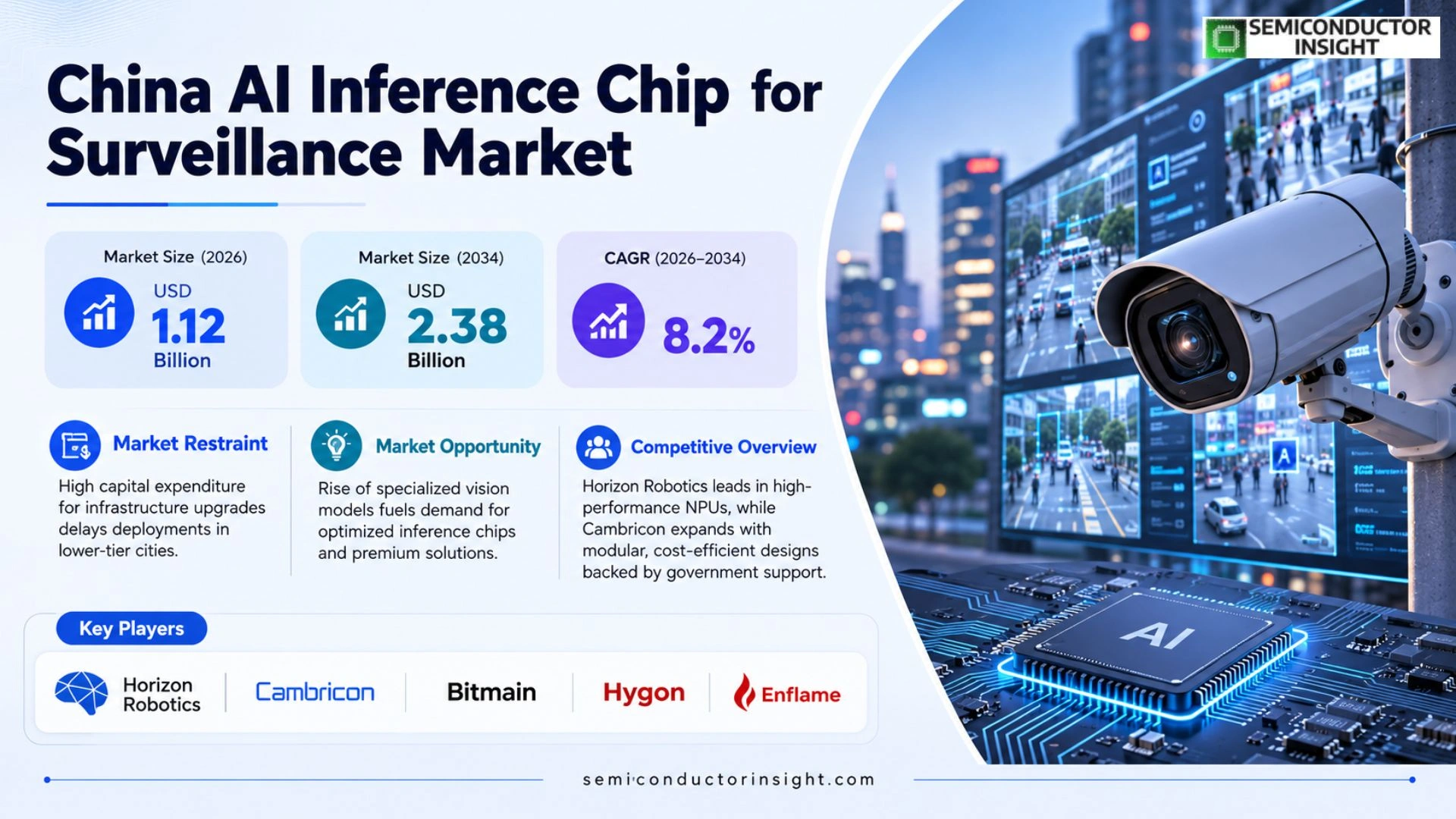
Global China AI inference chip for surveillance market size was valued at USD 1.05 billion in 2025. The market is projected to grow from USD 1.12 billion in 2026 to USD 2.38 billion by 2034, exhibiting a CAGR of 8.2% during the forecast period.
AI inference chips designed for surveillance integrate deep‑learning accelerators that process video streams locally, reducing latency and bandwidth usage. These processors combine tensor cores, low‑power architectures, and edge‑optimized software stacks to enable real‑time object detection, facial recognition, and behavior analysis within cameras or edge gateways.
The market is gaining momentum because Chinese municipalities are expanding smart‑city initiatives that mandate on‑device analytics for public safety. Moreover, recent government subsidies for domestic semiconductor development lower entry barriers for firms such as Horizon Robotics, Cambricon and Alibaba’s Pingtouge. Consequently, adoption accelerates as operators seek cost‑effective solutions that comply with data‑privacy regulations while delivering high‑resolution analytics.
MARKET DRIVERS
Escalating Urban Safety Requirements
Municipal authorities across major Chinese cities are upgrading public‑space monitoring systems to meet stricter safety mandates. The shift toward AI‑enabled analytics compels vendors to adopt inference chips that can process video streams locally, reducing latency and bandwidth costs. Consequently, China AI Inference Chip for Surveillance Market is experiencing a surge in procurement cycles as city planners prioritize real‑time threat detection.
Proliferation of Edge‑Computing Architectures
Enterprises are moving computation to the edge to avoid cloud‑related privacy constraints and to meet stringent data‑sovereignty regulations. Modern inference chips, designed for low‑power operation, enable on‑premise analytics without compromising model accuracy. This architectural shift fuels demand for chips that can sustain high‑resolution feeds from thousands of cameras simultaneously.
➤ “Edge inference delivers both compliance and performance, making it the preferred choice for next‑generation surveillance deployments.”
Investments in smart‑city platforms are also encouraging cross‑industry collaborations, where chip manufacturers partner with system integrators to co‑develop turnkey solutions. Such alliances shorten time‑to‑market and create a virtuous cycle of adoption across public and private sectors.
MARKET CHALLENGES
Fragmented Supply Chain Landscape
The domestic chip ecosystem is marked by a multitude of small‑scale fabs that lack the volume to achieve economies of scale. This fragmentation inflates component costs and introduces variability in quality, which can deter large‑scale surveillance projects that require consistent performance across thousands of nodes.
Other Challenges
Regulatory Uncertainty
Frequent revisions to data‑privacy statutes create an environment where compliance requirements can shift mid‑project, forcing vendors to redesign firmware or re‑certify hardware, thereby extending development timelines.
MARKET RESTRAINTS
High Capital Expenditure for Upgrades
Retrofitting legacy CCTV infrastructure with AI inference capabilities demands substantial upfront outlays. Many operators, especially in lower‑tier cities, delay upgrades until clear ROI evidence emerges, limiting short‑term market acceleration.
MARKET OPPORTUNITIES
Emergence of Specialized Vision Models
Advances in domain‑specific neural networks,such as person‑re‑identification and abnormal‑behavior detection,are driving demand for chips optimized for these workloads. Manufacturers that tailor silicon to accelerate these models can capture premium pricing and differentiate themselves in a crowded market.
China AI Inference Chip for Surveillance Market Trends
Edge‑Optimized Inference Drives Adoption
China AI Inference Chip for Surveillance Market is being reshaped by chips that embed deep‑learning accelerators directly into camera modules or edge gateways. By relocating tensor‑core calculations from cloud to device, vendors cut transmission delays and alleviate network load, which matters for dense urban deployments where thousands of video streams compete for bandwidth. Real‑time object detection, facial matching, and behavioral analytics become feasible on a per‑camera basis, allowing operators to trigger alerts instantly. This architectural shift not only trims operating expenditures but also creates a new value proposition around privacy‑preserving analytics, because raw footage never leaves the premises.
Other Trends
Domestic Supplier Momentum
Chinese semiconductor firms such as Horizon Robotics, Cambricon and Alibaba’s Pingtouge are capitalising on policy incentives that lower the cost of fab capacity and R&D. Targeted subsidies have accelerated their rollout of low‑power, high‑throughput inference silicon, making home‑grown alternatives financially competitive against imported solutions. As municipal procurement rules increasingly require compliance with national data‑security standards, these domestic portfolios gain a decisive edge. For system integrators, the expanding product line translates into shorter design cycles and reduced bill‑of‑materials, while end‑users benefit from warranties backed by local support networks.
Smart‑City Mandates Shape Procurement
The rollout of smart‑city programmes across Chinese municipalities introduces mandatory on‑device analytics for public‑safety cameras. Regulations now stipulate that video analytics must run locally to satisfy stringent privacy directives, prompting a rapid shift in procurement specifications. Vendors that can demonstrate seamless integration of AI inference chips with existing surveillance infrastructure are poised to capture the bulk of upcoming contracts. This environment forces traditional hardware suppliers to either partner with chip designers or develop in‑house inference capabilities, thereby intensifying the competitive landscape and encouraging consolidation among players that can deliver end‑to‑end solutions.
COMPETITIVE LANDSCAPE
Key Industry Players
China AI Inference Chip for Surveillance – Competitive Overview
Horizon Robotics dominates the high‑performance inference segment, leveraging its Next‑Generation Edge AI Processor (NPU) to deliver sub‑millisecond object detection within CCTV nodes. The company’s close collaboration with municipal smart‑city programs provides a reliable pipeline of contracts, reinforcing a market structure where a few vertically integrated firms control the bulk of system‑level sales. Cambricon, backed by state‑level subsidies, occupies the second tier by focusing on modular tensor‑core designs that can be embedded in third‑party camera platforms, thereby widening its addressable base without bearing full system integration costs. Alibaba’s Pingtouge unit, though newer to the niche, has attracted attention through aggressive pricing of its Yitian series, which combines low‑power silicon with a cloud‑synchronised analytics stack, nudging mid‑range operators toward domestically sourced solutions.
Beyond the headline contenders, a cohort of specialized firms adds depth to the competitive field. SenseTime supplies algorithm‑optimized AI cores that prioritize facial‑recognition throughput, while ByteDance’s emerging hardware arm experiments with AI‑accelerated edge chips for its short‑video ecosystem, hinting at cross‑industry synergies. Huawei’s HiSilicon division offers a family of edge processors that benefit from the company’s 5G portfolio, enabling seamless video streaming with on‑device inference. UNISOC and ZTE focus on cost‑sensitive deployments in secondary cities, delivering stripped‑down NPUs that satisfy basic analytics requirements. Bitmain, traditionally a mining ASIC player, repurposes its high‑density silicon for surveillance workloads, creating a niche for ultra‑high‑resolution streams. Additional players such as Semiconductor Manufacturing International Corp (SMIC) provide foundry services that underpin many of the above designs, while Inspur integrates AI chips into its edge server line‑up, rounding out a landscape where design, fabrication, and system integration intersect.
List of Key AI Inference Chip for Surveillance Companies Profiled
- Horizon Robotics
- Cambricon
- Alibaba Pingtouge
- SenseTime
- ByteDance AI Hardware
- Huawei HiSilicon
- UNISOC
- ZTE
- Bitmain
- SMIC
- Inspur
Segment Analysis:
| Segment Category | Sub-Segments | Key Insights |
| By Type |
|
Edge‑Optimized AI Inference Chips dominate because they:
|
| By Application |
|
Public Safety Cameras are the primary growth driver, as they:
|
| By End User |
|
Municipal Governments lead adoption because they:
|
| By Deployment Architecture |
|
Edge‑Gateway Integrated Solutions are gaining traction as they:
|
| By Performance Tier |
|
Mid‑Range Balanced chips are preferred in most deployments because they:
|
Regional Analysis: China AI Inference Chip for Surveillance Market
Local governments have introduced tiered approval pathways that accelerate deployment of AI‑enabled cameras, while simultaneously mandating data‑localization standards that favor domestically produced inference chips.
Close ties between chip designers, fab facilities, and system integrators enable rapid prototyping cycles, allowing firms to iterate on edge‑AI capabilities within months rather than years.
A handful of Chinese vendors dominate the market, leveraging economies of scale to undercut imported alternatives while investing heavily in custom AI kernels tuned for surveillance workloads.
Municipal security agencies prioritize solutions that combine low power draw with on‑device analytics, driving demand for chips that can execute complex neural networks without cloud reliance.
North America
In North America, adoption of China‑origin inference chips is restrained by stringent import controls and growing concern over supply‑chain resilience. Nonetheless, niche segments such as private‑sector logistics firms experiment with hybrid deployments, blending local chips with proprietary software stacks to gain a latency edge. Industry participants view the region as a testing ground for compliance‑focused solutions rather than a primary revenue stream, prompting a strategic emphasis on modular architectures that can be swapped for domestically certified alternatives if needed.
Europe
European regulators emphasize data‑privacy and provenance, which shapes procurement criteria for surveillance hardware. While the region’s mature market for video analytics creates a curiosity about cost‑competitive Chinese inference chips, approvals often hinge on transparent certification processes. Vendors that can demonstrate robust encryption and auditability of AI models find modest traction among municipalities seeking to upgrade aging camera fleets without incurring prohibitive license fees.
South America
South American cities, grappling with rapid urbanization, view AI‑enhanced surveillance as a tool for public safety. Budget constraints steer procurement toward affordable, integrated solutions, making Chinese inference chips attractive despite limited local support infrastructure. Partnerships between regional system integrators and Asian chip manufacturers are emerging, focusing on training programs that build in‑country expertise and mitigate concerns over after‑sales service.
Middle East & Africa
The Middle East & Africa region presents a mixed picture: wealthier Gulf states invest heavily in smart‑city initiatives, often favoring premium, globally sourced hardware, while many African nations prioritize cost‑effectiveness. In the latter markets, Chinese inference chips gain foothold through joint ventures that bundle chips with turnkey surveillance platforms. The prevailing business model leverages financing schemes that spread capital expenditure, allowing municipalities to adopt advanced AI analytics without immediate fiscal pressure.
Report Scope
This market research report provides a comprehensive analysis of the China AI Inference Chip for Surveillance Market , covering the forecast period 2026–2034. It offers detailed insights into market dynamics, technological advancements, competitive landscape, and key trends shaping the industry.
Key focus areas of the report include:
- Market Overview: The report begins with an overview outlining its current market scenario, key growth indicators, and industry transformation drivers. It discusses macroeconomic factors, demand–supply balance, regulatory landscape, and the strategic role of semiconductors in powering advancements across industries such as automotive, telecommunications, consumer electronics, and industrial automation.
- Market Size & Forecast: Historical data and future projections for revenue, unit shipments, and market value across major regions and segments.
- Segmentation Analysis: Detailed breakdown by product type, technology, application, and end-user industry to identify high-growth segments and investment opportunities.
- Regional Insights: Insights into market performance across North America, Europe, Asia-Pacific, Latin America, and the Middle East & Africa, including country-level analysis where relevant.
- Competitive Landscape: Profiles of leading market participants, including their product offerings, R&D focus, manufacturing capacity, pricing strategies, and recent developments such as mergers, acquisitions, and partnerships.
- Technology Trends & Innovation: Assessment of emerging technologies, integration of AI/IoT, semiconductor design trends, fabrication techniques, and evolving industry standards.
- Market Drivers & Restraints: Evaluation of factors driving market growth along with challenges, supply chain constraints, regulatory issues, and market-entry barriers.
- Stakeholder Insights: Insights for component suppliers, OEMs, system integrators, investors, and policymakers regarding the evolving ecosystem and strategic opportunities.
Primary and secondary research methods are employed, including interviews with industry experts, data from verified sources, and real-time market intelligence to ensure the accuracy and reliability of the insights presented.
FREQUENTLY ASKED QUESTIONS:
What is the current market size of China AI Inference Chip for Surveillance Market?
-> China AI Inference Chip for Surveillance Market was valued at USD 1.05 billion in 2025 and is expected to reach USD 2.38 billion by 2034.
Which key companies operate in China AI Inference Chip for Surveillance Market?
-> Key players include Horizon Robotics, Cambricon, and Alibaba Pingtouge, among others.
What are the key growth drivers?
-> Key growth drivers include smart‑city initiatives, government subsidies for domestic semiconductor development, and rising demand for on‑device analytics to meet data‑privacy regulations.
Which region dominates the market?
-> Asia‑Pacific is the fastest‑growing region, led by China, while Europe also maintains a strong presence.
What are the emerging trends?
-> Emerging trends include edge AI inference, ultra‑low‑power tensor cores, integration with 5G networks, and AI‑optimized ASIC designs for surveillance applications.

Get Sample Report PDF for Exclusive Insights
Report Sample Includes
- Table of Contents
- List of Tables & Figures
- Charts, Research Methodology, and more...
 Download Sample Report PDF