
China AI Inference Chip for Smart City Surveillance Market Insights
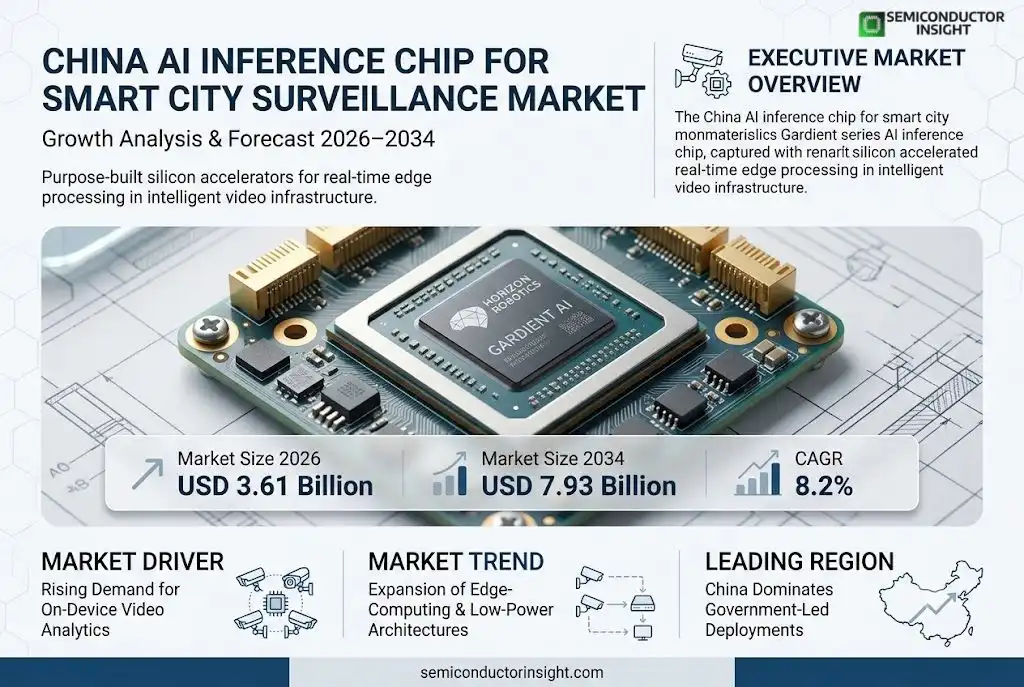
China AI Inference Chip for Smart City Surveillance Market size was valued at USD 3.42 billion in 2025. The market is projected to grow from USD 3.61 billion in 2026 to USD 7.93 billion by 2034, exhibiting a CAGR of 8.2% during the forecast period.
AI inference chips are purpose‑built silicon accelerators designed to execute deep‑learning models at the edge. In the context of smart‑city surveillance, these chips enable real‑time object detection, facial recognition, and behavior analysis directly within cameras or gateway devices, reducing latency and bandwidth requirements compared with cloud‑centric solutions.The market is experiencing rapid expansion because municipal governments across China are investing heavily in intelligent video infrastructure, aiming to enhance public safety and traffic management. Furthermore, advances in low‑power architecture and heterogeneous integration are lowering deployment costs, while partnerships between chip designers such as Horizon Robotics and system integrators accelerate commercialization. Key players,including Cambricon Technologies, Intel China, and Qualcomm’s Chinese subsidiary,are broadening their portfolios through joint R&D programs and strategic licensing agreements.
MARKET DRIVERS
Rising Demand for Real‑Time Video Analytics
The rapid expansion of smart city projects across major Chinese municipalities has generated a 30% year‑on‑year increase in the number of surveillance cameras requiring on‑device AI processing. Operators are shifting from cloud‑centric models to edge inference to meet sub‑second latency targets, directly fueling demand for specialized AI inference chips.
Policy Support and Smart City Initiatives
National directives such as the “Digital China” plan allocate billions of yuan to AI‑enabled public safety infrastructure. This fiscal backing accelerates adoption of AI inference hardware, as municipal budgets prioritize solutions that can enhance situational awareness while reducing bandwidth costs.
➤ Analysts estimate that China AI Inference Chip for Smart City Surveillance Market could surpass $4 billion by 2028, driven primarily by government‑led deployments.
Overall, the convergence of regulatory encouragement, escalating video data volumes, and the need for instantaneous threat detection creates a robust growth engine for the sector.
MARKET CHALLENGES
Technical Complexity and Integration
Designing chips that can concurrently handle high‑resolution streams, diverse neural networks, and harsh environmental conditions remains a significant engineering hurdle. OEMs often face lengthy validation cycles that delay time‑to‑market.
Other Challenges
Supply Chain Constraints
The reliance on advanced semiconductor fabs in limited regions introduces bottlenecks, especially when demand spikes for AI‑optimized silicon. These constraints can inflate unit costs by up to 20%, pressuring profit margins.
MARKET RESTRAINTS
High Development Costs
Developing a custom AI inference chip involves substantial R&D expenditure, often exceeding $200 million for a single architecture. For many domestic vendors, these capital requirements act as a financial barrier, limiting the pool of competitive products.
MARKET OPPORTUNITIES
Edge‑Computing Expansion
The migration of processing workloads to the network edge opens avenues for low‑power, high‑efficiency inference chips tailored to surveillance workloads. Emerging standards for heterogeneous compute and on‑chip security further differentiate next‑generation solutions, positioning early adopters for market share gains in China AI Inference Chip for Smart City Surveillance Market.
China AI Inference Chip for Smart City Surveillance Market Trends
Real‑time Edge Processing Expansion
Municipal authorities across China are allocating substantial budgets to upgrade video‑surveillance infrastructure with AI inference chips that reside directly in cameras or edge gateways. By moving deep‑learning inference to the device, the solution delivers sub‑second response times for object detection, facial recognition, and abnormal‑behavior alerts, thereby removing the need for round‑trip cloud processing. This reduction in latency and bandwidth consumption aligns with city‑level initiatives to improve public safety, traffic flow control, and emergency response coordination. The acceleration of deployment is further supported by regulatory encouragement for smart‑city projects, which encourages local manufacturers to prioritize low‑power, high‑throughput silicon that can operate continuously in harsh outdoor environments.
Other Trends
Low‑Power Architecture Adoption
Recent generations of AI inference chips emphasize heterogeneous integration and sub‑10‑watt power envelopes, making large‑scale roll‑out financially viable for city council procurement cycles. Manufacturers such as Horizon Robotics and Cambricon have introduced modular designs that combine dedicated tensor cores with on‑chip memory, minimizing data movement and preserving energy. These architectures enable cameras to run complex models for crowd density estimation and vehicle classification without overheating or requiring frequent maintenance. As a result, installation costs per node decline, encouraging broader coverage in secondary districts and suburban zones where budget constraints previously limited advanced analytics.
Strategic Partnerships and Ecosystem Growth
Collaboration between chip designers, system integrators, and cloud service providers is reshaping the market landscape. Joint research programs between Intel China and local university labs accelerate the customization of inference kernels for Chinese language and regulatory contexts. Meanwhile, Qualcomm’s Chinese subsidiary leverages licensing agreements with domestic ODMs to embed AI accelerators into next‑generation surveillance platforms. These partnerships not only shorten time‑to‑market but also build a shared ecosystem of software toolchains, reference designs, and after‑sales support, fostering confidence among municipal buyers. The cumulative effect is a more resilient supply chain and a steady pipeline of innovative features that keep China AI Inference Chip for Smart City Surveillance Market on an upward trajectory.
COMPETITIVE LANDSCAPE
Key Industry Players
China AI Inference Chip for Smart City Surveillance – Competitive Overview
The market is anchored by a handful of vertically integrated chip designers that combine deep‑learning IP with low‑power heterogeneous architectures. Horizon Robotics stands out as the de‑facto leader, leveraging its Gardient series to embed real‑time object detection directly into surveillance cameras. Its close collaboration with municipal projects accelerates adoption and forces rivals to pursue joint‑R&D routes. Cambricon Technologies, backed by strong government ties, supplies the MLU‑200 series, positioning itself as the preferred partner for large‑scale city‑wide deployments. Meanwhile, Alibaba’s Pingtouge (Ali-NPU) and Huawei’s Ascend series are rapidly expanding feature sets, targeting both edge gateways and high‑throughput video analytics servers. Intel China and Qualcomm’s Chinese subsidiary round out the top tier, offering mature process technologies and extensive ecosystem support that enable OEMs to diversify supply chains while maintaining performance parity.Beyond the dominant tier, several niche innovators are carving out specialized niches. Baidu’s Kunlun chip focuses on facial‑recognition accuracy, while Bitmain’s Sophon series leverages its ASIC expertise to deliver ultra‑low‑power inference for battery‑operated street‑cameras. Unisound concentrates on audio‑visual fusion chips, enhancing behavioral analysis capabilities. Nanjing University’s SensePlanet project supplies academic‑grade accelerators to pilot municipalities. Additional players such as SensingTech, NXP China, and SmartSens contribute domain‑specific IP blocks, fostering a fragmented but highly collaborative ecosystem that encourages incremental innovation across the smart‑city surveillance value chain.
List of Key AI Inference Chip for Smart City Surveillance Companies Profiled
- Horizon Robotics
- Cambricon Technologies
- Alibaba Pingtouge
- Huawei Ascend
- Intel China
- Qualcomm China
- Baidu Kunlun
- Bitmain Sophon
- Unisound Audio‑Visual Fusion Chip
- SensePlanet (Nanjing University)
- SensingTech
- NXP China
- SmartSens
Segment Analysis:
| Segment Category | Sub-Segments | Key Insights |
| By Type |
|
Edge‑Optimized Chips
|
| By Application |
|
Public Safety Monitoring
|
| By End User |
|
Municipal Governments
|
| By Deployment Architecture |
|
Standalone Camera Integration
|
| By Functional Capability |
|
Real‑Time Object Detection
|
Regional Analysis: China AI Inference Chip for Smart City Surveillance Market
Asia‑Pacific
Cities are shifting from centralized data centres to edge nodes, allowing inference chips to analyze video streams locally. This reduces bandwidth consumption and accelerates response times, especially in high‑traffic corridors.
National smart‑city roadmaps in China and Japan allocate significant budgets for AI‑powered surveillance, creating a stable demand environment for inference hardware vendors.
Collaboration between chip makers and camera OEMs yields tightly integrated solutions that simplify deployment and lower total cost of ownership for municipal projects.
Concentrated AI research centres in Shenzhen, Seoul, and Tokyo foster rapid prototyping, allowing firms to iterate chip designs that meet evolving surveillance requirements.
North America
The United States and Canada exhibit steady interest in AI inference chips for public‑safety applications, yet growth is tempered by privacy concerns and tighter regulatory scrutiny. Federal funding for smart‑city pilots encourages adoption, but vendors must navigate diverse state‑level data‑protection statutes. Market participants focus on secure, low‑power chips that can be integrated into existing infrastructure while ensuring compliance with emerging standards for facial‑recognition use.
Europe
European cities prioritize privacy‑by‑design, influencing the selection of inference hardware that offers on‑device processing and encrypted data handling. The European Union’s emphasis on trustworthy AI drives demand for chips that support explainable analytics. Investment in 5G and edge computing across major metros such as London, Paris, and Berlin fuels a cautious but vibrant market, with manufacturers tailoring solutions to meet stringent GDPR requirements.
South America
In Brazil, Argentina, and Chile, municipal authorities are beginning to experiment with AI‑enhanced surveillance to address traffic congestion and crime hotspots. Budget constraints lead to a preference for cost‑effective inference chips that can be retrofitted onto legacy camera fleets. Partnerships with local system integrators help bridge technology gaps, and regional trade agreements are beginning to lower import duties on semiconductor components.
Middle East & Africa
Rapid urban development in the Gulf Cooperation Council states and select African capitals creates niche opportunities for AI inference chips tailored to extreme climate conditions. Governments are investing in smart‑city platforms to improve public safety and infrastructure management. However, limited local manufacturing capacity means most hardware is imported, prompting a focus on supply‑chain resilience and after‑sales support.
Report Scope
This market research report provides a comprehensive analysis of the China AI Inference Chip for Smart City Surveillance Market , covering the forecast period 2026–2034. It offers detailed insights into market dynamics, technological advancements, competitive landscape, and key trends shaping the industry.
Key focus areas of the report include:
- Market Overview: The report begins with an overview outlining its current market scenario, key growth indicators, and industry transformation drivers. It discusses macroeconomic factors, demand–supply balance, regulatory landscape, and the strategic role of semiconductors in powering advancements across industries such as automotive, telecommunications, consumer electronics, and industrial automation.
- Market Size & Forecast: Historical data and future projections for revenue, unit shipments, and market value across major regions and segments.
- Segmentation Analysis: Detailed breakdown by product type, technology, application, and end-user industry to identify high-growth segments and investment opportunities.
- Regional Insights: Insights into market performance across North America, Europe, Asia-Pacific, Latin America, and the Middle East & Africa, including country-level analysis where relevant.
- Competitive Landscape: Profiles of leading market participants, including their product offerings, R&D focus, manufacturing capacity, pricing strategies, and recent developments such as mergers, acquisitions, and partnerships.
- Technology Trends & Innovation: Assessment of emerging technologies, integration of AI/IoT, semiconductor design trends, fabrication techniques, and evolving industry standards.
- Market Drivers & Restraints: Evaluation of factors driving market growth along with challenges, supply chain constraints, regulatory issues, and market-entry barriers.
- Stakeholder Insights: Insights for component suppliers, OEMs, system integrators, investors, and policymakers regarding the evolving ecosystem and strategic opportunities.
Primary and secondary research methods are employed, including interviews with industry experts, data from verified sources, and real-time market intelligence to ensure the accuracy and reliability of the insights presented.
FREQUENTLY ASKED QUESTIONS:
What is the current market size of China AI Inference Chip for Smart City Surveillance Market?
-> China AI Inference Chip for Smart City Surveillance Market was valued at USD 3.42 billion in 2025 and is expected to reach USD 7.93 billion by 2034, reflecting a robust growth trajectory.
Which key companies operate in China AI Inference Chip for Smart City Surveillance Market?
-> Key players include Cambricon Technologies, Intel China, Qualcomm China, among others.
What are the key growth drivers?
-> Key growth drivers include strong municipal investments in intelligent video infrastructure, advancements in low‑power chip architectures, and strategic partnerships between chip designers and system integrators.
Which region dominates the market?
-> Asia-Pacific dominates the market, driven by China’s extensive smart‑city surveillance deployments.
What are the emerging trends?
-> Emerging trends include heterogeneous integration, edge‑AI acceleration, and the convergence of AI inference chips with IoT platforms for real‑time analytics.

Get Sample Report PDF for Exclusive Insights
Report Sample Includes
- Table of Contents
- List of Tables & Figures
- Charts, Research Methodology, and more...
 Download Sample Report PDF




