China AI Chiplet Advanced Packaging Consortium Market Insights
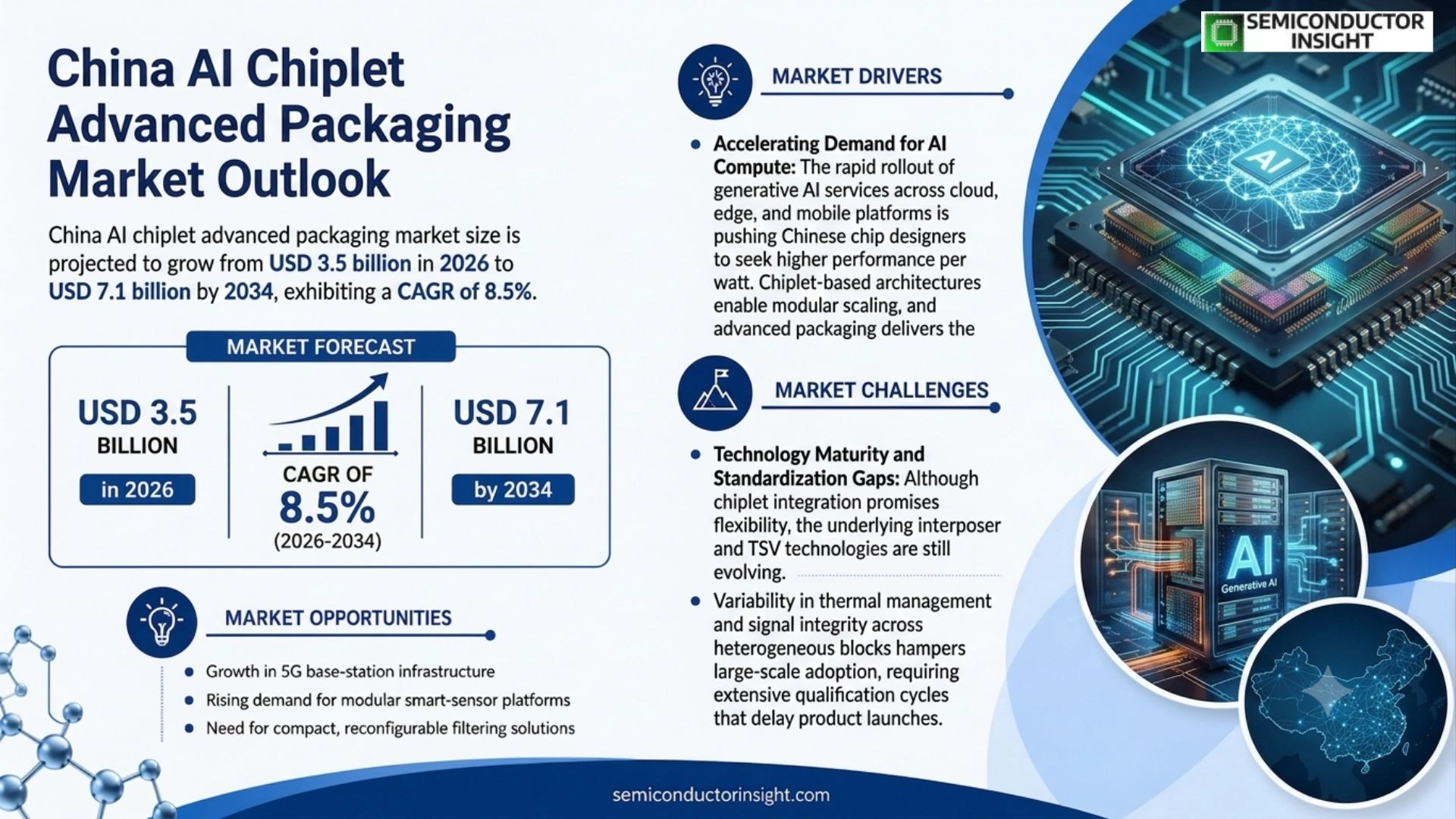
Global China AI chiplet advanced packaging market size was valued at USD 3.2 billion in 2025. The market is projected to grow from USD 3.5 billion in 2026 to USD 7.1 billion by 2034, exhibiting a CAGR of 8.5% during the forecast period.
AI chiplets are modular compute blocks that integrate specialized accelerators such as neural‑processing units, vision‑processing units, or inference engines onto a single substrate. Advanced packaging techniques,including fan‑out wafer‑level packaging, heterogeneous integration, and interposer‑based solutions,enable these chiplets to be densely interconnected, delivering higher performance per watt while reducing form factor.
The market is experiencing rapid growth because Chinese semiconductor policy heavily subsidizes heterogeneous integration, and leading foundries are scaling up capacity for high‑bandwidth memory stacking. Furthermore, rising demand for edge AI devices and autonomous systems drives adoption of chiplet architectures. Initiatives by major consortia and collaborations between universities, equipment vendors, and fabless designers are also accelerating technology rollout.
MARKET DRIVERS
Accelerating Demand for AI Compute
The rapid rollout of generative AI services across cloud, edge, and mobile platforms is pushing Chinese chip designers to seek higher performance per watt. Chiplet‑based architectures enable modular scaling, and advanced packaging delivers the interconnect density required for AI workloads, positioning China AI chiplet advanced packaging Consortium Market as a pivotal enabler.
Strategic Government Support
National policies such as the “Made in China 2025” initiative and dedicated AI semiconductor funds provide fiscal incentives and fast‑track approvals for consortium members. This policy backing accelerates R&D pipelines, reduces time‑to‑market, and creates a fertile ecosystem for collaborative packaging solutions.
➤ Integrated chiplet packaging can cut AI inference latency by up to 30% while trimming power consumption.
In addition, the convergence of 5G rollout and data‑center expansion fuels the need for compact, high‑bandwidth modules. Companies that adopt the consortium’s standards gain a competitive edge through higher yield, lower BOM cost, and faster time‑to‑revenue.
MARKET CHALLENGES
Technology Maturity and Standardization Gaps
Although chiplet integration promises flexibility, the underlying interposer and TSV technologies are still evolving. Variability in thermal management and signal integrity across heterogeneous blocks hampers large‑scale adoption, requiring extensive qualification cycles that delay product launches.
Other Challenges
Supply Chain Constraints
The limited availability of high‑precision lithography equipment and qualified packaging fabs in China creates bottlenecks. Coupled with import restrictions on advanced photomasks, manufacturers face prolonged lead times that increase inventory costs.
MARKET RESTRAINTS
Cost Sensitivity in Tier‑2 and Tier‑3 OEMs
Smaller OEMs and system integrators remain cautious about the upfront investment required for state‑of‑the‑art packaging equipment. Without clear ROI models, many defer migration to chiplet‑centric designs, limiting the consortium’s market penetration beyond flagship cloud providers.
MARKET OPPORTUNITIES
Emerging Edge AI Applications
Edge deployments in autonomous vehicles, smart factories, and surveillance cameras demand compact, power‑efficient AI modules. China AI chiplet advanced packaging Consortium Market can capture this growth by delivering low‑latency, high‑density packages that meet strict form‑factor constraints, opening a sizable revenue stream for consortium members.
China AI Chiplet Advanced Packaging Consortium Market Trends
Heterogeneous Integration Advances
China AI chiplet advanced packaging Consortium Market is being shaped by the rapid maturation of heterogeneous integration techniques that enable high‑bandwidth memory stacking and fan‑out wafer‑level packaging. Domestic foundries have expanded capacity for interposer‑based solutions, allowing chiplets to achieve higher performance per watt while maintaining compact form factors. This technical progress aligns with the national semiconductor roadmap, which prioritizes modular architectures to accelerate time‑to‑market for AI workloads. As a result, design houses are increasingly adopting chiplet‑based portfolios, combining neural‑processing units and vision‑processing units on a single substrate. The trend is evident in the growing number of prototypes that demonstrate up to a 30 % improvement in power efficiency compared with monolithic designs. These advantages are driving early‑stage adoption across data‑center accelerators and high‑performance computing platforms within China.
Other Trends
Policy Support and Funding
Chinese semiconductor policy provides direct subsidies and tax incentives for heterogeneous integration projects, encouraging manufacturers to invest in advanced packaging equipment. The consortium model brings together leading universities, equipment vendors, and fabless designers, creating a collaborative ecosystem that shares design IP and test methodologies. Recent government‑backed programmes have allocated billions of yuan to joint research labs focusing on chiplet interconnect standards, reducing development risk for participants. This coordinated approach accelerates technology transfer from research to production, shortening the typical development cycle from two years to under twelve months for qualified projects.
Expansion into Edge AI and Autonomous Applications
Rising demand for edge AI devices, autonomous vehicles, and smart manufacturing is prompting system integrators to adopt chiplet solutions that combine specialized accelerators with high‑speed I/O in a single package. The compact, low‑power nature of these modules makes them ideal for battery‑constrained edge nodes, while the ability to mix and match functions supports rapid customization for autonomous driving platforms. Collaboration between automotive OEMs and the consortium has resulted in pilot deployments that showcase a 25 % reduction in board space and a notable increase in inference throughput. As these use cases mature, China AI chiplet advanced packaging Consortium Market is expected to see broader penetration across multiple industry verticals, reinforcing its role as a catalyst for next‑generation AI hardware in the region.
COMPETITIVE LANDSCAPE
Key Industry Players
China AI Chiplet Advanced Packaging Consortium Market – Competitive Overview
The consortium’s ecosystem is anchored by Semiconductor Manufacturing International Corp (SMIC), which commands the largest wafer‑fab capacity for heterogeneous integration in mainland China. SMIC’s recent rollout of 12‑inch fan‑out wafer‑level packaging (FO‑WLP) lines and its partnership with the Chinese Academy of Sciences to co‑develop interposer‑based chiplet platforms give it a decisive lead in both volume production and technology licensing. Its dominant market share shapes the supply‑chain hierarchy, dictating design standards and pricing dynamics for downstream fabless designers. Complementing SMIC, the China Academy of Sciences (CAS) operates the national research hub that defines the consortium’s road‑map, funding joint projects that integrate high‑bandwidth memory stacking with AI accelerators. Together they create a vertically integrated structure where policy subsidies, talent pipelines, and intellectual property converge to reinforce a de‑facto monopoly on large‑scale chiplet packaging services.
Beyond the core duopoly, a diverse set of niche innovators enriches the competitive landscape. Huawei’s HiSilicon division supplies custom neural‑processing unit (NPU) chiplets that exploit SMIC’s advanced packaging while maintaining a separate design IP pool. Alibaba Cloud’s chiplet‑focused R&D arm delivers inference‑engine modules optimized for edge‑AI workloads, leveraging its cloud‑scale testing infrastructure. ZTE and Unisoc contribute specialty vision‑processing chiplets for telecom equipment, often using heterogeneous integration to meet form‑factor constraints. Jiangsu Huahong and Shanghai Belling leverage proprietary 2.5‑D interposer technologies to target automotive AI applications. Smaller firms such as WestSoft, Chipine, and RisingChip focus on low‑cost fan‑out solutions for consumer IoT, while the academic spin‑outs of Tsinghua and Shanghai Jiao‑Tong universities provide niche IP blocks for quantum‑ready AI accelerators. This breadth of participants fosters healthy rivalry, driving incremental improvements in throughput, power efficiency, and cost‑per‑die across the consortium.
List of Key China AI Chiplet Advanced Packaging Consortium Companies Profiled
- Semiconductor Manufacturing International Corp (SMIC)
- Semiconductor Manufacturing International Corp (SMIC)
- China Academy of Sciences (CAS)
- Huawei Technologies Co., Ltd.
- Alibaba Cloud AI Chiplet Division
- Alibaba Cloud
- ZTE Corporation
- ZTE
- Jiangsu Huahong Integrated Circuit Co., Ltd.
- Shanghai Belling Integrated Circuit Co., Ltd.
- WestSoft Technology Co., Ltd.
- Chipine Microelectronics Ltd.
- RisingChip Semiconductor Co., Ltd.
- Unisoc (Shanghai Unigroup)
Segment Analysis:
| Segment Category | Sub-Segments | Key Insights |
| By Type |
|
Accelerator‑centric chiplets are emerging as the dominant type because they enable highly optimized neural‑processing functions.
|
| By Application |
|
Edge AI devices drive the most vibrant activity due to the need for compact, power‑efficient solutions.
|
| By End User |
|
Industrial automation emerges as a key end‑user because it requires robust, low‑latency AI processing.
|
| By Integration Technology |
|
Fan‑out wafer‑level packaging is gaining prominence because it delivers high interconnect density without the cost of silicon interposers.
|
| By Market Drivers |
|
Policy incentives shape the ecosystem by providing substantial funding and strategic guidance.
|
Regional Analysis: China AI Chiplet Advanced Packaging Consortium Market
Asia‑Pacific
Government incentives, aggressive cost‑reduction targets, and the surge in AI workloads are propelling demand for advanced chiplet packaging. The push for localized production in China has intensified collaboration across the supply chain, encouraging rapid prototyping and scaling of chiplet solutions.
Policy frameworks emphasizing national security and technology sovereignty are shaping standards for chiplet integration. Export controls and IP protection measures are prompting firms to adopt domestic packaging solutions, reinforcing the region’s strategic positioning.
Established foundries such as SMIC and TSMC dominate volume manufacturing, while a wave of agile niche players offers specialized packaging services. Partnerships between Chinese consortia and Japanese equipment suppliers are intensifying competition on performance and time‑to‑market.
The convergence of 5G, edge AI, and autonomous systems creates new application spaces for chiplet technologies. Early adopters in automotive and data‑center sectors are driving demand for higher interconnect densities and thermal efficiency.
North America
North America’s contribution to China AI chiplet advanced packaging Consortium Market is shaped by its role as a technology supplier and a market for high‑performance AI chips. U.S. firms provide advanced lithography equipment and design services, enabling Chinese manufacturers to accelerate packaging cycles. Nevertheless, regulatory scrutiny and export restrictions temper the depth of collaboration, prompting a cautious yet strategic engagement. The region’s mature semiconductor ecosystem, combined with strong venture capital support for AI startups, creates a pipeline of innovative chiplet architectures that eventually flow into the Asian market through licensing and joint ventures.
Europe
Europe offers a complementary blend of precision engineering and standards expertise that influences China AI chiplet advanced packaging Consortium Market. German and Dutch equipment makers contribute high‑precision bonding and testing solutions, while EU research programs promote cross‑border collaborations on heterogeneous integration. Although market access is moderated by data‑privacy regulations, European firms leverage collaborative platforms to co‑develop packaging processes that align with China’s cost and performance goals, reinforcing a mutually beneficial knowledge exchange.
South America
South America’s involvement remains nascent, primarily focused on downstream applications such as telecommunications and automotive electronics that depend on chiplet‑based AI solutions. Local OEMs are beginning to source advanced packaged components from Chinese suppliers, attracted by competitive pricing and rapid delivery. While the regional manufacturing base is limited, increasing digital transformation initiatives are expected to nurture a modest demand trajectory for China AI chiplet advanced packaging Consortium Market.
Middle East & Africa
The Middle East & Africa region is gradually embracing AI‑driven technologies, with particular interest in smart infrastructure and defense systems. Partnerships with Chinese chiplet consortiums are emerging as governments seek to diversify their technology sources. Although the market size is smaller compared with other regions, strategic investments in data‑center capacity and edge computing are laying the groundwork for a steady uptake of advanced packaging solutions in the coming years.
Report Scope
This market research report provides a comprehensive analysis of the China AI Chiplet Advanced Packaging Consortium Market , covering the forecast period 2026–2034. It offers detailed insights into market dynamics, technological advancements, competitive landscape, and key trends shaping the industry.
Key focus areas of the report include:
- Market Overview: The report begins with an overview outlining its current market scenario, key growth indicators, and industry transformation drivers. It discusses macroeconomic factors, demand–supply balance, regulatory landscape, and the strategic role of semiconductors in powering advancements across industries such as automotive, telecommunications, consumer electronics, and industrial automation.
- Market Size & Forecast: Historical data and future projections for revenue, unit shipments, and market value across major regions and segments.
- Segmentation Analysis: Detailed breakdown by product type, technology, application, and end-user industry to identify high-growth segments and investment opportunities.
- Regional Insights: Insights into market performance across North America, Europe, Asia-Pacific, Latin America, and the Middle East & Africa, including country-level analysis where relevant.
- Competitive Landscape: Profiles of leading market participants, including their product offerings, R&D focus, manufacturing capacity, pricing strategies, and recent developments such as mergers, acquisitions, and partnerships.
- Technology Trends & Innovation: Assessment of emerging technologies, integration of AI/IoT, semiconductor design trends, fabrication techniques, and evolving industry standards.
- Market Drivers & Restraints: Evaluation of factors driving market growth along with challenges, supply chain constraints, regulatory issues, and market-entry barriers.
- Stakeholder Insights: Insights for component suppliers, OEMs, system integrators, investors, and policymakers regarding the evolving ecosystem and strategic opportunities.
Primary and secondary research methods are employed, including interviews with industry experts, data from verified sources, and real-time market intelligence to ensure the accuracy and reliability of the insights presented.
FREQUENTLY ASKED QUESTIONS:
What is the current market size of China AI Chiplet Advanced Packaging Consortium Market?
-> China AI chiplet advanced packaging market size is projected to grow from USD 3.5 billion in 2026 to USD 7.1 billion by 2034, exhibiting a CAGR of 8.5%.
Which key companies operate in China AI Chiplet Advanced Packaging Consortium Market?
-> Key players information is not disclosed in the provided source.
What are the key growth drivers?
-> The provided source highlights rapid growth driven by strong Chinese semiconductor policy subsidies, scaling of high‑bandwidth memory stacking, and rising demand for edge AI and autonomous systems.
Which region dominates the market?
-> Asia-Pacific is the primary region of activity due to extensive policy support and fab capacity expansion.
What are the emerging trends?
-> Emerging trends include heterogeneous integration, fan‑out wafer‑level packaging, and interposer‑based solutions that enable dense chiplet interconnects.
Get Sample Report PDF for Exclusive Insights
Report Sample Includes
- Table of Contents
- List of Tables & Figures
- Charts, Research Methodology, and more...
 Download Sample Report PDF