MARKET INSIGHTS
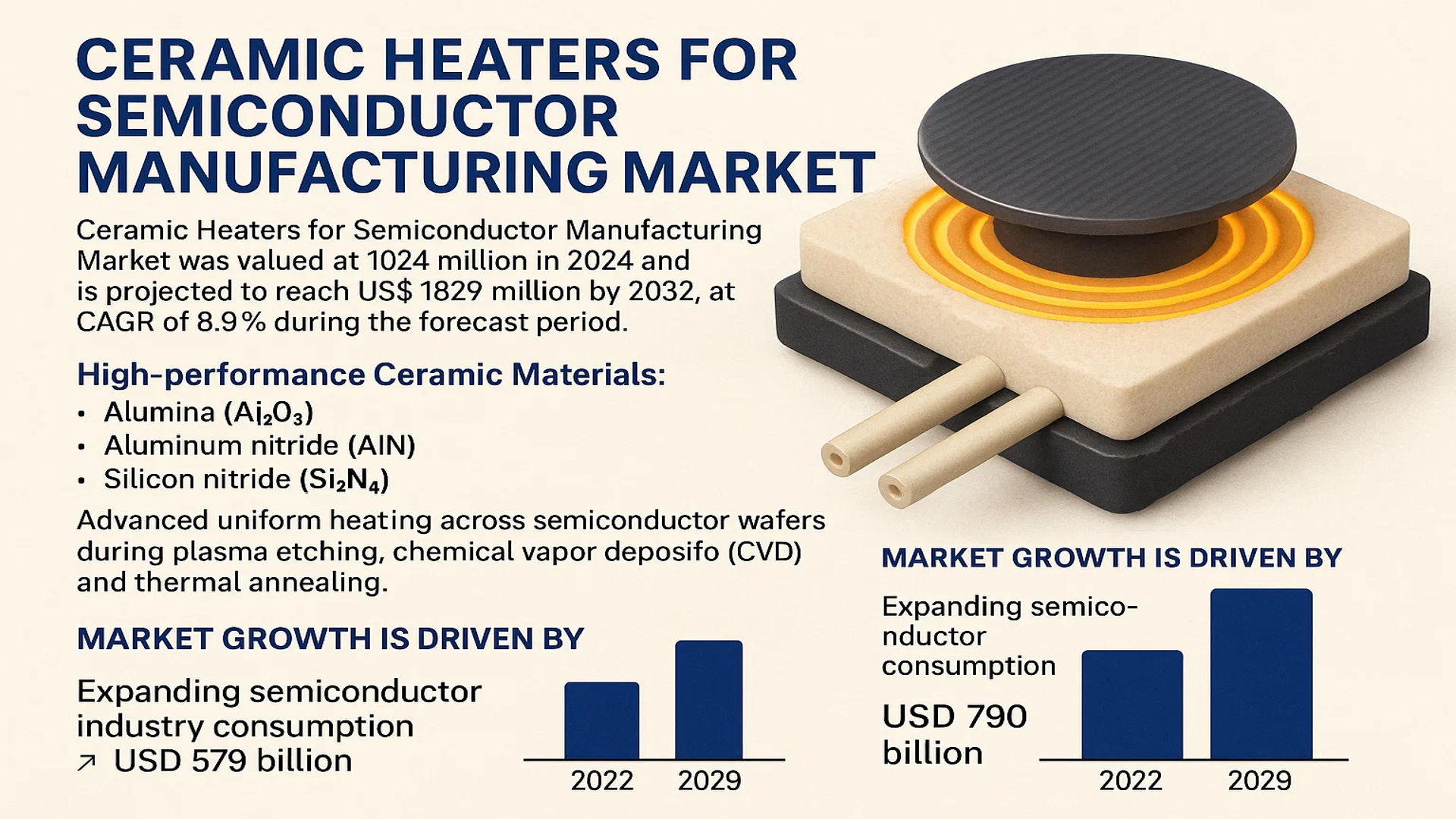
The global Ceramic Heaters for Semiconductor Manufacturing Market was valued at 1024 million in 2024 and is projected to reach US$ 1829 million by 2032, at a CAGR of 8.9% during the forecast period.
Ceramic heaters for semiconductor manufacturing are advanced thermal management components designed to provide uniform heating across semiconductor wafers during critical fabrication processes. These heaters utilize high-performance ceramic materials such as alumina (Al2O3), aluminum nitride (AlN), and silicon nitride (Si3N4), which offer superior thermal conductivity, electrical insulation, and chemical resistance. Their precision heating capabilities ensure consistent wafer processing quality in applications including plasma etching, chemical vapor deposition (CVD), and thermal annealing.
The market growth is driven by the expanding semiconductor industry, which was valued at USD 579 billion in 2022 and is projected to reach USD 790 billion by 2029. While memory segments faced declines, analog and logic IC segments grew over 14% in 2022, reflecting strong demand for IoT and automotive applications. Furthermore, increasing adoption of 5G, AI chips, and advanced packaging technologies necessitates precise temperature control solutions. Key players like Sumitomo Electric and NGK Insulators are innovating ceramic heater designs to meet evolving industry requirements for miniaturization and energy efficiency.
 1
1
MARKET DYNAMICS
MARKET DRIVERS
Expansion of Semiconductor Manufacturing Facilities Worldwide to Fuel Demand
The global semiconductor industry is experiencing unprecedented growth with countries investing heavily in domestic chip production capacity. Major economies have announced ambitious plans to build new semiconductor fabrication plants (fabs), with over 40 new facilities planned worldwide by 2025. This surge in fab construction directly drives demand for ceramic heaters which are critical components in multiple semiconductor manufacturing processes including chemical vapor deposition and thermal annealing. The push for semiconductor self-sufficiency has led to significant investments, with some regions allocating billions in subsidies to attract chip manufacturers. These developments create sustained demand for high-performance ceramic heating elements that can withstand extreme temperatures while maintaining precise thermal control.
Advancement in Semiconductor Processing Technologies to Drive Market
Emerging semiconductor technologies like 3D NAND, advanced packaging, and sub-5nm process nodes require increasingly sophisticated thermal processing solutions. Advanced nodes demand tighter temperature uniformity across wafers, which traditional metal heaters struggle to achieve. Aluminum nitride (AlN) and silicon nitride (Si3N4) ceramic heaters have emerged as preferred solutions due to their superior thermal conductivity and stability at high temperatures. The transition to larger wafer sizes (300mm and beyond) further amplifies this demand, as maintaining temperature uniformity across larger surface areas becomes more technically challenging. Additionally, new memory architectures and compound semiconductor applications are creating specialized thermal processing requirements that ceramic heaters are uniquely positioned to address.
Stringent Quality Requirements in Semiconductor Manufacturing to Boost Adoption
Semiconductor manufacturers face increasingly strict requirements for process control and yield optimization. Ceramic heaters offer significant advantages in this environment due to their minimal particle generation, chemical inertness, and long-term stability. Unlike metal counterparts, high-purity ceramic materials don’t contaminate processes or require frequent replacement. The trend toward more stringent defect budgets at advanced nodes makes ceramic heating solutions increasingly attractive. Furthermore, their ability to maintain performance in corrosive process environments common in etch and deposition applications provides additional value. As yield management becomes more critical for profitability in advanced semiconductor manufacturing, these quality advantages are accelerating ceramic heater adoption.
MARKET RESTRAINTS
High Manufacturing Costs and Complex Production Process to Limit Market Growth
While ceramic heaters offer superior performance, their manufacturing involves complex processes and specialized materials that result in significantly higher costs compared to conventional heating solutions. The production of high-purity aluminum nitride, for example, requires controlled atmosphere sintering and precise temperature profiles that add to overall expenses. Additionally, the need for tight dimensional tolerances and customized designs for specific semiconductor tools necessitates specialized machining capabilities. These factors contribute to ceramic heaters typically costing several times more than metal-based alternatives, making adoption challenging in cost-sensitive segments of the semiconductor industry where price remains a key decision factor.
Supply Chain Vulnerabilities for Specialty Materials to Create Challenges
The ceramic heater market faces constraints from limited availability and concentration of key raw material suppliers. Aluminum nitride powder, a critical material for high-performance heaters, is produced by only a handful of manufacturers worldwide. This concentration creates supply chain vulnerabilities, as evidenced by recent disruptions that have led to extended lead times and price volatility. Furthermore, the production of specialized ceramic components requires rare earth elements and other materials subject to geopolitical and trade uncertainties. Semiconductor manufacturers increasingly seek to qualify multiple supply sources, but the technical complexity of ceramic heater production makes alternative supplier qualification a lengthy and costly process that can delay market expansion.
MARKET OPPORTUNITIES
Emerging Applications in Compound Semiconductor Manufacturing to Open New Growth Avenues
The rapid growth of compound semiconductor markets presents significant opportunities for ceramic heater manufacturers. Applications such as GaN power electronics and RF devices, silicon carbide for electric vehicles, and photonics manufacturing all require specialized thermal processing solutions. These materials often require higher processing temperatures and more controlled heating environments than traditional silicon, creating demand for advanced ceramic heating systems. Additionally, the transition to wide bandgap semiconductors is driving innovation in heater designs to meet the unique requirements of these emerging technologies. Companies investing in tailored solutions for compound semiconductor applications stand to benefit from this fast-growing segment of the semiconductor market.
Integration of Smart Features and IoT Capabilities to Create Value-Added Solutions
The increasing adoption of Industry 4.0 technologies in semiconductor fabs creates opportunities to develop smart ceramic heaters with embedded sensors and connectivity features. Such advanced heaters could provide real-time performance data, predictive maintenance capabilities, and adaptive thermal control. The integration of temperature monitoring directly into heater elements could improve process control while reducing the need for additional metrology equipment. As semiconductor manufacturers seek to optimize equipment utilization and minimize unplanned downtime, these intelligent heating solutions could command premium pricing and create new service revenue streams for manufacturers through performance-based contracts and predictive maintenance offerings.
MARKET CHALLENGES
Technical Challenges in Extreme Process Conditions to Constrain Adoption
Semiconductor manufacturing continues to push the boundaries of thermal processing, creating significant technical challenges for ceramic heater providers. Emerging applications require heaters capable of withstanding temperatures exceeding 1,000°C while maintaining sub-degree uniformity across large-diameter wafers. Additionally, new materials and 3D device architectures demand heaters that can maintain performance through thousands of thermal cycles with minimal degradation. The increasingly aggressive process chemistries used in advanced nodes also create material compatibility issues that heater manufacturers must address. Developing solutions that meet these extreme requirements without compromising reliability or significantly increasing costs remains an ongoing challenge for the industry.
Long Qualification Cycles and Industry Conservatism to Slow Market Penetration
The semiconductor industry’s rigorous qualification processes present a significant challenge for new ceramic heater technologies. Equipment manufacturers and chipmakers typically require extensive testing and validation of new components before adoption, with qualification cycles often lasting 12-18 months. This lengthy process discourages rapid technology adoption even when performance benefits are significant. Additionally, the conservative nature of semiconductor manufacturing makes companies reluctant to change established processes unless the benefits clearly outweigh the qualification costs and risks. Overcoming these barriers requires heater manufacturers to invest heavily in test wafer programs and provide comprehensive performance data while working closely with customers to understand their specific process requirements.
CERAMIC HEATERS FOR SEMICONDUCTOR MANUFACTURING MARKET TRENDS
Advanced Thermal Processing Needs Drive Adoption of High-Performance Ceramic Heaters
The rapid expansion of semiconductor manufacturing, particularly for advanced nodes below 7nm, has intensified the demand for precision ceramic heaters capable of maintaining ultra-uniform wafer temperatures. As foundries push deeper into extreme ultraviolet (EUV) lithography and 3D chip stacking technologies, temperature control tolerances have tightened to ±0.5°C across 300mm wafers. This has prompted a shift toward aluminum nitride (AlN) ceramic heaters, which demonstrate superior thermal conductivity (170-200 W/mK) compared to traditional alumina models (24-30 W/mK). While these high-performance solutions command premium pricing, wafer fabrication plants are prioritizing their adoption to minimize yield losses in sensitive deposition and etching processes.
Other Trends
Miniaturization Demands New Material Solutions
The semiconductor industry’s relentless pursuit of miniaturization has created unique thermal management challenges, particularly in transition to 450mm wafer processing. Larger wafer sizes exponentially increase the risk of thermal gradients during rapid annealing cycles, necessitating ceramic heaters with engineered porosity and graded material compositions. Leading manufacturers are now embedding multizone heating elements within silicon nitride matrices (Si3N4), achieving localized temperature control with response times under 3 seconds. This innovation proves critical for next-generation memory production where thermal budgets must be minimized to prevent cell degradation.
Geopolitical Factors Reshaping Supply Chain Strategies
Recent export controls on advanced semiconductor equipment have accelerated regionalization of ceramic heater supply chains. Domestic production capacity for AlN-based heating components has grown 37% year-over-year in non-sanctioned markets as chipmakers diversify suppliers. This localization trend coincides with increased R&D into alternative dielectric ceramics, particularly for back-end processes where slightly lower thermal conductivity can be tolerated. The market is also observing a strategic shift toward modular heater designs that allow quick component replacement, reducing dependence on single-source suppliers for complete assemblies.
Sustainability Initiatives Influence Product Development
Environmental regulations are driving innovation in low-emission ceramic heating technologies. Modern designs now incorporate recycled ceramic content up to 40% without compromising thermal performance, responding to foundry sustainability targets. Simultaneously, manufacturers are developing energy-efficient heater architectures that reduce power consumption by up to 22% during idle periods, a critical factor as electricity costs now constitute over 18% of wafer production expenses. These developments align with broader industry commitments to achieve carbon-neutral fab operations by 2030.
COMPETITIVE LANDSCAPE
Key Industry Players
Innovation and Precision Drive Competition in Ceramic Heater Market
The global ceramic heaters for semiconductor manufacturing market features a diversified competitive landscape with established players dominating through technological superiority and regional reach. Sumitomo Electric leads the market with its extensive portfolio of high-performance aluminum nitride (AlN) heaters, which are widely adopted in advanced chip fabrication processes.
NGK Insulators and CoorsTek maintain strong market positions due to their expertise in manufacturing durable silicon nitride (Si3N4) and alumina (Al2O3) heaters respectively. These materials are preferred for their thermal stability and cost-effectiveness in semiconductor deposition processes.
Japanese manufacturers particularly excel in ceramic heater production, with Sumitomo commanding approximately 22% of the global market share in 2024. This leadership stems from their precision manufacturing capabilities and strong relationships with semiconductor equipment OEMs.
Meanwhile, North American players like Cactus Materials and Oasis Materials are gaining traction through innovative heater designs that reduce micro-cracking during thermal cycling. Their growth is further supported by the U.S. government’s initiatives to strengthen domestic semiconductor manufacturing capabilities.
The competitive dynamics are intensifying as companies focus on developing heaters with superior temperature uniformity (±1°C across 300mm wafers) and faster thermal response times. Strategic partnerships with semiconductor equipment manufacturers are becoming crucial for market access, particularly in the foundry and memory sectors.
Recent industry movements include NGK Insulators’ expansion of its silicon nitride heater production capacity by 30% in 2023 to meet growing demand from logic chip manufacturers. Similarly, CoorsTek announced a collaborative development program with leading EUV lithography equipment providers to optimize heater performance for next-generation nodes.
List of Key Ceramic Heater Manufacturers
- Sumitomo Electric Industries, Ltd. (Japan)
- NGK Insulators, Ltd. (Japan)
- Mico Ceramics Co., Ltd. (Japan)
- BACH Resistor Ceramics GmbH (Germany)
- BOBOO Hitech Co., Ltd. (China)
- Semixicon LLC (U.S.)
- CoorsTek, Inc. (U.S.)
- Oasis Materials Corporation (U.S.)
- Cactus Materials, Inc. (U.S.)
Segment Analysis:
By Type
Alumina (Al2O3) Segment Holds Major Share Due to Superior Thermal and Mechanical Properties
The market is segmented based on type into:
- Alumina (Al2O3)
- Aluminum Nitride (AlN)
- Silicon Nitride (Si3N4)
- Others
By Application
Plasma Process Segment Dominates Owing to Critical Role in Semiconductor Fabrication
The market is segmented based on application into:
- Plasma Process
- Thermal Treatment
- Wet Chemical Process
By End User
Foundries Lead the Market Due to High-Volume Semiconductor Production Needs
The market is segmented based on end user into:
- Foundries
- Integrated Device Manufacturers (IDMs)
- Research Institutions
Regional Analysis: Ceramic Heaters for Semiconductor Manufacturing Market
Asia-Pacific
The Asia-Pacific region dominates the global ceramic heaters market for semiconductor manufacturing, accounting for over 45% of total market share in 2024. This leadership position stems from massive semiconductor fabrication investments, particularly in China, Taiwan, South Korea, and Japan – which collectively represent more than 65% of global chip production capacity. The region benefits from strong government support, such as China’s $143 billion semiconductor industry investment plan and Taiwan’s ongoing dominance in foundry services. Aluminum Nitride (AlN) ceramic heaters are gaining traction due to their superior thermal conductivity properties needed for advanced wafer processing nodes below 14nm. However, supply chain disruptions and geopolitical tensions present ongoing challenges for equipment suppliers in the region.
North America
North America’s semiconductor ceramic heater market is driven by advanced R&D facilities and leading-edge fab expansions, particularly in the U.S. states of Arizona and Texas where Intel, TSMC, and Samsung have committed over $40 billion in new fab investments. The region shows strong preference for Silicon Nitride (Si3N4) ceramic heaters due to their exceptional mechanical strength and thermal shock resistance. Strict cleanroom requirements and automation trends are pushing manufacturers toward customized heater solutions with integrated temperature sensing. While the CHIPS Act provides funding incentives, workforce shortages and lengthy equipment qualification processes remain key constraints for market growth.
Europe
Europe maintains a strong position in specialty semiconductor manufacturing, particularly for automotive and industrial applications, driving demand for robust ceramic heating solutions. Germany leads regional adoption with its concentration of automotive chipmakers and equipment manufacturers. The market shows increasing preference for Alumina (Al2O3) heaters for cost-sensitive applications, though higher-end fabs are transitioning to composite materials. European suppliers emphasize circular economy principles, developing reusable heater components and recycling programs. However, energy price volatility and slower adoption of next-gen nodes compared to Asia limit some market expansion opportunities.
South America
While representing a smaller market share, South America shows emerging potential in ceramic heaters for semiconductor back-end operations and packaging applications. Brazil leads regional demand with its growing electronics manufacturing sector. The market primarily utilizes standard Alumina heaters due to cost considerations, with only limited adoption of advanced materials. Infrastructure limitations and dependence on imported equipment constrain market growth, though regional trade agreements are improving access to technology. Some local players are developing customized solutions for specialized semiconductor applications in medical and industrial sectors.
Middle East & Africa
The MEA region presents developing opportunities, particularly in Israel and the UAE where governments are investing in high-tech manufacturing capabilities. Most demand currently comes from research institutions and small-scale semiconductor operations rather than volume production. The market shows preference for turnkey heating solutions due to limited local technical expertise. While adoption of ceramic heaters remains modest, planned semiconductor initiatives like Saudi Arabia’s $6 billion semiconductor manufacturing strategy could drive future demand. Regional growth is constrained by infrastructure gaps and competition for investment from more established manufacturing hubs.
Report Scope
This market research report provides a comprehensive analysis of the global Ceramic Heaters for Semiconductor Manufacturing market, covering the forecast period 2025–2032. It offers detailed insights into market dynamics, technological advancements, competitive landscape, and key trends shaping the industry.
Key focus areas of the report include:
- Market Size & Forecast: Historical data and future projections for revenue, unit shipments, and market value across major regions and segments. The global Ceramic Heaters for Semiconductor Manufacturing market was valued at USD 1024 million in 2024 and is projected to reach USD 1829 million by 2032, growing at a CAGR of 8.9%.
- Segmentation Analysis: Detailed breakdown by product type (Alumina, Silicon Nitride, Aluminum Nitride, Others), application (Plasma Process, Thermal Treatment, Wet Chemical Process), and end-user industry to identify high-growth segments.
- Regional Outlook: Insights into market performance across North America, Europe, Asia-Pacific, Latin America, and the Middle East & Africa, with Asia-Pacific accounting for the largest market share in 2024.
- Competitive Landscape: Profiles of leading market participants including Sumitomo Electric, NGK Insulators, CoorsTek, and others, covering their product portfolios, R&D investments, and strategic initiatives.
- Technology Trends: Assessment of emerging innovations in ceramic heating technologies, integration with advanced semiconductor manufacturing processes, and material science breakthroughs.
- Market Drivers & Restraints: Analysis of factors such as growing semiconductor industry (projected to reach USD 790 billion by 2029), demand for precision heating solutions, alongside challenges like material costs and supply chain complexities.
- Stakeholder Analysis: Strategic insights for semiconductor equipment manufacturers, material suppliers, foundries, and investors regarding market opportunities and competitive positioning.
The research methodology combines primary interviews with industry experts and analysis of verified market data from reputable sources to ensure accuracy and reliability.
FREQUENTLY ASKED QUESTIONS:
What is the current market size of Global Ceramic Heaters for Semiconductor Manufacturing Market?
->Ceramic Heaters for Semiconductor Manufacturing Market was valued at 1024 million in 2024 and is projected to reach US$ 1829 million by 2032, at a CAGR of 8.9% during the forecast period.
Which key companies operate in this market?
-> Major players include Sumitomo Electric, NGK Insulators, Mico Ceramics, CoorsTek, BOBOO Hitech, and Semixicon.
What are the key growth drivers?
-> Growth is driven by rising semiconductor production (6% CAGR), increasing wafer sizes, and demand for precision thermal processing in advanced chip manufacturing.
Which region dominates the market?
-> Asia-Pacific leads the market due to concentrated semiconductor manufacturing in countries like China, South Korea, and Taiwan.
What are the emerging trends?
-> Emerging trends include development of ultra-pure ceramic materials, integration with Industry 4.0 systems, and adoption of larger 300mm+ wafer heating solutions.

Get Sample Report PDF for Exclusive Insights
Report Sample Includes
- Table of Contents
- List of Tables & Figures
- Charts, Research Methodology, and more...
 Download Sample Report PDF