Cell Phone Chargers Market Insights
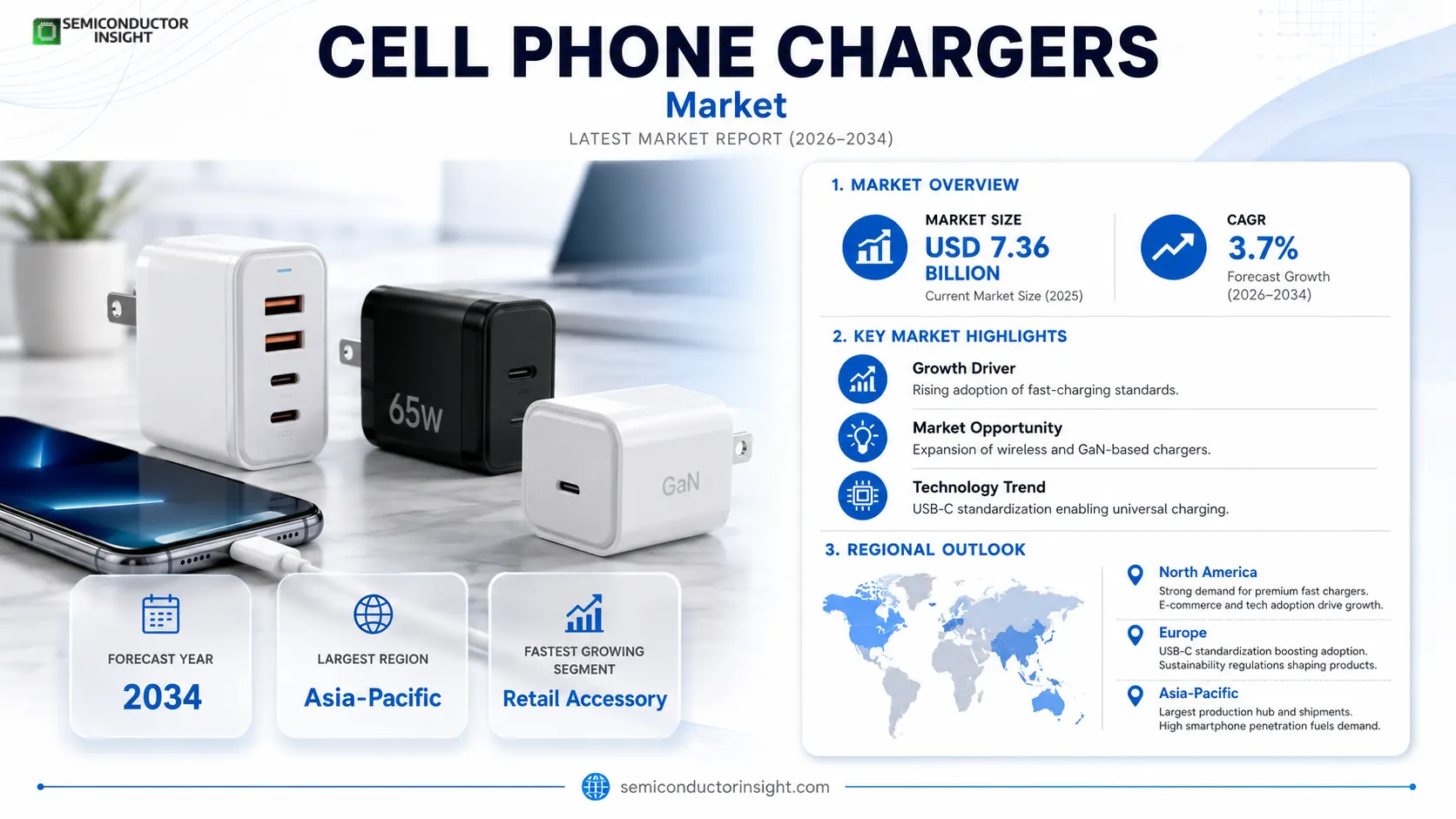
Cell Phone Chargers market size was valued at USD 7,364 million in 2025. The market will reach USD 9,460 million by 2032, reflecting a CAGR of 3.7% over the forecast period.
Cell phone chargers are AC‑to‑DC power adapters that provide safe and stable power for mobile phones. They comprise in‑box units bundled with devices and out‑of‑box retail chargers. Most products use USB‑C or USB‑A connectors and support fast‑charging protocols such as USB PD, PPS and QC, while newer designs push higher power levels, smaller footprints, multi‑port layouts and gallium nitride (GaN) technology.Growth is driven by worldwide adoption of USB‑C standards, the shift away from mandatory in‑box chargers, mid‑range smartphones adopting higher charging powers, and GaN enabling greater efficiency in compact form factors.
MARKET DRIVERS
Ubiquity of Smartphones Fuels Demand
Cell Phone Chargers Market has been buoyed by the 2023 smartphone shipment of roughly 1.6 billion units, a figure that eclipses the previous year by 8 %. Every new handset adds a compulsory accessory, and manufacturers are increasingly bundling higher‑output adapters to meet consumer expectations for quick top‑ups.
Fast‑Charging Standards Gain Acceptance
Adoption of USB‑PD and proprietary 30 W‑plus solutions accelerated at a compound annual rate of about 45 % from 2021‑2023. Brands that integrate these protocols report a measurable uplift in accessory cross‑selling, as users replace legacy chargers to exploit the faster throughput.
➤ “Consumers now expect a full charge in under thirty minutes; those who cannot deliver will lose market share,” says a senior product manager at a leading charger OEM.
Beyond speed, regulatory incentives for energy‑efficient designs have prompted OEMs to shrink standby draw, creating a niche for smart chargers that dynamically adjust output. This convergence of technology, policy, and user habit underpins the current upward trajectory of the market.
MARKET CHALLENGES
Supply Chain Volatility Raises Costs
Component shortagesparticularly for high‑purity copper wire and silicon chipshave driven unit costs up by an estimated 12 % in 2023. Manufacturers scramble to secure contracts, and the resulting price pressure compresses margins, especially for low‑cost, high‑volume models.
Other Challenges
Fragmented Standard Landscape
Multiple fast‑charging protocols coexist across brands, forcing retailers to stock a wider SKU mix. This inventory complexity erodes operational efficiency and can deter smaller distributors from fully engaging the segment.
MARKET RESTRAINTS
Regulatory Hurdles on Power Limitations
Emerging regulations in the EU and North America cap maximum charger output for non‑essential devices at 65 W, limiting the rollout of ultra‑high‑speed solutions. Companies that have invested heavily in 100 W architectures now face the prospect of redesigning product lines to comply, which adds both time and expense.
MARKET OPPORTUNITIES
Wireless Power Transfer Expansion
Wireless charging pads and resonant‑inductive pads have captured roughly 9 % of total charger shipments in 2023, up from 5 % two years earlier. As device manufacturers embed larger coil areas and as standards converge, Cell Phone Chargers Market can expect a sizable shift toward cable‑free solutions, opening avenues for premium pricing and differentiated design.
Cell Phone Chargers Market Trends
Shift Toward Retail‑Only Chargers
In 2025, in‑box charger shipments represented roughly 0.62 billion units, while retail adapters accounted for 1.06 billion units. The deliberate removal of bundled chargers by major OEMs has redirected demand from the traditional volume‑driven model to a fragmented retail ecosystem. This transition raises the average selling price to US$4.8 per unit and lifts gross margins to about 17 %. Companies that can secure shelf space on e‑commerce platforms or partner with telecom operators now capture a larger share of the total spend, because consumers are forced to purchase a separate accessory for every new device.
Other Trends
GaN‑Enabled High‑Power Solutions
The adoption of gallium‑nitride (GaN) devices is reshaping the product hierarchy. GaN chips permit power densities that were previously achievable only with bulky silicon converters, enabling chargers that deliver 65 W or more in a size comparable to a standard USB‑A brick. Early adopters report margin expansion of up to 4 percentage points, reflecting both a premium price tag and reduced material usage. For manufacturers, the barrier to entry lies in securing reliable GaN fab capacity and navigating the additional certification steps linked to higher thermal loads.
Standardization of USB‑C and Fast‑Charging Protocols
Regulatory alignment around the USB‑C connector, together with the convergence of fast‑charging standards such as USB‑PD, PPS and QC, has created a de‑facto universal charger. The result is a higher utilization rate per unit; a single adapter can now service smartphones, tablets, earbuds and even laptops. This multi‑device applicability drives a shift in consumer perceptionfrom a disposable accessory to a core component of the personal electronics suite. Suppliers that integrate comprehensive protocol support into a compact chassis differentiate themselves and are better positioned to command price premiums, especially in mid‑range and flagship segments where users prioritize both speed and safety.
COMPETITIVE LANDSCAPE
Key Industry Players
Cell Phone Chargers Market: Competitive Overview
The ecosystem is anchored by a handful of manufacturers that dominate both in‑box sourcing for OEMs and the fast‑moving retail channel. Samsung, leveraging its handset volume, continues to command a sizable share of bundled adapters while also expanding its branded accessory lineup to address premium‑price segments. Anker, with a reputation for durable, high‑output USB‑C solutions, has turned the retail market into a growth engine by pairing aggressive marketing with iterative product launches that showcase GaN‑based chargers. These two firms illustrate how scale, brand equity, and technology leadership intersect to shape pricing power and distribution reach. Meanwhile, the supply chain is increasingly consolidated around component specialists such as Delta Electronics and Lite‑On, whose expertise in power‑management ICs and magnetics enables OEMs to differentiate on efficiency and thermal performance without inflating bill‑of‑materials.Beyond the marquee names, a dense layer of niche participants adds depth to the market. Baseus and Ugreen have built sizable followings on e‑commerce platforms by offering multi‑port, foldable, and color‑customized designs that appeal to price‑sensitive yet style‑aware consumers. European‑based Belkin, together with British‑origin Mophie/Zagg, rely on strong retail partnerships and rigorous safety certifications to command premium margins. Asian manufacturers such as Salcomp, Aohai Technology, and BYD Electronics focus on volume contracts with smartphone OEMs, capitalising on cost‑efficient production capacities in mainland China and Vietnam. Flextronics and Chicony Power act as contract manufacturers, providing turnkey solutions that let emerging brands launch quickly. Huntkey and Goneo Group round out the landscape by targeting specific regional niches, often leveraging local distribution networks to sustain moderate profitability despite intense price competition. The breadth of players, from pure‑play accessory brands to integrated contract manufacturers, underscores a market where differentiation hinges on design innovation, regulatory compliance, and the ability to navigate a fragmented sales environment.
List of Key Cell Phone Chargers Companies Profiled
- Samsung
- Anker
- Baseus
- Belkin
- Ugreen
- Salcomp
- Aohai Technology
- Flextronics
- Lite‑On Technology
- Delta Electronics
- Chicony Power
- BYD Electronics
- Mophie/Zagg
- Huntkey
- Goneo Group
Segment Analysis:
| Segment Category | Sub-Segments | Key Insights |
| By Type |
|
Wired Charger remains the dominant offering due to its broad compatibility and cost efficiency.
|
| By Application |
|
Entry/Mid‑range drives the bulk of volume because most smartphones are positioned in this tier.
|
| By End User |
|
Retail Accessory has become the most dynamic segment as OEMs reduce in‑box inclusion.
|
| By Technology |
|
USB‑C Interface is the anchor technology shaping the market ecosystem.
|
| By Power Rating |
|
Medium‑Power Fast Charger is gaining traction as the sweet spot between speed and portability.
|
Regional Analysis: Cell Phone Chargers Market
Buyers increasingly demand chargers that deliver rapid power without excessive heat, leading manufacturers to adopt gallium‑nitride components. This shift also favors modular designs that can serve multiple devices, reducing clutter and simplifying inventory for retailers.
Federal guidelines on electronic waste and energy consumption push firms toward recyclable materials and higher efficiency ratings, compelling a redesign of product housings and internal circuitry.
Recent semiconductor shortages have forced chargers producers to diversify sourcing, prompting strategic partnerships with Asian component makers while keeping final assembly within North American borders for speed to market.
The convergence of chargers with smart‑home hubs and vehicle infotainment systems creates cross‑selling opportunities, encouraging firms to embed wireless standards that communicate with broader IoT platforms.
Europe
European consumers exhibit a cautious yet progressive attitude toward charging technologies, often balancing performance with rigorous safety standards. The region’s emphasis on universal compatibility has accelerated the adoption of USB‑C as the default interface, compelling manufacturers to phase out legacy connectors. Environmental directives, especially the EU Ecodesign regulation, compel firms to embed power‑management features that limit idle draw, reshaping product engineering priorities. Retail distribution in Europe leans heavily on specialist electronics retailers, which influence brand perception through curated assortments and in‑store demonstrations. Business‑to‑business procurement, driven by remote‑working policies, sustains demand for high‑capacity, cable‑management solutions that can serve multiple endpoints across office environments.
Asia‑Pacific
The Asia‑Pacific market showcases a blend of high‑volume consumption and rapid technology diffusion, propelled by a youthful demographic that embraces the latest mobile innovations. Local manufacturers leverage cost‑effective production capabilities to introduce competitively priced fast‑charging accessories, often bundling them with flagship smartphones. However, fragmented regulatory frameworks across countries create divergent compliance pathways, prompting multinational brands to adopt a modular approach that can be quickly adapted to regional standards. Mobile gaming and streaming trends intensify the need for reliable, high‑wattage chargers, while the growing prevalence of 5G devices amplifies power draw, fueling demand for next‑generation charging solutions.
South America
In South America, market maturation aligns with expanding broadband penetration and increasing smartphone replacement cycles. Consumers prioritize durability and affordability, leading to a preference for rugged chargers that can endure varied environmental conditions. Import tariffs and logistical complexities elevate the importance of local assembly, encouraging players to establish regional hubs that reduce lead times. Subscription‑based power‑bank services emerge as a complementary revenue stream, reflecting a consumer desire for uninterrupted connectivity in regions where grid reliability can fluctuate.
Middle East & Africa
The Middle East & Africa region presents a heterogeneous landscape where affluent urban centers drive premium charger adoption, while emerging markets focus on value‑priced, basic solutions. Climate considerations, such as high ambient temperatures, push manufacturers to incorporate thermal‑management designs that safeguard device longevity. Energy‑efficiency policies in Gulf Cooperation Council nations incentivize the rollout of smart‑charging stations in public spaces, creating opportunities for B2B collaborations. Meanwhile, expanding mobile‑first internet access across Africa fuels a steady rise in demand for portable charging accessories that support extended usage periods.
Report Scope
This market research report provides a comprehensive analysis of Cell Phone Chargers Market , covering the forecast period 2026–2034. It offers detailed insights into market dynamics, technological advancements, competitive landscape, and key trends shaping the industry.
Key focus areas of the report include:
- Market Overview: The report begins with an overview outlining its current market scenario, key growth indicators, and industry transformation drivers. It discusses macroeconomic factors, demand–supply balance, regulatory landscape, and the strategic role of semiconductors in powering advancements across industries such as automotive, telecommunications, consumer electronics, and industrial automation.
- Market Size & Forecast: Historical data and future projections for revenue, unit shipments, and market value across major regions and segments.
- Segmentation Analysis: Detailed breakdown by product type, technology, application, and end-user industry to identify high-growth segments and investment opportunities.
- Regional Insights: Insights into market performance across North America, Europe, Asia-Pacific, Latin America, and the Middle East & Africa, including country-level analysis where relevant.
- Competitive Landscape: Profiles of leading market participants, including their product offerings, R&D focus, manufacturing capacity, pricing strategies, and recent developments such as mergers, acquisitions, and partnerships.
- Technology Trends & Innovation: Assessment of emerging technologies, integration of AI/IoT, semiconductor design trends, fabrication techniques, and evolving industry standards.
- Market Drivers & Restraints: Evaluation of factors driving market growth along with challenges, supply chain constraints, regulatory issues, and market-entry barriers.
- Stakeholder Insights: Insights for component suppliers, OEMs, system integrators, investors, and policymakers regarding the evolving ecosystem and strategic opportunities.
Primary and secondary research methods are employed, including interviews with industry experts, data from verified sources, and real-time market intelligence to ensure the accuracy and reliability of the insights presented.
FREQUENTLY ASKED QUESTIONS:
What is the current market size of Cell Phone Chargers Market?
-> Cell Phone Chargers Market was valued at USD 7,364 million in 2025 and is expected to reach USD 9,460 million by 2032, growing at a CAGR of 3.7%.
Which key companies operate in Cell Phone Chargers Market?
-> Key players include Salcomp, Aohai Technology, Flextronics, Lite-On Technology, Bichamp, BYD Electronics, Huntkey, Delta Electronics, Chicony Power, Samsung, Anker, Baseus, Mophie/Zagg, Belkin, Ugreen and Goneo Group.
What are the key growth drivers?
-> Key growth drivers include standardization of USB‑C and fast‑charging protocols, the structural shift from in‑box to retail chargers, power‑upgrade adoption in mid‑range devices, GaN technology enabling higher power density, and the expanding smart‑device ecosystem that raises demand for versatile, high‑efficiency chargers.
Which region dominates the market?
-> Asia accounts for the largest share of shipments and revenue, driven by high smartphone penetration and strong manufacturing bases, while North America and Europe remain important secondary markets.
What are the emerging trends?
-> Emerging trends include adoption of Gallium Nitride (GaN) power devices, multi‑port and foldable‑plug designs, higher‑power fast‑charging standards (USB‑PD, PPS, QC), and increased focus on safety, thermal management and compact form factors.
Get Sample Report PDF for Exclusive Insights
Report Sample Includes
- Table of Contents
- List of Tables & Figures
- Charts, Research Methodology, and more...